McAfee is a security firm backed by the hardware giant Intel and, as a result, their security products are bundled on most Windows laptops, ultrabooks and other devices with Intel processors. Their premium security solution is called McAfee Total Protection, and it is a product that promises to protect you against various security threats, ranging from malware and network attacks to dangerous websites and phishing attempts. In recent versions of their products, McAfee improved the user interface and other features a lot. We wanted to see how good their latest security product is, so we took it for a spin, and we tested it for a couple of days. If you want to know whether it was a positive experience, read this review:
What is McAfee Total Protection good at?
McAfee Total Protection is a security suite that is good at:
Protecting you against malware, as long as it is not very new malware (zero-day)
Protecting your computer while you connect to public wireless networks
Securing your online experience by blocking malicious websites before you load them
Being friendly with beginners and less knowledgeable users
McAfee LiveSafe has everything that McAfee Total Protection has too, but also offers a Secure Cloud Storage space of 1GB, on the company's servers. It also tends to be slightly more expensive than Total Protection. Unless you need the additional cloud storage, we consider McAfee Total Protection a better deal than McAfee LiveSafe. However, the choice is yours.
Pros and cons
McAfee Total Protection has its good parts:
The security suite has little negative effect on the performance and speed of your computer
The firewall does a good job at protecting you when connected to public WiFi networks
The web protection module, Net Guard, and the web browser extension, WebAdvisor, work well and protect you efficiently against online threats
The user interface is "bright and shiny." It looks good, and it is easy to use, which is a welcome change from the past
The antivirus engine is pretty fast at scanning files
Unfortunately, this product also has its problems:
The antivirus engine did manage to identify and remove most of the malware samples that we used in our tests, but a few remained untouched
The antivirus does not automatically scan removable drives, nor does it ask whether you would like to do that
There is no VPN service included in this Total Protection suite
Product rating3/5
Verdict
Comparing it with past versions, the McAfee Total Protection security suite from this year is a lot better than it used to be. It has changed from being one of the worst security products that we had reviewed, to a decent security product. Its new user interface looks a lot better, and it is more usable and friendly, especially for beginners. The firewall does an excellent job when you are connected to public Wi-Fi networks, the web browser protection you get is efficient, the antivirus engine is a lot faster at scanning than before, and the consumption of system resources has gone down. However, McAfee Total Protection seems to have some troubles identifying very new malware samples and the way it handles removable drives is not the best. All in all, the latest McAfee Total Protection is a security suite that is worth trying, if you are a beginner and if you do not work in a hazardous environment where you are exposed to many security threats.
The download and installation experience
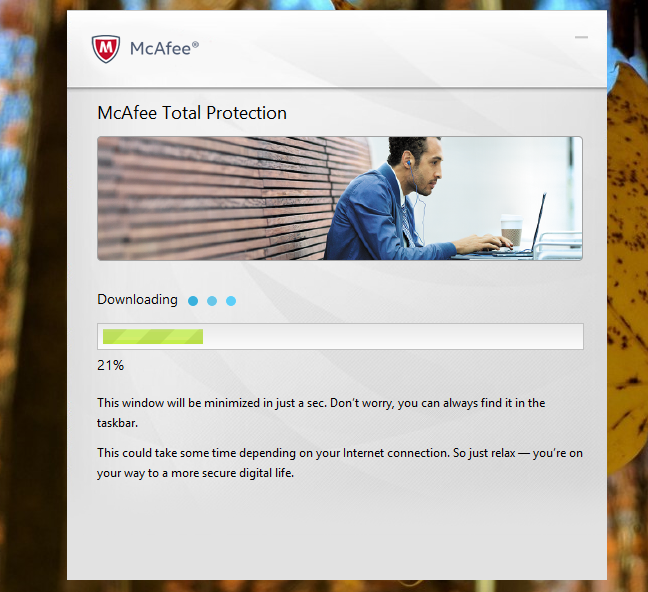
To get a trial of McAfee Total Protection on your Windows computer, all you have to do is download and run an executable file called mcafee_trial_setup_[some-numbers]_key.exe. It has a small size of 5.01MB, but during the installation process, it downloads another 534 MB of data from McAfee's servers. It is quite a lot, so keep that in mind if you are using a metered internet connection.
McAfee, Total Protection, LiveSafe
The good thing is that the only personal information you must provide for getting the trial up and running on your computer is a valid email address.
When we launched the setup file, the installation wizard checked whether our test computer was compatible with McAfee Total Protection. The installation process went through without any issues, and in a couple of minutes the security suite loaded its user interface and was ready to use, no reboot required.
McAfee, Total Protection, LiveSafe
It is worth mentioning that McAfee Total Protection does not ask you about anything during its installation. You do not get to choose what protection modules you want, and you do not even get to choose where to install it on your computer.
McAfee Total Protection is easy to install, as the installation wizard is simple and straightforward. The fact that it does not require personal information adds to a positive first impression.
Integration with Windows, web browsers and universal Windows platform apps
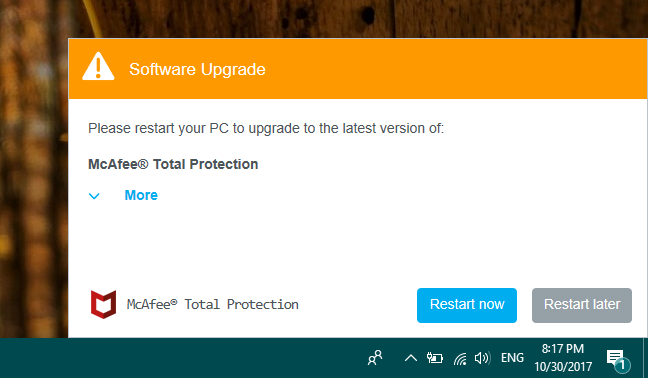
A couple of minutes after installing it, McAfee Total Protection updates its database with new virus definitions. However, a thing that is a bit curious is that the security suite requires you to close its user interface when it performs its first update. And then you also have to reboot your computer, which feels like an unnecessary requirement.
McAfee, Total Protection, LiveSafe
McAfee Total Protection automatically disables Windows Firewall and Windows Defender, which is a good thing because it makes sure that you do not have to handle unexpected conflicts or slowdowns triggered by the use of two similar security products at the same time.
McAfee does well regarding integration with Windows' networking features. We had no problems when we created or when we joined a local homegroup, when we accessed shared files and folders or when we streamed media files over the local network. Working with universal Windows apps was also a pain-free experience.
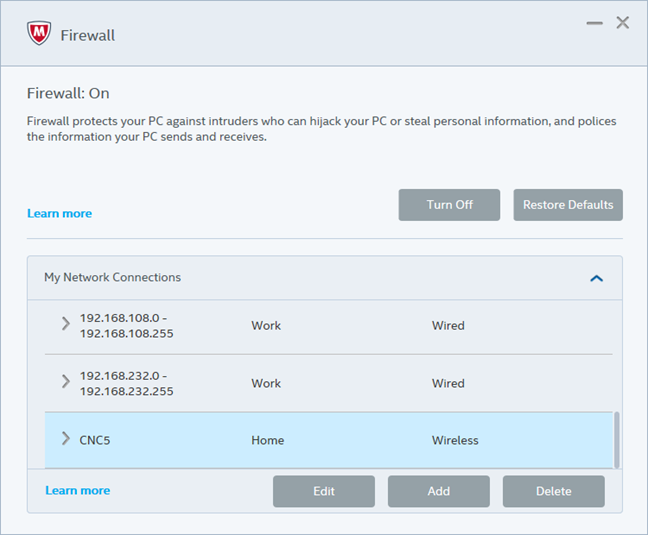
We noticed that McAfee's firewall module detects the network location you set in Windows 10 and automatically changes its security profile accordingly. If you set your network location to Public, in Windows, so does McAfee Total Protection. If you set it to Private, the McAfee firewall adjusts again. We appreciate this behavior.
McAfee, Total Protection, LiveSafe
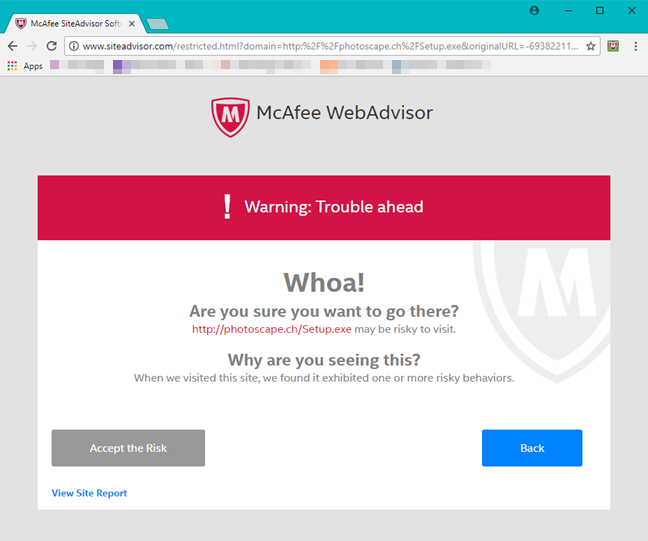
McAfee Total Protection uses its Net Guard engine to scan internet traffic and protect you from malicious websites and online threats. Although you get a desktop notification from the antivirus when you stumble on a dangerous web resource, it does not display an easy to understand message in your web browser, when it identifies a threat.
The web browser just tells you that it cannot load that website. However, if you prefer having a nicer in-browser experience, you can install the Web Advisor add-on. Unfortunately, this add-on is available only for Google Chrome, Mozilla Firefox, and the old Internet Explorer. Microsoft Edge and Opera are not supported.
McAfee, Total Protection, LiveSafe
We also wanted to see if McAfee Total Protection has a meaningful negative effect on the speed and overall performance of our test computer. We began by checking how much RAM it needs to keep all its processes running. We found that it rarely goes over the limit of 150MB on our test laptop when everything is all right. We checked if the boot time of our test computer increased after we installed McAfee Total Protection on it. BootRacer did not measure any significant difference in the average time needed for boot.
The security suite does not hurt the internet speed or the local network speed. The tests that we ran with Speedtest.net and LAN Speed Test resulted in the same average internet and local network speeds before and after installing the security suite.
McAfee Total Protection is a security suite that integrates well with Windows and its networking features. We appreciate the fact that its firewall module automatically adjusts its protection level according to the network profile you set in Windows. We also like the fact that it is not consuming many system resources and it doesn't slow down your network connection.
Ease of use & configuration
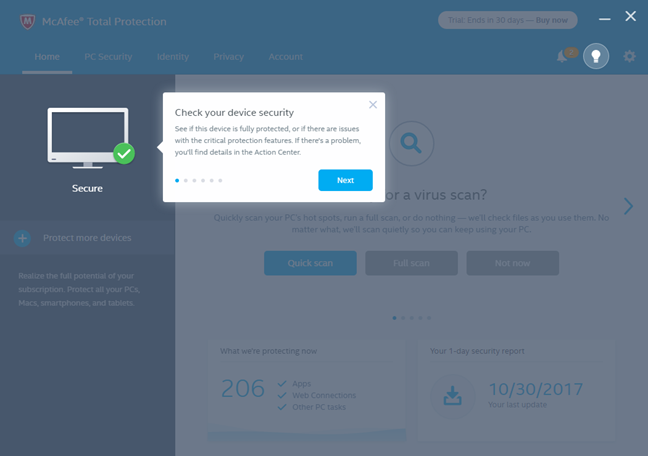
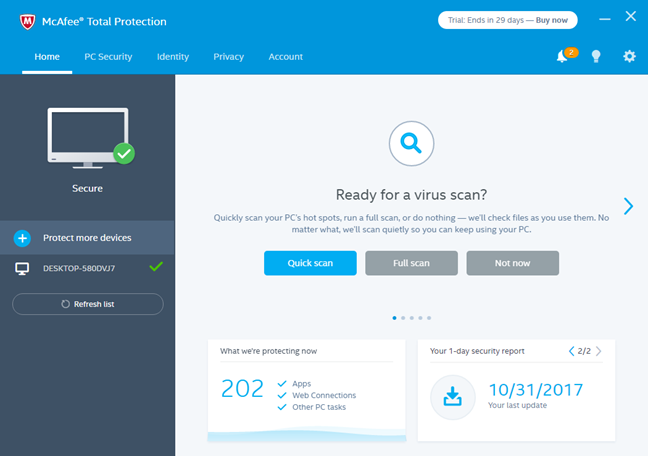
The user interface of McAfee Total Protection starts with a dashboard that looks a lot better than any user interface we have seen so far on McAfee's products. It is a lightweight interface with blue and soft gray colors.
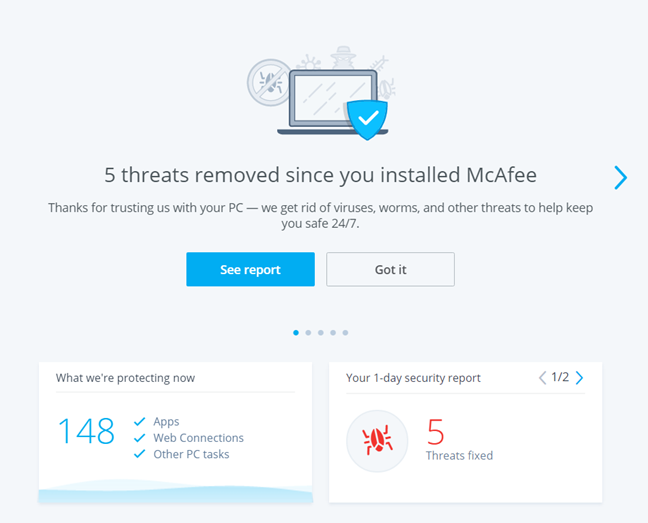
The Home tab that you meet when you open McAfee Total Protection shows whether your computer is safe or not, and other information like the devices that are protected by your security suite, options for running security scans, security reports, and links for enabling or configuring various features of the suite.
McAfee, Total Protection, LiveSafe
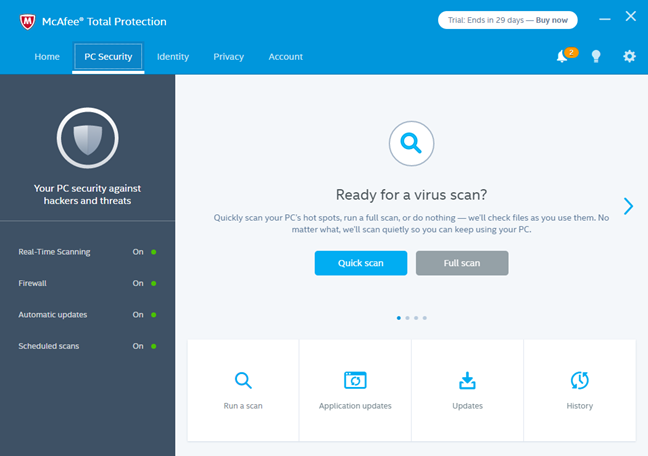
The user interface is split into five different tabs: Home, PC Security, Identity, Privacy, and Account. Each of these tabs gives you access to features, options, and controls that are part of their respective category. For instance, the PC Security tab lets you access the Real-Time Scanning engine, the Firewall, the Automatic updates settings, and the Scheduled scans.
McAfee, Total Protection, LiveSafe
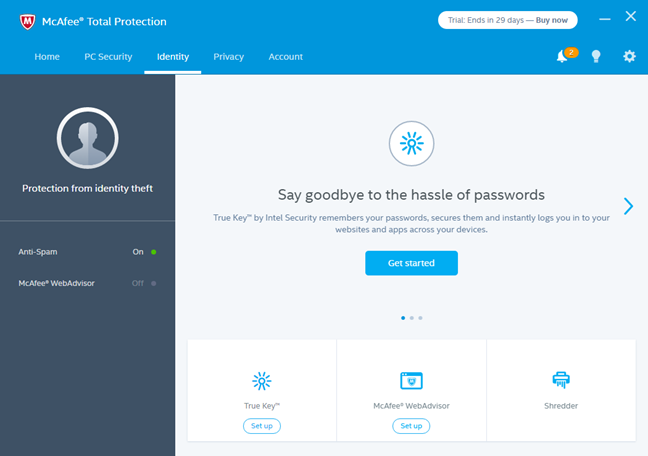
On the same note, the Identity tab gives you access to the Anti-Spam module and the McAfee WebAdvisor add-ons, the Privacy tab allows you to configure the Parental Controls, and the Account tab shows you information about your subscription, but also gives you access to the support options that are available.
McAfee, Total Protection, LiveSafe
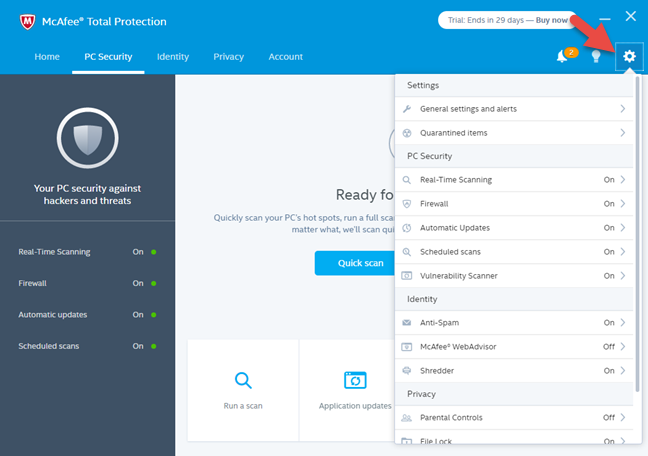
You can access the settings of each module and each feature from its dedicated area in the user interface, as well as by using the Settings menu from the top-right corner of the window. This is probably the faster way to get to the configuration options.
McAfee, Total Protection, LiveSafe
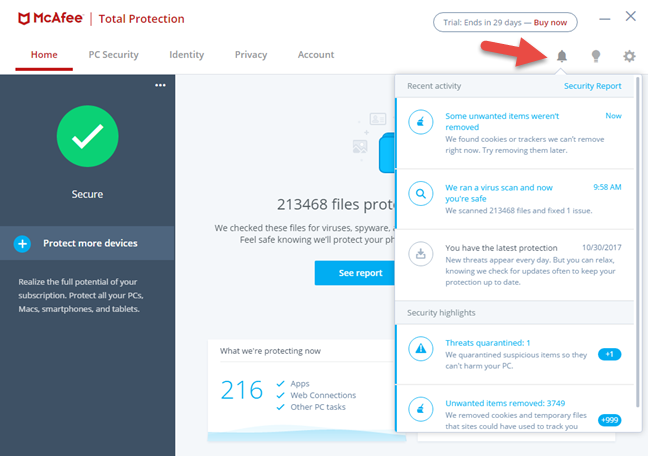
Another nice thing about the user interface is its notification system: on the top-right corner of the window, there is a small bell icon that shows the number of notifications sent by McAfee. Click on it, and you can see them all listed.
McAfee, Total Protection, LiveSafe
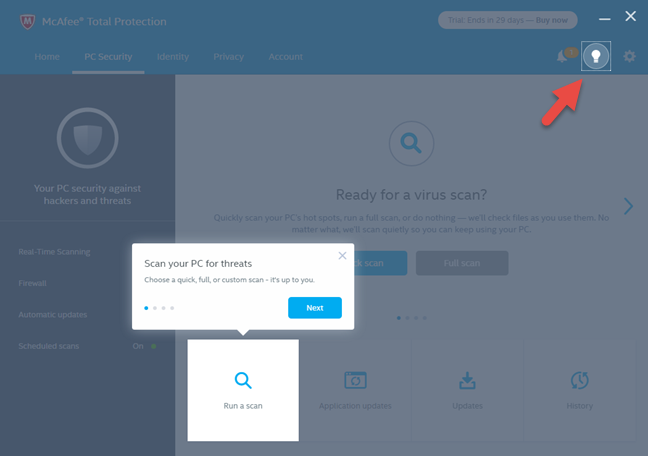
If you need help with understanding what specific features, modules or settings do, McAfee Total Protection is quite friendly. The user interface is filled with small bits of information describing its tools, and when you are fiddling with the settings, you can use the Learn more links to go online and see what they do, on McAfee's support website. Also, if you just want a quick tour of the interface, just click on the lightbulb icon from the top-right.
McAfee, Total Protection, LiveSafe
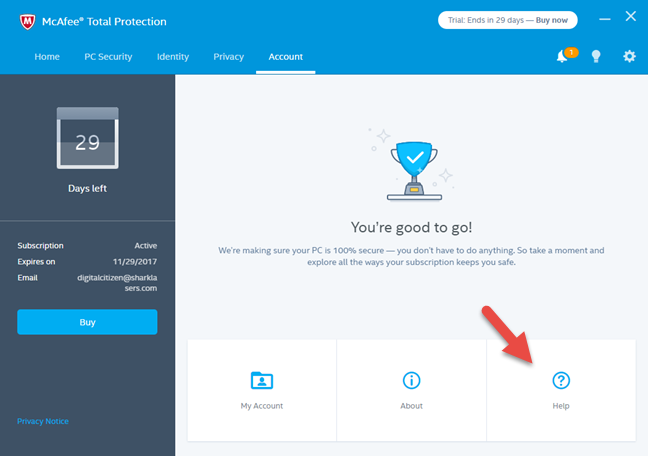
Also regarding help, McAfee Total Protection offers online documentation, FAQs, a knowledge base and community forums, as well as live chat and phone support options. You can access all that from the Account tab, by clicking on the Help button.
McAfee, Total Protection, LiveSafe
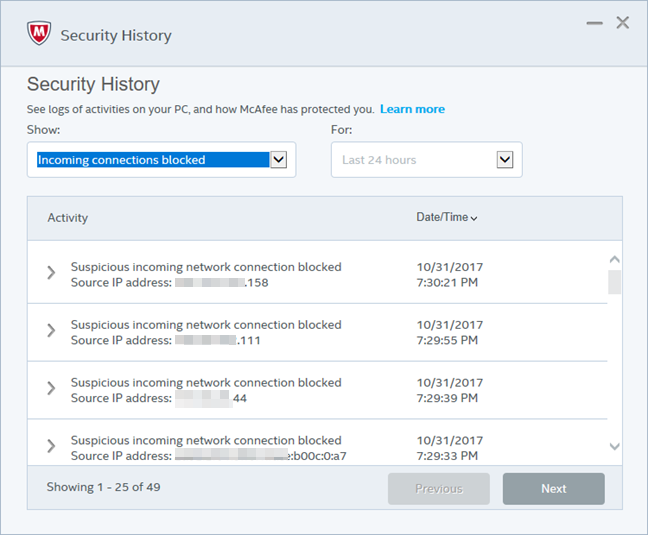
When it comes to logs and history, McAfee Total Protection includes journals that let you see what happened on your computer, both detailed text logs, and some visual reports.
McAfee, Total Protection, LiveSafe
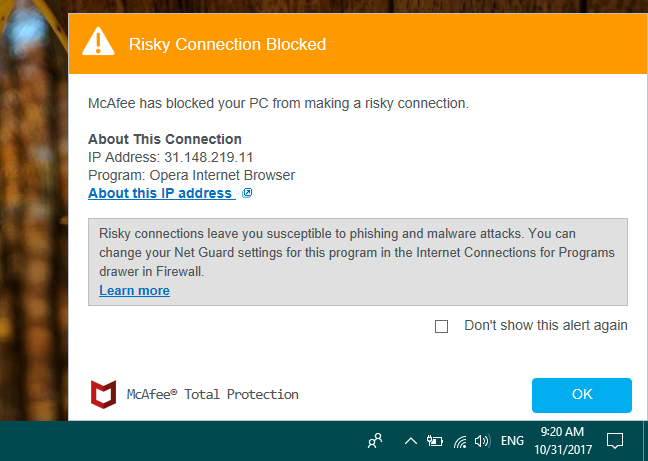
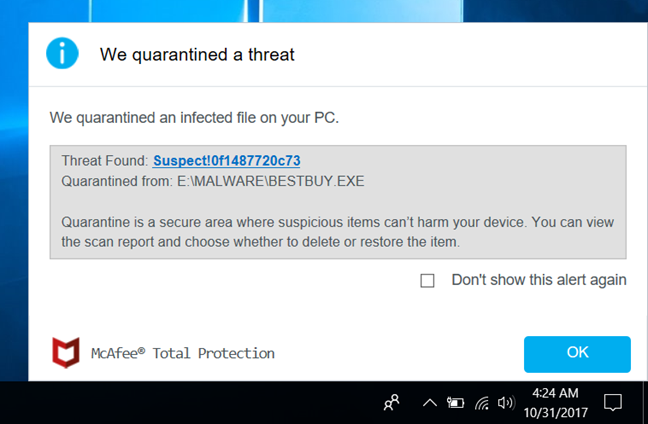
During the time in which we tested McAfee Total Protection, we saw it display alerts about malware infected files, but we did not see any firewall notifications.
McAfee Total Protection is a security product that offers a lightweight, friendly, and beautiful user interface. It looks like McAfee finally hired a team of user experience designers. After many years of poor user interfaces, this time they managed to create something worthy of a modern antivirus product.
On the next page of this review, you can see how effective McAfee Total Protection is at protecting your computer from network attacks and malware. You can also see what additional features are included in this security suite, and check our recommendations for what settings you should adjust.
Firewall protection
The firewall module included by McAfee Total Protection can automatically adjust its protection level according to the network profile you set in Windows. That means that, if you set your network to be public in Windows, so will McAfee's firewall, and if you set it to private, the firewall does that too. It is an excellent approach that requires less intervention from the user.
McAfee, Total Protection, LiveSafe
To see if the firewall module is also efficient, we ran a few tests with two well-known network vulnerability scanners: Nmap and Nessus. At first, we set our test laptop to use a public network profile. In this case, neither Nmap nor Nessus managed to find any open ports or any other significant information.
Then we changed the network profile to private and reran the tests. This time Nmap found 10 open ports and Nessus discovered 5 open ports and one vulnerability to "man-in-the-middle" attacks. The only other information the scanners managed to find was the MAC address of our test computer. However, this is not a critical security information.
The firewall module you get from McAfee Total Protection excels when you connect to public networks. However, when you use a private network profile, the security you get is of average effectiveness.
Antivirus and antispyware
The first thing we checked regarding antimalware security, was how McAfee Total Protection protects you against online threats. The security suite uses its Net Guard engine to scan the internet traffic and block malicious websites when you try to visit them. This engine protects you regardless of the web browser you prefer using. Additionally, the security suite also offers an optional browser add-on called WebAdvisor, which is also designed to stop you from visiting malicious websites before you load them. This add-on is available for Google Chrome, Mozilla Firefox and Internet Explorer and, when a dangerous website is detected, shows a stop message in your web browser. It would have been nice if Webadvisor had also worked in Microsoft Edge or Opera. We tested both the Net Guard engine and the Web Advisor add-on by trying to visit a series of dangerous websites, and both features worked great. As far as online protection is involved, you can rest assured that McAfee's antivirus solution protects you efficiently.
McAfee, Total Protection, LiveSafe
Next, we checked how McAfee Total Protection handles removable drives. We took a USB memory stick, we copied some viruses and some PUPs (Potentially Unwanted Programs) on it, and then we plugged it into our test computer. Unfortunately, McAfee Total Protection did not react. It did not automatically scan the memory stick, and it did not ask if we wanted to scan it either. It did not say anything, not even when we opened the contents of the memory stick in File Explorer. McAfee Total Protection reacted only when we tried to run an infected file. When we did that, it deleted the virus, but it did not check if the other files found in the same folder were infected. Seeing that, we ran a contextual scan on the memory stick and, unfortunately, the antivirus only detected eight out of the 12 malware samples on it. Four samples remained untouched. So, the memory stick was still a malware bomb waiting to explode. In our opinion, this is a not a good result.
McAfee, Total Protection, LiveSafe
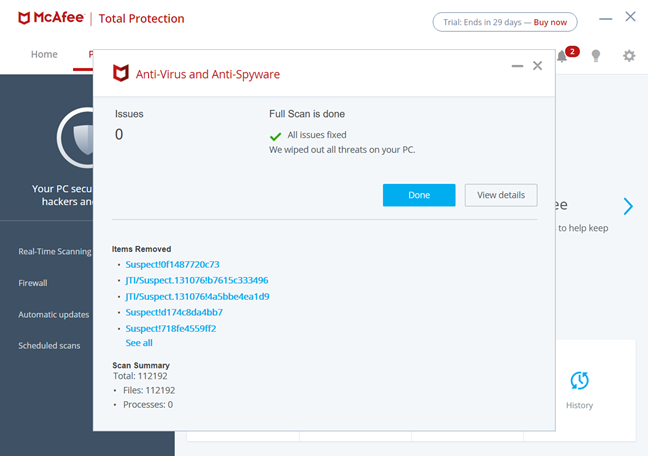
For the final and most comprehensive test, we installed Windows 10 on our test computer, and then we infected it with a series of nasty viruses, including some ransomware. Then we asked McAfee Total Protection to install itself and clean the computer. The security suite managed to download and install itself, but it only detected two viruses on its own, using its real-time engine. To get the others out of our system, we had to run a full system scan. This time, the antivirus solution removed another batch of infected files, but the test laptop still had four malware samples remaining, stored right where we had placed them, on the desktop. This is not what we expect from a good antivirus product.
McAfee, Total Protection, LiveSafe
We also measured the time needed by McAfee Total Protection to perform a full system scan: it was about 11 minutes on our 126GB partition with 35GB of data on it. This is a good result.
For a second opinion, we also looked at what independent security organizations had to say about McAfee Total Protection:
AV-TEST gave McAfee a score of 5.5 points out of 6 for protection and the maximum score of 6 points out of 6 for performance and usability.
AV-Comparatives awarded McAfee's antivirus with their top Advanced+ badge in their "Malware Protection Test" and "Performance Test," and with their worst badge, Standard, in the "Real World Protection Test." We tend to agree with these ratings.
Virus Bulletin has not tested McAfee's security products in a long time.
The antivirus engine offered by McAfee Total Protection can clean some of the viruses on your computer and your removable drives. However, to do that, you have to ask the antivirus to run manual scans. Unfortunately, it looks like McAfee does not react as it should when it encounters very new malware samples. On the other hand, the web protection it offers is excellent, and that should help in preventing malware from reaching your computer in the first place.
Extra features
McAfee Total Protection provides a series of extra features that might make it more attractive to some users:
Vulnerability Scanner - checks for and installs software updates for Windows and other programs installed on your computer.
Anti-Spam -checks your email messages and marks those that are unsolicited or that contain phishing messages, by moving them into a separate Anti-Spam folder. It works with email desktop clients such as Outlook and Thunderbird.
TrueKey - a password manager that you can use to store your passwords, create safely encrypted notes and other information, and which can automatically fill your login details into the various websites you connect to. If you are not already using a similar service like LastPass, this tool could be useful for you. TrueKey works on Windows, Mac, iOS and Android systems, and supports Chrome, Firefox and Microsoft Edge.
Shredder - a tool that lets you permanently delete the files which you do not want to be recovered easily.
Parental Controls - lets you set how much time your children are allowed to use the internet and also what kind of websites they can access. We checked if the internet restrictions work well, by trying to load a few websites that are not suitable for children. McAfee did a good job at blocking them.
QuickClean - removes unwanted and unnecessary files from your computer, such as temporary files used by websites to track your activity, Windows history or lost file fragments from your drives.
My Home Network - shows you a view of what your local network looks like and what devices are connected to it.
File Lock - allows you to create a personal vault, which is a fancy name for an encrypted folder, in which you can store valuable personal files.
QuickClean - sweeps your computer of unnecessary system files.
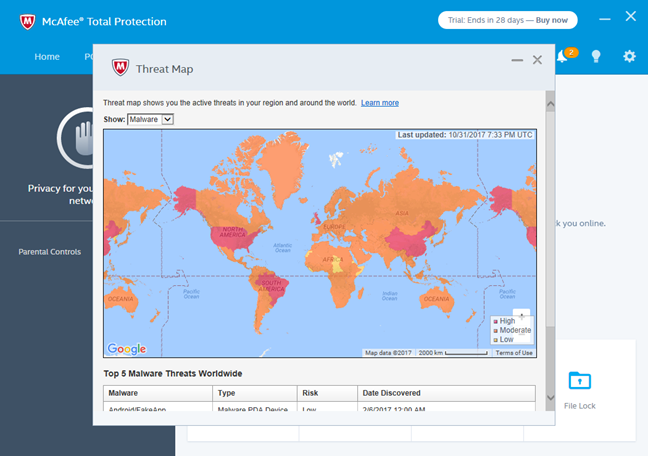
Threat Map - displays a World map on which you can see the active threats worldwide.
McAfee, Total Protection, LiveSafe
Some of the features bundled by McAfee Total Protection, such as Quick Clean, are duplicates of what Windows offers, while others, like the TrueKey or Shredder, are genuinely useful. We like the fact that they work reasonably well and they do exactly what you expect them to do. Unfortunately, there is no VPN service included in this Total Protection suite.
Default settings you might want to adjust
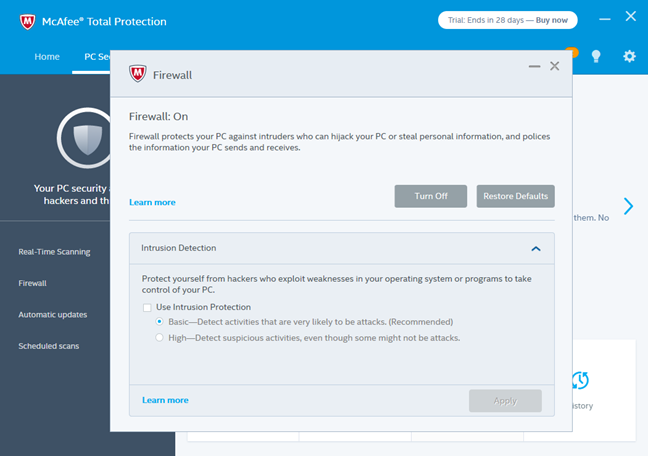
McAfee Total Protection does not have many advanced settings, so it is not much you can change about the way it works. Our only recommendation for you is to enable Intrusion Detection. By default, it is disabled, but enabling it will protect you from hackers trying to exploit the weaknesses found in Windows or the programs that you have installed, to take control of your computer. You can find this setting in the Firewall settings, in the Intrusion Detection section.
McAfee, Total Protection, LiveSafe
What is your opinion about McAfee Total Protection or McAfee LiveSafe?
Now you know what we think about McAfee Total Protection, and you have also seen how it fared in our tests. Before closing this review, share your opinions about McAfee's products, in the comments section below. Do you like what they have to offer? How do you enjoy the improved user interface?
I have found it does run all of my external drives {3} But as far as running a full scan? It took the best of 3 solid days to scan my computer with the 3 external drives [about 9 TB’s] It also did not catch some of the infections on my computer., I found that out when I ran microsofts version to recheck some noticable problems I experienced as well as Malwarebytes corporate antimalware that picked up where McAfee left out.














Discussion (1)
I have found it does run all of my external drives {3} But as far as running a full scan? It took the best of 3 solid days to scan my computer with the 3 external drives [about 9 TB’s] It also did not catch some of the infections on my computer., I found that out when I ran microsofts version to recheck some noticable problems I experienced as well as Malwarebytes corporate antimalware that picked up where McAfee left out.