



It's time to get ourselves more acquainted with the portfolio of wireless routers offered by TP-LINK. This time, we will test their second most expensive router at the time of this review: TP-LINK Archer C9. It is a solid device, with very good specifications, at a very reasonable price. We tested it in our labs for about two weeks and now we are ready to share our conclusions. Learn whether this router is worth buying or not, from this review:
Unboxing The TP-LINK Archer C9 AC1900 Wireless Dual Band Gigabit Router
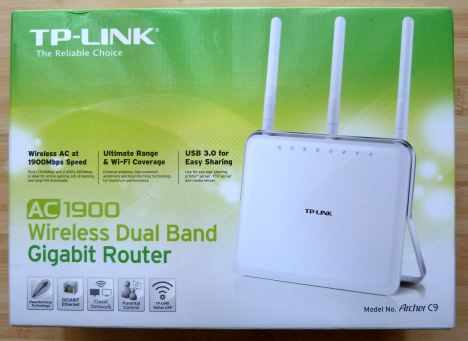
TP-LINK Archer C9 is packaged in a standard green box which shares a picture of the router and some of its most important capabilities, like the total available bandwidth of 1.9 Gbps.
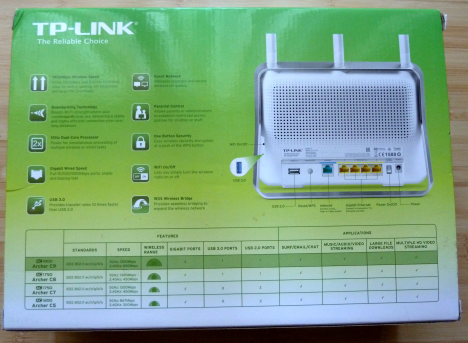
On the back of the box, you get a more detailed breakdown of its features, as well as a comparison with other routers from the TP-LINK portfolio. As you can see, Archer C9 is one of the top models from TP-LINK.
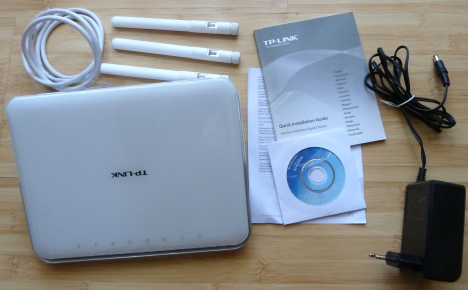
Inside the packaging, you will find the router, 3 detachable antennas, the power supply unit, an Ethernet cable, the resource CD, the Quick Installation Guide and the warranty.
Now that we know about the unboxing experience, let's see what this router offers in terms of hardware specifications:
Hardware Specifications
TP-LINK Archer C9 has a dual-core Broadcom BCM4709 processor running at 1 GHz, 128 MB of RAM memory and 16 MB of flash storage. As you expect from a high-end wireless router, it offers support for all the modern networking standards, including 802.11ac and 802.11n.
The maximum available bandwidth is of 1.9 Gbps: 1300 Mbps for the 5GHz wireless network and 600 Mbps for the 2.4 GHz wireless network. We all know that these speeds are rather theoretical and, in real life you will not be able to see them. For real-life measurements, keep reading this review to learn more.
On the back of the Archer C9, you will find 5 Gigabit Ethernet ports, one of which will be used for the Internet connection. There's also a USB 2.0 port and the WPS button that also acts as a Reset switch. Last but not least, you will find an On/Off button for the router and the jack for the power supply.
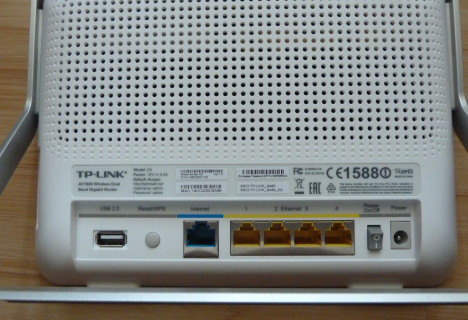
On the left side of the router you will find an additional USB 3.0 port and a button for turning the wireless network On and Off.
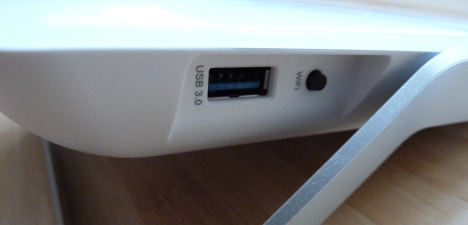
The size of this router is 8.7 x 3.4 x 6.6 inches (Width x Depth x Height) or 221 x 86 x 168.5mm, without the 3 detachable antennas plugged in. This makes TP-LINK Archer C9 identical in shape and size to its more affordable brother - TP-LINK Archer C8. Only the hardware differs.
Those of you who want the official list of specifications, you can find them here: TP-LINK AC1900 Wireless Dual Band Gigabit Router Specifications.
Setting Up & Using The Archer C9 AC1900 Wireless Dual Band Gigabit Router
The setup wizard used by TP-LINK is fast and easy to use. It asked us a couple of questions like the region, the time zone, the Internet connection type and the basic wireless settings that we want applied. We were up and running in about a minute.
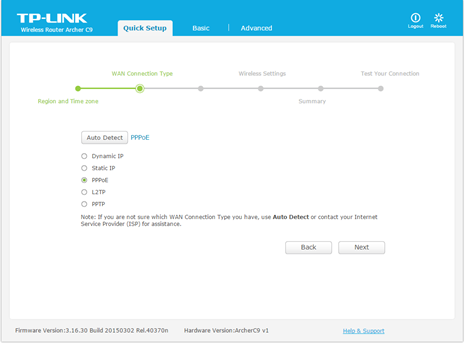
The only downside that we identified during the setup process is the fact that TP-LINK doesn't recommend that you change the default login details. This would have improved the security of the network broadcast by the router. We highly recommend that all users not use the default login username and password and change them when they set up their home network.
The user interface is available only in English and it includes two tabs alongside the Quick Setup: Basic and Advanced.
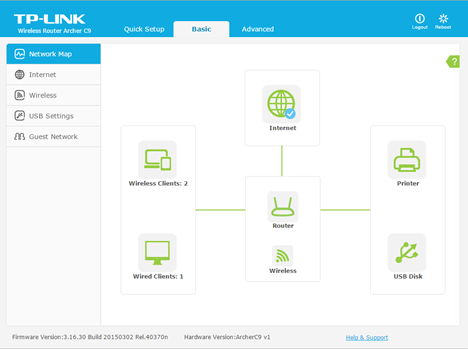
The first tab shows the most important controls and settings: the network map, Internet connection settings, basic wireless settings, USB settings and the basic settings for the Guest network. The second shows the complete list of settings and features that are available on TP-LINK Archer C9.
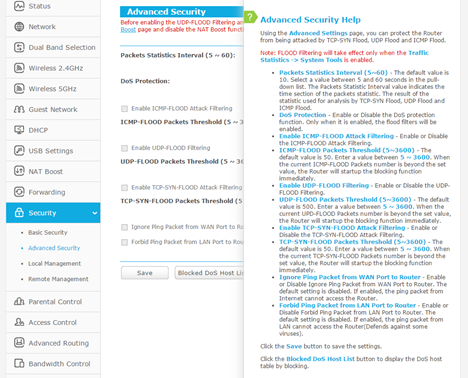
The Advanced tab is well organized and offers complete access to all the settings. Technical users and IT professionals won't have any troubles finding their way through it and will appreciate the detailed manner in which they can configure this router. However, beginners and casual users, will need to read the Help documentation in order to understand certain aspects. Luckily, this is easily available: you click the question mark icon on the top-right side of the administration window, and you immediately get access to documentation about the configuration options that you see on the screen.
After the initial setup, we upgraded the firmware on this router to the latest version that was available: 3.17.0 Build 20150507 Rel.34590n. Unfortunately, the firmware upgrade involved resetting all user settings and having to re-configure the router again. Hopefully, future firmware upgrades for this router won't involve resetting all user settings.
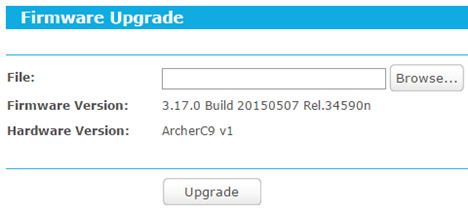
After the upgrade was performed, we started connecting our wireless devices to the network that was broadcast by TP-LINK Archer C9. We did not have any trouble connecting wireless and wired devices to the network and everything worked smoothly, but more on that later in this review.
Since TP-LINK Archer C9 looks the same as TP-LINK Archer C8 and it has the same size, it also shares it's only important design flaw: it is impossible to mount on a wall or ceiling. It can only be used on stable surfaces like your desk. This may be a downside to users who need to mount the router in some remote corner of a room.
Overall, we were pleased by the ease of use and configuration offered by TP-LINK Archer C9. The few downsides we identified are that TP-LINK doesn't offer multilingual support, the router can't be mounted on walls and it doesn't recommend that users change the default username and password used for the admin user.
Wireless Network Performance
As always, we have made several measurements in order to evaluate the real-world performance offered by this router. But first, let's take a look at the apartment that was used in our testing and how it is set up. You can see that the router is placed in the living room.
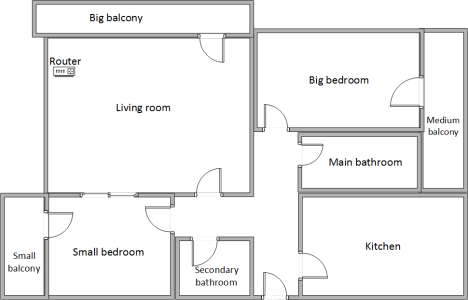
Our testing was done using a fast 1 Gigabit Internet connection that's capable of uploads on the Internet of up to 200 Mbps. We used a Microsoft Surface Pro 3 for all our measurements and several software tools. To get a better perspective of the performance offered by TP-LINK Archer C9, we compared it to its slightly more affordable brother TP-LINK Archer C8 and ASUS RT-AC87U.
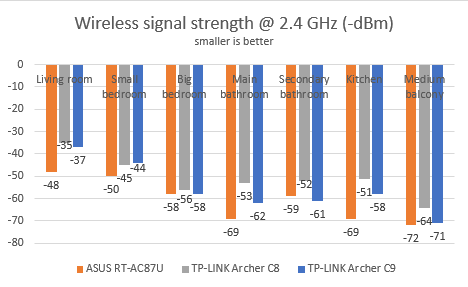
We started by measuring the strength of the wireless signal across the apartment, using inSSIDer. Below you can see how the signal strength evolves from room to room when using the 2.4 GHz wireless network. We found it surprising the that signal strength offered TP-LINK Archer C9 is weaker than that offered by TP-LINK Archer C8. However, this doesn't mean that the wireless network connection will be slower, as you will see later in this review.
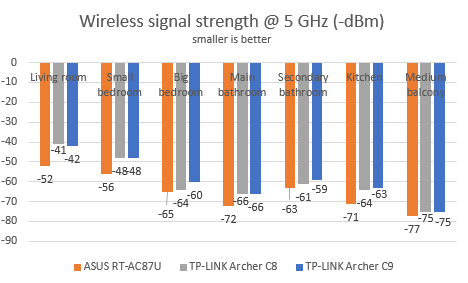
Then, we measured the signal strength for the 5GHz wireless network. Here, TP-LINK Archer C9 and C8 had almost identical performance.
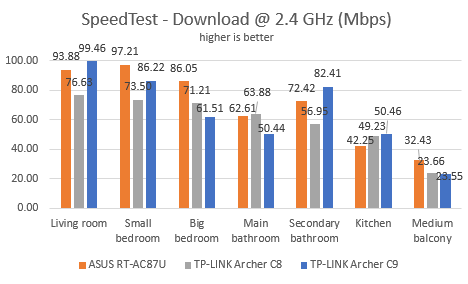
Next, we measured how fast the download speed was, using SpeedTest. When using the 2.4 GHz wireless network, the download speed was very good across the whole apartment, with TP-LINK Archer C9 delivering meaningful improvements over its more affordable brother - TP-LINK Archer C8.
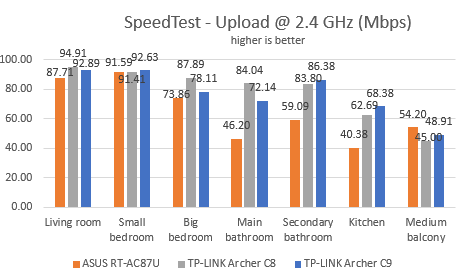
When it comes to the upload speed though, the differences between TP-LINK Archer C9 and C8 were generally very small.
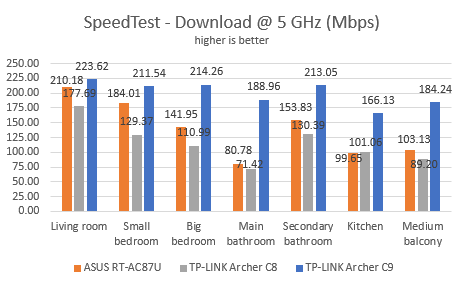
Next, we used SpeedTest on the 5GHz wireless network. Here TP-LINK Archer C9 was simply outstanding, delivering very fast downloads across the whole apartment.
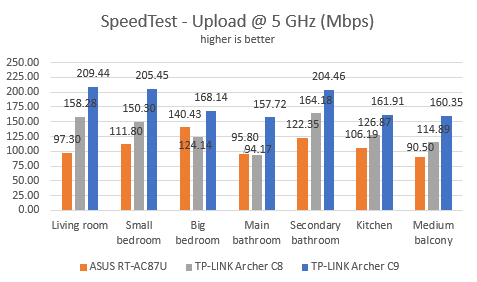
The same was true in terms of upload speeds, with TP-LINK Archer C9 being a true performance leader.
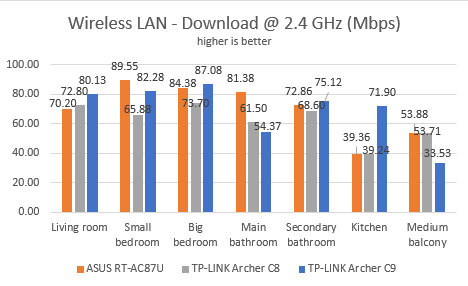
For our last set of measurements on the wireless network, we used LAN Speed Test Lite to measure downloads and uploads when transferring a 350 MB file between two computers connected to the network. We did this first on the 2.4 GHz wireless networks.
TP-LINK Archer C9 was a good performer but ASUS RT-AC87U was faster in several rooms.
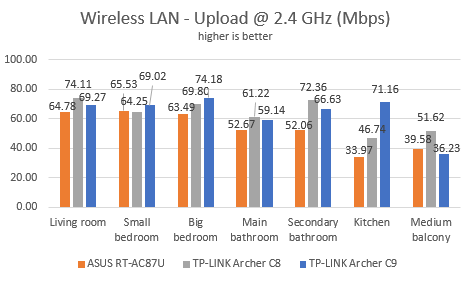
The picture was mixed when measuring the average upload speed on the 2.4 GHz wireless network. There's no clear winner. However, TP-LINK Archer C9 delivered good results in most rooms.
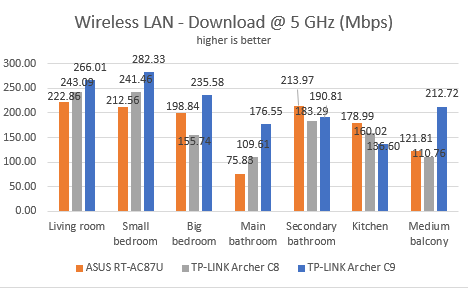
Last but not least, we used LAN Speed Test Lite on the 5 GHz wireless network. Again, TP-LINK Archer C9 was outstanding, with very fast downloads.
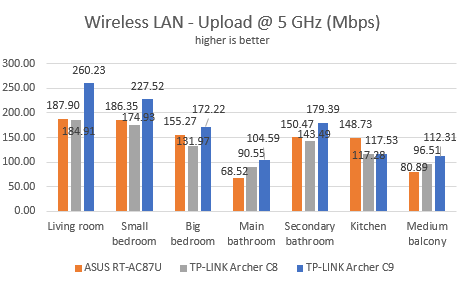
When measuring the upload speed, TP-LINK Archer C9 was, again, the performance leader.
The wireless performance delivered by TP-LINK Archer C9 is solid. However, this router shines when using it on 5GHz wireless networks. In our tests, it managed to deliver very fast downloads, as well as uploads, completed by very good signal coverage.
Wired Network Performance
In order to test the quality of the wired Ethernet connection, we used a desktop PC, equipped with an Intel Core i5 4460 processor, running at 3.20GHz, 16GB of RAM and a very fast Samsung 850 Pro 512GB SSD and a Microsoft Surface Pro 3 with an Intel Core i5-4300U processor, running at 1.9 GHz, 8 GB of RAM and a fast 256 GB SSD drive from Samsung.
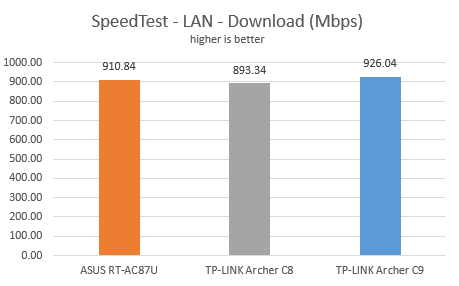
First, we measured the download and upload speeds using SpeedTest. When downloading data from the SpeedTest servers, TP-LINK Archer C9 was slightly faster than its competitors.
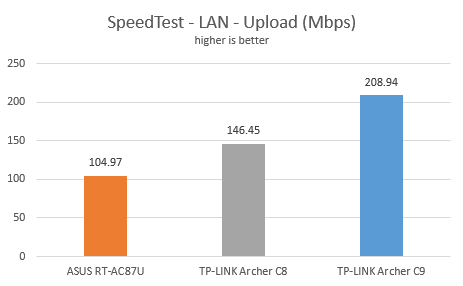
In terms of uploading data, TP-LINK Archer C9 was a clear winner.
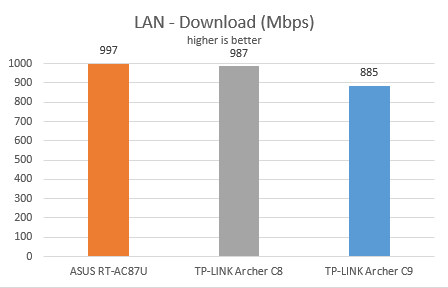
For our final test, we measured the download and upload speeds when transferring an 883 MB file to and from the two computers connected to the network, both of which were using an Ethernet cable.
Here, TP-LINK Archer C9 was outperformed both by ASUS RT-AC87U and TP-LINK Archer C8. However, we can't say that it was slow. It just wasn't as fast as its competition.
The same trend we noticed when measuring the upload speed over the network.
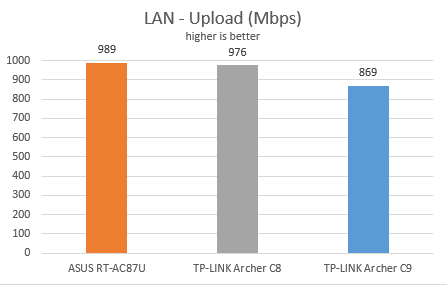
TP-LINK Archer C9 delivers true 1 Gbps wired network connections. If you have computers with modern processors and SSD drives, you will be able to enjoy very fast transfers over the network.
Extra Features
In terms of extra features, TP-LINK Archer C9, offers fewer features than its competitors from other manufacturers:
- Guest Network - we were impressed by the number of controls that TP-LINK offers for creating Guest networks. You can set them in a very detailed manner.
-
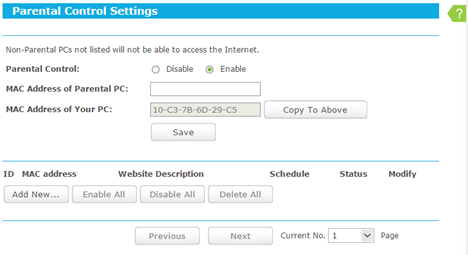
Parental Control - a basic set of controls which allow you to control the Internet access for the devices that are used by your children. We found it relatively hard to configure when compared to routers made by other manufacturers.

TP-LINK, AC1900, Wireless, Dual Band ,Gigabit, Router, Archer C9, review - Access Control - this router offers the ability to create all kinds of advanced rules that apply to the traffic on your network.
- TP-LINK Tether - an Android and iOS app that allows you to manage the router from your smartphone. Unfortunately, there is no version for Windows Phone.
-
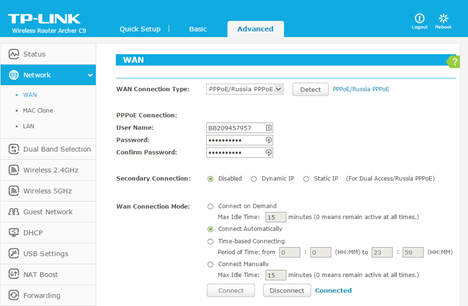
Secondary Connection - this feature is available only for PPPoE connections. If your ISP provides an extra connection type such as Dynamic/Static IP to connect to a local area network, then you can check the radio button of Dynamic/Static IP to activate this secondary connection.

TP-LINK, AC1900, Wireless, Dual Band ,Gigabit, Router, Archer C9, review
The list of extra features offered by TP-LINK Archer C9 is less generous than that of other vendors. However, everything that's offered works well and adds value to users.
Verdict
TP-LINK Archer C9 offers very good wireless networking performance, especially when using modern 5GHz wireless networks using the 802.11ac standard. Its feature set, while not as extensive as that of its competitors, does its job very well. We think that this router provides a very good price/performance ratio that's hard to match by other wireless routers. If you want very good performance without too many bells and whistles, at a reasonable price, TP-LINK Archer C9 is a very good choice that you should definitely take into consideration.
Discussion (2)
What DSL Modem did you use for testing with the tp-link archer c9 ?
No DSL modem. My ISP provides me with a direct fiber connection, straight to my home. I just plug the network cable into the back of the router.