Over the last few years, smartphones have evolved with a mind boggling speed. They went all the way from having screens of 3 or 4 inches, single core processors and maximum 512MB of RAM memory, to having screens of 5 inches or more, quad core processors and at least 1GB of RAM. And let's not get started about the capabilities of their cameras and how many megapixels they pack. While we get more power and performance from our smartphones, there is one area that just can't keep up with the pace of this evolution: it's those darn batteries. The capacity of batteries has not improved too much even though batteries nowadays do charge faster than they used to. Also, smartphone manufacturers don't pack very large batteries because they take a lot of space. ASUS has recently decided to surprise us all and release ASUS ZenFone Max (ZC550KL) - a smartphone that has a whooping 5000 mAh battery built-in. We have used this smartphone for about two weeks and we would like to share our experience with you, in this review:
Hardware specifications and packaging
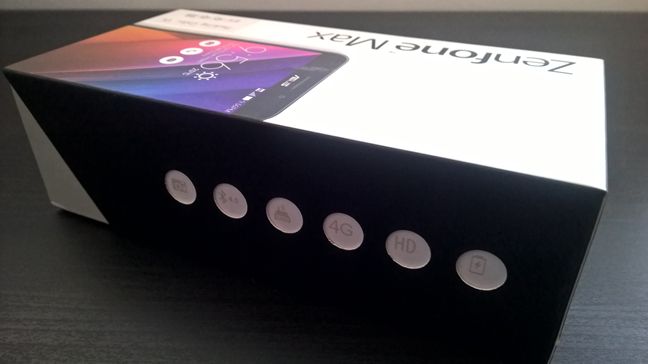
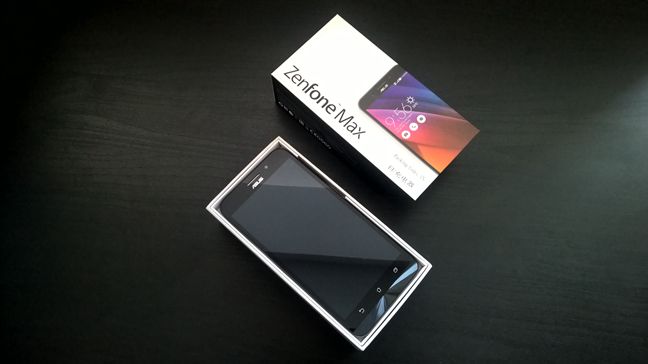
The ASUS ZenFone Max (ZC550KL) comes packaged inside a premium-looking glossy box. On the top side you get to see a printed image of the smartphone, while on the sides you'll find some information about its most important specifications.
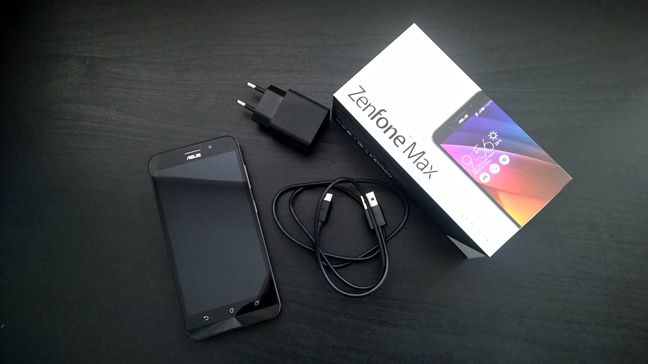
Underneath the ASUS ZenFone Max, you will find the usual accessories: the power charger, a detachable USB to microUSB cable, as well as the warranty card and the quick start guide.
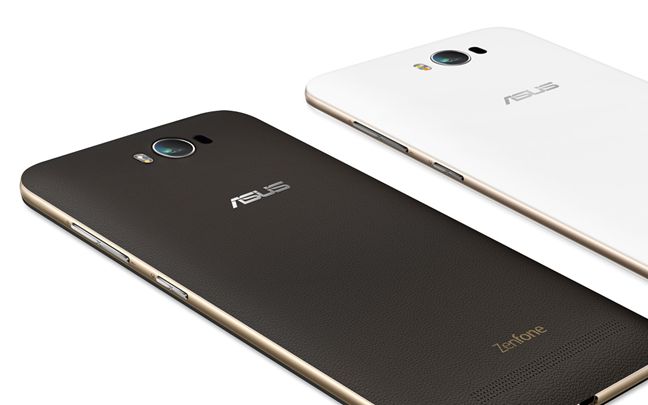
The ASUS ZenFone Max is available in two color variants that fit in style with both casual and business users: Pure White and Osmium Black. As you can see from our images, we tested an Osmium Black colored ASUS ZenFone Max, a color variant that fits anyone.
The ASUS ZenFone Max sports a 5.5 inches display with an HD resolution of 1280x720 pixels and an IPS panel. The IPS technology assures you from the start that you will get wide viewing angles (up to a maximum of 178 degrees), good color reproduction and a high contrast. ASUS decided to protect the display with Corning Gorilla Glass 4, so it's not prone to gather scratches very easily.
In terms of processing power, the ASUS ZenFone Max is powered by a Qualcomm Snapdragon 410 MSM8916 quad core processor that runs at 1.2 GHz, while the graphics are handled by an Adreno 306 video chip with OpenGL ES 3.0 that works at 400 MHz. You also get 2GB of RAM memory and 16GB of internal storage space that can be extended with a MicroSD card of up to 64 GB.
The ASUS ZenFone Max includes a rear 13 megapixels camera with laser autofocus and dual-LED flash that offers panorama and HDR capabilities, while on the front you get a 5 megapixels camera. Both these cameras have an F2.0 aperture that will come in handy when you take low light photos.
As for the connectivity options available on the ASUS ZenFone Max, you should know that it includes a microUSB 2.0 port, a 3.5 mm audio jack, a Bluetooth v4.0 chip and a wireless network chip that's capable to connect only to 2.4 GHz Wi-Fi networks that use the 802.11 b/g/n standards. Another feature we see quite often at ASUS' smartphones and one that's also present on the ZenFone Max is the fact that you can simultaneously use two SIM cards. The downside is that only the first SIM offers support for 4G networks, the second SIM being able to connect only to 2G/3G mobile networks.
The strongest point of the ASUS ZenFone Max specs is its battery. This smartphone features a mammoth sized non-removable lithium polymer battery of 5000mAh. Yes, you've heard it right! It's a smartphone that has a tablet's battery, so we expect it to offer quite an impressive autonomy, but we'll talk more details later in this review.
The 5.5 inch display put together with the very large battery, directly impact the dimensions of the ASUS ZenFone Max. In the metric system, this smartphone is 77.5 x 156 x 10.55 mm in width, depth and height, while in the imperial system it's dimensions are 3.05 x 6.14 x 0.41 inches. The ASUS ZenFone Max weighs 202 grams, which is about 7.12 ounces.
If you'd like to get more details about all the specifications of the ASUS ZenFone Max, check it's official web page, here: ASUS ZenFone Max Specifications.
The ASUS ZenFone Max is, by all accounts, a mid-range smartphone, with one very important exception: its autonomy. The huge 5000 mAh battery is its strong point and it will surely make it stand out amongst its competition.
Design and build quality
If there's one thing we really appreciate from ASUS is the fact that all their devices are consistent in design, making them very easily recognizable. That's true for their Republic Of Gamers devices for instance, and it's also true for their ZenFone family for smartphones. The ASUS ZenFone Max follows the same design patterns we've seen on other ZenFones.
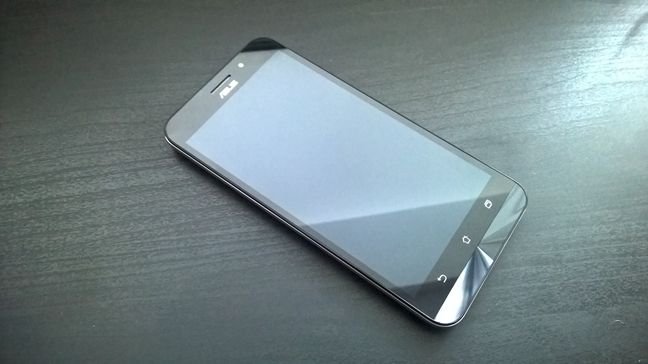
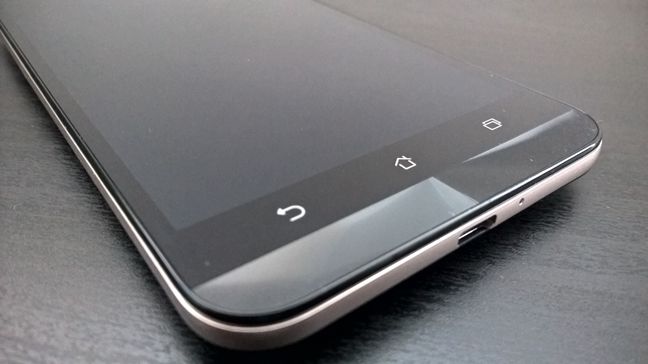
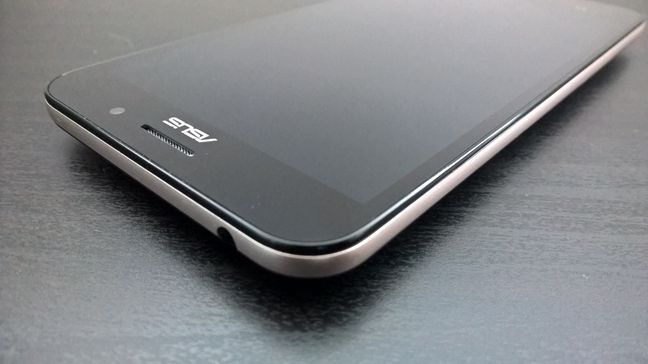
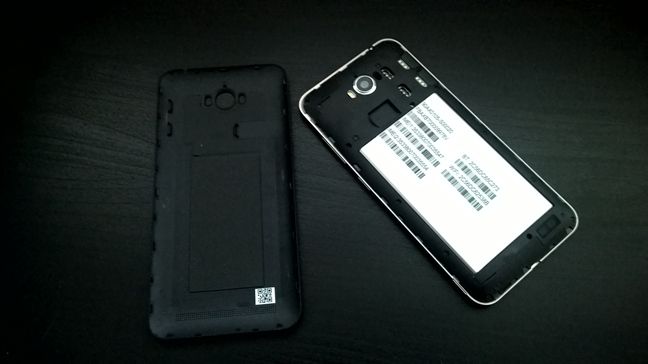
The top side of the screen holds the ASUS logo placed right below the earpiece grille, the bottom area holds the capacitive Android buttons and features the brushed concentric circles finish that's already a trademark for ASUS' ZenFones. The whole body is held together by a plastic golden rim with a metallic look.
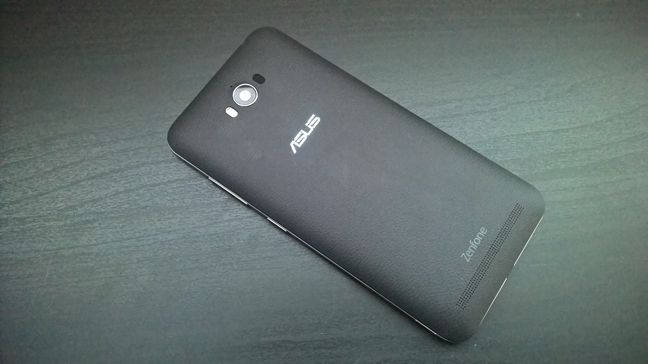
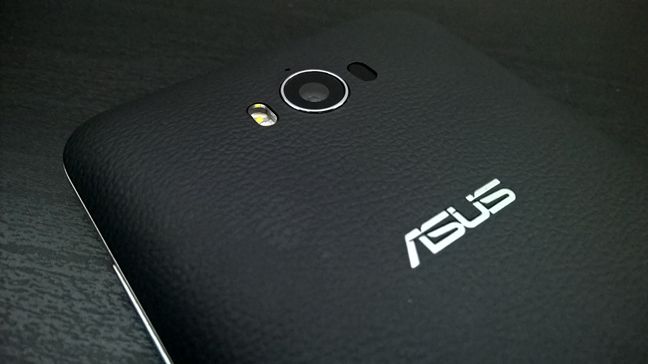
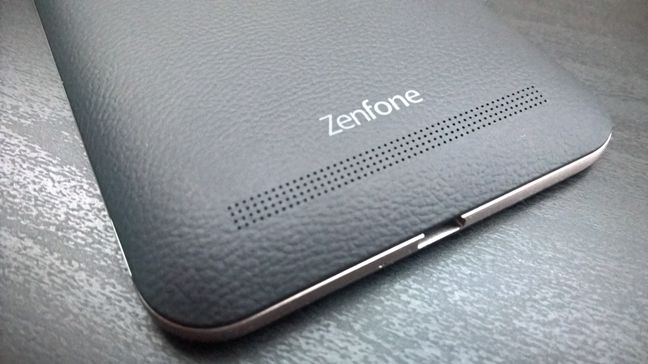
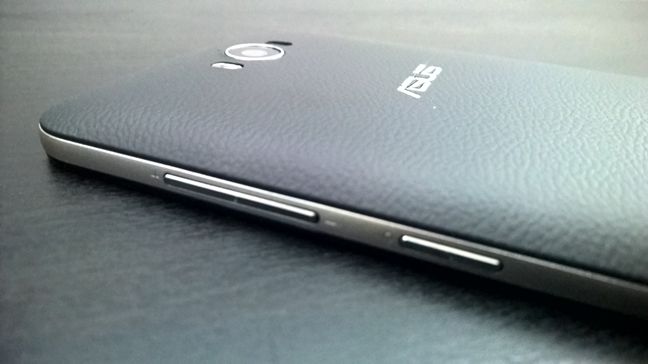
The ASUS ZenFone Max might be a mid-range smartphone, but its design makes it look a bit premium and the back cover adds to that feeling. The Osmium Black variant we tested has a back cover with a leather like texture that is both visually appealing and provides a very good grip.
On the upper area of the back cover you'll also find the camera lenses tucked between the dual LED flash and the laser autofocus sensor. Towards the center, you get the ASUS logo written in an embossed font.
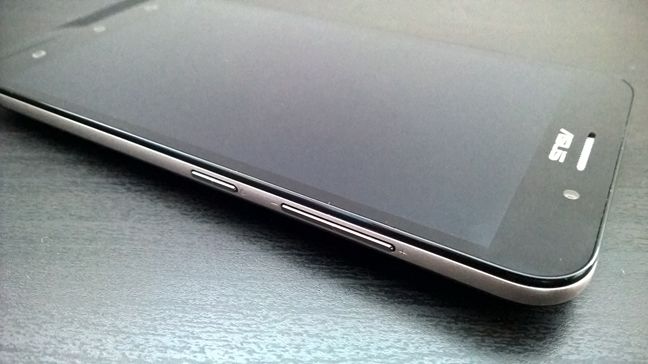
Unlike on other ZenFones, ASUS decided to go safe with the placement of the power button and volume rocker on the ZenFone Max. The Zenfone 2 for instance, had its power button placed on the top rim and its volume rocker on its backplate. For the ZenFone Max, ASUS placed both the power button and the volume rocker on the right edge of the smartphone - a classic location. This choice makes sense,, considering the smartphone's large body and it will probably please most users.
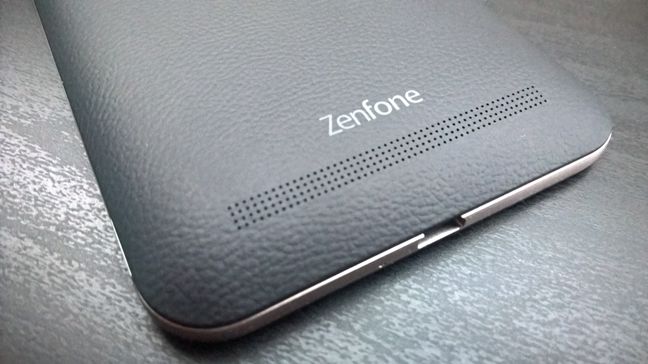
The bottom edge of the ASUS ZenFone Max holds only the microphone pinhole and the MicroUSB port that's used for both charging the smartphone and connecting it to a computer. On the bottom front side, you will find the three Android navigation keys for Back, Home and Recent Apps. They use the same nice looking icons we've seen all over the ZenFone family, but they have a flaw in our opinion: they are not backlit, meaning that they are a bit hard to find in the dark.
The left edge is completely free of any ports or buttons, while the top edge of the ASUS ZenFone Max features only the 3.5 mm audio jack and nothing more.
Another interesting design approach that we appreciate at the ASUS ZenFone Max is that its back panel is slightly curved towards the edges making the smartphone look and feel thinner than it actually is. This is a very good choice in terms of design and ergonomics, one that's consistent among all the ZenFone smartphones.
The ZenFone Max offers a large 5.5 inches screen that features an IPS panel with an HD resolution of 1280x720 pixels. The built-in IPS technology means wide viewing angles and makes sure that you get to see bright colors with a good contrast ratio. Some people might think that the 1280x720 pixels resolution might be too small for such a large screen. After all, it's a 5.5 inch display. However, we believe that ASUS made this choice in direct correlation with the smartphone's strong point: its autonomy. A smaller resolution for the screen means that less battery power is needed for it to be lit. Put that together with the huge 5000 mAh battery and you will probably have a very energy efficient device.
The ASUS ZenFone Max is a mid-range smartphone in terms of specifications and price. Even if it's not a flagship, ASUS managed to build a very good looking smartphone. It's a device that, just like any smartphone from the ZenFone family, will draw people's attention and will surely be recognized instantly by anyone who has seena ZenFone before.
The smartphone experience on the ASUS ZenFone Max
In terms of the phone experience, the audio calls we had on the ASUS ZenFone Max were of good quality. We had no issues in understanding what the people whom we talked to were saying, although they did sound a bit muffled. It's also worth noting that the maximum volume level during phone conversations is quite loud. Another meaningful phone experience aspect we'd like to mention is that the mobile network reception seems to be good, but not extraordinary. Our main cell operator offers 4G connectivity in the geographical area we live in, but the radio signal isn't that good. However, the ASUS ZenFone Max managed to keep a steady mobile connection.
Like many other ZenFone smartphones, the ASUS ZenFone Max also gives you the option to simultaneously use two SIM cards, either from the same mobile operator or from two different operators. This option can prove to be a real deal maker for some people. However, note that the first SIM supports 4G network connections, while the second SIM works only on 3G networks.
The audio quality when listening to music or watching videos is good if you're using a pair of headphones and decent if you resort to the smartphone's built-in loudspeaker. In the latter case, the maximum sound level is a bit lower than you'd expect, although the good side of this is that you won't hear any distortions.
As for the operating system, the ASUS ZenFone Max comes with Android 5.0.2 Lollipop and ASUS' proprietary ZenUI 2.0 user interface pre-installed. The ZenUI is a custom built user interface that brings many usability and design improvements to the standard Android experience.
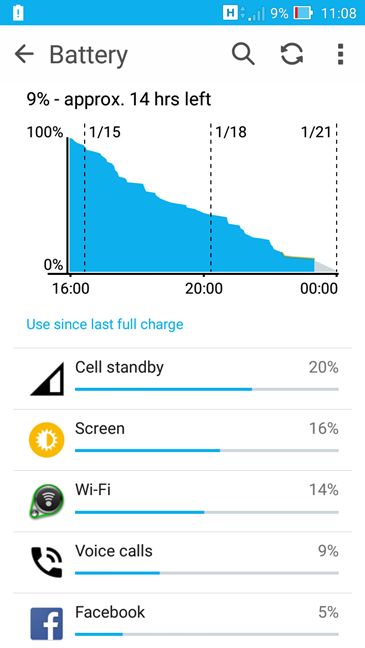
Finally, the huge 5000 mAh battery is more than impressive. We were blown away when we saw that this smartphone managed to keep running for 5 days and a couple of hours. We were expecting to see better than average autonomy, but we really did not expect to see it last for a bit more than 5 days. It's an extraordinary achievement that very few smartphones can brag about. Of course… what you should keep in mind is that the ASUS ZenFone Max went on working for 5 days on a single charge only when we used it like regular people would. A few hours of web browsing each day, apps like Facebook, Twitter and Whatsapp used for a couple of minutes each day and a bit of casual gaming. If you're going to use it to play demanding games or watch high definition videos for many hours, you should expect the ASUS ZenFone Max to last you for about 2 days, which is still a very good result.
The ASUS ZenFone Max is a mid-range Android smartphone that offers a good sound quality during phone calls, as well as a decent audio quality during music-listening sessions or while watching movies. However, its greatest feature is its incredible autonomy - the huge 5000 mAh battery keeps you going for around 5 days on a single charge, in normal usage conditions.
The camera experience on the ASUS ZenFone Max
The main camera found on the ASUS ZenFone Max has a 13 megapixels sensor that can take photos at a maximum resolution of 4096x3072 pixels and features ASUS' PixelMaster technology. In theory, this technology mixes the power of the hardware, software and that of the optics in order to obtain better images in most situations , especially for photos you take in low light conditions. We couldn't find the exact model of the camera found on the ZenFone Max but it feels very similar to the cameras we saw on the ASUS ZenFone 2 and on the ASUS Zenfone 2 Laser , so we suspect it to use the same Toshiba sensor we saw on these smartphones. The main camera from the ZenFone Max is aided by a dual LED flash in low light conditions that also helps you take portrait photos that look natural in terms of colors.
We found the photos we took with the ASUS ZenFone Max to be quite good in terms of details and colors. However, the photos we captured in low light conditions look a bit noisy if taken without the aid of the flash, while the outdoor photos seem to be oversaturated in bright areas. Don't interpret these as being deal breaker flaws as they aren't. We've seen these problems at most of the smartphones we reviewed here at Digital Citizen and most mobile devices, even premium ones, have these issues.
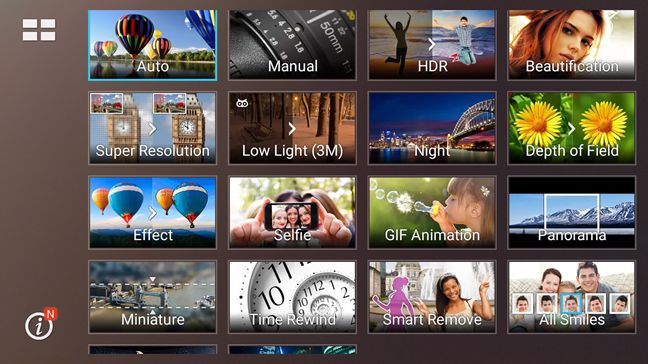
It's also worth mentioning that, just like other ZenFone smartphones, the ASUS ZenFone Max offers a camera app that includes lots of special photo modes you can play with. Among them, the options we found to be most useful are the Manual controls and the fact that you can capture panoramas and take photos using HDR.
The front camera found on the ASUS ZenFone Max is modest when compared to its rear one, but its 5 megapixels are more than enough for video chat and selfies.
Feel free to browse the photo gallery below: we've included the photos we took with the ASUS ZenFone Max taken both outdoors and indoors, photos we took in low light with and without flash, as well as a panorama and a few HDR photos. Note however, that for most of these sample photos we didn't use any special camera modes and instead, we relied on its auto settings.
In terms of video options, the main camera of the ASUS ZenFone Max is capable of recording Full HD videos at 1920x1080 pixels and 30 frames per second. They have a video bit rate of 15 Mbps and an audio bit rate of 81 Kbps. The ASUS ZenFone Max can also digitally stabilize videos, but in order to do that, you will have to accept a lesser resolution of 720p.
To get a better idea of how the ASUS ZenFone Max fares when recording a video with moving objects, check this sample we took:
As usual, we also recorded a static panorama by moving the smartphone while we stood still. By watching this video, you can see how the ASUS ZenFone Max does when recording static videos, with small amounts of movement involved.
The ASUS ZenFone Max offers a good camera that's able to take good photos and record good quality videos in most conditions. We appreciate the wealth of camera modes and settings ASUS made available on this smartphone, even if it's not a high-end device. Many smartphone manufacturers choose to offer only a handful of camera options for their mid-range or budget devices, but that's not the case with ASUS. However, low light photos suffer from a bit of noise, while outdoor photos have a tendency to be oversaturated in bright areas.
Read the next page of this review to learn more about the software installed on the ASUS ZenFone Max and find the results it had in our benchmarks.
Android 5.0.2 Lollipop, ASUS ZenUI 2.0 & Bundled apps
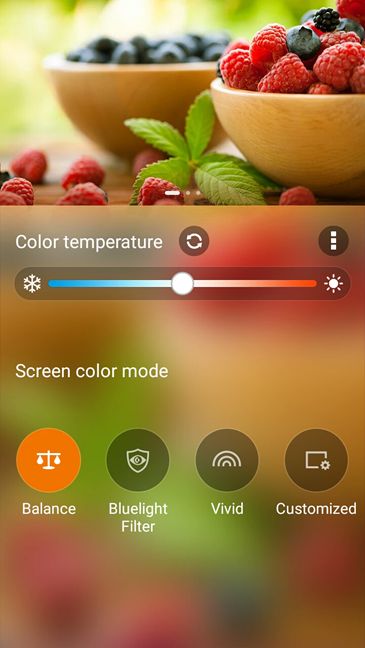
The ASUS ZenFone Max comes with Android 5.0.2 Lollipop pre-installed and with ASUS' proprietary ZenUI user interface. If you've read any of the reviews we wrote in the past for other ASUS smartphones, you know that we like this user interface and we consider it to be one of the best user interfaces available for Android devices. The ZenUI version 2 found on the ZenFone Max continues to offer plenty of options in terms of customization options and various other improvements to the standard Android experience.
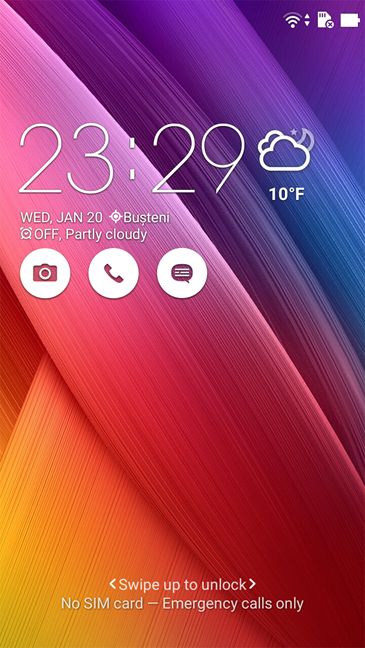
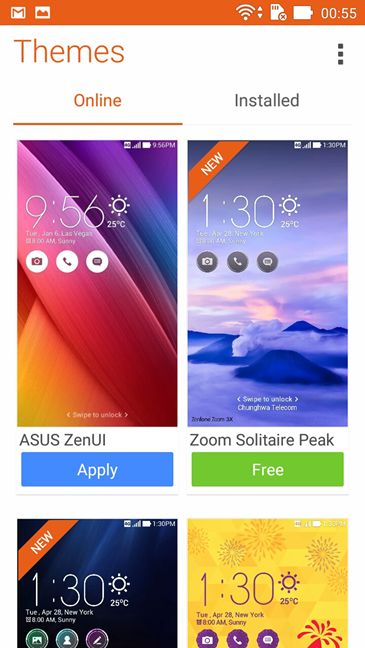
We'd like to point out the eye catching lockscreen and the neatly designed system themes that enhance every visual aspect of the user interface, from the icons it uses, to the background and the accent colors, with just one tap.
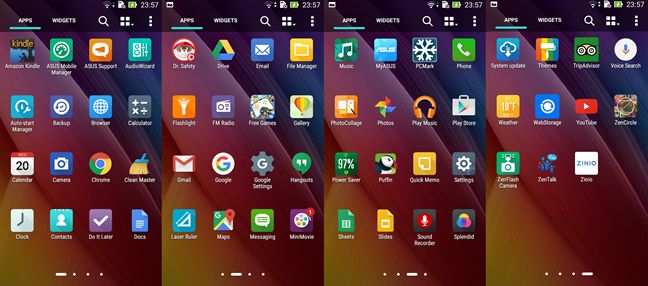
However, we're sad to say that the ASUS ZenFone Max suffers from having too many bundled apps. There are over 50 apps pre-installed and many of them really weren't necessary and only make you feel like the phone is excessively bloated. Our friendly advice is for you to check each of them and keep only the ones you really need or want.
To help you choose which apps you'll keep, we've compiled a list of what you'll find bundled by default by ASUS on the ZenFone Max. Note that our list doesn't include the default Google apps that you are likely to find on any other Android device:
Amazon Kindle - the ebook reader app that lets you shop and read Ebooks from Amazon.
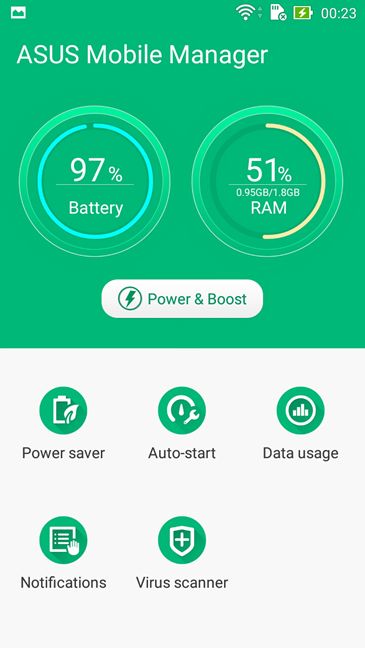
ASUS Mobile Manager - an app that acts as a central point for various system maintenance tasks. It gives you a quick overview of your battery and memory use, as well as quick access to the Power Saver battery modes, the Auto-start Manager (where you can set which apps are allowed to start automatically), to the details of your Data usage , the apps are allowed to show push notifications and it also lets you quickly access the Dr. Safety antivirus from Trend Micro.
ASUS Support - gives information about the Zen UI and support options for any smartphone related problems.
AudioWizard - lets you personalize the audio on your smartphone.
Backup - lets you create and restore backups of your system apps and the apps that you installed.
Browser and Puffin Browser - Browser is a web browser customized and enhanced by ASUS, while Puffin is another web browser from another company. Taking into consideration that you also have Google Chrome pre-installed, this whole array of web browsers is redundant. We recommend you to keep only the web browser you like using.
Clean Master - an app that focuses mainly on finding and removing unneeded cache files, empty folders, unused thumbnails and other junk files. Some people might use this app, while others won't.
Do It Later - helps you create and organize daily tasks, reminders, notes and other planning tools.
File Manager - lets you see and manage the files found on your ASUS ZenFone Max. Every user needs an app like this, so you should probably keep this one.
Flashlight - lights up your smartphone's flash or screen, just so that you don't stumble on a Stephen King character in a eerie night. 🙂
FM Radio - lets you listen to the FM radio stations in your area, as long as you have connected your headphones to the ASUS ZenFone Max. They act as an antenna.
Free games - a weblink that takes you to a website powered by Gameloft that's called Ludigames, where you can play casual browser-based games. We didn't like the huge amount of ads on this website.
Laser Ruler - uses the laser camera sensor in order to measure distances. It works nice and fast, but it can make precise measurements only for distances of up to 50 cm (19.68 in).
MiniMovie - it will create movies from the photos saved on your smartphone, which you can then share on social media websites.
MyASUS - offers access to 24/7 support from ASUS.
PhotoCollage - lets you easily create photo collages. Some people might find this app interesting.
Quick Memo - a very simple app for taking quick notes. Honestly, this is one of our favorite apps that are bundled by ASUS. 🙂
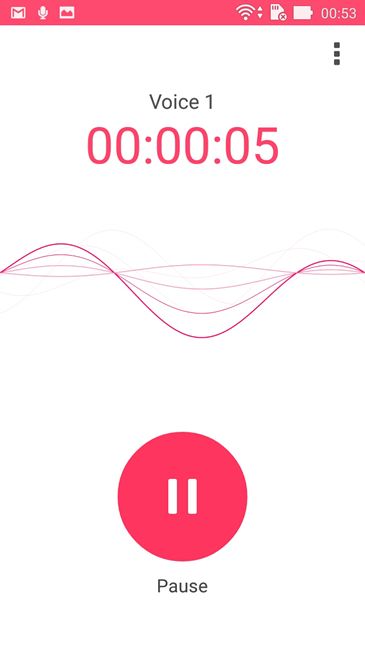
Sound Recorder - a simple app that uses the smartphone's microphone to record sound. There are times when such an app can come in handy. Like when someone promises you something and you want to make sure they don't forget. 🙂
Themes - is a portal of sorts from where you can see, download, install and apply various system themes created by ASUS. We must say that we like these themes and, from a beautification point of view, they are totally worth it.
TripAdvisor - the Android app developed by the popular travel website. It lets you plan and book your entire vacation trips.
Weather - an app developed by ASUS that gives you all the weather forecasts you want, based on AccuWeather's data feeds.
WebStorage - is a cloud service from ASUS that offers you 5GB of free storage space.
ZenCircle - a social network that works by sharing smartphone created videos.
ZenFlash Camera - if you ow n a ZenFlash (which is an external Xenon Flash from ASUS), t his app connects it to your ASUS ZenFone Max and helps you take better pictures.
ZenTalk - A forum dedicated to all owners of ZenFone smartphones, which can prove quite useful.
Zinio - the Android app for "the world's largest newsstand". You can use it to buy individual issues or make subscriptions to various magazines.
The ZenUI user interface that's loaded on the ASUS ZenFone Max is beautiful. It's also fast, each visual aspect is polished and each transition is smooth. We love it but our positive feelings are somewhat hindered by the very large number of bundled apps. With more than 50 apps pre-installed, ASUS overstepped on this one.
Performance in benchmarks
The ASUS ZenFone Max has the hardware components needed to make it a worthy option in the market of mid-range Android smartphones. Its quad-core 1.2 GHz processor put together with the 2GB of RAM memory should be enough to offer a good level of performance in any usage scenario, be it regular web browsing or playing casual video games.
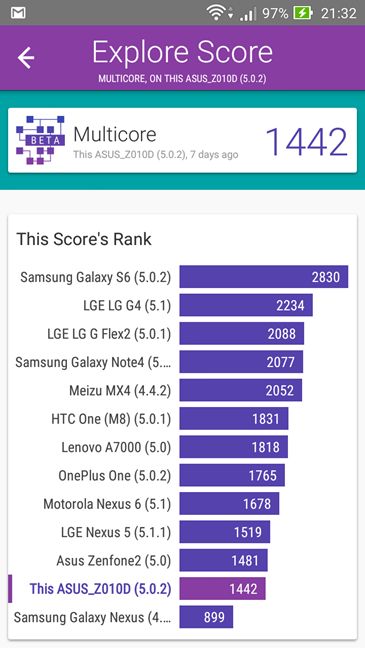
As we do for all the Android devices we review here at Digital Citizen, we started our testing for the ASUS ZenFone Max with the popular Vellamo benchmarking app from Qualcomm. The first benchmark we ran was Vellamo Multicore, a series of tests designed to measure the processor performance when running multiple tasks at the same time. We got a good score of 1442 points, similar to the results we measured for the ASUS ZenFone 2 Laser. It's also a score close to that of the ASUS ZenFone 2 (ZE551ML) and not far from what you'd get from an LG Nexus 5.
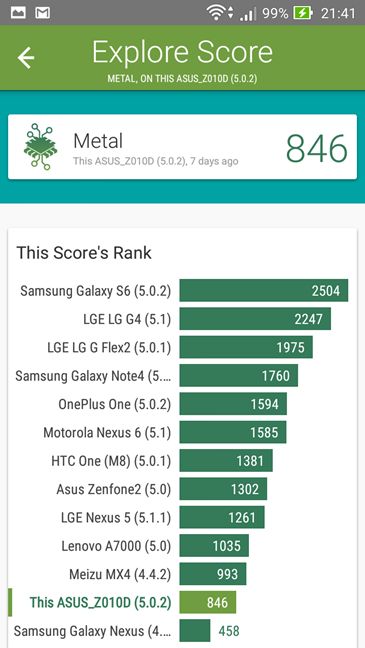
Next, we checked how the ASUS ZenFone Max fares in single core operations. We used Vellamo Metal, a benchmark that runs a series of tests designed to measure the performance offered by the processor when only one of its cores is used. There are many apps in the Play Store that still don't know how to use more than one core at a time, so this test is quite important. The ASUS ZenFone Max managed to score only 846 points here. We were expecting that, considering that each of the cores from the processor runs at only 1.2 GHz. However, it is a decent score that's similar to what the ASUS ZenFone 2 Laser offers and what you'd get from a Lenovo A7000 (which has a 1.5 GHz octa-core processor from Mediatek) or from a Meizu MX4 (which is powered by a Mediatek 2.2 GHz / 1.7 GHz octa core processor).
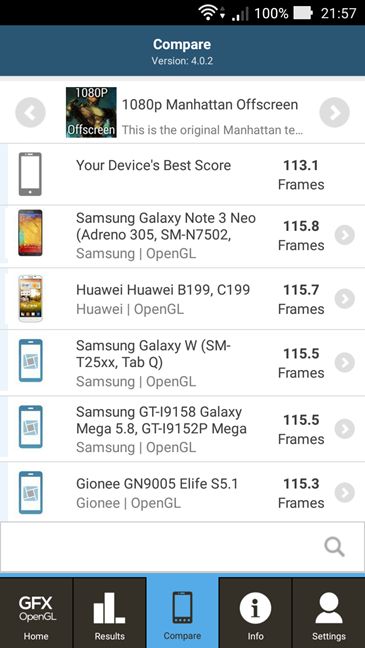
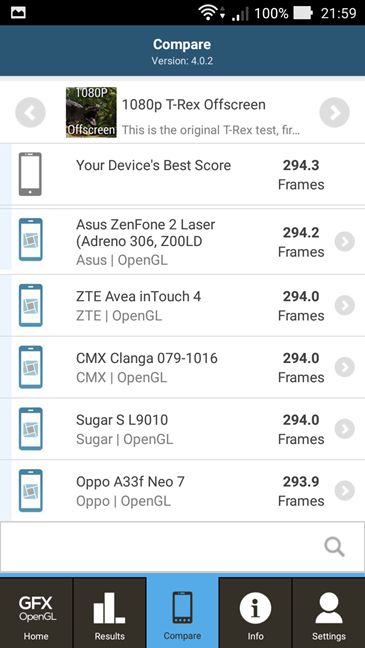
Then we moved on to the gaming tests. After all, many people use smartphones for gaming too. To measure the performance offered by the ASUS ZenFone Max in games, we used the Manhattan and T-Rex tests offered by the GFXBench GL Benchmark app. We usually take into consideration only the 1080p Offscreen versions of these tests because they are run at the same resolution on any device, regardless of their native display resolutions. This makes more sense when you compare the results you get with those from other devices.
In the Manhattan Offscreen test, the ASUS ZenFone Max managed to render only 113.1 frames, which is a very low score. This result is similar to the one we got for the Xiaomi Redmi 2 and it's close to what you'd get from a Samsung Galaxy A3 or a Samsung Galaxy Note 3. Overall, this low graphics performance also shows that the ASUS ZenFone Max is not a smartphone destined for gaming.
The next gaming test, the T-Rex Offscreen, ended with another poor result. The ASUS ZenFone Max managed to render only 294.3 frames, a similar result to the one we measured for its older sibling - the ASUS ZenFone 2 Laser - and for the Chinese budget smartphone Xiaomi Redmi 2. Again, a result that proves the ASUS ZenFone Max is not a smartphone for gamers.
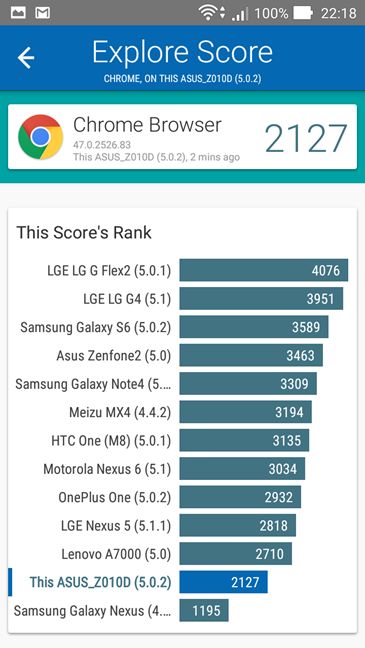
Going further, we wanted to see how well the ASUS ZenFone Max fares in a more mundane activity: browsing the web. We turned to Vellamo again and we ran its Browser tests. This test measures the performance offered by the device when rendering websites coded with HTML5 and CSS3, as well as when running all kinds of scripts. The ASUS ZenFone Max got 2127 points in Google Chrome, which is a good score and a better one than that of the ASUS ZenFone 2 Laser.
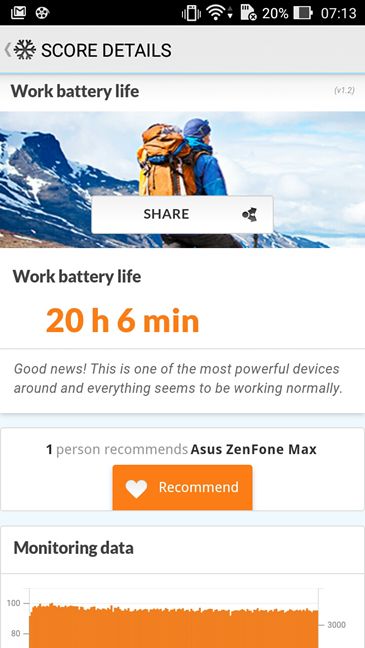
In the end, we got to the most important benchmark that we could run for this special smartphone: the battery test. You don't see a 5000 mAh battery on a smartphone everyday, so this makes the ASUS ZenFone Max quite special. We told you earlier in this review that it managed to last us for 5 days and more than a few hours on one charge, but this gets even more interesting after you see the benchmarks results. The Work battery life series of tests from the PCMark app ended with a whopping battery life of a little more than 20 hours. This score is very impressive. Imagine a smartphone lasting a full day while it's being used constantly for many demanding tasks. Most smartphones won't last for more than 8 hours in this situation.
The results we got in the benchmark tests we ran on the ASUS ZenFone Max clearly show that this is a good mid-range smartphone. While it lags behind when it comes to gaming performance, the overall processor performance and web browsing performance, put together with its incredible battery life make this smartphone a great deal. The battery on the ASUS ZenFone Max is truly impressive.
Product rating4/5
Verdict
After looking at everything the ASUS ZenFone Max has to offer, we believe that it is a great deal. It's like the ASUS ZenFone Laser reborn with a huge battery. The hardware is not the top of the line in the Android world, but it is enough for any modern day mobile computing task. However, its battery is the one that's truly impressive: using your smartphone for 5 or more days in a single charge is something that very few smartphones can brag about. If you want a mid-range smartphone that looks good, that has decent hardware and that you can take on a hike and not worry about charging it than the ASUS ZenFone Max is a very good choice.









Discussion (0)
Comments are closed.