



Even though it was founded only recently, in 2010, Xiaomi has quickly become one of the largest smartphone manufacturers in the world. The company does great in budget markets like China, India or Eastern Europe. We recently received for testing their newest low budget smartphone: Xiaomi Redmi 4A. This smartphone runs on Android 6 and promises a good user experience at around 110 USD. It is also sold in many markets, including the USA. Does this very affordable smartphone offer a good user experience? Let's find out, in this review:
What is the Xiaomi Redmi 4A smartphone good at?
The Xiaomi Redmi 4A is a great smartphone for:
- Fulfilling basic smartphone needs, such as browsing the web, running social media apps or taking a quick picture
- Keeping you connected to the world while not asking you to charge it every day, because its battery can last for two days in a row
- Giving it to your child or to someone elderly, as their first smartphone to use
- A great backup smartphone, in case your main one breaks or it remains without battery
Pros and cons
The Xiaomi Redmi 4A has quite a few good things to brag about:
- It is very affordable
- The main camera is better than the average you get for a similar price
- The battery can keep the smartphone running for more than a day
- The display has good colors and brightness
- It has enough hardware power to meet basic user needs
- It is a Dual-SIM smartphone which means you can use two SIM cards simultaneously
- It offers 4G LTE connectivity so internet should be speedy
On the other hand, the Xiaomi Redmi 4A also has a few not so positive things about it:
- More demanding apps might become sluggish over time because of its low-end hardware
- Gaming is not a great experience
- Signal reception could be better
- According to xiaomidevices.com, there's no official plan for upgrading to Android 7 Nougat

Verdict
The Xiaomi Redmi 4A is a bargain. It costs very little and offers all the basics you need. It doesn't impress with its hardware nor with its looks, but it manages to impress with its long lasting battery and with the good quality of its screen, camera and build. Xiaomi Redmi 4A is not for those who want speedy internet browsing sessions or high framerates in games. It is however, a great smartphone for those who are just meeting with the Android world and don't want to spend lots on it. It is also a great choice for your children and for your grandparents.
It could also be a good choice for your backup smartphone, to keep in your backpack while travelling or use it when your main one breaks. In the world of ultra budget smartphones, Xiaomi Redmi 4A might be the best choice you can make.
Hardware specifications and packaging
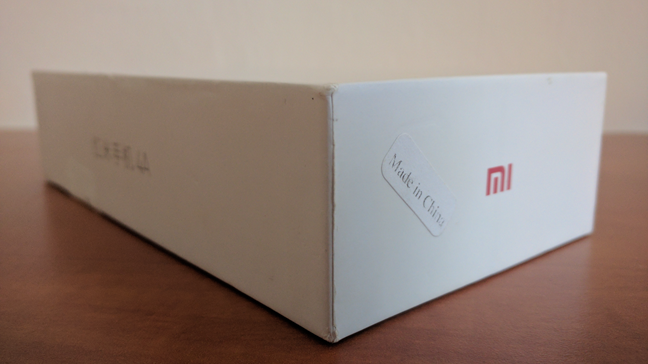
The Xiaomi Redmi 4A smartphone arrives in a small white box with a simple design. It is made from cardboard and it features a large 4A text engraved in white on its top. One of its sides holds a small MI logo and the other something written in Chinese.
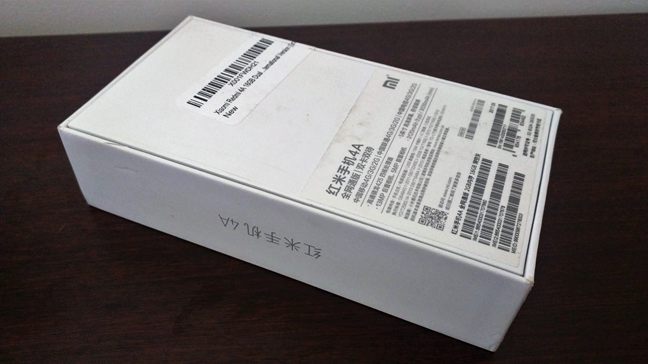
If you turn the box upside down, you can see that there are a few stickers attached. They tell you the exact model of your smartphone, as well as other information such as the IMEI or serial numbers. Most of the other details printed on those stickers is in Chinese however, so unless you speak this language, they are not very useful.
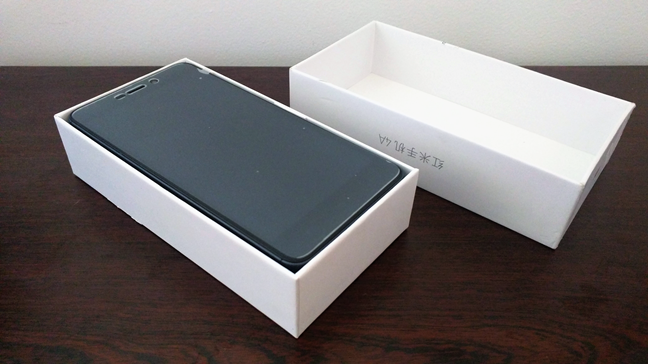
Open the box and you can see the Xiaomi Redmi 4A smartphone sitting on top of an inner paper tray.
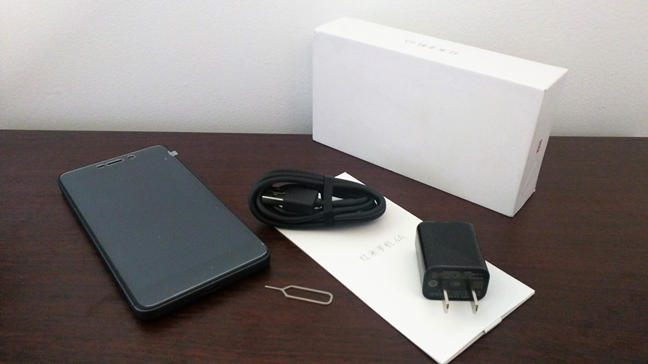
Once you take the smartphone out, you can take a look at what is bundled with it: a power adapter, a USB 2.0 cable, the warranty card, the user guide, and a SIM insertion tool. There are no headphones included, probably because they would have slightly increased the smartphone's price.
The Xiaomi Redmi 4A smartphone is available in three different color variations: Gold, Rose Gold, and Dark Grey. The model we tested was the more sober one, Dark Gray.
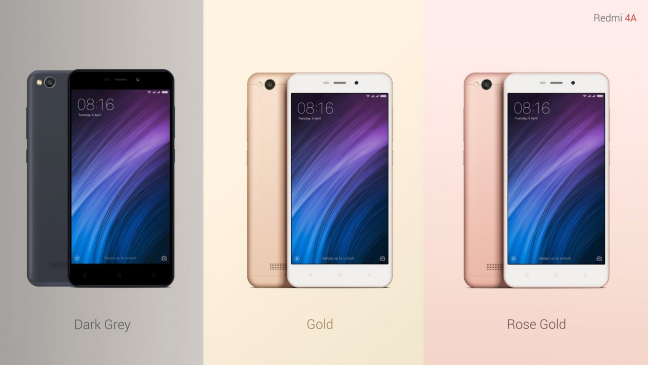
The Xiaomi Redmi 4A has a 5.0 inch IPS LCD screen with a resolution of 720 x 1280 pixels and 296 PPI pixel density. You can read more about PPI and what it means, in this guide: What is PPI and does it matter?. Unfortunately, there is no Corning Gorilla Glass protecting the display.
This smartphone is powered by a quad-core Snapdragon 425 processor running at a top speed of 1.4GHz and an Adreno 308 graphical unit running at 500MHz. It works with 2GB of RAM and offers an internal flash storage space of 16GB. If you need more storage capacity, you can use the secondary SIM slot to insert a microSD card with a maximum size of 128GB.
The rear camera on the Xiaomi Redmi 4A has a sensor of 13 megapixels, an aperture of f/2.2, autofocus, and benefits from a LED flash for low-light photography. The front camera has 5 megapixels and an aperture of f/2.2.
In terms of connectivity, Xiaomi Redmi 4A comes with support for the 802.11 b/g/n wireless standards but not 802.11ac. This means that you can use it connect only to 2.4GHz wireless networks. There is also a Bluetooth 4.1 chip inside the smartphone for connecting it to various devices.
The Xiaomi Redmi 4A is a Dual-SIM smartphone and it works in Dual SIM Dual Standby mode. When you have two SIM cards inserted, the smartphone supports 4G calls and data connections only on the primary SIM, while the secondary works only in 2G.
Xiaomi Redmi 4A comes with a variety of sensors installed, such as an accelerometer, a gyroscope, and a proximity sensor. There is also a GPS chip, FM radio, and even an infrared port on it. The Xiaomi Redmi 4A comes with a non-removable battery of 3120 mAh that should offer it plenty of autonomy.
Regarding its size and weight, the Xiaomi Redmi 4A is rather small and light: it is 5.51 inches (139.9mm) in height, 2.77 inches (70.4mm) in width, 0.33 inches (8.5mm) in thickness, and it weighs only 4.66 oz or 131.5 grams.
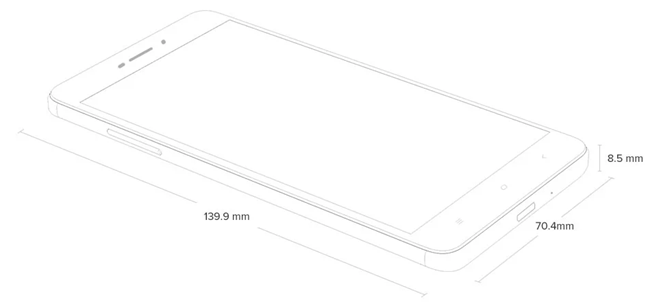
If you want more details on the specs and features of the Xiaomi Redmi 4A, visit its web page: Xiaomi Redmi 4A Specifications.
The Xiaomi Redmi 4A offers a simple unboxing experience, but a pleasant one nonetheless. The hardware specifications of this smartphone are not impressive but they are good for its ultra low price tag.
Design and build quality
The Xiaomi Redmi 4A has a classic design, with sharper lines than its predecessors. It is a small smartphone with a 5 inch screen, and a very light one too, mainly because its body is made from polycarbonate. At first glance it looks like the body is metallic but the appearance is misleading.
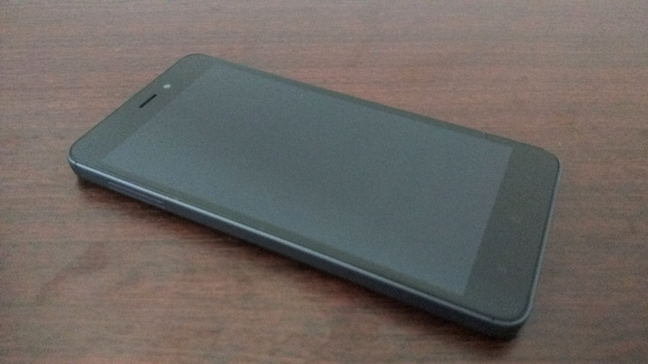
The hardware buttons are placed in their traditional spots: both the volume rocker and the power buttons are on the top left edge of the smartphone. Although they don't have different textures, you should not have problems identifying which is which because the volume rocker is made from a single piece and it is a lot longer than the power button.
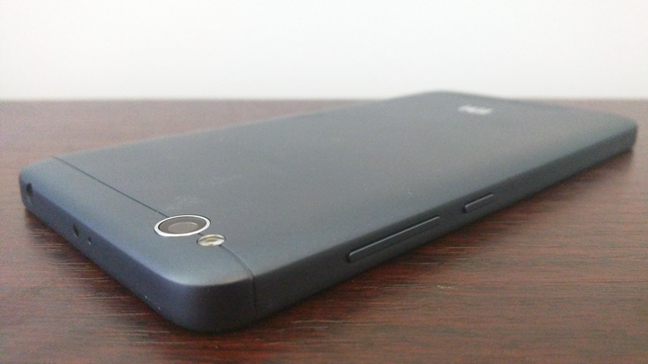
On the left edge, there's the SIM tray which you can eject using the pin from the box or any paper clip you have at hand. The bottom edge holds the micro USB 2.0 port used for charging and data transfers, and the top edge is home for the infrared port and the audio jack.
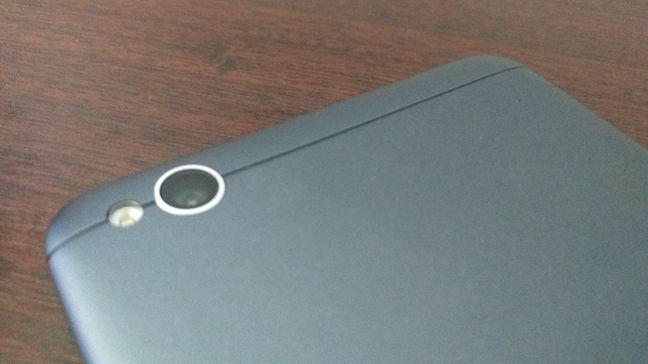
On the back of the smartphone, you can find the rear camera and the LED flash placed right at the top. Unfortunately, the camera is very close to the edge and that means that you can easily cover it with your fingers while taking photos or recording videos.
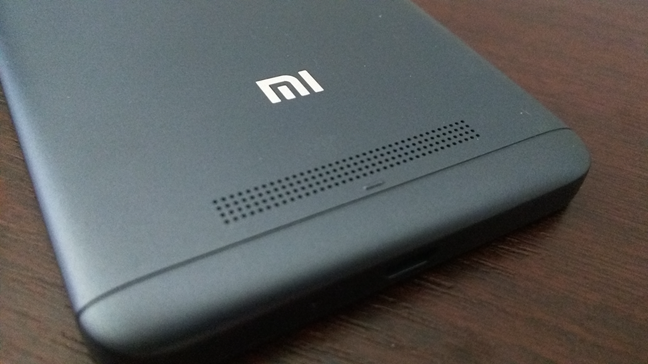
On the back, towards the bottom of the smartphone, there is the speaker grille and a silverish MI logo.
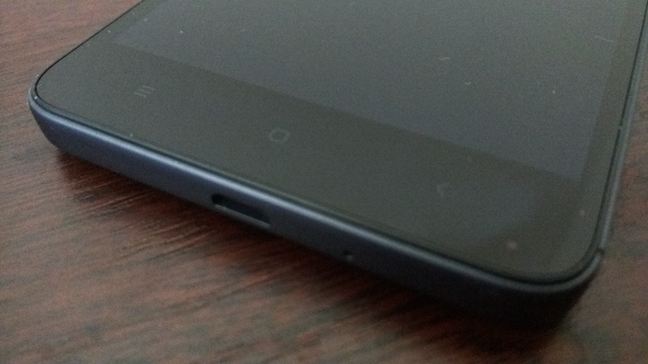
The software buttons are all found beneath the display on the front side of the smartphone. We like the fact that they are separated from the screen. However, there are also two things that we did not like about them: one is that they are not backlit so they are hard to identify during the night, and the second is that they are positioned opposite from the standard Android smartphones. From left to right, the Xiaomi Redmi 4A has Apps, Home and Back. The usual order is Back, Home and Apps. It works but you must adjust to this arrangement.
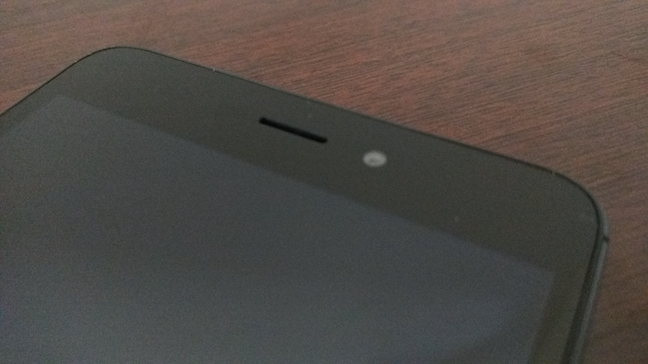
On the top side of the screen, you can find the rather small earpiece and the front camera.
Overall, the Xiaomi Redmi 4A does not disappoint when it comes to design and build quality. Sure, it does not look spectacular, nor does it have a body made from metal or glass like pricier smartphones. However, the polycarbonate body feels well assembled and it should not break easily.
If you would like to read more about the smartphone experience offered by Xiaomi Redmi 4A, its camera, bundled apps and performance in benchmarks, open the second page of this review.
The smartphone experience on the Xiaomi Redmi 4A
We were surprised by how light the Xiaomi Redmi 4A is. That's because its body is made from plastic materials. Many people will surely like that it is so light, as it is easy to carry in your pocket or purse and doesn't feel like a burden.
Because it has a 5 inch screen, which is smaller than most smartphones produced nowadays, it is also easy to use with only one hand. That is something many people want, especially tennagers and people with small hands.
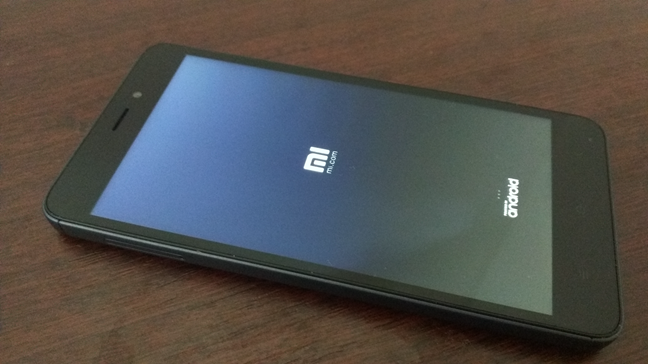
Regarding speed and performance, the Xiaomi Redmi 4A does not have the most powerful processor, nor the fastest graphic chip. However, during the time we had it in testing, it behaved nicely and did not feel like an underpowered device. Xiaomi's proprietary MIUI interface feels snappy and launching apps is pretty fast. Even Facebook felt fast although it is known to be one of the most power hungry apps for Android.
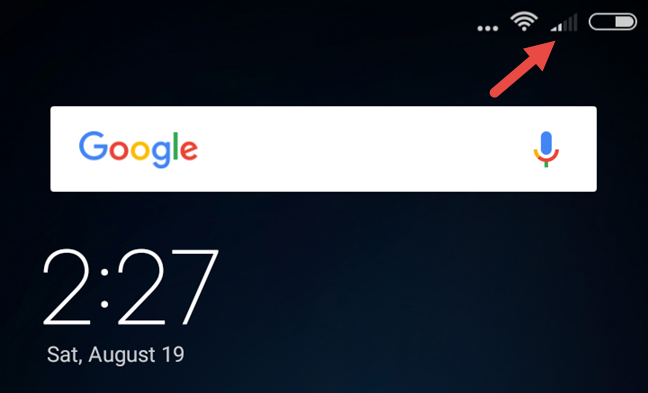
On another note, although the internet speed when connected to 4G networks is good, the signal reception is not marvelous. When we used it outdoors it was great, but indoors, between two concrete walls, the mobile reach was choppy at times.
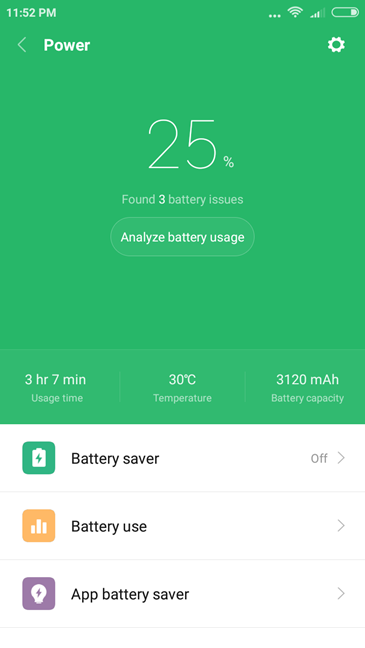
The Xiaomi Redmi 4A shines when it comes to its autonomy. The 3120 mAh battery and the not demanding hardware help it last for more than a day between charges. If you use it intensively, it should last a day. We took one day off from work and used it to take a lot of photos, browse the web and use Facebook a lot. We also had the screen set to maximum brightness because we used it mostly outdoors in direct sunlight. That day, it lasted for a day on a full charge.
The Xiaomi Redmi 4A is a good choice if you want to watch a movie or a YouTube clip on it. The screen is bright enough to do this outdoors, although we wouldn't recommend it in direct sunlight on the beach. 🙂 However, it is not a very good choice if you want to listen to music. The speaker is not the best and when the volume is maxed, it can distort sounds. But, you can always use a pair of headphones to overcome this issue.
If you like games, the Xiaomi Redmi 4A can run them but the graphic chip is pretty weak so expect low video quality and do not expect high frame rates. If you like Candy Crush Soda Saga, you'll be happy with this smartphone but if you want more complex games like Grand Theft Auto, don't expect top-notch performance.
The Xiaomi Redmi 4A offers a good user experience, although there are some things we wished would have been better, like the signal reception.
The camera experience on the Xiaomi Redmi 4A
The rear main camera on the Xiaomi Redmi 4A has 13 megapixels, an f/2.2 aperture and the optical part of the camera uses 5 lenses. There's also an LED flash for low light environments and a front camera with 5 megapixels.
The rear camera performs decently and above average when compared with other smartphones with a similar price, such as the ASUS Zenfone Live. The photos we took using it outdoors have good colors and contrast, if the light is right. When the environment is dim or the subject is too close or moving, things change and Xiaomi Redmi 4A does not produce satisfactory results. In poor light conditions, there is a lot of noise and when the subject is moving the camera does not always focus correctly. The front camera is decent for taking selfies although it does not excel at it. If you want to get a better view of how the cameras perform, in the gallery below, you can see a series of photos we took the Xiaomi Redmi 4A.
When it comes to shooting videos, the Xiaomi Redmi 4A doesn't impress but it doesn't disappoint either. Don't expect optical video stabilization because there is none. However, you can record video in Full HD resolution and the result is OK as long as your hands are not shaking. In the sample below you can see how Xiaomi Redmi 4A performs when recording videos with just a little movement:
If you are curious, here's another sample with a video taken while in a car, which shows you how the Xiaomi Redmi 4A does when there is a lot of movement involved:
The Xiaomi Redmi 4A offers decent results in terms of both photography and video recording. It is not impressive but it is better than average you get in its price range.
Android 6.0.1, MIUI 8.5 and bundled apps
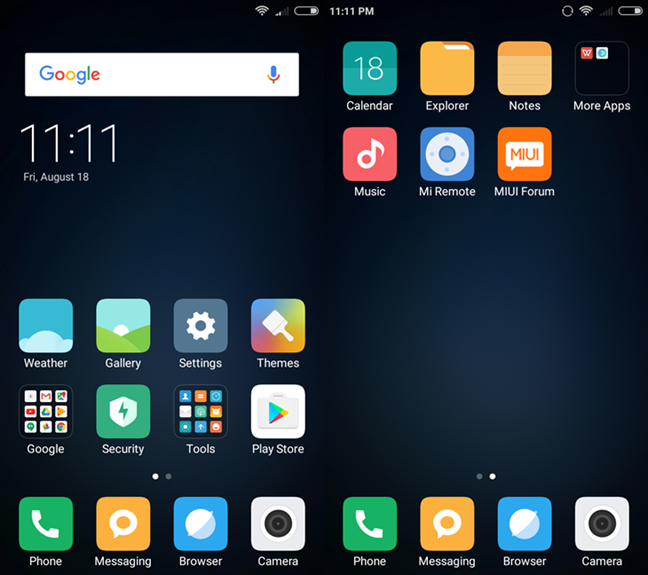
Xiaomi Redmi 4A comes with Android 6.0.1 Marshmallow pre-installed and with Xiaomi's proprietary user interface MIUI 8.5. MIUI is a user interface that looks good and has a minimalist design. It is so easy to work with, that probably even someone who never saw an Android smartphone before could adapt to it quickly. However, we don't like that MIUI has no app drawer. That means that you get only a series of homescreens, with all the apps and shortcuts. The only way to organize your apps is to create folders and move them around. It's not our favorite way of doing things but, then again, you can always install another launcher.
As for the apps that are bundled with the operating system, Xiaomi added quite a few. If you are curious to know what's on the Redmi 4A by default, besides the usual Google apps, here's the list:
- Calculator - makes math calculations easy.
- Calendar - a calendar app that lets you schedule your daily agenda.
- Clock - a simple clock app that also lets you set alarms and use a stopwatch and a timer.
- Compass - shows you where the North is, unless you're at the Magnetic North Pole. 🙂
- Contacts - stores and lets you manage the details of your contacts.
- Explorer - use it to browse and manage the folders and files stored on your Xiaomi Redmi 4A.
- Feedback - you can use this app to give feedback to Xiaomi's engineers about your smartphone.
- FM Radio - turns your smartphone into an FM radio receiver so you can listen to radio stations that are broadcasting in your area. You need to connect a pair of headphones to be able to use this app.
- Gallery - a Google Photos clone that lets you browse and see the photos stored on your smartphone.
- Mail - the default email app offered by Xiaomi.You may prefer other apps from the Google Play store.
- Mi Account - helps you create and connect to your Mi account, which you need if you want to access all the services that are offered by Xiaomi.
- Mi Remote - uses Xiaomi Redmi 4A's infrared sensor to make your smartphone act as a remote for various devices like your TV, DVD player or AC. This is useful when you can't find your TV's remote.
- MIUI Forum - gives you access to the MIUI forums where you can ask for information or help about anything related to your smartphone.
- Music - lets you listen and enjoy the music stored on your smartphone.
- Notes - a simple app that lets you take notes.
- Recorder - an app that records sounds using the smartphone's microphone.
- Scanner - uses the smartphone's camera to scan QR codes.
- Security - keeps your smartphone secure by running antivirus scans and also helps you clean junk files from it. The antivirus is offered by Avast.
- SwiftKey Keyboard - the popular alternative keyboard app to Google Keyboard.
- Themes - lets you customize the way the MIUI interface looks, with the help of various themes.
- Updater - the official app for checking, downloading and installing new system updates for the Xiaomi Redmi 4A.
- Weather - gives you the weather forecast in your location or anywhere else in the world.
- WPS Office - an office suite that lets you open and edit documents of all kinds. Unfortunately it displays ads unless you buy the full version.
Xiaomi Redmi 4A comes with Android 6.0 and Xiaomi does not have plans to offer an upgrade to Android 7 Nougat. The smartphone also includes Xiaomi's own MIUI user interface which we like but would prefer that it had an app drawer. Last but not least, we appreciate the fact that most of the bundled apps are useful, even though their number could be smaller.
Performance in benchmarks
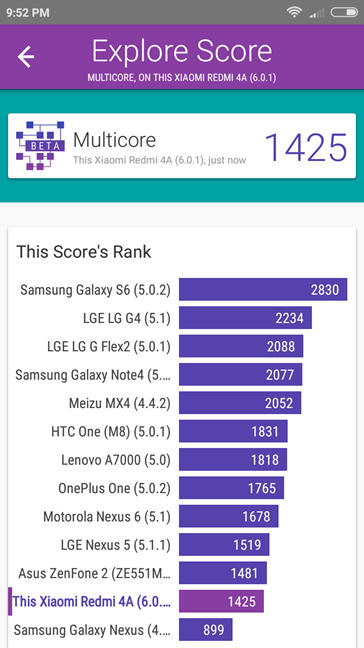
The first benchmark we ran was Vellamo, which is an app that is developed by Qualcomm. We started with Multicore, a series of test that measure the processor's performance when it has to deal with multiple execution threads at the same time. The score offered by these tests show how good the smartphone is when handling multiple apps and doing multitasking in general. Xiaomi Redmi 4A got 1425 points which is a score similar to what you would get from an ASUS Zenfone 2 or an LG Nexus 5. It is also a better score than that of the ASUS Zenfone Live or the ASUS Zenfone 3 Max, which are similarly priced Android smartphones.
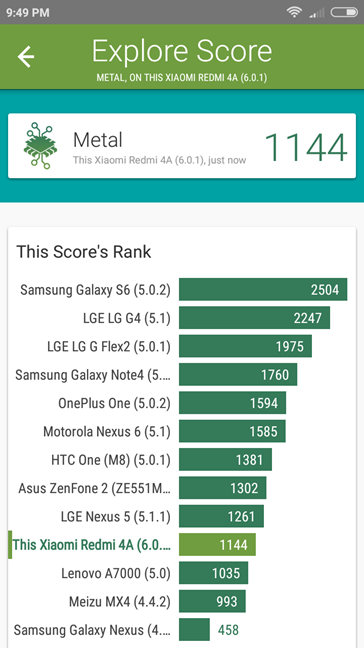
Then we ran the Metal tests offered by Vellamo, which assesses the processor's performance when handling single threads. This score gives you an idea of how good the smartphone is when it runs older apps that don't know how to work with multiple processor cores or apps that require a significant amount of power per core, such as games. Xiaomi Redmi 4A got 1144 points, again a score similar to that of an LG Nexus 5 and higher than what you would get from an ASUS Zenfone 3 Max or an ASUS Zenfone Live.
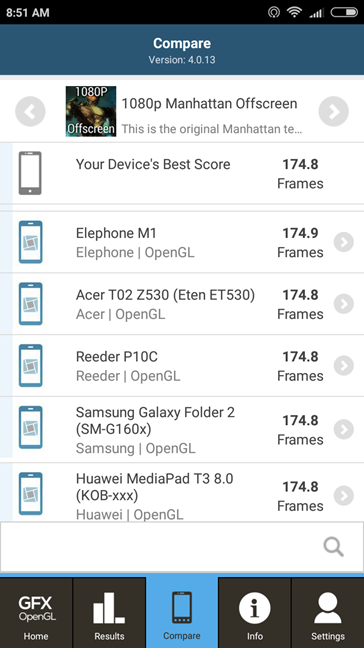
Then we moved on to see how well the Xiaomi Redmi 4A performs in games. To do that, we used an app called GFXBench GL Benchmark. We recorded the results from the 1080p Manhattan 3.1 Offscreen and 1080p T-Rex Offscreen tests. We usually run these tests in 1080p because that makes it easier to compare smartphones with different resolutions. We couldn't run the 1080p Car Chase Offscreen tests because the Adreno 308 video chip found on the Xiaomi Redmi 4A does not offer support for OpenGL ES 3.2 graphics rendering API which is used by the latest games. Adreno 308 only offers support for OpenGL ES 3.0.
In the 1080p Manhattan 3.1 Offscreen tests, Xiaomi Redmi 4A rendered 174.8 frames. It is a weak result but it is once again better than that of an ASUS Zenfone Live for instance.
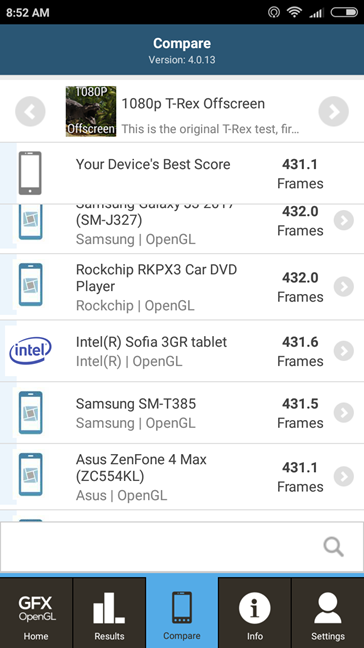
In the 1080p T-Rex Offscreen test, which evaluates the performance of the smartphone in older and less demanding games, the Xiaomi Redmi 4A managed to render 431.1 frames. Although not a good result, it is still better than that of the ASUS Zenfone Live or the ASUS Zenfone 3 Max.
The Xiaomi Redmi 4A is not a smartphone for gaming enthusiasts, although it can run most games. Just don't expect high frame rates or high graphics quality.
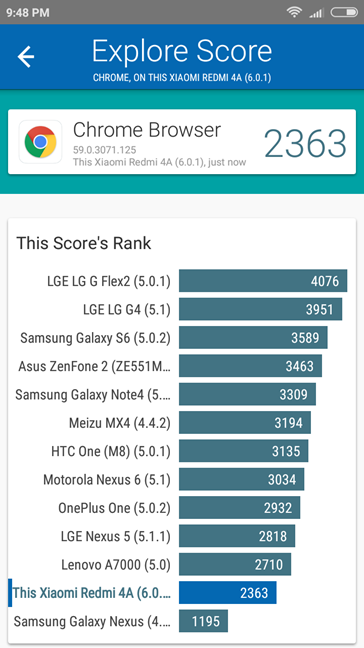
We then moved on to see how the Xiaomi Redmi 4A does in more mundane activities such as browsing the web. To do that, we went back to Vellamo and ran its Browser tests using Chrome. The smartphone managed to get a score of 2363 points. It is not an impressive result and it means that smartphone might have troubles sometimes when it has to load complex websites. Also, you shouldn't expect fast speeds when loading websites. But, it does better than the ASUS Zenfone Live.
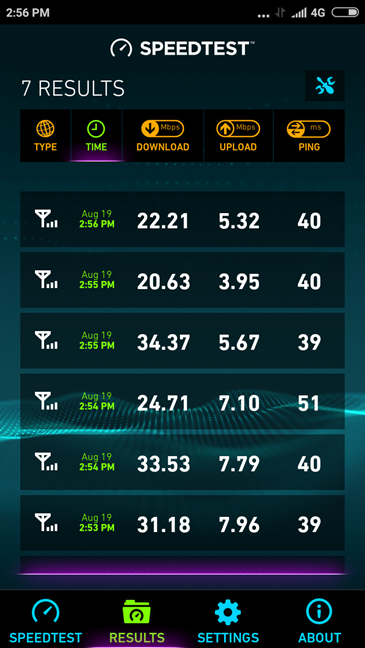
We also tested the 4G speed and reliability offered by the Xiaomi Redmi 4A. Although our mobile operator does not offer the greatest mobile coverage, the measurements we made with Speedtest were in line with other smartphones.
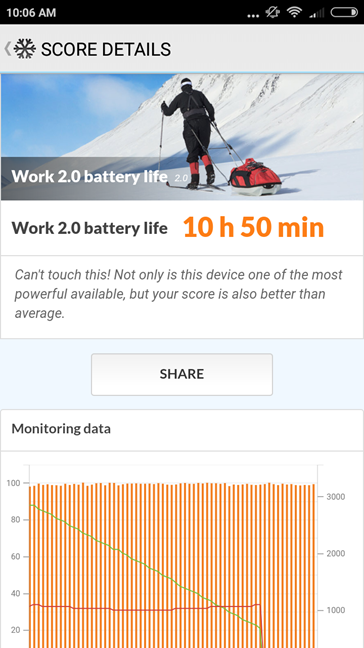
Last but not least, we also checked the battery performance, using the PCMark benchmark app. When running the Work 2.0 battery life test, Xiaomi Redmi 4A managed to keep going on for an impressive 10 hours and 50 minutes. This is an excellent result and it shows that the smartphone is a very good choice for those who don't want to have to charge their smartphone each day. This one should stay on for two days or at least a day and a couple hours, in normal usage scenarios.
The Xiaomi Redmi 4A cannot brag about powerful hardware or high performance. However, what it has to offer for its price tag is more than decent both when it comes to running smartphone apps and when playing games. Additionally, it also offers a impressive battery life for a smartphone this cheap.
What is your opinion about Xiaomi Redmi 4A?
Now that you know what our opinion about the Xiaomi Redmi 4A smartphone, its real-life performance and camera experience, we would love to hear from you. Is this smartphone an interesting choice for you? Would you buy it or you prefer alternatives like the ASUS Zenfone Live? Share your views in the comments below.
Discussion (0)
Comments are closed.