



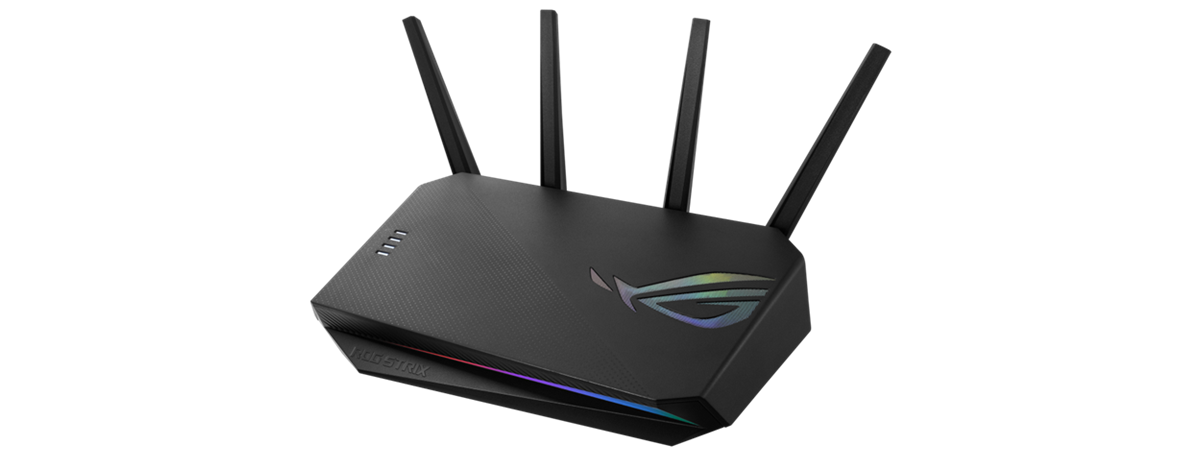
ASUS has several AX5400 wireless routers, most of which are gaming routers with RGB lighting. One of their newest models is the ASUS ROG Strix GS-AX5400. This router delivers Wi-Fi 6 connectivity, many gaming-oriented features, and powerful hardware for a slightly higher price than the competition. Read this detailed review and learn about the real-world performance of the ASUS GS-AX5400 gaming router:
![Verdict]()

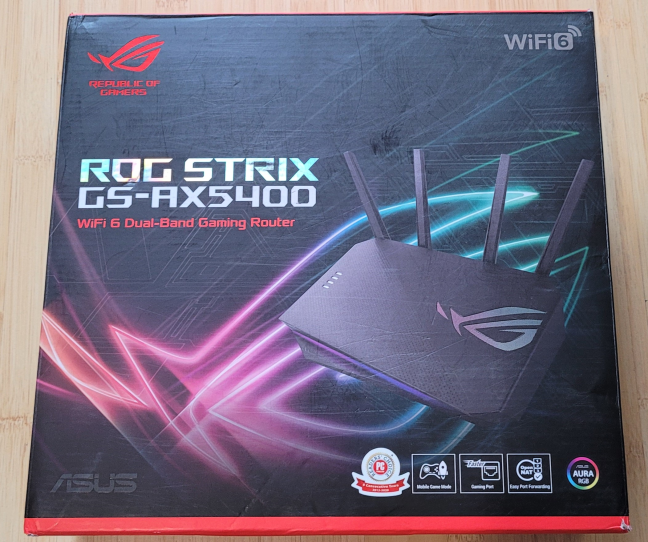
 The packaging used for ASUS GS-AX5400
Inside the box, you can find the following items: the router itself, its power adapter, a network cable, the quick start guide, a leaflet with troubleshooting information, the warranty, and other brochures.
The packaging used for ASUS GS-AX5400
Inside the box, you can find the following items: the router itself, its power adapter, a network cable, the quick start guide, a leaflet with troubleshooting information, the warranty, and other brochures.
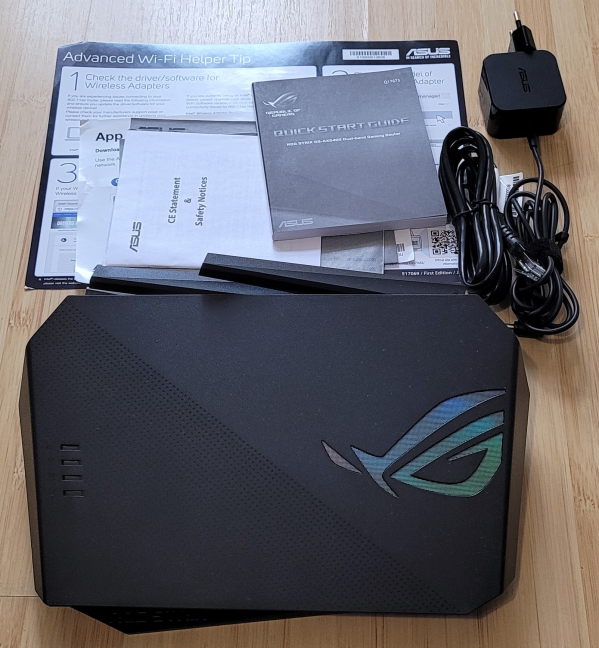
 Unboxing the ASUS GS-AX5400
Unboxing the ASUS ROG Strix GS-AX5400 wireless router is a quick and painless experience. Inside the box, you find everything you need to get started. However, if this is your first Wi-Fi 6 router, we strongly recommend that you read the troubleshooting and setup instructions before setting things up.
Unboxing the ASUS GS-AX5400
Unboxing the ASUS ROG Strix GS-AX5400 wireless router is a quick and painless experience. Inside the box, you find everything you need to get started. However, if this is your first Wi-Fi 6 router, we strongly recommend that you read the troubleshooting and setup instructions before setting things up.
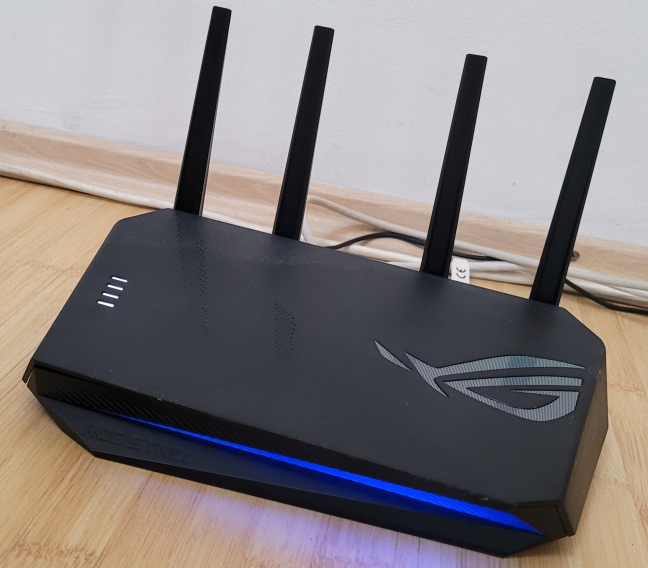
 ASUS GS-AX5400 features RGB lighting
On the left side, you see four LED lights. Two of them are for the Wi-Fi status (one LED for the 2.4 GHz band, another for 5 GHz), while the other two are for the internet connection status and the state of the router itself. Beneath them, you also see the ROG STRIX branding, which is barely noticeable if you don’t pay attention.
ASUS GS-AX5400 features RGB lighting
On the left side, you see four LED lights. Two of them are for the Wi-Fi status (one LED for the 2.4 GHz band, another for 5 GHz), while the other two are for the internet connection status and the state of the router itself. Beneath them, you also see the ROG STRIX branding, which is barely noticeable if you don’t pay attention.
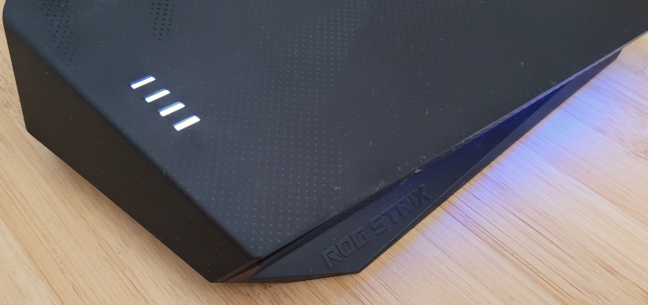
 The LEDs on the top
The router's case is made from plastic, and it is a dust magnet that needs to be cleaned regularly. The ASUS ROG Strix GS-AX5400 router is medium-sized, having 10.56 x 7.08 x 6.53 inches or 268 x 180 x 160 mm in width, depth, and height. It also weighs around 1.55 lbs or roughly 700 grams.
Flipping the router over, you see the ventilation grids, as well as stickers with information about the model you just bought. Two large rubber feet hold the router into place and prevent it from sliding around, while the two holes give you the option to mount the router on walls. Some users will appreciate their presence.
The LEDs on the top
The router's case is made from plastic, and it is a dust magnet that needs to be cleaned regularly. The ASUS ROG Strix GS-AX5400 router is medium-sized, having 10.56 x 7.08 x 6.53 inches or 268 x 180 x 160 mm in width, depth, and height. It also weighs around 1.55 lbs or roughly 700 grams.
Flipping the router over, you see the ventilation grids, as well as stickers with information about the model you just bought. Two large rubber feet hold the router into place and prevent it from sliding around, while the two holes give you the option to mount the router on walls. Some users will appreciate their presence.
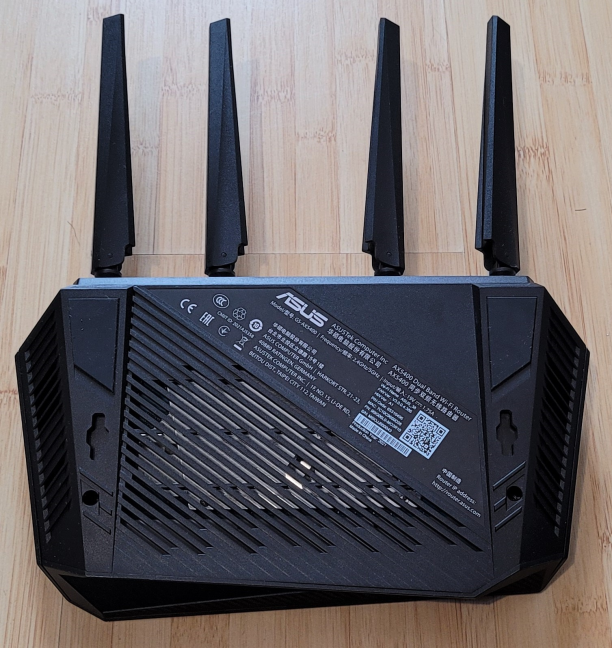
 The ventilation system is on the bottom of the ASUS GS-AX5400
On the back of the router, you find the Power port, the Power switch, a USB 3.2 Gen 1 port, and four 1 Gbps LAN ports, two of which support Link aggregation. Also, one of them is a prioritized gaming port. The list continues with the WAN port (also working at 1 Gbps), the WPS, and the Reset buttons.
The ventilation system is on the bottom of the ASUS GS-AX5400
On the back of the router, you find the Power port, the Power switch, a USB 3.2 Gen 1 port, and four 1 Gbps LAN ports, two of which support Link aggregation. Also, one of them is a prioritized gaming port. The list continues with the WAN port (also working at 1 Gbps), the WPS, and the Reset buttons.
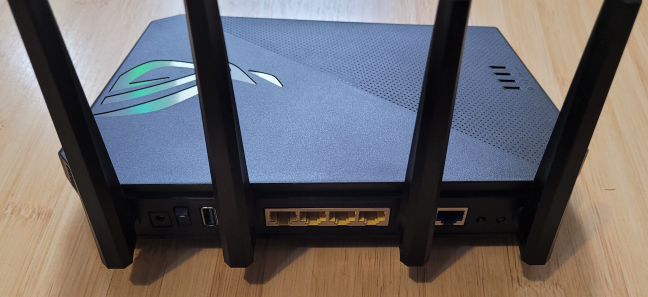
 The ports and buttons found on the back
Like the ASUS RT-AX82U, ASUS ROG Strix GS-AX5400 is also an AX5400 dual-band router, with a maximum bandwidth of 574 Mbps for the 2.4 GHz band and 4804 Mbps for the 5 GHz band. The similarities don’t end here, since it is also powered by a triple-core Broadcom BCM6750 SoC (System on a Chip), running at 1.5 GHz, with 512 MB of RAM and 256 MB of storage space for the firmware. It uses 4x4 MU-MIMO for wireless transfers on the 5 GHz band and 2x2 MU-MIMO for the 2.4 GHz band. One cool feature of this router is its support for WPA3 password encryption and Wi-Fi 6 with 160 MHz channel bandwidth.
If you would like to know more about the official specifications of this router, go to this page: ASUS ROG Strix GS-AX5400.
The ports and buttons found on the back
Like the ASUS RT-AX82U, ASUS ROG Strix GS-AX5400 is also an AX5400 dual-band router, with a maximum bandwidth of 574 Mbps for the 2.4 GHz band and 4804 Mbps for the 5 GHz band. The similarities don’t end here, since it is also powered by a triple-core Broadcom BCM6750 SoC (System on a Chip), running at 1.5 GHz, with 512 MB of RAM and 256 MB of storage space for the firmware. It uses 4x4 MU-MIMO for wireless transfers on the 5 GHz band and 2x2 MU-MIMO for the 2.4 GHz band. One cool feature of this router is its support for WPA3 password encryption and Wi-Fi 6 with 160 MHz channel bandwidth.
If you would like to know more about the official specifications of this router, go to this page: ASUS ROG Strix GS-AX5400.
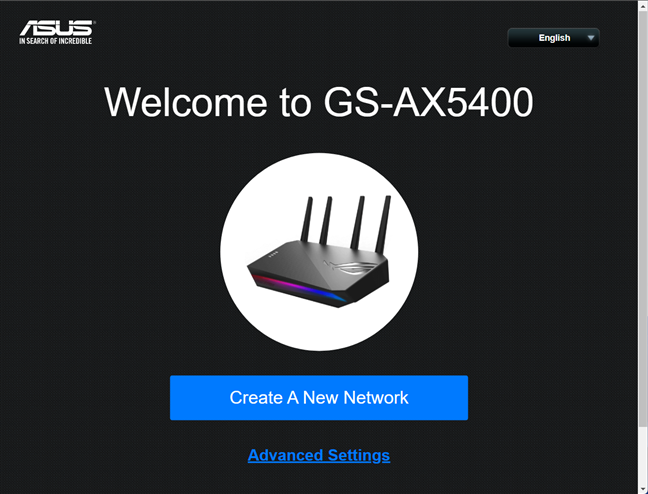
 Setting up the ASUS GS-AX5400 is easy
Then, you can connect your computers and devices to the network and access the router’s software for more fine-tuning. The administration interface is easy to use, well organized into logical sections, and available in 25 languages. You get to control a myriad of settings, and both casual and advanced users will be happy with the options available. As you can see below, a Republic of Gamers skin is applied over the standard interface that you get from most ASUS routers.
Setting up the ASUS GS-AX5400 is easy
Then, you can connect your computers and devices to the network and access the router’s software for more fine-tuning. The administration interface is easy to use, well organized into logical sections, and available in 25 languages. You get to control a myriad of settings, and both casual and advanced users will be happy with the options available. As you can see below, a Republic of Gamers skin is applied over the standard interface that you get from most ASUS routers.
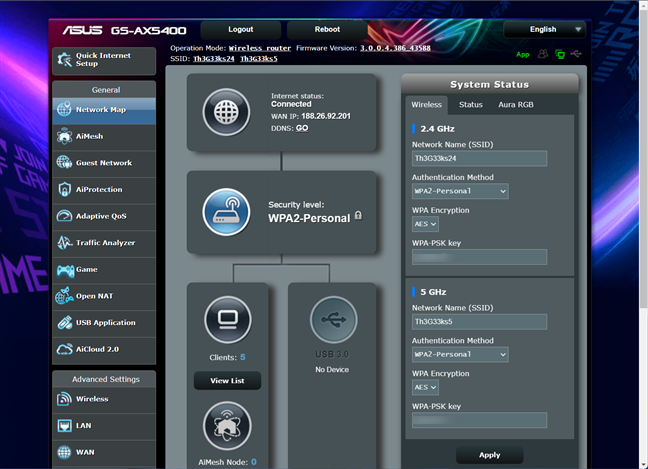
 The admin user interface
The user documentation is easily accessible: a question mark is shown when you move the mouse cursor over a setting that you do not understand. Click the question mark, and you see information explaining that setting. Unfortunately, the help documentation does not include information about all the features contained by ASUS in their latest firmware, so this trick does not work for every single setting.
The admin user interface
The user documentation is easily accessible: a question mark is shown when you move the mouse cursor over a setting that you do not understand. Click the question mark, and you see information explaining that setting. Unfortunately, the help documentation does not include information about all the features contained by ASUS in their latest firmware, so this trick does not work for every single setting.
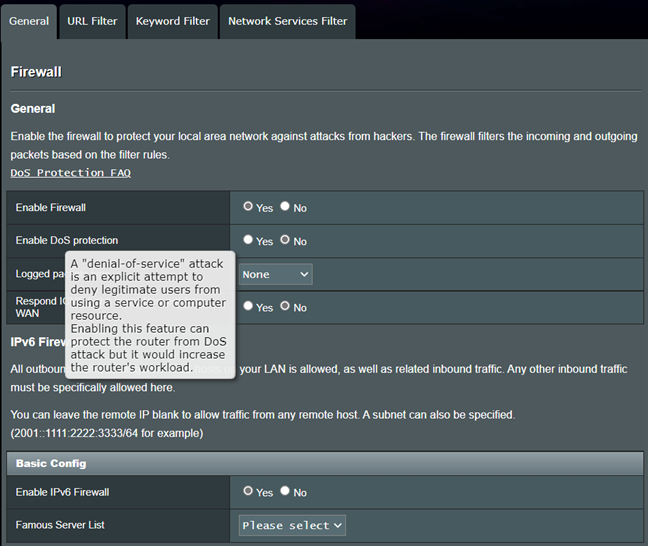
 Help is easily accessible
The firmware of the ASUS ROG Strix GS-AX5400 offers everything you need and wish for, from gaming features to AiMesh support that allows you to create a mesh Wi-Fi system of your own. In addition, the security tools available are top-notch and free to use for the whole life of the router.
One upside is that you can remote-control the router from your smartphone or tablet, using the ASUS Router mobile app even when you are not at home. This router is a ROG device, and the app uses a different skin, based on the visuals of this gaming-oriented brand.
Help is easily accessible
The firmware of the ASUS ROG Strix GS-AX5400 offers everything you need and wish for, from gaming features to AiMesh support that allows you to create a mesh Wi-Fi system of your own. In addition, the security tools available are top-notch and free to use for the whole life of the router.
One upside is that you can remote-control the router from your smartphone or tablet, using the ASUS Router mobile app even when you are not at home. This router is a ROG device, and the app uses a different skin, based on the visuals of this gaming-oriented brand.
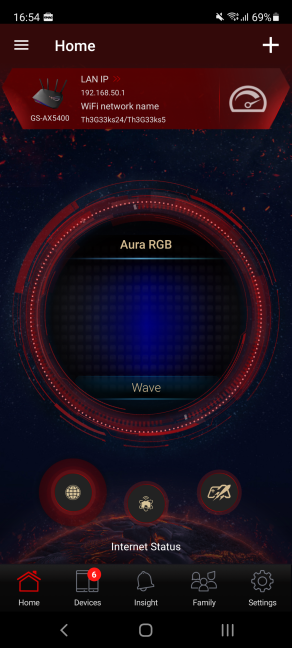
 The ASUS Router mobile app has a special ROG skin
The ASUS Router mobile app has plenty of advanced configuration options, including gaming-specific features like enabling the Mobile Game Mode or controlling the RGB lighting on the router. We find it easy to use, even if you don’t know much about networking.
To check the quality of the Wi-Fi broadcast by ASUS ROG Strix GS-AX5400, we took a laptop and moved it to a room separated by one wall from the router. Then, we made several wireless transfers on it, using a specialized app that measured the average speed and the variability of the network transfer. The average download speed was pretty good on the 2.4 GHz band and the Wi-Fi 4 standard, but the variability deserves some improvement. However, considering that the router offers 2x2 MU-MIMO on this band, not 4x4 MU-MIMO like on the 5 GHz band, the results we’ve obtained don’t surprise us.
The ASUS Router mobile app has a special ROG skin
The ASUS Router mobile app has plenty of advanced configuration options, including gaming-specific features like enabling the Mobile Game Mode or controlling the RGB lighting on the router. We find it easy to use, even if you don’t know much about networking.
To check the quality of the Wi-Fi broadcast by ASUS ROG Strix GS-AX5400, we took a laptop and moved it to a room separated by one wall from the router. Then, we made several wireless transfers on it, using a specialized app that measured the average speed and the variability of the network transfer. The average download speed was pretty good on the 2.4 GHz band and the Wi-Fi 4 standard, but the variability deserves some improvement. However, considering that the router offers 2x2 MU-MIMO on this band, not 4x4 MU-MIMO like on the 5 GHz band, the results we’ve obtained don’t surprise us.
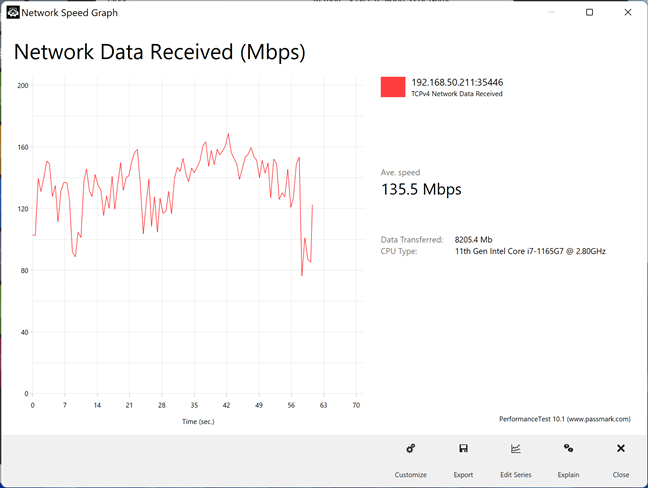
 ASUS GS-AX5400 - a network transfer on Wi-Fi 4
We noticed a significant improvement when switching to the 5 GHz band and Wi-Fi 5 in the same room. The average download speed was a lot higher, and the variability diminished.
ASUS GS-AX5400 - a network transfer on Wi-Fi 4
We noticed a significant improvement when switching to the 5 GHz band and Wi-Fi 5 in the same room. The average download speed was a lot higher, and the variability diminished.
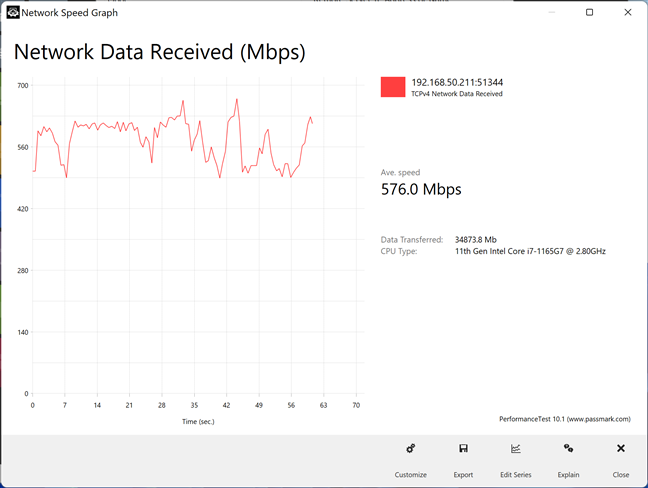 ASUS GS-AX5400 - a network transfer on Wi-Fi 5
When switching to Wi-Fi 6 on the 5 GHz band, the ASUS ROG Strix GS-AX5400 performed beautifully. We enjoyed a super-fast network transfer and a rock-solid connection.
ASUS GS-AX5400 - a network transfer on Wi-Fi 5
When switching to Wi-Fi 6 on the 5 GHz band, the ASUS ROG Strix GS-AX5400 performed beautifully. We enjoyed a super-fast network transfer and a rock-solid connection.
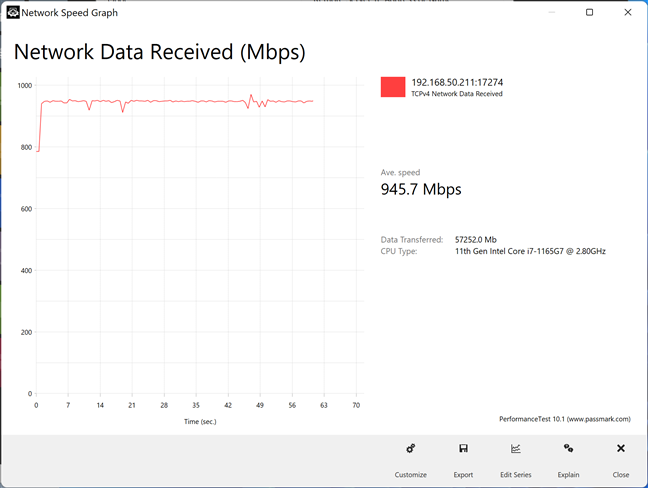 ASUS GS-AX5400 - a network transfer on Wi-Fi 6
This comparison shows a clear focus from ASUS on delivering a great networking experience on the 5 GHz band when using Wi-Fi 6 and Wi-Fi 5. The older Wi-Fi 4 works well too, but the variability of network transfers could be improved.
If you want to know more about the real-world performance offered by ASUS GS-AX5400, including comparisons with other wireless routers, go to the next page of this review.
ASUS GS-AX5400 - a network transfer on Wi-Fi 6
This comparison shows a clear focus from ASUS on delivering a great networking experience on the 5 GHz band when using Wi-Fi 6 and Wi-Fi 5. The older Wi-Fi 4 works well too, but the variability of network transfers could be improved.
If you want to know more about the real-world performance offered by ASUS GS-AX5400, including comparisons with other wireless routers, go to the next page of this review.
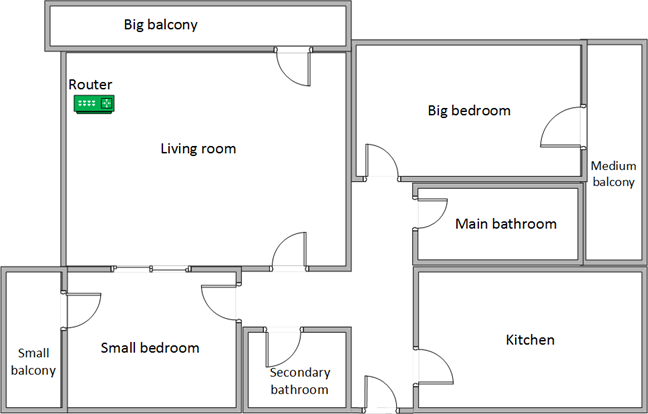
 The apartment in which we tested ASUS GS-AX5400
We have a fast 1 Gigabit Internet connection capable of upload speeds of up to 800 Mbps. We evaluated the Wi-Fi emitted by ASUS GS-AX5400 using the following standards: Wi-Fi 4 on the 2.4 GHz band, Wi-Fi 5, and Wi-Fi 6 on the 5 GHz band.
To get a better idea of the performance offered by ASUS GS-AX5400, we compared it with ASUS RT-AX82U - another AX5400 Wi-Fi 6 router with identical hardware, similar features, price, and marketing positioning. We also compared it to an older Wi-Fi 5 gaming router with the same 5400 Mbps bandwidth TP-Link Archer C5400X, just to get a perspective of whether there are any meaningful differences when switching from a Wi-Fi 5 router to a Wi-Fi 6 one.
We first analyzed the 2.4 GHz band using the Wi-Fi 4 standard and measured the signal strength with NetSpot. The signal strength offered by ASUS GS-AX5400 was pretty good in all the rooms from our test apartment.
The apartment in which we tested ASUS GS-AX5400
We have a fast 1 Gigabit Internet connection capable of upload speeds of up to 800 Mbps. We evaluated the Wi-Fi emitted by ASUS GS-AX5400 using the following standards: Wi-Fi 4 on the 2.4 GHz band, Wi-Fi 5, and Wi-Fi 6 on the 5 GHz band.
To get a better idea of the performance offered by ASUS GS-AX5400, we compared it with ASUS RT-AX82U - another AX5400 Wi-Fi 6 router with identical hardware, similar features, price, and marketing positioning. We also compared it to an older Wi-Fi 5 gaming router with the same 5400 Mbps bandwidth TP-Link Archer C5400X, just to get a perspective of whether there are any meaningful differences when switching from a Wi-Fi 5 router to a Wi-Fi 6 one.
We first analyzed the 2.4 GHz band using the Wi-Fi 4 standard and measured the signal strength with NetSpot. The signal strength offered by ASUS GS-AX5400 was pretty good in all the rooms from our test apartment.
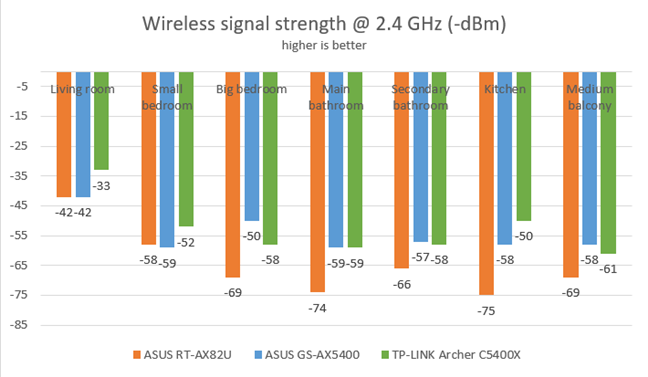
 The signal strength on the 2.4 GHz band
We used SpeedTest to measure the internet connection speed when connected to the 2.4 GHz band on Wi-Fi 4. The download speed offered by ASUS GS-AX5400 was pretty good in all the rooms of our apartment. In troublesome places like the Kitchen and other rooms where many routers struggle, ASUS GS-AX5400 is the speed champion of this comparison.
The signal strength on the 2.4 GHz band
We used SpeedTest to measure the internet connection speed when connected to the 2.4 GHz band on Wi-Fi 4. The download speed offered by ASUS GS-AX5400 was pretty good in all the rooms of our apartment. In troublesome places like the Kitchen and other rooms where many routers struggle, ASUS GS-AX5400 is the speed champion of this comparison.
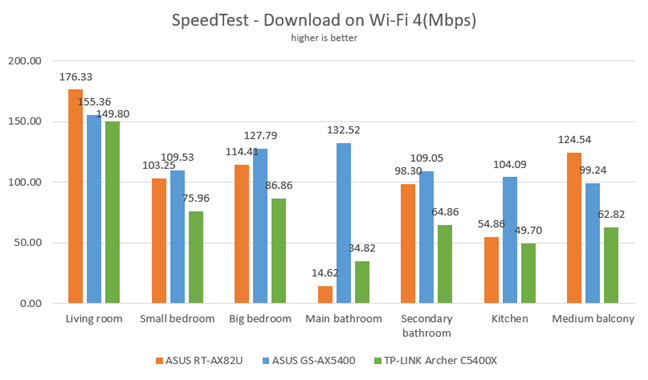
 SpeedTest - Download speeds on Wi-Fi 4
When we measured the upload speed on the 2.4 GHz band, ASUS GS-AX5400 performed well in all rooms.
SpeedTest - Download speeds on Wi-Fi 4
When we measured the upload speed on the 2.4 GHz band, ASUS GS-AX5400 performed well in all rooms.
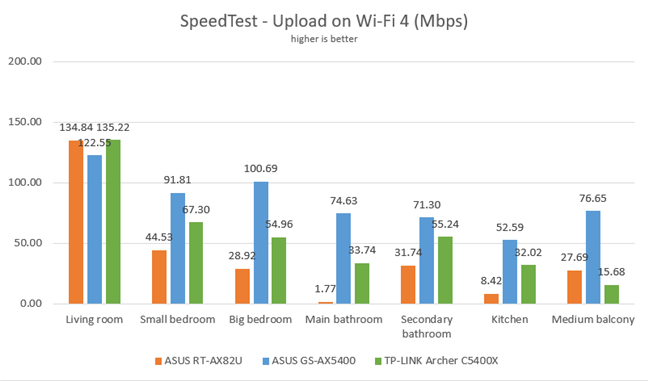
 SpeedTest - Upload speeds on Wi-Fi 4
We used the PassMark Performance test to transfer data between two computers connected to the network on the 2.4 GHz band using Wi-Fi 4. ASUS GS-AX5400 was the speed champion in all the rooms of our apartment.
SpeedTest - Upload speeds on Wi-Fi 4
We used the PassMark Performance test to transfer data between two computers connected to the network on the 2.4 GHz band using Wi-Fi 4. ASUS GS-AX5400 was the speed champion in all the rooms of our apartment.
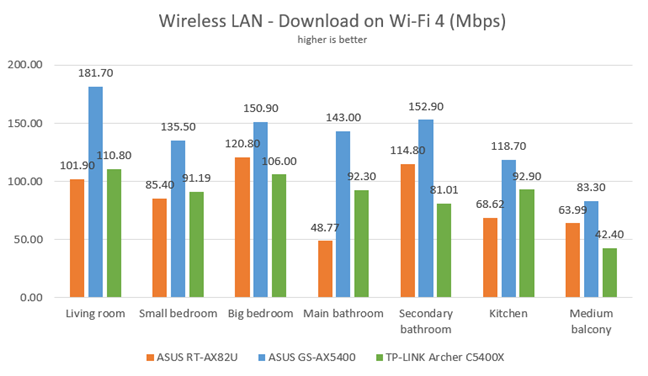
 Download speeds on Wi-Fi 4
When we measured the upload speed, ASUS GS-AX5400 performed well in all rooms.
Download speeds on Wi-Fi 4
When we measured the upload speed, ASUS GS-AX5400 performed well in all rooms.
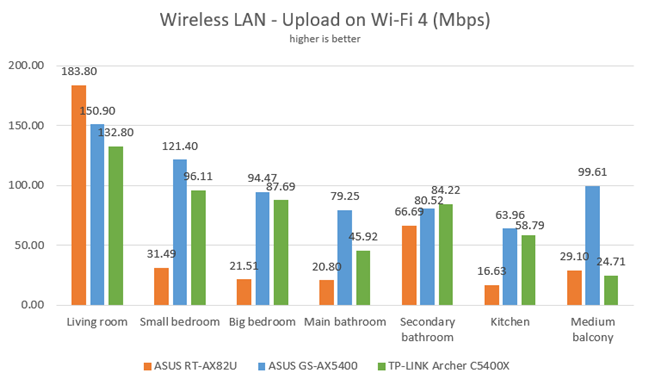
 Upload speeds on Wi-Fi 4
On the 2.4 GHz band, when using the Wi-Fi 4 standard, ASUS ROG Strix GS-AX5400 is a solid performer with excellent coverage.
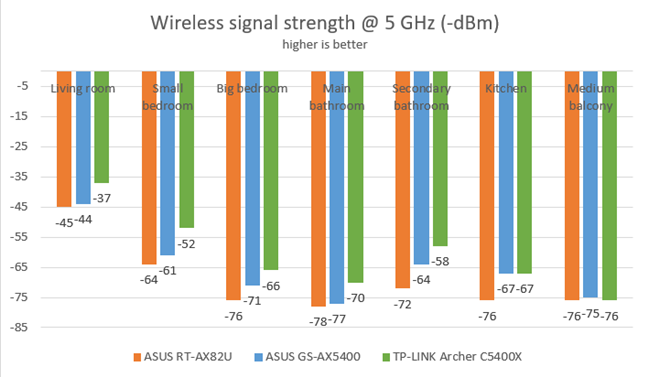
For the next set of measurements, we analyzed the performance of the 5GHz wireless band using Wi-Fi 5. We looked at the evolution of the signal strength from room to room. As you can see, ASUS GS-AX5400 was in the middle of the pack.
Upload speeds on Wi-Fi 4
On the 2.4 GHz band, when using the Wi-Fi 4 standard, ASUS ROG Strix GS-AX5400 is a solid performer with excellent coverage.
For the next set of measurements, we analyzed the performance of the 5GHz wireless band using Wi-Fi 5. We looked at the evolution of the signal strength from room to room. As you can see, ASUS GS-AX5400 was in the middle of the pack.
 The signal strength on the 5 GHz band
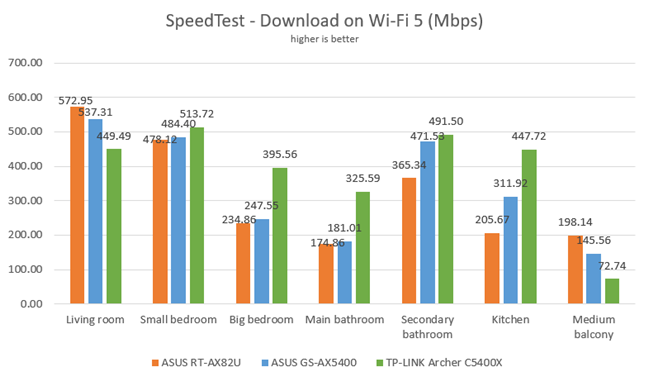
We used SpeedTest to measure the internet connection speed when connected to the 5 GHz band, using the Wi-Fi 5 standard. In most rooms, the older TP-Link Archer C5400X Wi-Fi 5 gaming router outmatched the download speeds offered by ASUS GS-AX5400.
The signal strength on the 5 GHz band
We used SpeedTest to measure the internet connection speed when connected to the 5 GHz band, using the Wi-Fi 5 standard. In most rooms, the older TP-Link Archer C5400X Wi-Fi 5 gaming router outmatched the download speeds offered by ASUS GS-AX5400.
 SpeedTest - Download speeds on Wi-Fi 5
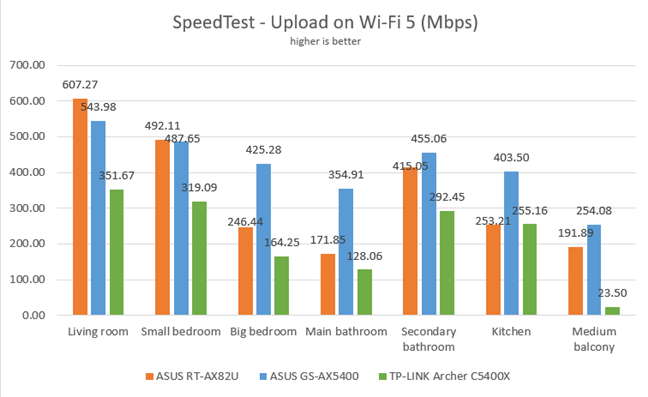
When measuring the upload speed, the situation was slightly different, and the ASUS GS-AX5400 came out on top in many rooms.
SpeedTest - Download speeds on Wi-Fi 5
When measuring the upload speed, the situation was slightly different, and the ASUS GS-AX5400 came out on top in many rooms.
 SpeedTest - Upload speeds on Wi-Fi 5
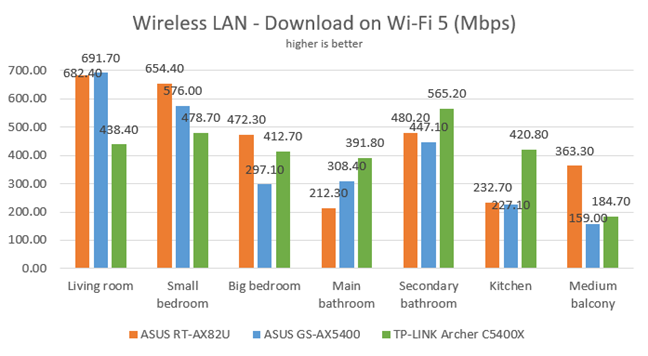
We then used the PassMark Performance test to transfer data between two computers connected to the network using Wi-Fi 5. ASUS GS-AX5400 outmatched the other routers in only one room. While it performed well in all the others, it was not the speed champion of this comparison.
SpeedTest - Upload speeds on Wi-Fi 5
We then used the PassMark Performance test to transfer data between two computers connected to the network using Wi-Fi 5. ASUS GS-AX5400 outmatched the other routers in only one room. While it performed well in all the others, it was not the speed champion of this comparison.
 Download speeds on Wi-Fi 5
Numbers were mixed when measuring the upload speed on Wi-Fi 5, as you can see below.
Download speeds on Wi-Fi 5
Numbers were mixed when measuring the upload speed on Wi-Fi 5, as you can see below.
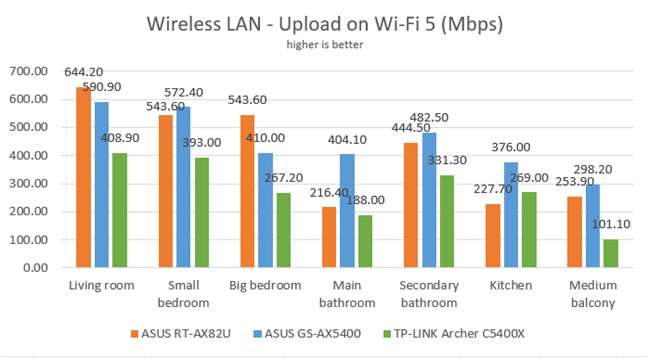
 Upload speeds on Wi-Fi 5
ASUS GS-AX5400 is a good performer on the 5 GHz band when using the Wi-Fi 5 standard. However, it doesn’t manage to outperform other routers with similar maximum bandwidth.
We remained on the 5GHz wireless band, but we switched to using the Wi-Fi 6 standard. Because the TP-Link Archer C5400X is an older Wi-Fi 5 router, it doesn’t get featured in the comparisons that follow.
We first used SpeedTest to see how fast the internet connection is when using Wi-Fi 6. When measuring the download speed, ASUS GS-AX5400 exchanged blows with ASUS RT-AX82U. There was no clear winner between the two.
Upload speeds on Wi-Fi 5
ASUS GS-AX5400 is a good performer on the 5 GHz band when using the Wi-Fi 5 standard. However, it doesn’t manage to outperform other routers with similar maximum bandwidth.
We remained on the 5GHz wireless band, but we switched to using the Wi-Fi 6 standard. Because the TP-Link Archer C5400X is an older Wi-Fi 5 router, it doesn’t get featured in the comparisons that follow.
We first used SpeedTest to see how fast the internet connection is when using Wi-Fi 6. When measuring the download speed, ASUS GS-AX5400 exchanged blows with ASUS RT-AX82U. There was no clear winner between the two.
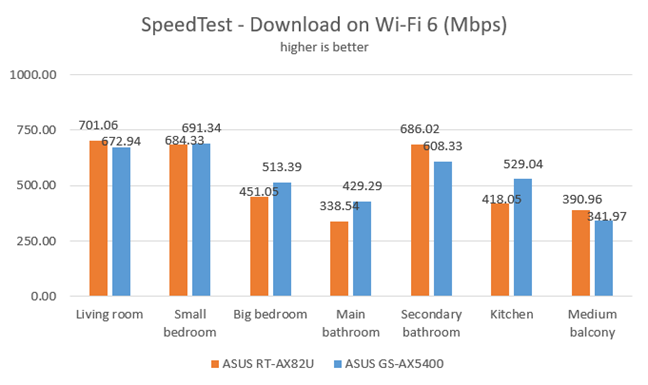 SpeedTest - Download speeds on Wi-Fi 6
When measuring the upload speed, ASUS GS-AX5400 was the clear winner in this comparison.
SpeedTest - Download speeds on Wi-Fi 6
When measuring the upload speed, ASUS GS-AX5400 was the clear winner in this comparison.
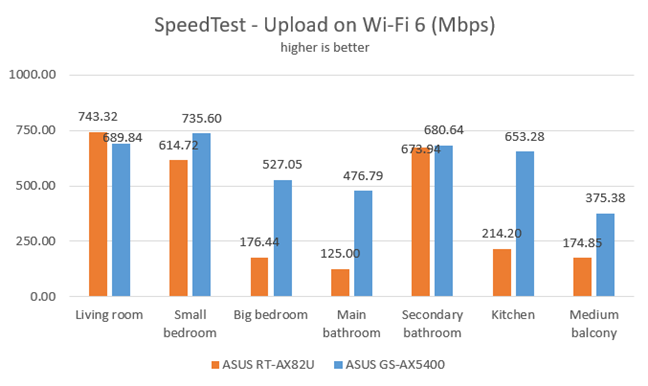
 SpeedTest - Upload speeds on Wi-Fi 6
We then used the PassMark Performance test to transfer data between two computers connected to the network using Wi-Fi 6. ASUS GS-AX5400 delivered high-speed downloads everywhere.
SpeedTest - Upload speeds on Wi-Fi 6
We then used the PassMark Performance test to transfer data between two computers connected to the network using Wi-Fi 6. ASUS GS-AX5400 delivered high-speed downloads everywhere.
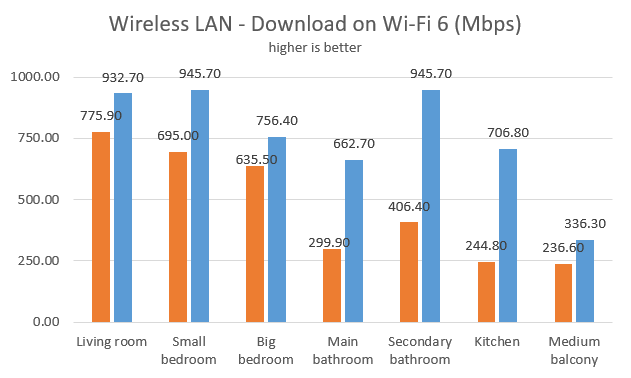
 Download speeds on Wi-Fi 6
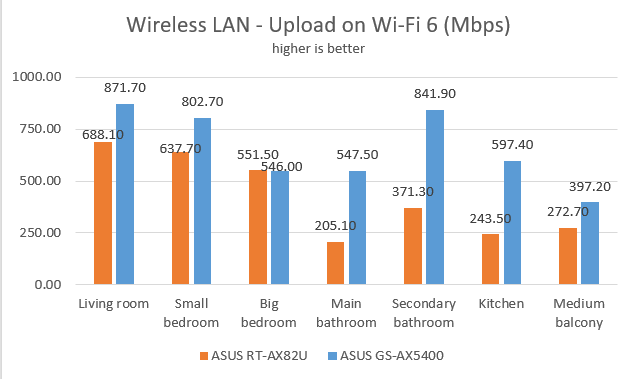
The same happened when measuring the upload speed too. Again, ASUS GS-AX5400 was faster than its similarly-priced counterpart.
Download speeds on Wi-Fi 6
The same happened when measuring the upload speed too. Again, ASUS GS-AX5400 was faster than its similarly-priced counterpart.
 Upload speeds on Wi-Fi 6
When using Wi-Fi 6, ASUS ROG Strix GS-AX5400 is an excellent performer, offering fast network transfers and wide coverage.
Upload speeds on Wi-Fi 6
When using Wi-Fi 6, ASUS ROG Strix GS-AX5400 is an excellent performer, offering fast network transfers and wide coverage.
 SpeedTest on Ethernet connections
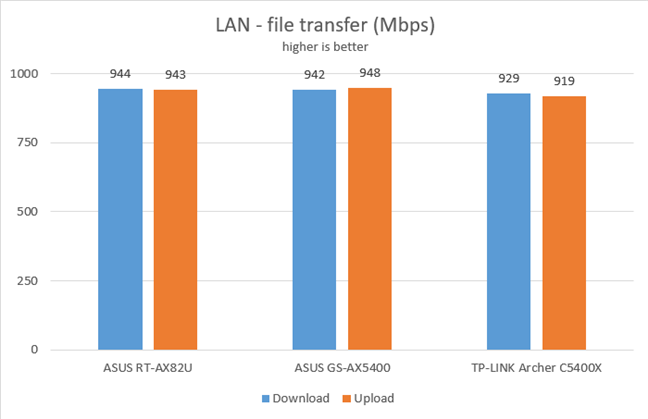
Then, we ran a network transfer between two computers, using the PassMark Performance test. ASUS GS-AX5400 got very close to the maximum speed possible of 1 Gbps. Then again, the others did as well.
SpeedTest on Ethernet connections
Then, we ran a network transfer between two computers, using the PassMark Performance test. ASUS GS-AX5400 got very close to the maximum speed possible of 1 Gbps. Then again, the others did as well.
 Network transfers using Ethernet connections
ASUS ROG Strix GS-AX5400 has no problems using 1 Gbps internet connections and delivering speeds of up to 1 Gbps for wired networked devices.
Network transfers using Ethernet connections
ASUS ROG Strix GS-AX5400 has no problems using 1 Gbps internet connections and delivering speeds of up to 1 Gbps for wired networked devices.
 How fast is the USB port
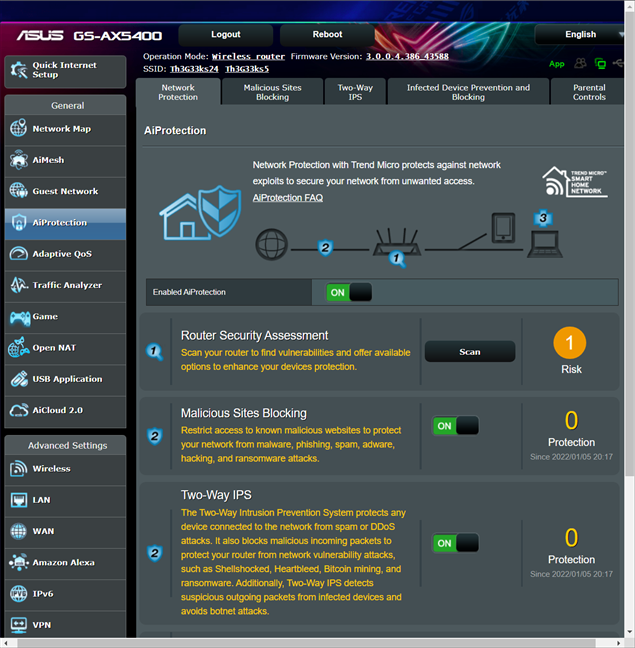
 The security tools are found in the AiProtection module
There are also many useful gaming features:
The security tools are found in the AiProtection module
There are also many useful gaming features:

 There are many gaming features on the ASUS GS-AX5400
The list of advanced features doesn’t stop here. You also get:
There are many gaming features on the ASUS GS-AX5400
The list of advanced features doesn’t stop here. You also get:
ASUS GS-AX5400: Who is it good for?
This wireless router is a suitable choice for:- People who want to migrate to Wi-Fi 6
- Gamers who play online
- Parents who are in need of efficient parental controls for their home network
- Users who want a secure network with proper antivirus and firewall protection
- People who want to control their router remotely using a mobile app
- Users who wish to control their home network using Amazon’s Alexa or Google’s Assistant
- People who want task automation services from their wireless router through IFTTT (If This, Then That)
Pros and cons
Here are the things we like about ASUS GS-AX5400:
- 160 MHz channel width on Wi-Fi 6, with WPA3 security
- Solid Wi-Fi performance
- Powerful hardware that can handle many network clients
- Useful features for gamers
- Fast USB 3.2 port
- Link aggregation available
- Excellent security tools and parental controls
- Innovative VPN app that connects your mobile devices to your home network
- You can remotely control it with a mobile app from anywhere on the internet
- Boring design
- There are several AX5400 routers from ASUS with similar prices and features. It’s confusing to tell them apart
Verdict
ASUS GS-AX5400 is an interesting gaming router in a crowded market space. There are many alternatives, including similar models from ASUS, with slightly lower prices. While it is not the cheapest AX5400 Wi-Fi 6 router, it is one of the best in its niche. You get an extensive feature-set, including tools that are useful to gamers, solid Wi-Fi performance and coverage, and excellent security tools. It’s a great choice, especially for gamers.Unboxing the ASUS GS-AX5400 Wi-Fi 6 router
This dual-band Wi-Fi 6 router comes in a cardboard box that uses the Republic of Gamers branding and colors. The information printed on the package presents some of its most interesting gaming-oriented features.Hardware specifications and design
The ASUS GS-AX5400 has a somewhat blocky design, with four external antennas. There’s a reflective Republic of Gamers logo on the top. You may assume that it is RGB-lit, but that is not the case. Only a light band on the bottom can be configured from the firmware to light up any way you want. You can also turn it off if you don’t like it.Setting up and using the ASUS GS-AX5400 Wi-Fi 6 router
The initial setup of this router can be done both using a PC that’s connected to the router or a smartphone and the ASUS Router mobile app for iOS and Android. The process involves detecting the type of internet connection you use, providing the necessary connection details, choosing a name and password for the Wi-Fi, and deciding whether to enable Wi-Fi 6. The router checks for firmware updates at the end of the quick setup guide. It’s a good idea to install the latest firmware, in order to benefit from the latest bug fixes and improvements.Wireless network performance
Let’s look at the apartment used in our testing: the router is placed in the living room. Unfortunately, the signal strength is not good with most wireless routers in the Kitchen and the Medium balcony.Wired network performance
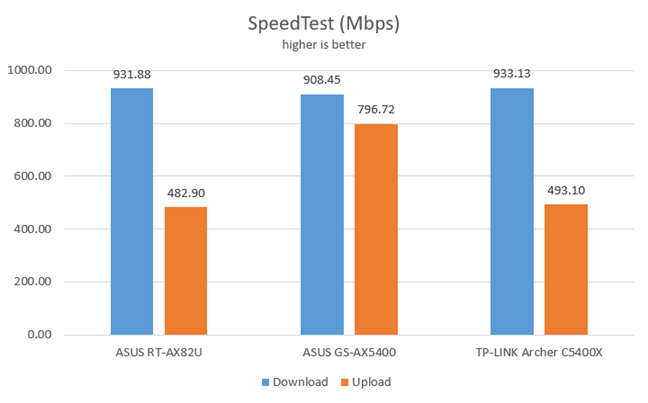
It’s time to evaluate the performance we get on Ethernet network connections. When we reviewed the other routers in this comparison, our internet connection was capped at 1 Gbps for the download speed and 500 Mbps for the upload speed. In the meantime, the cap for the upload speed has increased to 800 Mbps. When using SpeedTest, ASUS GS-AX5400 reached the maximum potential of our internet connection, as you can see below.USB port
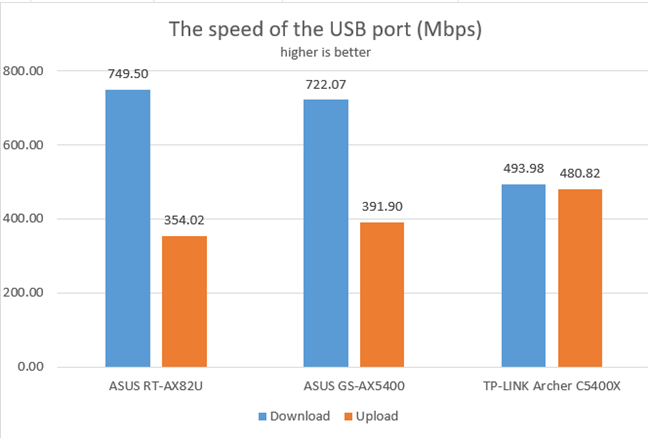
We connected a portable SSD to the USB 3.2 port on the back of the ASUS GS-AX5400 and made some data transfers on it. We measured an average download speed of 722.07 Mbps and an upload speed of 391.90 Mbps. These are excellent speeds that are going to please many users.Extra features
Security and gaming are a big deal on the ASUS ROG Strix GS-AX5400. This router includes the AiProtection module that provides the following security tools:- A Router Security Assessment tool that verifies whether your settings are secure. When it finds problems, it proactively informs you and helps you fix things.
- Malicious Sites Blocking – an efficient cloud-based module that blocks access to malicious websites on all the devices connected to your network.
- Two-Way IPS - is a two-way intrusion prevention system that protects your network from spam, DDoS attacks, network attacks, etc. Additionally, it also scans the packets sent from your network to the internet.
- Infected Device Prevention and Blocking – if your network devices get infected and become zombies in malware networks, they are automatically blocked, and you are informed about this problem.
- Parental Controls – cloud-based parental controls that can be used to set rules about internet access for children’s devices. If you are interested in using them, read How to set up Parental Controls on an ASUS router and How to control your child’s internet time on your ASUS router.
- Game Boost - a set of tools that gamers may appreciate:
- Gear Accelerator - allows you to prioritize your gaming devices (consoles, gaming PCs, etc.).
- Mobile Game Mode - with the help of the ASUS Router app, you can enable a specialized game mode that improves your mobile gaming experience.
- Open NAT - a hassle-free way to create port forwarding rules for online games and optimize the routing packets from your gaming console.
- Gaming port - a special LAN port that automatically prioritizes any wired device connected to it. You don't need to configure it. Instead, connect your gaming PC, PlayStation 5, or Xbox console to the gaming port to put it at the top of the queue in your home network.
- AiMesh - you can use the router to build a mesh Wi-Fi network alongside other ASUS routers for increased Wi-Fi coverage.
- Guest Network – you can enable three wireless guest networks with individual security and access settings on each band (2.4 and 5 GHz).
- Adaptive QoS – an easy-to-use Quality of Service feature that you can use to optimize network traffic, including but not limited to online gaming.
- Traffic Analyzer – visual traffic statistics give you a clear picture of how your network is used and by which devices.
- USB Applications - set up your router to use external hard drives or printers through its USB ports. There’s also support for Apple’s Time Machine functionality from macOS. For more information, here’s How to turn your ASUS router into a NAS.
- AiCloud 2.0 - gives you the tools to create your cloud storage service using a hard drive connected to the router.
- Dual WAN - you can use two internet connections at the same time.
- IPv6 – support for IPv6 addresses that are slowly but surely replacing IPv4.
- VPN – you can set the router to work as a VPN server using the following protocols: PPTP, OpenVPN, and IPSec VPN. You can also use it to turn your network-connected devices into VPN-enabled clients without additional VPN software required.
- Instant Guard - a mobile app that helps you establish a VPN connection to your router when you’re on the go, using insecure public Wi-Fi networks.
- VPN Fusion - another new feature available on select ASUS routers. This one allows you to connect to multiple VPN servers simultaneously and assign your client devices to connect to different VPN tunnels. So, for example, your gaming devices can use a gaming-oriented VPN service for playing online, while your work devices can connect to the company’s VPN, all happening simultaneously.
- Network Tools – for analyzing the network and identifying what’s wrong. They are helpful when you need to troubleshoot problems.
- DDNS – a service that allows you to connect to the router from the internet, even if your internet provider assigns you a dynamic public IP address.
- Integration with Amazon’s Alexa, Google Assistant, and IFTTT – you can say things like “Alexa, ask ASUS ROUTER to upgrade the firmware” to perform different tasks. You can also automate tasks that might be repetitive or for devices unable to “talk to each other”, through IFTTT.


Discussion (0)
Comments are closed.