



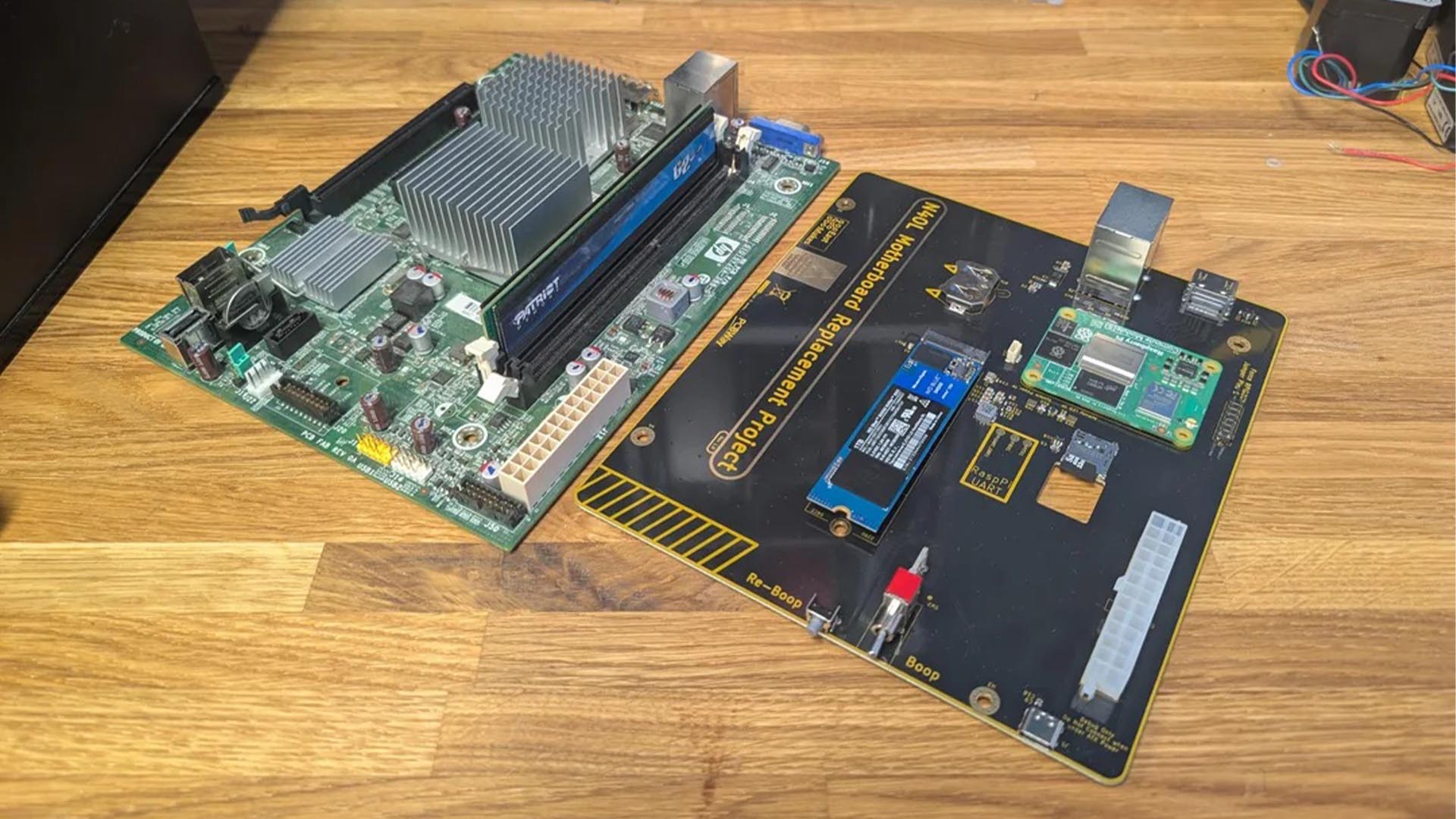
A hardware enthusiast has rebuilt an aging HP ProLiant MicroServer with a custom motherboard designed around the Raspberry Pi Compute Module 5, giving the old server chassis a much more modern internal platform.
The original HP ProLiant MicroServer used an N40L motherboard with an older AMD processor and DDR3 memory. Rather than discard the system, the owner created a replacement board that preserves the chassis while adding newer compute, storage, networking, and connectivity options.
An M.2 PCIe NVMe SSD is also part of the upgrade, helping improve storage performance compared with the hardware the server originally shipped with.
| Component | Custom upgrade |
|---|---|
| Original system | HP ProLiant MicroServer |
| Original motherboard | N40L |
| Original platform | Older AMD CPU with DDR3 |
| New compute module | Raspberry Pi CM5 |
| Storage | M.2 PCIe NVMe SSD |
| Networking | Ethernet |
| Other connectivity | USB |
| Power connection | 24 pin connector |
| Board type | Custom motherboard |
Custom Board Replaces the Original N40L Platform
The original N40L hardware is now relatively limited for modern home server workloads.
Its AMD processor and DDR3 memory can become bottlenecks when running newer applications, services, or multiple workloads at the same time.
The replacement design uses the Raspberry Pi Compute Module 5 as the main computing platform.
A Compute Module combines important system components such as the processor, memory, and supporting hardware into a compact module that can be installed on a custom carrier board.
That makes it suitable for projects where the designer wants Raspberry Pi hardware but needs a different layout or port arrangement from a normal Raspberry Pi board.
NVMe Storage Brings a Major Speed Upgrade
The custom board includes support for an M.2 PCIe NVMe SSD.
That is a significant change from the storage options associated with much older server platforms.
NVMe drives can offer much higher transfer speeds and lower latency than older mechanical hard drives or SATA based storage.
For a home server, that can improve tasks such as application loading, database access, system updates, container workloads, and file operations.
The project still retains the server chassis, so the owner can continue using the physical design and drive infrastructure while modernizing the parts that affect performance most.
Existing Power Supply Can Still Be Used
One of the more practical parts of the project is the effort to maintain compatibility with the original server.
The custom motherboard includes a white 24 pin power connector designed to work with the existing power supply.
That avoids the need to replace or heavily modify another major component inside the chassis.
Ethernet and USB ports are also positioned to line up with the existing openings in the HP case.
This kind of alignment is important in a custom board because even a powerful replacement would be much less useful if it required cutting large sections of the chassis or abandoning the original rear I/O layout.
Raspberry Pi CM5 Changes the Scale of the Hardware
The project also demonstrates how much computing hardware has shrunk.
The original HP motherboard needed a conventional server board layout with separate processor, memory, and supporting components.
The CM5 places much of that functionality onto a much smaller module.
That saves internal space and gives the custom board designer more freedom when arranging storage, ports, power delivery, and other components.
The smaller design does not automatically make the system suitable for every server workload, but it can be a good fit for lighter home server tasks where power efficiency and compact hardware matter.
Custom Controls Add a Personal Touch
The creator also added tactile buttons to the front edge of the custom motherboard.
They are labelled "Boop" and "Re Boop," apparently serving as power and reset controls.
These details do not change performance, but they show how a custom board can be tailored to both the chassis and the owner's preferences.
Old Server Chassis Can Still Be Useful
The project is a good example of upgrading selected parts instead of replacing an entire machine.
Older servers may have weak processors and outdated memory, but their cases, drive bays, power supplies, and physical layout can still be useful.
By replacing the mainboard with a modern platform and adding NVMe storage, the owner has extended the useful life of the HP ProLiant MicroServer without starting from a completely new system.
The result is not an official HP upgrade path, but a custom home server project that combines an older chassis with much newer compact computing hardware.

Discussion (0)
Be the first to comment.