




A new Digital Foundry test shows that the standard PlayStation 5 can run path traced games in some form, but only with heavy compromises. The most demanding example was Cyberpunk 2077, which managed playable frame rates with RT Overdrive enabled only after dropping the internal resolution extremely low and using performance focused upscaling.
The test became possible because of a new Linux loader that allows older, non updated PlayStation 5 consoles to be used more like a PC. Digital Foundry used that setup to test Quake II RTX, Portal with RTX, and Cyberpunk 2077, which represent different levels of path tracing difficulty. Quake II RTX is an older game rebuilt around path tracing, Portal with RTX is more advanced through RTX Remix, and Cyberpunk 2077’s RT Overdrive mode remains one of the toughest path tracing workloads available.
The results show path tracing is possible on PS5, but image quality takes the biggest hit
Quake II RTX produced the best result. At native 4K, the PS5 struggled and reached only around 10 FPS. When using TAAU to output 4K from 1080p, performance improved to around 40 FPS. With dynamic resolution scaling, the game could reach 60 FPS, though the lower end of the resolution range dropped to 540p. Digital Foundry suggested the result still looked credible enough that a similar path traced release could work on PS5 or Xbox Series X and S if the game was built carefully around those limits.
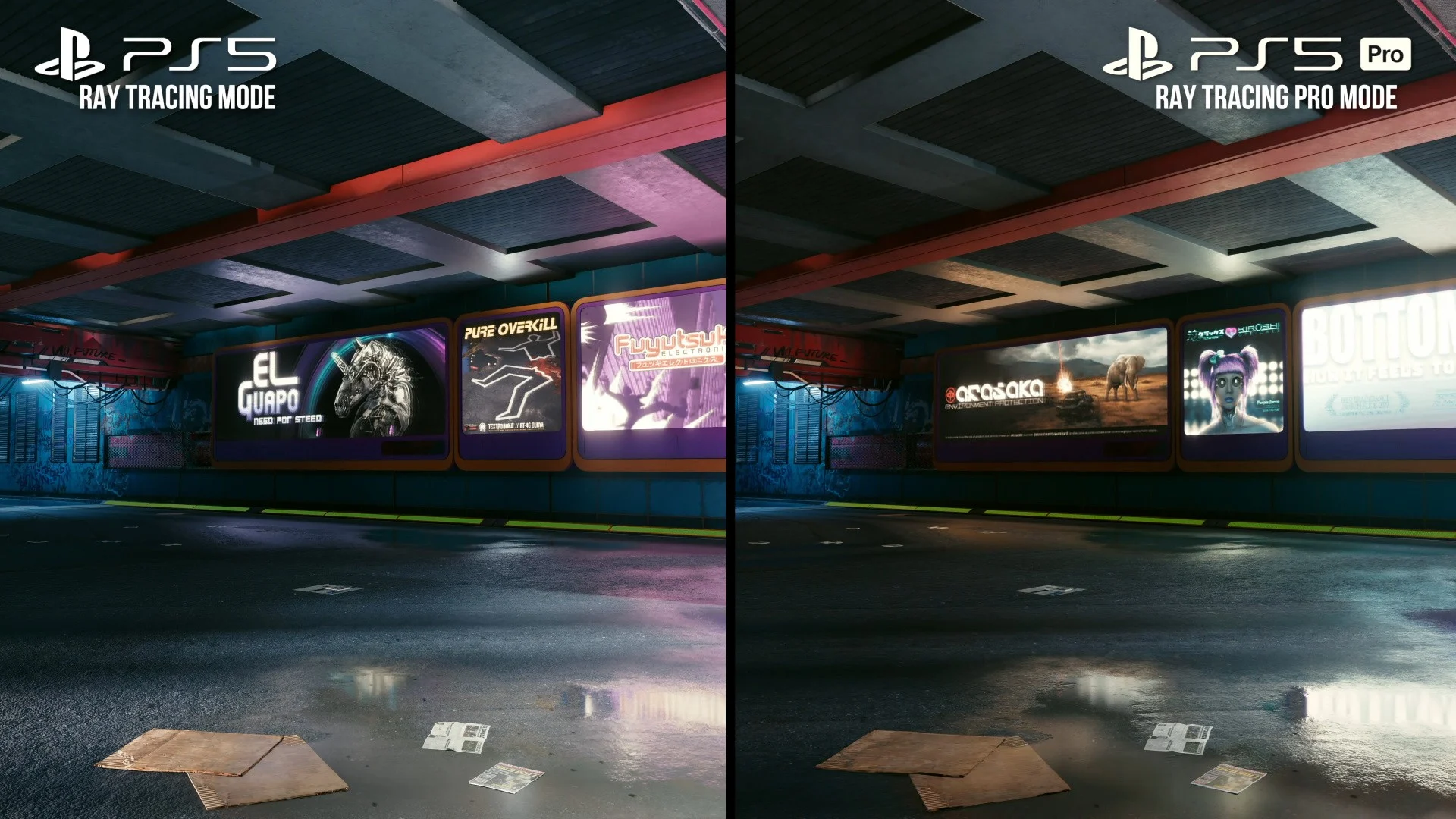
Portal with RTX was less convincing. At 1080p output with TAAU from an internal 540p resolution, it barely reached 30 FPS. The result was technically playable, but poor denoising and weak image quality made it feel more like an experiment than a realistic way to play the game.
Cyberpunk 2077 required the harshest cuts. At 1080p with XeSS Performance mode, the game’s benchmark averaged 22.6 FPS in RT Overdrive. Lowering the output to 1920 x 800 pushed the internal resolution to just 348p, raising the result to 26.9 FPS. With the PT Optimized mod, which reduces ray bounces from two to one, the average increased to 35.5 FPS.
| Game | Best result in the test | Main compromise |
|---|---|---|
| Quake II RTX | Up to 60 FPS with DRS | Resolution could drop to 540p |
| Portal with RTX | Around 30 FPS | Internal 540p and poor image quality |
| Cyberpunk 2077 | Around 35.5 FPS with PT Optimized mod | Internal resolution around 348p |
Frame generation through AMD FSR 3.1 pushed Cyberpunk 2077’s benchmark readout to around 70 FPS, but the generated frames reportedly did not look correct. The game was running, but the final image quality and frame pacing were not strong enough to make it feel like a proper console mode.
The test still matters because it shows that path tracing is not completely out of reach for console hardware. The standard PS5 was not built for this kind of workload, yet it could run these games with enough scaling and tuning. The result also suggests that PlayStation 5 Pro, with stronger ray tracing hardware and PSSR, could have handled a more realistic experimental 30 FPS path tracing mode. Looking further ahead, PlayStation 6 is likely to make path tracing more practical, though developers will still need to balance performance, image quality, and any handheld support requirements.


Discussion (0)
Be the first to comment.