



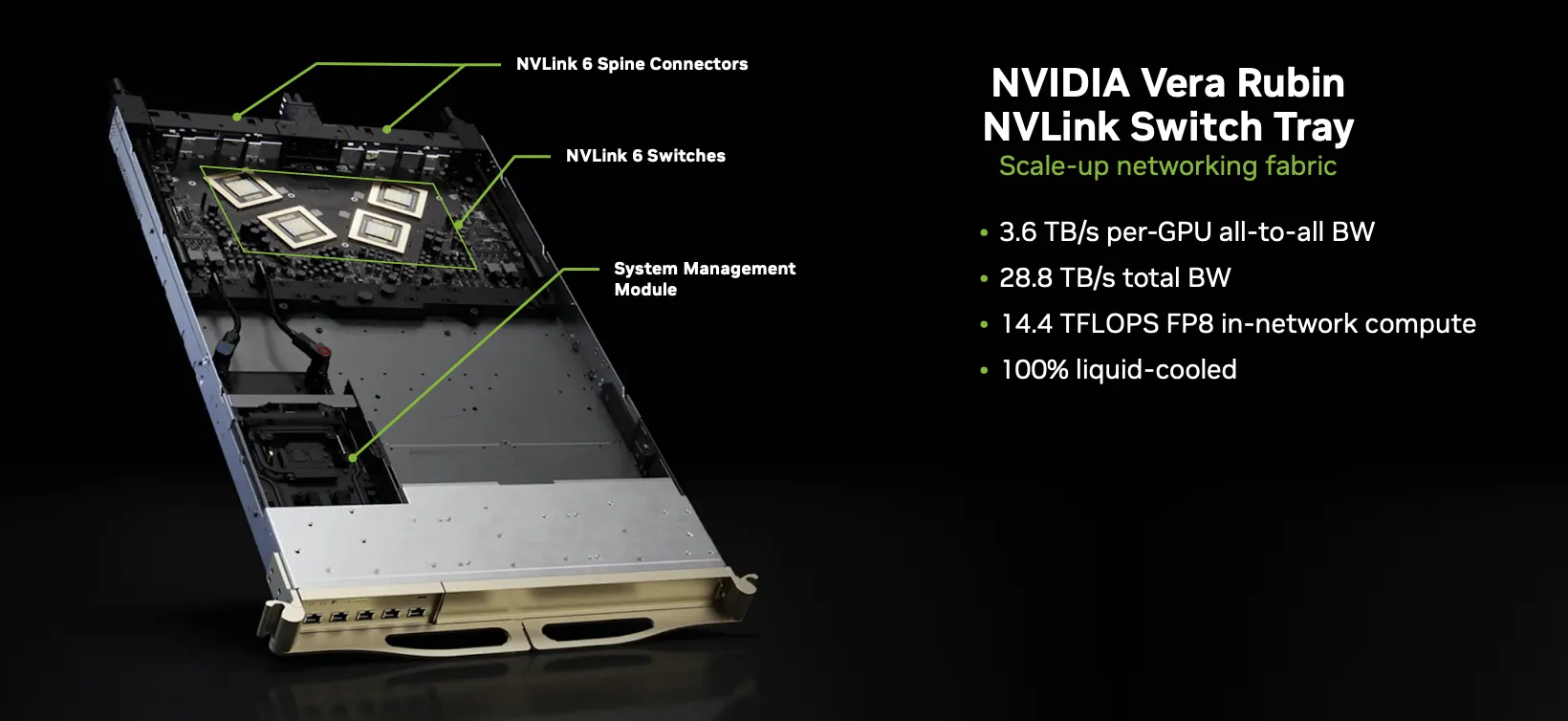
NVIDIA’s Vera Rubin NVL72 AI platform is now reaching major cloud providers for validation, with CoreWeave and Oracle among the first companies to bring up the new rack scale system. The platform pairs 72 Rubin GPUs with 36 Vera CPUs in a massive AI rack designed for next generation training and inference workloads.
The rollout marks the next stage after Grace Blackwell, which has already become a major part of NVIDIA’s AI data center business. Vera Rubin is meant to push that performance further, especially for agentic AI, mixture of experts training, and lower cost inference at scale.
The systems are not simply graphics cards placed into servers. They are full AI infrastructure platforms that depend on power delivery, liquid cooling, high speed networking, rack control software, and NVIDIA’s CUDA based software stack. That is why early validation by cloud providers matters before wider deployment begins.
CoreWeave and Oracle are among the first to test Vera Rubin NVL72
Oracle Cloud Infrastructure and CoreWeave have both shown early Vera Rubin NVL72 systems being brought up for testing. These deployments are part of the validation process before the platform becomes broadly operational in cloud data centers.
The scale of each NVL72 rack is significant. A single rack includes 72 Rubin GPUs and 36 Vera CPUs, making it a complete accelerated computing system rather than a standard server cabinet.
| Platform detail | NVIDIA Vera Rubin NVL72 |
|---|---|
| GPUs | 72 Rubin GPUs |
| CPUs | 36 Vera CPUs |
| Target use | AI training and inference |
| Early cloud providers | CoreWeave and Oracle |
| Main focus | Agentic AI and next generation cloud AI workloads |
| Infrastructure needs | Power, cooling, networking, rack control, software stack |
| Production status | Volume production underway |
CoreWeave has also highlighted its supporting infrastructure, including software defined liquid cooling and unified rack control. That shows how modern AI systems depend on more than the chip itself.
Vera Rubin is designed to move beyond Blackwell
NVIDIA’s Blackwell platform is already setting records in AI benchmarks, but the company is moving quickly to the next generation. Vera Rubin is positioned as the follow up that gives cloud providers more performance and better efficiency for large scale AI.
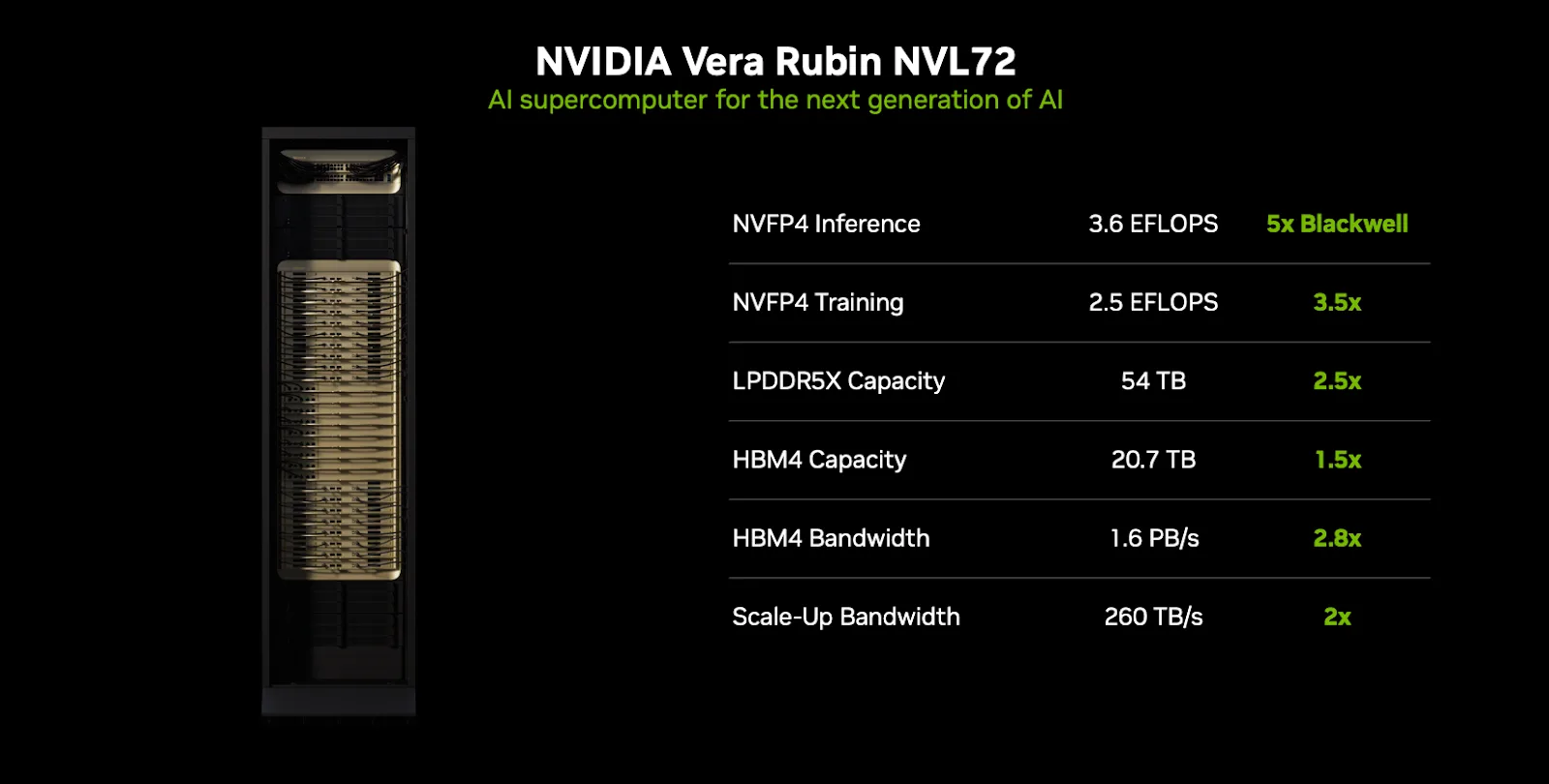
According to the report, Vera Rubin can deliver mixture of experts training speed using only one fourth of the GPUs compared with Blackwell, while inference can reach one tenth of the cost per token. Those numbers will need to be proven in real customer workloads, but they explain why major cloud providers are already validating the hardware.
For companies building AI services, cost per token is becoming one of the most important metrics. Better inference economics can make AI tools cheaper to run, easier to scale, and more profitable.
The rack shows how AI hardware is becoming full infrastructure
The Vera Rubin NVL72 rack also shows where data center hardware is heading. AI platforms are now built as complete systems, not individual components.
A single rack needs heavy power delivery, advanced cooling, high bandwidth interconnects, orchestration software, and reliability tools. Moving one of these systems into a facility is closer to installing industrial infrastructure than adding a normal server.
That is why cloud providers such as Oracle and CoreWeave are important early partners. They have to prove that the full stack works in real data center conditions before customers can rely on it for large AI workloads.
NVIDIA’s software stack remains a major advantage
NVIDIA’s hardware is only one part of the platform. The company’s CUDA and CUDA X software ecosystem remains one of its strongest advantages in AI.
Developers, researchers, and cloud providers already build around NVIDIA’s tools. That makes each new generation easier to adopt because customers are not starting from scratch. Vera Rubin can enter a market where NVIDIA already has deep software support and strong cloud relationships.
This is difficult for competitors to copy quickly. Even if rival chips improve, they still need a mature software ecosystem, developer trust, cloud availability, and optimized libraries.
Vera Rubin could shape the next wave of AI data centers
The first Vera Rubin NVL72 systems arriving at major cloud providers suggests NVIDIA is moving fast toward its next AI platform cycle. If validation goes well, the first operational deployments are expected to begin in the coming months.
For cloud customers, the impact may show up as faster model training, lower inference costs, and new AI services built around more capable infrastructure. For NVIDIA, Vera Rubin is the next test of whether it can keep its lead after Blackwell.
The platform also reinforces a broader shift in the data center market. AI hardware is no longer just about faster chips. It is about full rack systems, cooling, networking, memory, software, and supply chain execution.
CoreWeave and Oracle getting early Vera Rubin NVL72 systems is a sign that the next phase of AI infrastructure is already moving from roadmap slides into real data centers.



Discussion (0)
Be the first to comment.