



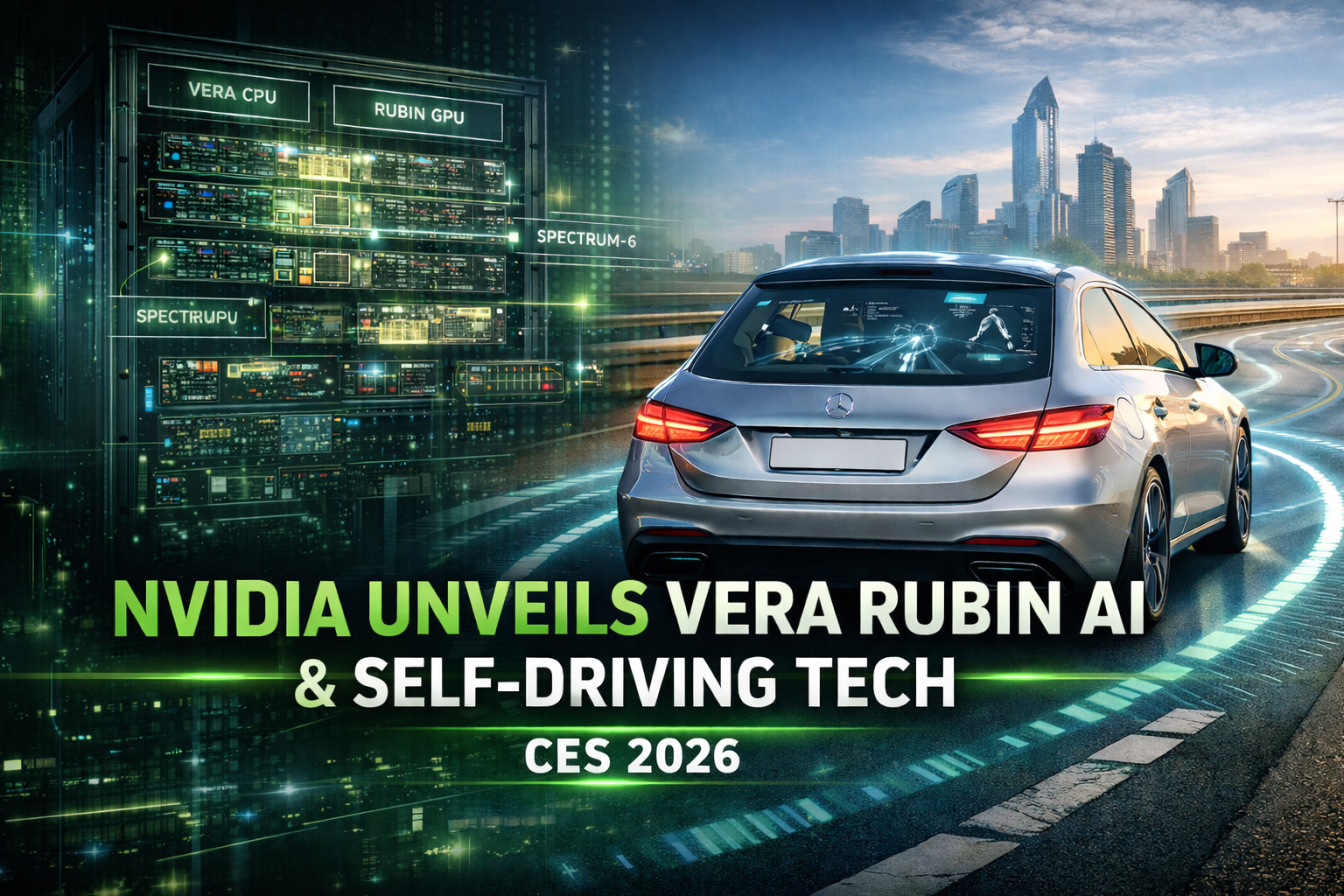
Nvidia used CES 2026 to reset expectations for artificial intelligence, introducing the Vera Rubin AI architecture alongside new reasoning-based technology for self-driving cars. CEO Jensen Huang framed the announcements as the next step toward large-scale, real-world AI systems that can think, plan, and act.
Vera Rubin marks Nvidia’s next AI platform shift
Vera Rubin replaces Blackwell as Nvidia’s flagship AI architecture and moves decisively toward rack-scale AI computing. Instead of focusing on individual chips, Nvidia designed Rubin as a tightly integrated system that treats an entire rack as a single AI supercomputer.
The platform combines a new Vera CPU, Rubin GPU, NVLink 6, ConnectX-9 SuperNIC, BlueField-4 DPU, and Spectrum-6 Ethernet into one coordinated stack. Nvidia says this co-design approach delivers up to 5× faster inference and 3.5× faster training compared to Blackwell-based systems, while significantly improving efficiency for large reasoning and agentic AI models.
Nvidia confirmed that Vera Rubin systems are already in production, with partner deployments expected to begin in the second half of 2026.
Built for reasoning, agents, and massive scale
Rubin targets workloads that push beyond traditional model training. Nvidia optimized the platform for mixture-of-experts models, AI agents, and long-running reasoning tasks that require extreme memory bandwidth and low-latency interconnects.
According to Nvidia, this architecture reduces the cost of training and inference by aligning hardware, networking, and software from the start. The company positions Rubin as the foundation for future AI data centers, robotics platforms, and physical-world AI systems.
New self-driving AI focuses on reasoning, not reactions
Alongside Rubin, Nvidia introduced Alpamayo, a new AI model designed specifically for autonomous driving. Unlike traditional perception-first systems, Alpamayo emphasizes reasoning and decision-making, allowing vehicles to anticipate hazards and plan multi-step actions.
During CES demonstrations, Nvidia showed vehicles navigating complex real-world scenarios using the new system. The company described Alpamayo as a major step toward human-like driving intelligence, capable of understanding intent, predicting outcomes, and adapting to unpredictable conditions.
Nvidia sees this technology as a core building block for future autonomous vehicles, robotics, and other forms of physical AI.
Expanding beyond data centers
The CES 2026 announcements underline Nvidia’s broader strategy shift. The company now targets not only cloud and enterprise AI, but also cars, robots, and edge devices that operate in the physical world.
By pairing the Vera Rubin platform with reasoning-based AI models, Nvidia aims to accelerate adoption across industries that demand real-time decision-making at massive scale.
What happens next
Vera Rubin systems will begin reaching partners later this year, while Nvidia continues refining its autonomous driving stack with industry collaborators. The company expects both platforms to play a central role in AI development throughout 2026 and beyond.
With Rubin and Alpamayo, Nvidia made one thing clear at CES: the next phase of AI centers on systems that reason, act, and scale together.


Discussion (0)
Be the first to comment.