



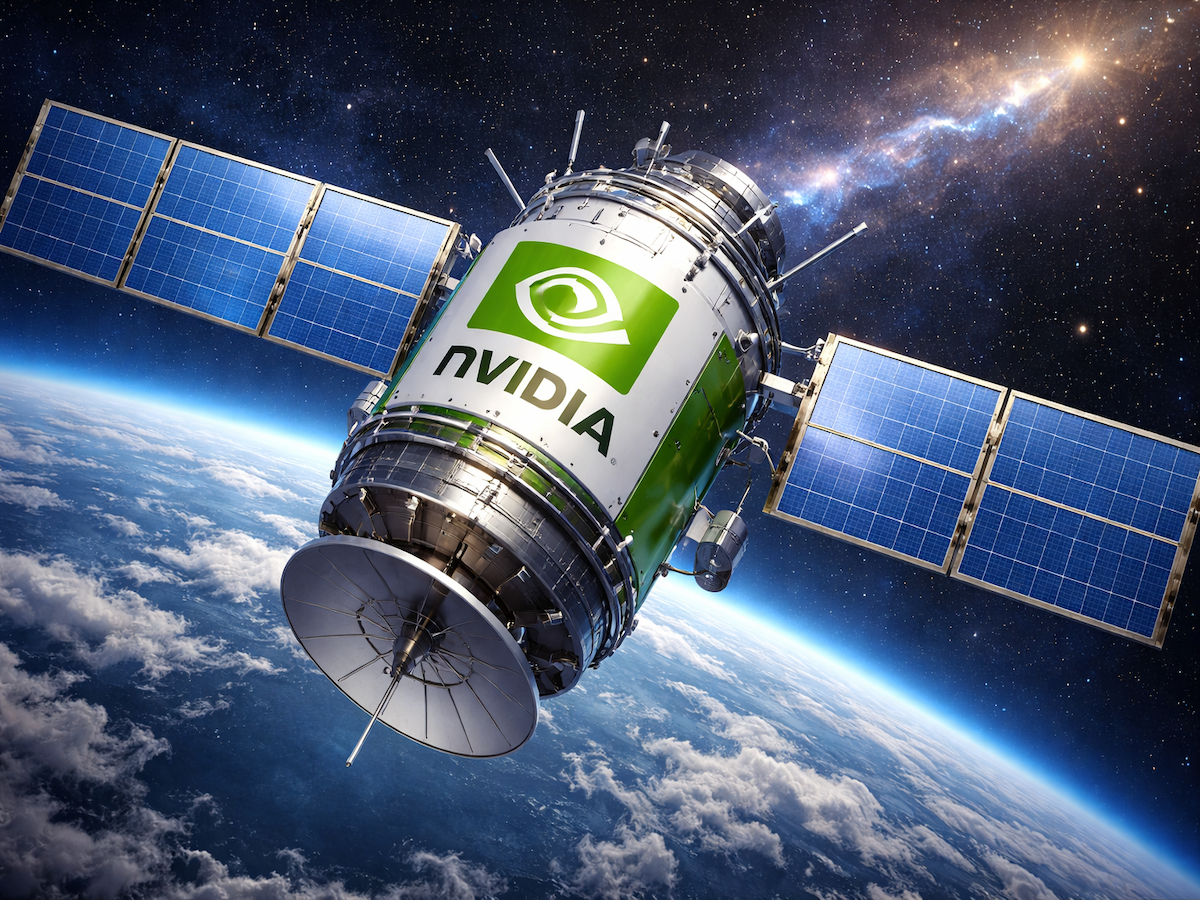
NVIDIA is looking beyond Earth for the next stage of AI infrastructure.
The company is reportedly working with several partners on space based AI data center ideas, as power, cooling, land, and water become bigger problems for large AI facilities on Earth.
Modern AI data centers already cost billions of dollars to build. They also need huge amounts of electricity and cooling. In some regions, that has created backlash from communities worried about rising power bills, water usage, and environmental pressure.
The argument for space is simple. Solar power is easier to collect continuously in orbit, and the vacuum of space could help with cooling. That does not make orbital data centers easy or cheap, but it gives companies a reason to study them as AI demand keeps growing.
NVIDIA is reportedly working with Starcloud, Planet Labs, Kepler Communications, Firefly Aerospace, and Sophia Space. Starcloud, which is part of NVIDIA’s Inception startup program, has proposed a massive 5 gigawatt orbital data center spanning 4 square kilometers. The idea would use large solar arrays for power and space itself as part of the cooling strategy.
NVIDIA has also introduced a space focused AI module called Space 1 Vera Rubin. It is based on the company’s Vera Rubin architecture and is designed for data center class AI workloads in orbit.
| Area | Details |
|---|---|
| Main idea | AI data centers in orbit |
| NVIDIA partners | Starcloud, Planet Labs, Kepler Communications, Firefly Aerospace, Sophia Space |
| Starcloud proposal | 5 gigawatt orbital data center |
| Claimed advantage | Lower energy cost and better cooling potential |
| NVIDIA hardware | Space 1 Vera Rubin module |
| Target uses | Geospatial intelligence, autonomous systems, on orbit analytics |
The Space 1 Vera Rubin module is described as a tightly integrated CPU and GPU design powered by solar energy. It is meant for satellites and space vehicles that need high performance AI inference away from Earth.
NVIDIA says the module can deliver up to 25 times the AI compute capability of the H100 for orbital workloads. It is aimed at real time AI processing for tasks such as geospatial intelligence, autonomous operations, and on orbit analytics.
The company is not alone. Elon Musk’s SpaceXAI is also reportedly working with Anthropic on a multi gigawatt orbital AI data center concept. The basic motivation is similar: moving compute off Earth could reduce pressure on land, power grids, and cooling infrastructure.

The idea still has serious challenges.
Launching thousands or hundreds of thousands of GPUs into orbit would be extremely difficult and expensive. Hardware would need to survive radiation, thermal cycling, maintenance limits, and launch stress. Networking would also be a major issue, because AI data centers need massive data movement, not just raw compute.
There is also the question of repairs. A broken server on Earth can be replaced by a technician. A broken orbital data center needs robotics, modular servicing, or very expensive missions.
Still, the fact that companies are exploring this shows how large the AI infrastructure problem has become. If AI demand keeps rising at the current pace, the limits may not only be chip supply. They may be electricity, cooling, land, water, and physical space.
Orbital AI data centers are not around the corner for everyday computing, but they are no longer pure science fiction either. NVIDIA and its partners are clearly treating space as one possible path for scaling AI when Earth based infrastructure becomes too constrained.



Discussion (0)
Be the first to comment.