



Intel may be preparing a much bigger return to on-package memory with Razor Lake-AX, a future high end mobile chip aimed at competing with AMD’s Halo class APUs.
According to a new rumor, Razor Lake-AX will place memory on the same package as the processor. Intel last used this approach with Lunar Lake, where LPDDR5X memory was placed close to the chip to improve efficiency and reduce motherboard space.
Razor Lake-AX would be a different kind of product. Instead of targeting thin and light low power laptops, it is expected to go after premium mobile systems with stronger CPU and GPU performance.
The memory type has not been confirmed, but LPDDR6 looks likely if the chip launches around 2028. That would make sense because Razor Lake-AX is expected to include a large integrated GPU, and that kind of design needs a lot of memory bandwidth. Intel could also use its own Z-Angle Memory technology if it wants to show off a newer memory approach.
The main advantage is simple: moving memory closer to the chip can improve efficiency, reduce latency, save space, and help compact PCs deliver higher performance without needing a traditional discrete GPU setup.
Here is the rumored picture:
| Chip | Intel Razor Lake-AX |
|---|---|
| Target platform | High end laptops and mobile PCs |
| Memory | On-package memory |
| Possible memory type | LPDDR6 or Intel Z-Angle Memory |
| Expected timing | Around 2028 |
| CPU cores | Griffin Cove P cores and Golden Eagle E cores |
| GPU | Refined Xe3P Celestial or future Xe4 Druid |
| Main rival | AMD Medusa Halo |
| Product type | Large SoC with strong CPU, GPU, cache, and controllers |
Razor Lake itself is expected to be an optimized follow up to Nova Lake. Standard Razor Lake chips should arrive for desktop and mobile platforms around 2027 and may keep compatibility with Nova Lake platforms. Razor Lake-AX, however, appears to be a separate higher end design that will need different systems because of its larger SoC layout and on-package memory.
The real target is AMD’s Halo strategy. AMD’s Strix Halo already sits at the top of its AI PC APU lineup, combining strong CPU performance with a large integrated GPU. Gorgon Halo is expected as a refresh, while Medusa Halo is expected around 2027 to 2028.
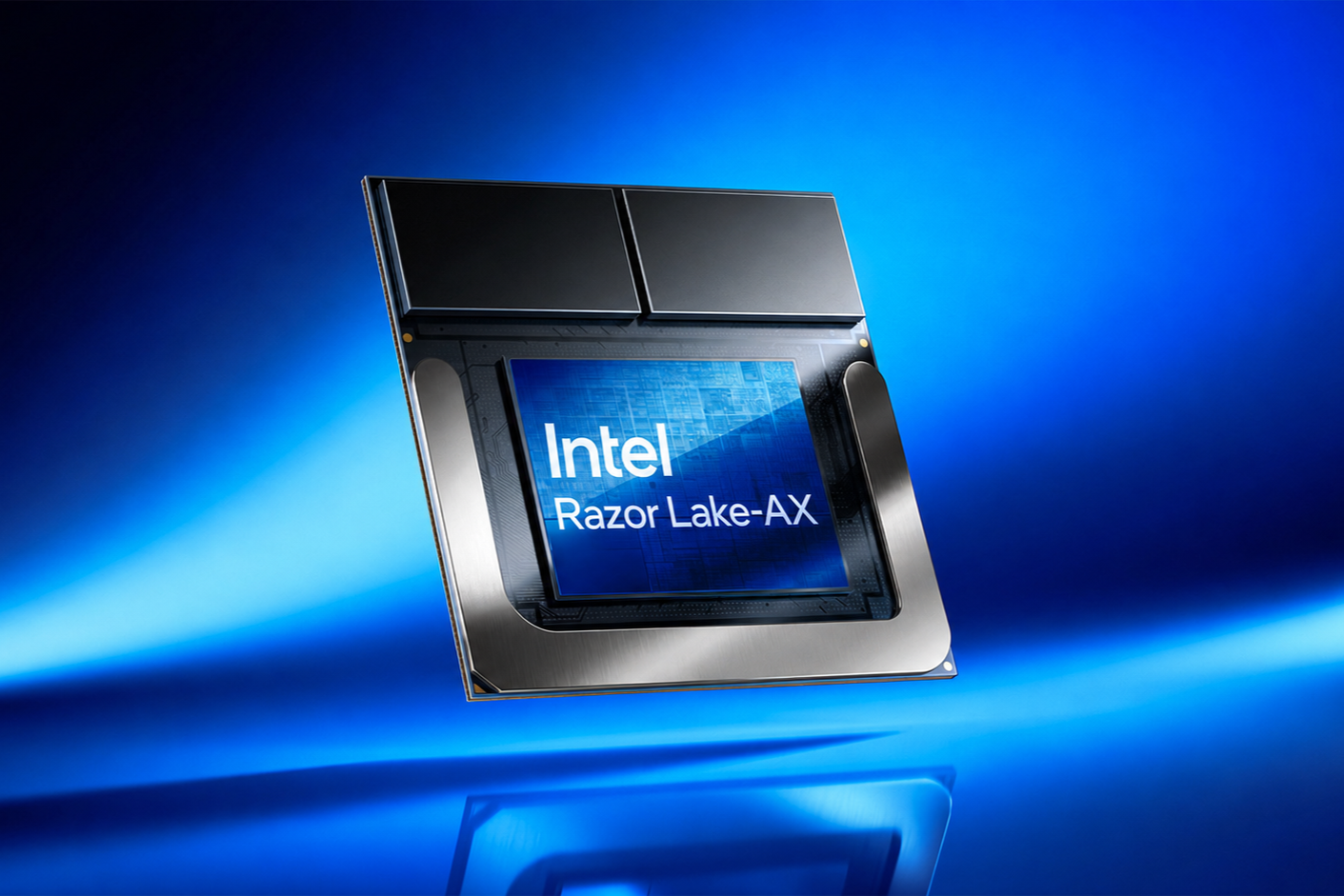
That gives Intel a clear reason to build Razor Lake-AX. Premium laptops are moving toward powerful integrated graphics, AI engines, and compact high bandwidth memory designs. These chips can offer strong creator, gaming, and AI performance without requiring a full discrete GPU in every system.
Razor Lake-AX could also arrive around the same time as Intel’s custom Serpent Lake SoCs, which are expected to combine Intel x86 CPU cores with NVIDIA RTX graphics. That would give Intel two different routes into high end mobile performance: one with its own large integrated GPU, and another with NVIDIA graphics technology.
There are still many unknowns. Intel has not confirmed Razor Lake-AX, its memory configuration, its GPU architecture, or its launch window. The 2028 timing also means plans could change.
Still, the idea makes sense. AMD is pushing hard with high performance APUs, Apple has shown how effective unified memory can be in laptops, and memory bandwidth is becoming more important for AI and graphics workloads.
If the rumor is accurate, Razor Lake-AX could be one of Intel’s most important mobile chips of the next few years. It would show Intel trying to compete not only with traditional CPUs, but with full platform designs built around CPU, GPU, memory, AI, and efficiency together.

Discussion (0)
Be the first to comment.