



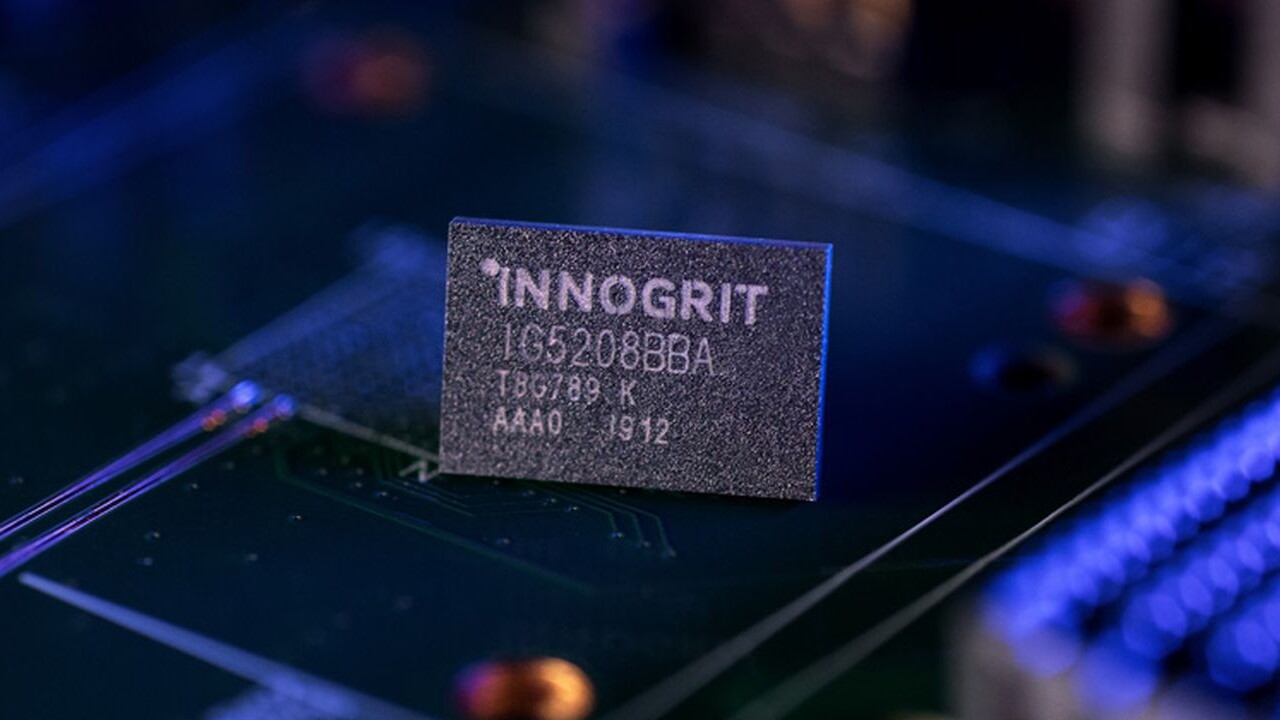
InnoGrit has revealed its first PCIe 6 SSD controller, showing how quickly enterprise storage is moving toward faster speeds, larger capacities, and AI focused workloads. The new controller, called Crestone IG5686, is designed for data centers, enterprise systems, and AI infrastructure rather than consumer PCs.
The IG5686 supports PCIe Gen6 x4 and NVMe 2.3, with advertised read speeds of up to 28GB per second and write speeds of up to 22GB per second. It also supports SSD capacities of up to 256TB, making it suitable for large scale storage environments where AI models, training data, inference systems, and cloud workloads need fast access to massive datasets.
Random performance is also a major part of the design. InnoGrit says the controller can deliver up to 7 million random read IOPS and 5 million random write IOPS. That kind of performance is aimed at servers where many requests happen at the same time, rather than normal desktop use.
PCIe 6 storage is being built for AI before it reaches gaming PCs
The controller supports SLC, MLC, TLC, QLC NAND, and SCM storage media. It also supports NAND speeds of up to 4800 MT/s. In practice, that gives SSD makers flexibility to build different products around the same controller, from high endurance enterprise drives to very large capacity models.
| Feature | InnoGrit IG5686 |
|---|---|
| Interface | PCIe Gen6 x4 |
| Protocol | NVMe 2.3 |
| Maximum capacity | Up to 256TB |
| Sequential read speed | Up to 28GB per second |
| Sequential write speed | Up to 22GB per second |
| Random read performance | Up to 7 million IOPS |
| Random write performance | Up to 5 million IOPS |
| Supported storage | SLC, MLC, TLC, QLC NAND and SCM |
| Main target | Enterprise, AI, and data center systems |
The first SSDs using the IG5686 are expected to focus on E1.S and E3.S form factors. These are common in modern servers because they offer better density, cooling, and serviceability than consumer M.2 drives. With capacities reaching up to 256TB, these drives could help data centers pack more storage into fewer systems.
InnoGrit also showed its Cascade IG5676 controller, which supports CXL 3.1 Type 3 devices. This controller is designed for lower latency storage and memory expansion use cases, with support for XL Flash as storage class memory. It supports up to 2TB of capacity and is being positioned as a more cost effective solution.
CXL support is important because the future of data center storage is not only about faster SSDs. Servers increasingly need memory like storage that can sit closer to CPUs, GPUs, and accelerators. CXL can help systems share memory and storage resources more efficiently, especially in AI clusters.
InnoGrit’s roadmap is even more aggressive. For 2027, the company is targeting 25 million to 50 million IOPS through deeper PCIe 6 and CXL integration. By 2028, it wants to reach up to 100 million IOPS with PCIe 7 and CXL based products.
Those numbers show where enterprise storage is heading. AI workloads are creating demand for storage systems that can feed data to accelerators without becoming a bottleneck. Large language models, long context processing, inference clusters, and AI native databases all need faster movement of data between storage, memory, and compute.
For normal PC buyers, this does not mean PCIe 6 SSDs are arriving soon. Consumer PCIe 5 SSDs are still relatively new, expensive, and already fast enough for most real world tasks. Gaming and desktop workloads rarely benefit from the kind of performance PCIe 6 promises today.
PCIe 6 SSDs will likely stay in enterprise and AI systems first. Client platforms may not see mainstream PCIe 6 SSD support until closer to the end of the decade. Even then, the question will be whether the extra speed makes games load faster or everyday systems feel more responsive.
Still, InnoGrit’s announcement matters because it shows that Chinese controller makers are preparing to compete in the next generation of storage. Samsung, Micron, Phison, and other major players are already working on PCIe 6 solutions, and InnoGrit wants a place in that race.
The IG5686 is not a consumer product, but it gives a clear preview of the future. SSDs are becoming larger, faster, and more closely tied to AI infrastructure. PCIe 6 and CXL will not only raise benchmark numbers. They will help define how data centers store, move, and process the huge datasets behind the next wave of AI systems.
Discussion (0)
Be the first to comment.