



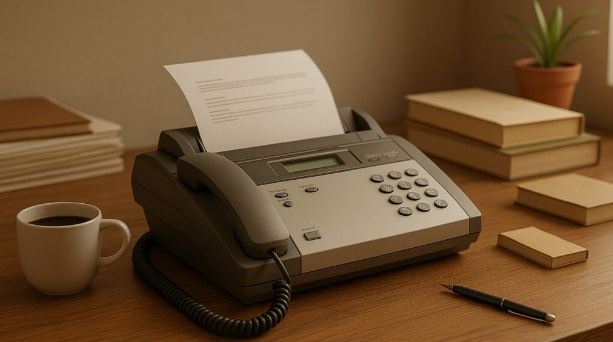
Faxing still matters in 2026. Legal documents, medical records, financial paperwork, and government forms often require a fax number rather than an email address. The good news is that you do not need a fax machine, a phone line, or any specialist hardware to send one. Your Windows PC and an internet connection are everything you need.
This guide covers three methods: a completely free online fax service, Windows' own built-in fax tool, and what to do when you need to send faxes regularly.
Why Faxing Still Exists
Before choosing a method, it helps to understand why faxing persists despite email being far more convenient for most communication.
Fax transmissions are considered legally binding in contexts where email is not. Many courts, healthcare providers, financial institutions, and government agencies require faxed signatures and documentation precisely because fax creates a verifiable transmission record that is harder to tamper with than an email attachment. The confirmation report a fax generates is a record that something was sent and received at a specific time. For sensitive industries, the phone-line-based nature of traditional faxing also provides a degree of security that internet communication cannot fully replicate.
Method 1: Use a Free Online Fax Service (Easiest)
This is the right starting point for most people. It requires no software installation, no phone line, and no fax modem. All you need is a browser, the document you want to send, and the recipient's fax number.
Several online fax services offer a limited number of free faxes per month. iFax, Fax.Plus, and HelloFax are well-established options. The process is identical across all of them.
Step 1: Create a Free Account
Go to the website of your chosen service. Create a free account using your email address. Most services allow five to ten pages of outgoing faxes per month on a free plan before requiring an upgrade.
Step 2: Prepare Your Document
The document you want to fax should be in a standard format. PDF is the most widely supported and produces the cleanest results. Word documents, JPG images, and PNG files are accepted by most services. If your document exists only on paper, scan it first using a scanner or a phone scanning app to create a digital file.
Step 3: Upload the Document and Enter the Fax Number
In the online fax service's send interface, upload your document using the upload button. Enter the recipient's fax number in the designated field. Include the full number with country code if sending internationally. Most services show the format they require.
Step 4: Add a Cover Page if Needed
Many fax recipients and industries expect a cover page that identifies the sender, recipient, subject, and number of pages. Most online fax services generate this automatically. Fill in the fields provided or skip the cover page if it is not required for your situation.
Step 5: Send and Confirm
Click Send. The service converts your document into a fax transmission and sends it over its own infrastructure to the recipient's fax machine or fax number. Most services send a confirmation email within a few minutes confirming whether the fax was delivered successfully.
The confirmation is important. Save or print it if the fax is for legal, medical, or financial purposes. It serves as your proof of transmission.
Method 2: Windows Fax and Scan (Built-In Tool)
Windows includes a built-in faxing application called Windows Fax and Scan. It has been part of Windows since Vista and is available in Windows 10 and Windows 11. The trade-off is that it requires a fax modem connected to a physical phone line to send faxes. If you have a fax modem, this is a capable and free option that keeps your transmissions off third-party servers.
Step 1: Install Windows Fax and Scan
On Windows 11, press Windows and I to open Settings. Go to Apps, then Optional Features. Click View Features and search for Windows Fax and Scan. Select it and click Next, then Install. Restart the PC if prompted.
On Windows 10, go to Settings, then Apps, then Optional Features. Click Add a Feature and search for Windows Fax and Scan. Install it.
Step 2: Connect Your Fax Modem
Plug your USB fax modem into the computer and connect it to an active phone line using a standard telephone cable. Install any drivers that came with the modem or let Windows install them automatically.
Step 3: Configure the Fax Account
Open Windows Fax and Scan from the Start menu. Click Tools in the menu bar, then Fax Settings. Follow the setup wizard to configure your fax modem. Enter your name, company name, and fax number in the appropriate fields. This information appears on the cover pages of outgoing faxes.
Step 4: Send a Fax
Click New Fax in the top left corner of Windows Fax and Scan. A new fax composition window opens. In the To field, type the recipient's fax number. Add a subject and any cover page notes in the fields provided.
To attach your document, click Insert in the menu bar and select Pages from Scanner or File. Choose File to attach a digital document. PDF and image files are supported.
Step 5: Send and Check the Sent Folder
Click Send. Windows Fax and Scan transmits the fax through the connected modem and phone line. Once sent, the fax appears in the Sent Items folder in the left panel. A transmission report confirms whether it was delivered.
Method 3: Email to Fax for Regular Senders
If you send faxes regularly as part of your job, an email-to-fax service is the most practical long-term approach. These services give you a dedicated fax number and let you send faxes directly from your email client without opening any additional software.
The process works through a simple convention. Instead of entering an email address in the To field when composing an email, you enter the recipient's fax number followed by the service's domain. For example, using a service like eFax, you would address the email to [email protected].
Attach the document you want to fax to the email as you would a normal attachment. Any text in the email body appears as a cover page message. Send the email normally and the service converts it into a fax transmission and delivers it to the recipient's fax machine.
The advantage over standard online fax services is workflow integration. If you are already composing in Outlook or Gmail, there is no additional login or interface to navigate. Services like eFax, MyFax, and Fax.Plus all offer email-to-fax capabilities on their paid plans.
Choosing the Right Method
For a one-off fax to a doctor, a court, or a government office, a free online fax service is the most practical choice. It takes five minutes, requires no hardware, and costs nothing for occasional use.
For businesses or individuals who need a permanent fax number and send faxes weekly, a paid online fax subscription provides the best combination of reliability, delivery confirmation, and workflow integration with email.
For anyone who already has a fax modem and phone line and wants a no-cost solution that keeps transmissions off third-party servers, Windows Fax and Scan covers everything needed without any ongoing expense.
Frequently Asked Questions
Do I need a phone line to fax from my computer?
Only if you use Windows Fax and Scan with a physical fax modem. Online fax services and email-to-fax methods work entirely over your internet connection with no phone line required. For most people in 2026, an online fax service is the more practical option precisely because it eliminates the phone line requirement.
Is online faxing as secure as traditional faxing?
Reputable online fax services use end-to-end encryption for transmissions, which is comparable to or better than the security of traditional phone-line faxing for most purposes. For industries with strict compliance requirements such as healthcare and legal services, look for services that specifically advertise HIPAA compliance or equivalent standards to ensure the service meets the relevant regulatory requirements for your sector.
How do I fax a document that only exists on paper?
Scan the paper document first to create a digital file. Most modern phones have scanning apps that can produce a clean PDF from a photographed document. Microsoft Lens is a free option for both iPhone and Android that produces well-cropped, high-contrast scans suitable for faxing. Alternatively, a flatbed scanner or a printer with a scanning function produces higher quality results.

Discussion (0)
Be the first to comment.