



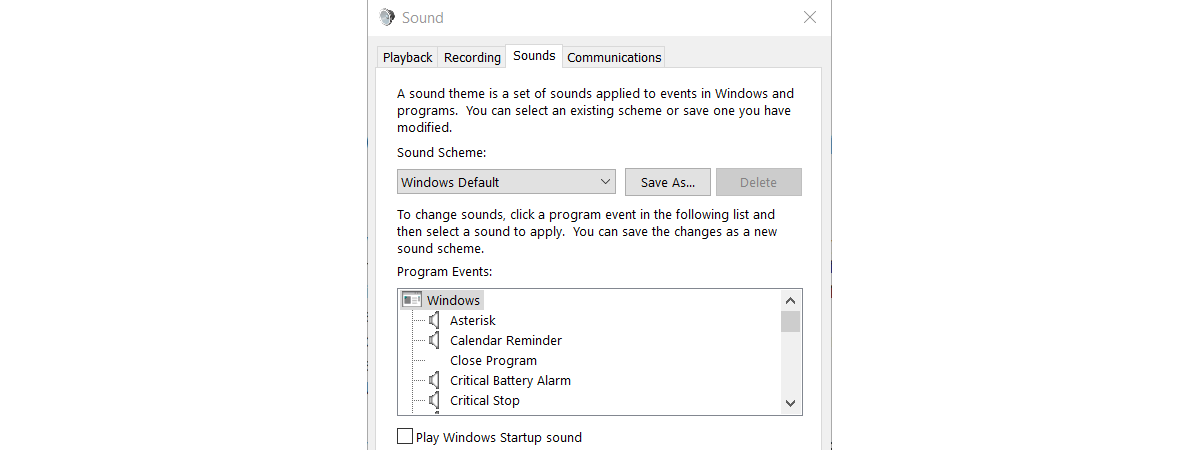
The Windows sound schemes are collections of sounds that play automatically during certain system and app events, like errors, notifications, or reminders. If you find the current alerts annoying, you can customize the sound schemes for Windows 10 to play what you want in every situation. Furthermore, it only takes a few clicks or taps to mute your system entirely. This guide covers how to customize the sound scheme on your PC, including how to turn off system sounds in Windows 10:
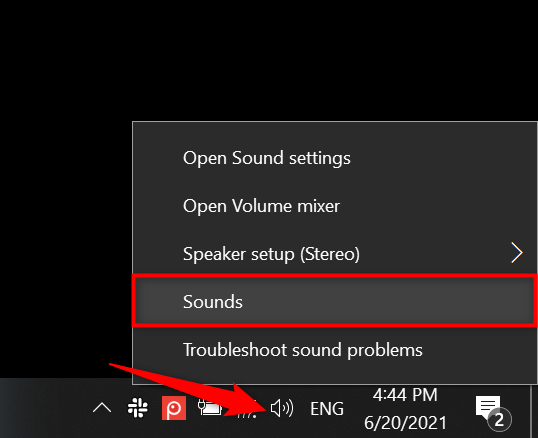
 Use the speaker icon to access the Windows sound schemes
An alternative is to open the Settings app and access Personalization.
Use the speaker icon to access the Windows sound schemes
An alternative is to open the Settings app and access Personalization.
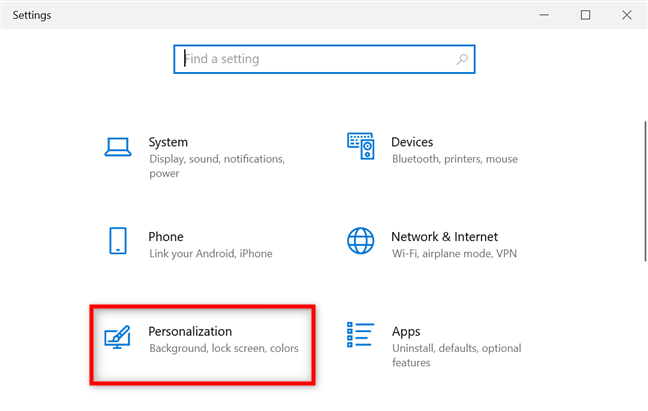
 Click or tap on Personalization
Then, access the Themes tab from the left column and, on the right, click or tap on Sounds.
Click or tap on Personalization
Then, access the Themes tab from the left column and, on the right, click or tap on Sounds.
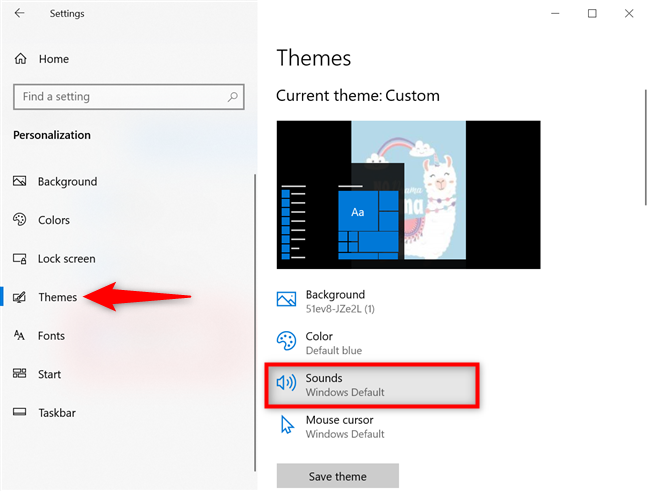
 Click on Sounds to access the sound schemes for Windows 10
No matter the method, the Sound window opens to its Sounds tab, as seen below.
Click on Sounds to access the sound schemes for Windows 10
No matter the method, the Sound window opens to its Sounds tab, as seen below.
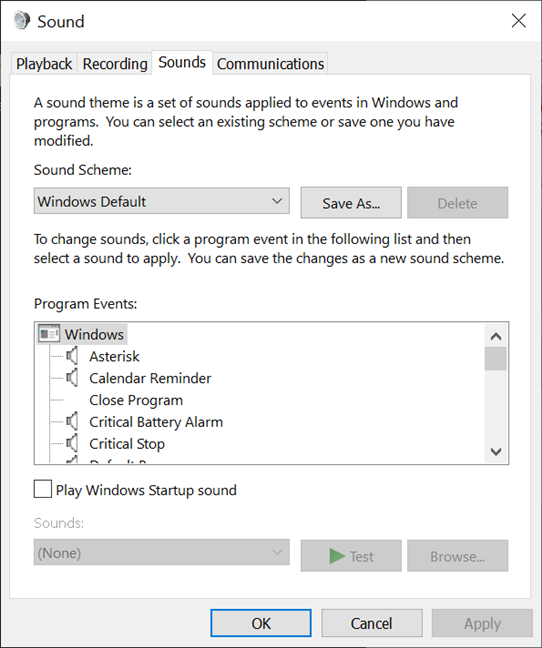
 The Sound window from Windows 10
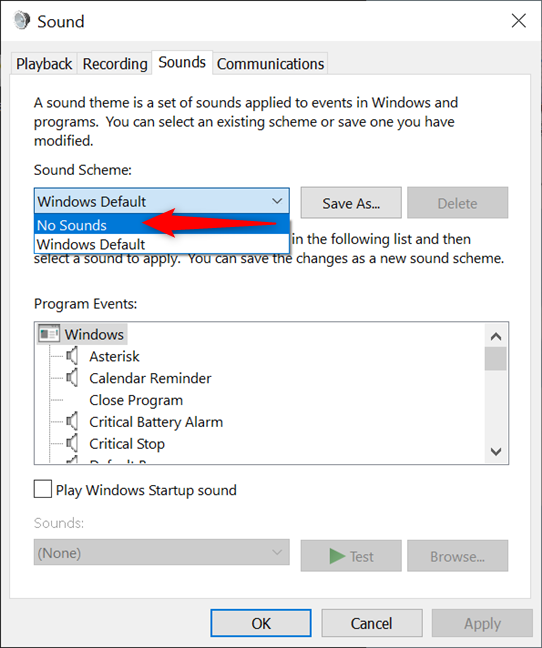 How to turn off system sounds in Windows 10
TIP: If you install or create other sound schemes on your Windows 10 computer or device, you can also use these steps to change the active sound scheme to another one.
If you only want to turn off the sounds for certain events, the next chapter provides more details on customizing a sound scheme by changing the desired sound effects.
How to turn off system sounds in Windows 10
TIP: If you install or create other sound schemes on your Windows 10 computer or device, you can also use these steps to change the active sound scheme to another one.
If you only want to turn off the sounds for certain events, the next chapter provides more details on customizing a sound scheme by changing the desired sound effects.
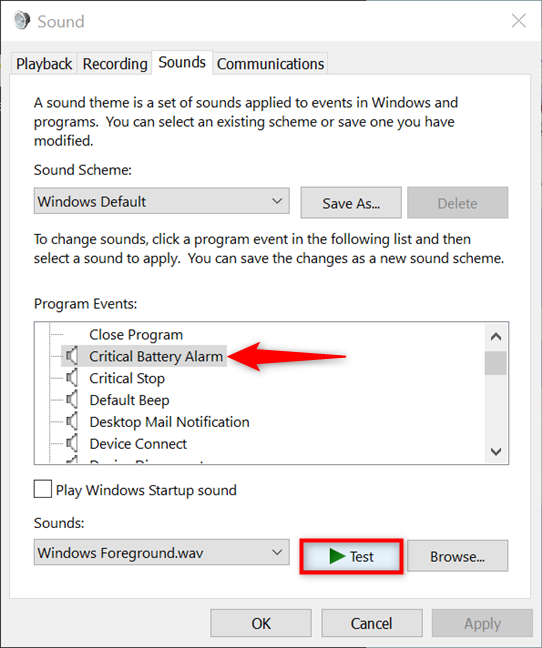 Test the current sound assigned to an event
NOTE: If you want more details on the Program Events on this screen, you can first find out when Windows plays each sound.
To change the default alert for a selected event, click or tap on the Sounds field at the bottom.
Test the current sound assigned to an event
NOTE: If you want more details on the Program Events on this screen, you can first find out when Windows plays each sound.
To change the default alert for a selected event, click or tap on the Sounds field at the bottom.
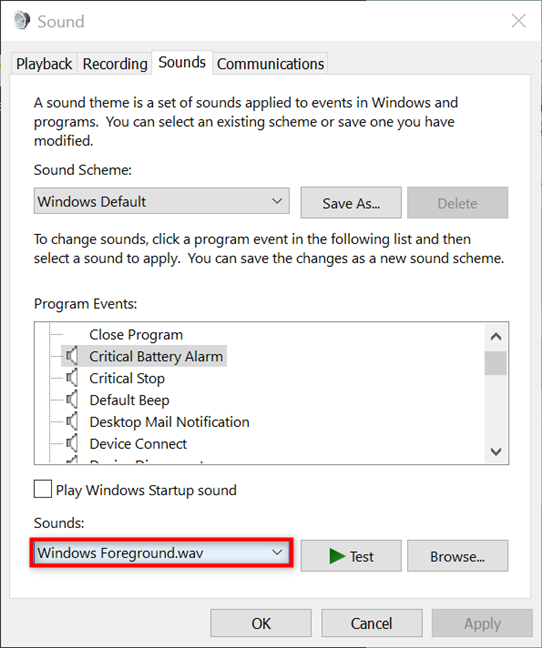 Use Sounds to choose another alert for a selected program event
This opens a dropdown menu with all the sounds available by default in Windows 10. Click or tap on the sound you want to use for that event.
Use Sounds to choose another alert for a selected program event
This opens a dropdown menu with all the sounds available by default in Windows 10. Click or tap on the sound you want to use for that event.
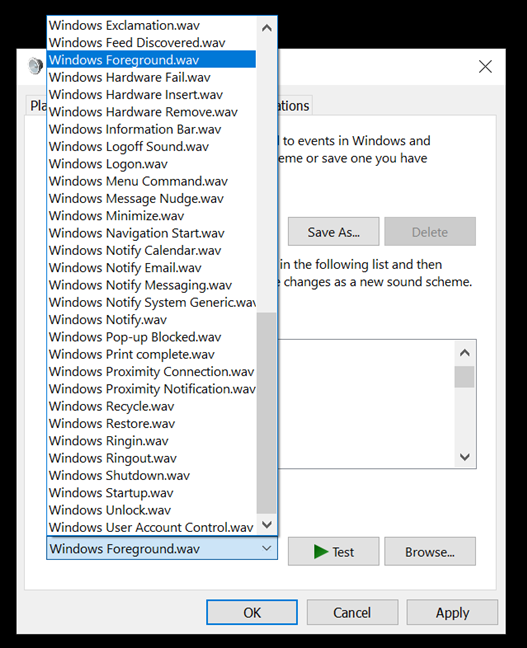
 Select the sound file you want to use for the program event
Alternatively, you can also press Browse to locate and use any WAV file on your Windows 10 PC for that event.
Select the sound file you want to use for the program event
Alternatively, you can also press Browse to locate and use any WAV file on your Windows 10 PC for that event.
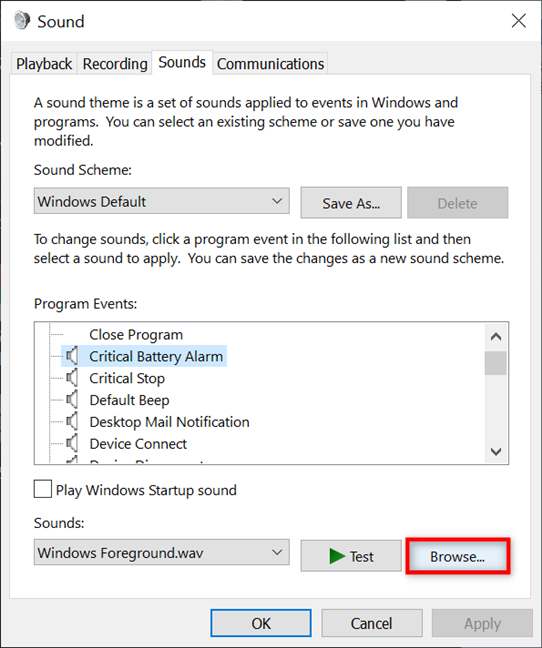 Browse to find another WAV file for your event
Follow the same steps for all the Program Events you want to customize. The speaker icon next to the one(s) you modify is highlighted in a different color to help you remember your changes.
Browse to find another WAV file for your event
Follow the same steps for all the Program Events you want to customize. The speaker icon next to the one(s) you modify is highlighted in a different color to help you remember your changes.
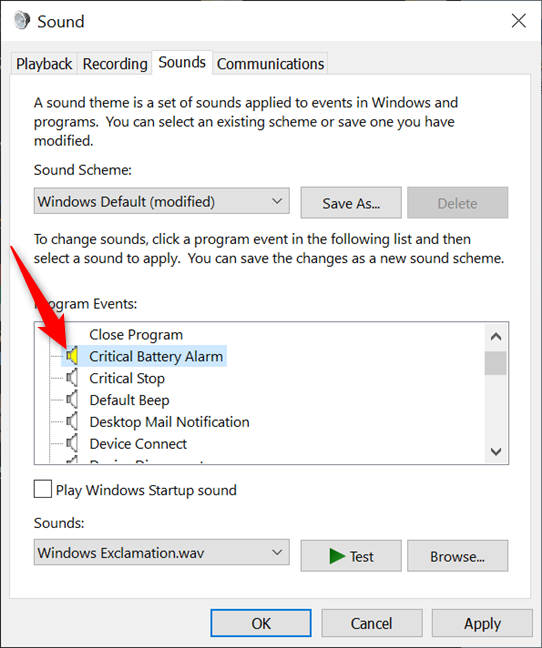 The speaker icon indicates the event is modified
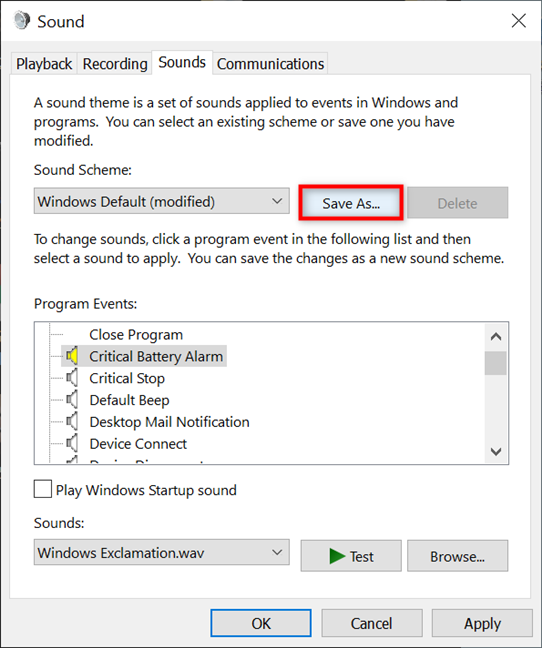 Press Save As
Type the name you want for the new sound scheme in the “Save Scheme As” window and press OK.
Press Save As
Type the name you want for the new sound scheme in the “Save Scheme As” window and press OK.
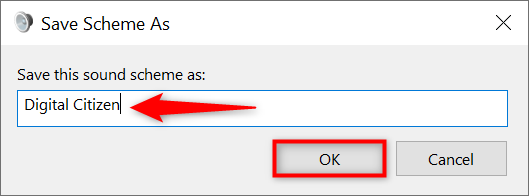
 Name your new sound scheme
From now on, the new scheme is displayed in the list of sound schemes, and you can select in Windows 10.
Name your new sound scheme
From now on, the new scheme is displayed in the list of sound schemes, and you can select in Windows 10.
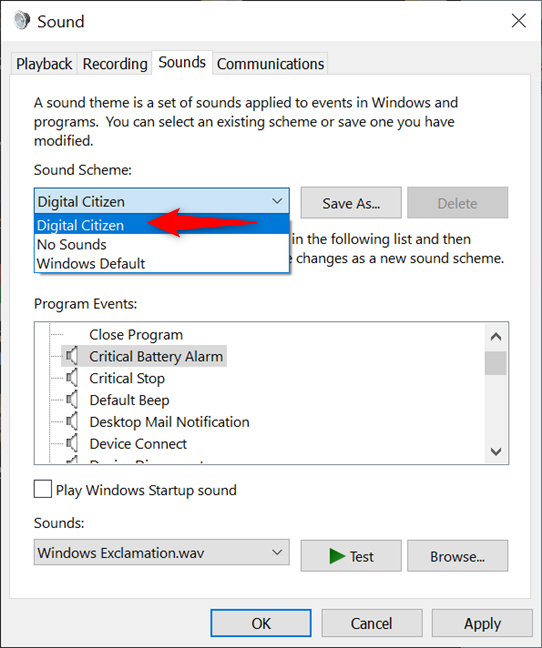 Windows 10 saves your new Sound Scheme
If you get bored with a scheme you created, you can use the Delete button and then confirm your choice to remove it from Windows 10.
Windows 10 saves your new Sound Scheme
If you get bored with a scheme you created, you can use the Delete button and then confirm your choice to remove it from Windows 10.
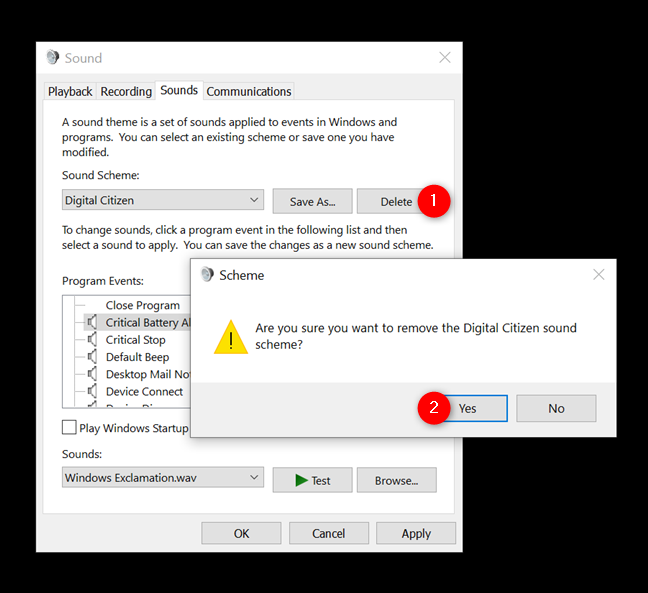
 How to delete a sound scheme in Windows 10
NOTE: Keep in mind that sound schemes are associated with Windows themes. By default, the themes bundled with Windows 10 are using the Windows Default sound scheme. When you change your Windows 10 theme, the sound scheme is also changed according to the new theme’s settings.
How to delete a sound scheme in Windows 10
NOTE: Keep in mind that sound schemes are associated with Windows themes. By default, the themes bundled with Windows 10 are using the Windows Default sound scheme. When you change your Windows 10 theme, the sound scheme is also changed according to the new theme’s settings.
How to access the Windows Sound Schemes settings
If you want to tinker with the Windows 10 sound schemes, first, you need to open the Sound window. The fastest method is to find the speaker icon in the Windows 10 system tray (bottom-right corner) and right-click on it. In the contextual menu that opens, click or tap on Sounds.How to turn off system sounds in Windows 10
By default, Windows 10 comes with only two sound schemes: Windows Default and No Sounds. If you want to turn off system sounds in Windows 10, click or tap on the Sound Scheme dropdown menu and select No Sounds.How to customize a sound scheme or create a new one
If you want to create a new sound scheme, start by customizing the sounds found in an existing one. To begin, click or tap an item in the Program Events section. To see the current sound assigned to this event, you can use the Test button at the bottom.How to save and delete a sound scheme in Windows 10
Once you finish changing the sounds included in a scheme, you should save it to ensure that your hard work doesn’t get lost. If you modify a scheme and do not save it, Windows 10 displays the sound scheme’s name with the text (modified) next to it, as shown below. Click or tap the Save As button.
Discussion (20)
Followed the article but the new theme only plays .wav files downloaded from the web and not the .wav voice files that I recorded myself. Cortana no help,
There must be something different about the coding of your .wav files, their bitrate or something.
I got one item, the trash, to change. The mail and other sounds are not changing in Windows 10.
Is there a way to disable or enable a sound for things that handle multiple ports? I want to disable the connect and disconnect sounds only for a specific USB port/device, but not all of them.
Can no longer resize desktop theme. Have tried EVERY MS Forum response to allow me to center theme but never works. Command Prompt shows correct for center(0). but still wont work.
wrong forum for above question
Question is I cannot Browse in WMP and replace “Empty Trash” Win7 sound with wav file. Works fine for other replacement but when open media player wav file is not there when browsing BUT if open WMP independently..it is there in WMP.
If your having a lot of strange windows problems then this is a clear sign of registry corruption. Wether it be from tinkering or malware is the question only you can answer? I’d check out Microsoft Fix It site and run relevant quick fix tools. If that and a simple roll-back don’t work then you may have to reinstall. Upgrading to Windows 10 could be a godsend for you!
I can’t find Open Windows or Close Windows in Windows 10 so I can assign my old sounds to them. Why is Windows 10 a godsend? I think not.
Is there any way to customize the sound made when typing on the keyboard or screen? I turned on the “play key sounds as I type” but the sound it makes is boring.
I would really like to replace the Windows Startup.wav with the one from Windows ME, but I can’t gain access to the permissions to do it.
I use the Win ME sounds and desktop themes in Win7 they’re great and simple to use as Plus had its own GUI to toggle between different effects or fonts etc. Just use an ISO tool to find the Plus themes and unpack to a folder. Right click on Plus main exe and set the right compatibility in is properties and to always run as in administrator mode.
Also when it first runs save your current settings in the GUI before playing around. I hear in runs in Win8 too but not tested yet. Shame this and video wallpaper arn’t around anymore as tinkering with approved software was easy and made PC’s more personable.
Have Fun!!
Hi. Is there any place I can check what it is exactly that windows sounds do? For example, in exactly what cases does windows play the “asterisk” sound?
We noted your request and we will try to publish a tutorial in the next couple of weeks. Thank you for asking this question.
We published the tutorial that we promised. You can find it here: https://www.digitalcitizen.life/when-each-sound-windows-sound-scheme-played
By the way …in win 8.1 ….
What about importing NEW .wav file sounds , puttting them in the computer file wher the Given wav files are and trying to select THOSE custom sounds for windows events ? I can’t get that to work …any ideas how to do so ?
Place your new .wav files in a new folder inside the “C:WindowsMedia” folder. Then follow our exact instructions for selecting new sounds, for the events where you want to change the sounds.
How to I change many sounds at a time? Like copy paste a list of .wav files into “certain” folder and then select that folder to change all the sounds at once instead of changing each and every single one?
I’m afraid there’s no method for that.
I found a workaround to get all the Windows 8 sounds in 10 I gave everyone all permissions over the whole SSD(including folders,files,programs,etc…) and I made a backup of all Windows 10 sounds and downloaded Windows 8/8.1 sounds and in the C:WindowsMedia folder I replaced all the default sounds by the downloaded sounds.