Located on the right side of the taskbar, the system tray, correctly called the Notification area, has been a part of Windows for over 20 years. It kept on improving since it was first introduced with Windows 95, providing easy access to system functions, notifications, and applications. The Windows 10 system tray is more customizable than ever before, as you get to configure which system and apps icons are shown in it. Whether you want to hide the volume icon, keep a particular icon always visible in the Notification area, or see nothing but the clock on your taskbar, this tutorial shows you how to do it:
How to show hidden icons in the system tray using the mouse
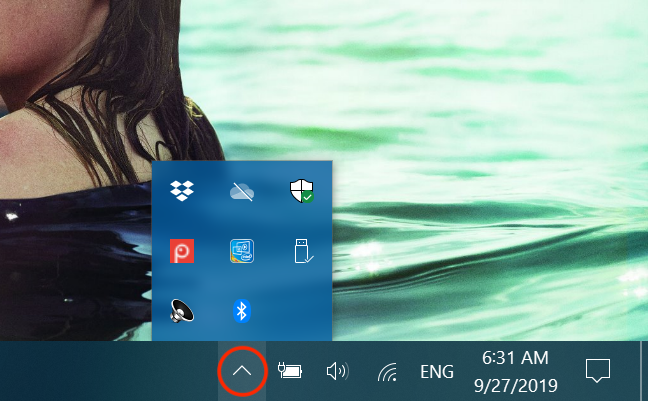
In Windows 10, a lot of icons are hidden by default in an expandable pane, giving you more space on your taskbar. To reveal them, click on the arrow left of the Notification area.
Click the arrow to reveal hidden system tray icons
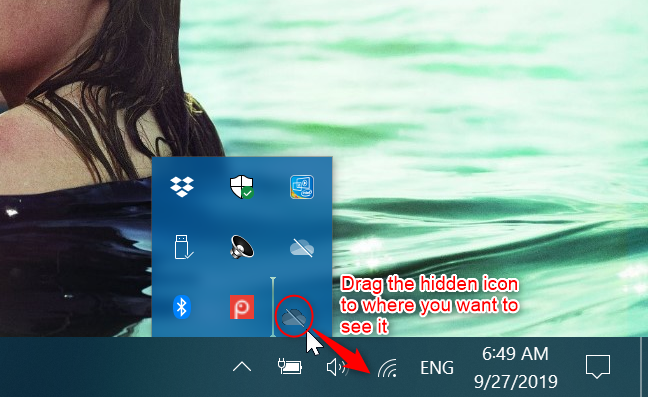
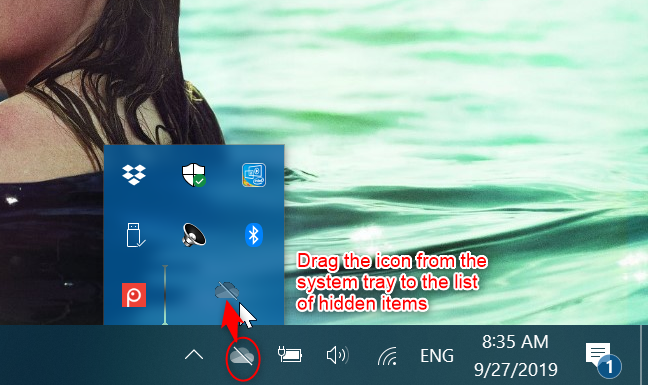
The most straightforward way to show any of these icons in your Notification area is to drag them with the cursor from the expandable pane to the taskbar.
Dragging the OneDrive icon to the Notification area
TIP: If enabled, the setting to "Always show all icons in the notification area" makes the arrow and the expandable pane disappear. Keep reading to learn more about this option.
How to show hidden icons in the system tray using Windows 10 settings
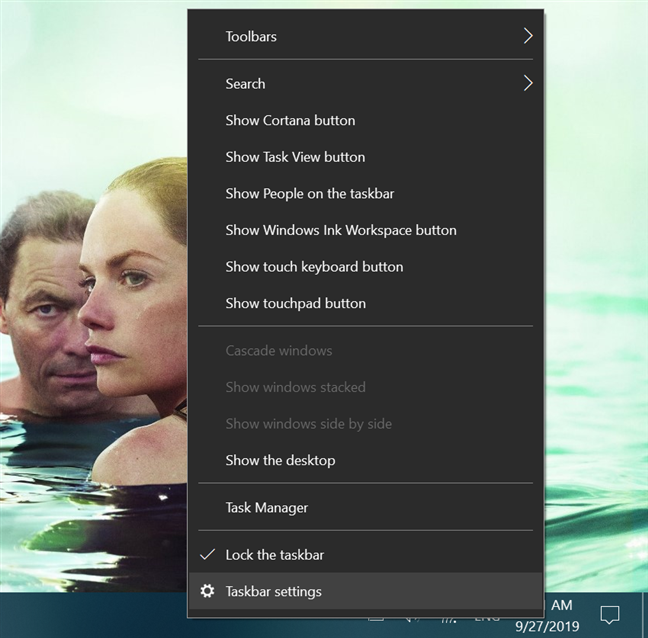
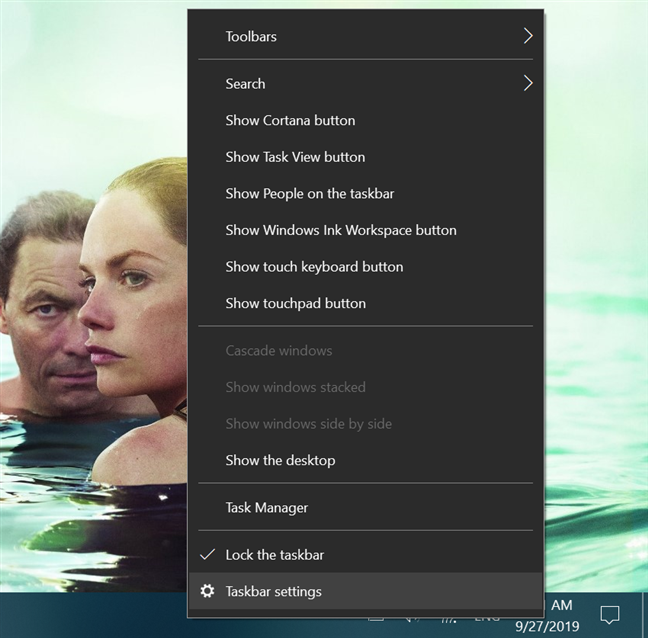
Another method for displaying the hidden icons in the system tray involves accessing the Taskbar settings. To do that, right-click or press-and-hold an unused area of the Taskbar and then click or tap Taskbar settings from its menu.
Access Taskbar settings
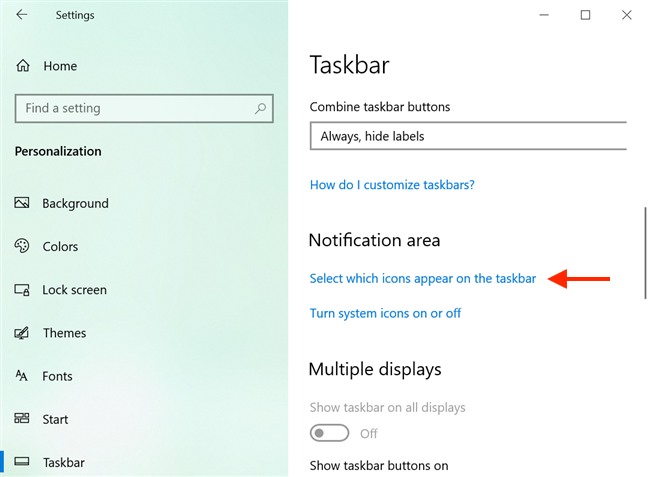
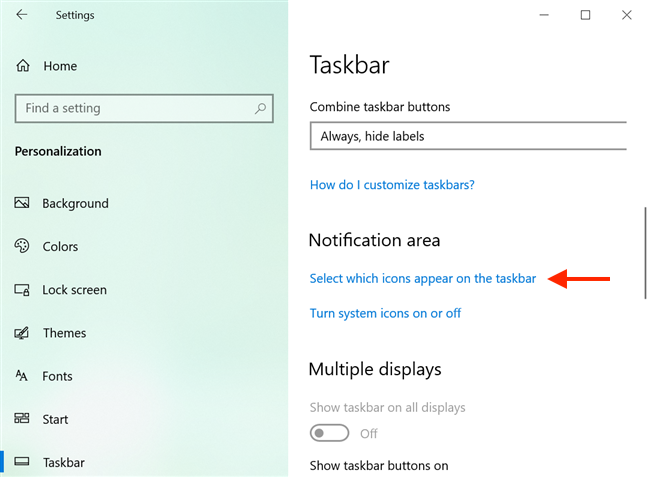
In the Taskbar section of the Settings app, scroll down the list of settings found on the right side of the window until you find Notification area. Click or tap on the "Select which icons appear on the taskbar" link.
Access Select which icons appear on the taskbar
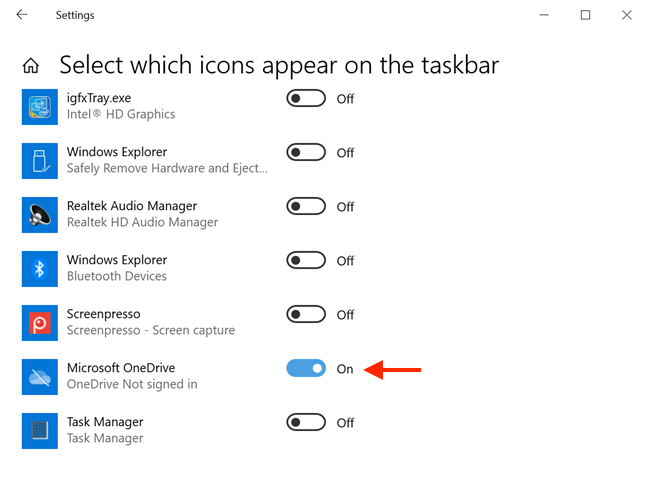
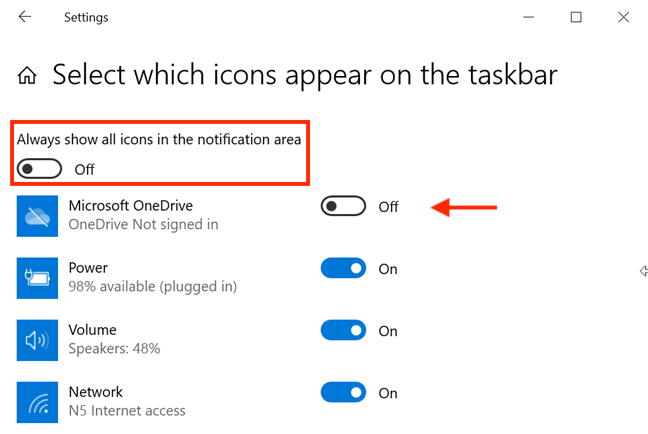
Turn on the switch of each icon you want in the Notification area. The icons you choose to show become instantly visible on the taskbar.
Turn on the OneDrive switch to show it on your taskbar
IMPORTANT: If you turned On the switch to show a certain icon and that icon is not instantly displayed on your taskbar, the corresponding app is probably not currently running on your computer. Keep in mind that the icons in your Notification area are only shown when their apps are running.
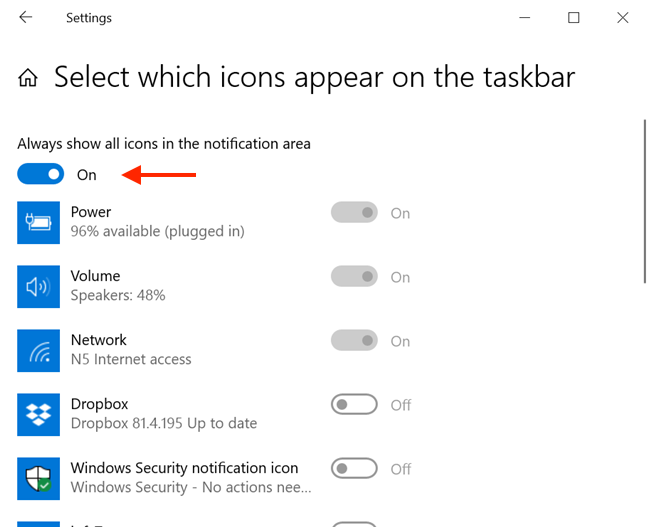
If you like to keep an eye on everything, you can use the "Always show all icons in the notification area" option at the top of the list. Turn On the switch next to it, and all the icons in the list are instantly displayed in your taskbar, while their individual settings, now obsolete, can no longer be changed.
Turn the "master switch" on to display all the icons in the Taskbar
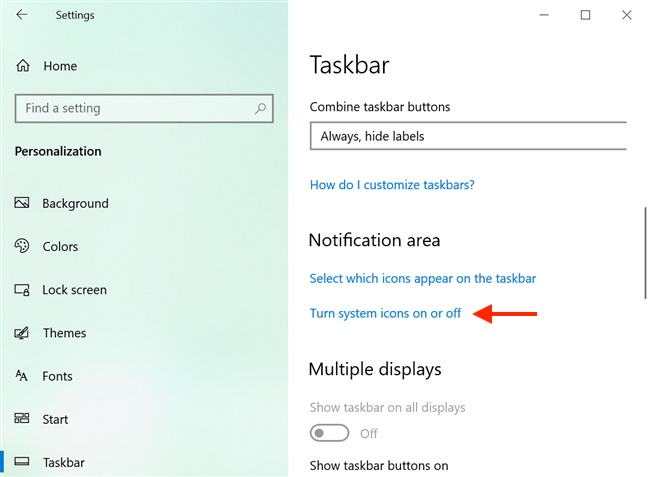
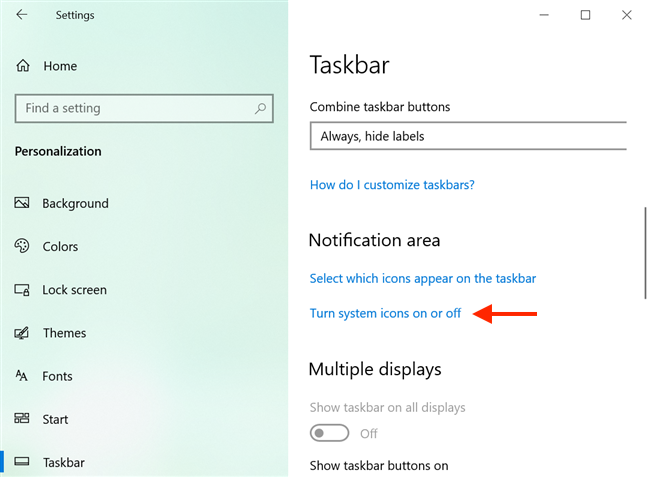
Some system icons, like Network or Volume, can be completely turned off, which means they are not displayed in the list of taskbar icons above, and they are nowhere to be found on your taskbar or in the expandable pane. To make them appear in the Notification area, you first need to enable them. Go to the Notification area section from the Taskbar settings again and click or tap the "Turn system icons on or off" link.
Access Turn system icons on or off
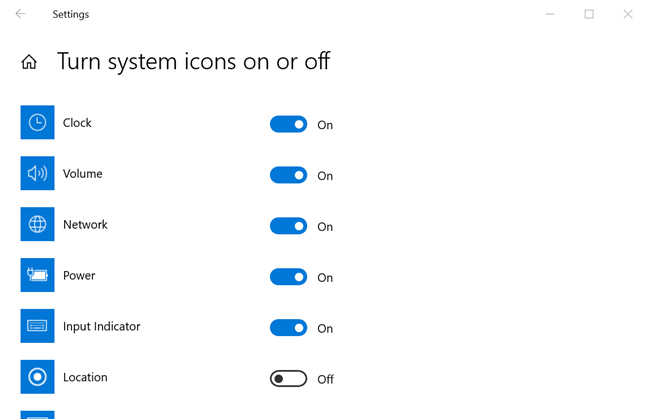
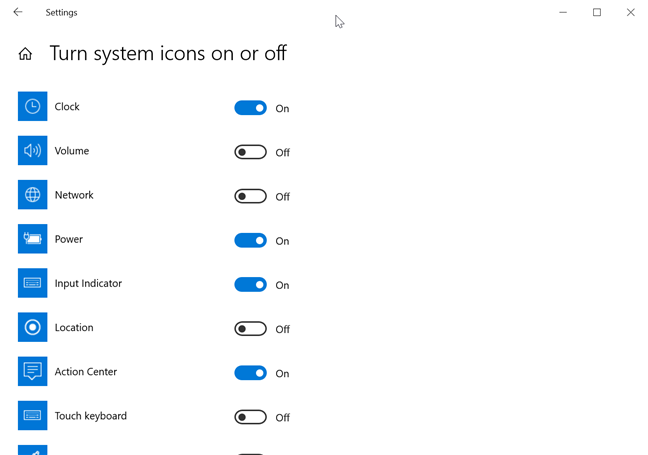
Choose which system icons are enabled by turning on the switch next to them.
Turn On the system icons that you want to enable
Once a system icon is turned On, you can use the instructions above to decide if you want to see it in your Notification area or access it from the expandable pane.
How to hide icons from the system tray using the mouse
Having too many icons in your Notification area (system tray) can make things a bit cluttered, while also reducing the space on your taskbar, so we recommend hiding the icons you don't need on a regular basis. The easiest way to do this is by dragging them with your cursor from the Notification area into the hidden expandable pane.
Hiding the OneDrive icon in the expandable pane
How to hide icons from the system tray using Windows 10 settings
You can also do this from the Taskbar settings, which are accessed by right-clicking or pressing-and-holding on a free area of the taskbar, and then going to Taskbar settings.
Access Taskbar settings
In the list of settings found on the right side of the window, scroll down until you find the Notification area section. Click or tap on "Select which icons appear on the taskbar."
Access Select which icons appear on the taskbar
Make sure the*"Always show all icons in the notification area"* option is turned Off and then, to hide the icons you no longer want to see in the Notification area, turn off the switch next to them. The icons are instantly hidden in the expandable pane.
Turn Off both the switch showing all icons and the switch for the icons that you want to hide
When it comes to system icons, they can not only be hidden, but completely disabled, thus keeping them out of both your Notification area and its expandable pane. To do this, you first have to return to the Notification area section from the Taskbar settings, and then click or tap the "Turn system icons on or off" link.
Click or tap on Turn system icons on or off
From the list in this window, turn Off the icons that you don't want to see in your Notification area. This makes them instantly disappear, never to bother you again.
Turn Off the system icons that you want to remove from your Notification area
How cluttered is your Notification area?
We like to keep things tidy, so our Notification area only displays the icons we need to keep an eye on, like the Power icon, or the ones we use daily, such as the Volume icon. What does your Notification area look like? How many icons do you have in it? Comment below and let's discuss.
Nice article but does not explain if and when yes how to add individual apps or applications to the notification area.
Diem Nguyen ·
Thanks for the article. I have a rather different question. In my Windows 10: some running apps have their icons underlined in the taskbar(TB) and no icon in the notification area(NA) such as Google Chrome, File Explorer, Microsoft Sense Clock, Adobe Digital Edition… Some others (running) do not have their icons underlined in TB but have their icons in NA such as GreenShot. One little dictionary app called Stardict has BOTH its icon underlined in TB and listed in NA! Have you run across situation like this? I’d like to make the apps if they are running then they should have their icons underlined in TB and that’s it. If I can get an email letting me know when you answer my question I’d really appreciate it. Thank you.
Peter ·
Thanks. It works
Anonymous ·
You are welcome. 😉
Georgia ·
I want to remove onedrive from the system tray, but it’s not listed under taskbar icons or under system icons.
Alokins ·
My Network button in taskbar was invisible.
To make it visible, go to =>SETTINGS=>personalization=>taskbar , and now switch of button under “Use small taskbar buttons”.
Rahul ·
Thanks
changeling616 ·
The problem I have is that the with the window that says “Select which icons appear on the taskbar”, the “Network” is not even shown. I have no idea why. Anyone know why that might be?
Digember ·
Great help.
Ciprian Adrian Rusen ·
Happy to help. Don’t hesitate to subscribe to our newsletter for more useful content.
Products ·
Is there a way to add the my skype icon to this taskbar?
Electromariner ·
This is useless information for anyone already familiar with W10 Settings who is looking for a way to turn off non-system icons in the tray.
ladymolly ·
The volume icon will not turn off and on. Only on off. I had this on the notification bar, but it disappeared. Can’t get it back.
LT ·
i came o the exact conclusion before reading the post.
The problem is that it dosnt allow you to select specific apps to be placed or customized apps/software!!!!
so basically if its not on the list with a on and off switch you cant place it in the tray !!!!
i have no idea why Microsft decided to make win10 like this
looks and acts like an IOS !!!
FYI Microsoft if i wanted a damn ipad / iphone or any of those other devices or operating systems out there i would have gotten one. not to mention the ugliest design of the start menu and its ios like features!!!!
i just dont get why microsft has done this !!!
worst microsoft windows ever
Terry Pinnell ·
How can I simply add any executable of my choice? Such as C:Windowsregedit.exe ?
Peter Owens ·
So this is easy?
As usual MS makes simple things tricky, mostly by making the path to change settings devious.
To those of us busy wanting to get something done farting around with settings & then remembering what we have done is just an unnecessary complication.
Anonymous ·
Thank God the process involved is different than in the past. I wouldn’t want to have a short learning curve, after all. Then what incentive would there be for me to stay with Windows rather than jettison it and use my learning curve to learn some other, superior O/S that doesn’t gobble all my resources or have substantial problems with viruses.














Discussion (17)
Nice article but does not explain if and when yes how to add individual apps or applications to the notification area.
Thanks for the article. I have a rather different question. In my Windows 10: some running apps have their icons underlined in the taskbar(TB) and no icon in the notification area(NA) such as Google Chrome, File Explorer, Microsoft Sense Clock, Adobe Digital Edition… Some others (running) do not have their icons underlined in TB but have their icons in NA such as GreenShot. One little dictionary app called Stardict has BOTH its icon underlined in TB and listed in NA! Have you run across situation like this? I’d like to make the apps if they are running then they should have their icons underlined in TB and that’s it. If I can get an email letting me know when you answer my question I’d really appreciate it. Thank you.
Thanks. It works
You are welcome. 😉
I want to remove onedrive from the system tray, but it’s not listed under taskbar icons or under system icons.
My Network button in taskbar was invisible.
To make it visible, go to =>SETTINGS=>personalization=>taskbar , and now switch of button under “Use small taskbar buttons”.
Thanks
The problem I have is that the with the window that says “Select which icons appear on the taskbar”, the “Network” is not even shown. I have no idea why. Anyone know why that might be?
Great help.
Happy to help. Don’t hesitate to subscribe to our newsletter for more useful content.
Is there a way to add the my skype icon to this taskbar?
This is useless information for anyone already familiar with W10 Settings who is looking for a way to turn off non-system icons in the tray.
The volume icon will not turn off and on. Only on off. I had this on the notification bar, but it disappeared. Can’t get it back.
i came o the exact conclusion before reading the post.
The problem is that it dosnt allow you to select specific apps to be placed or customized apps/software!!!!
so basically if its not on the list with a on and off switch you cant place it in the tray !!!!
i have no idea why Microsft decided to make win10 like this
looks and acts like an IOS !!!
FYI Microsoft if i wanted a damn ipad / iphone or any of those other devices or operating systems out there i would have gotten one. not to mention the ugliest design of the start menu and its ios like features!!!!
i just dont get why microsft has done this !!!
worst microsoft windows ever
How can I simply add any executable of my choice? Such as C:Windowsregedit.exe ?
So this is easy?
As usual MS makes simple things tricky, mostly by making the path to change settings devious.
To those of us busy wanting to get something done farting around with settings & then remembering what we have done is just an unnecessary complication.
Thank God the process involved is different than in the past. I wouldn’t want to have a short learning curve, after all. Then what incentive would there be for me to stay with Windows rather than jettison it and use my learning curve to learn some other, superior O/S that doesn’t gobble all my resources or have substantial problems with viruses.