




AMD has shared more details about its Dense Geometry Format technology, a new approach designed to help future Radeon GPUs handle much larger geometry counts in ray traced games and other real time 3D workloads.
DGF is built around a simple goal: store and stream dense geometry more efficiently. Instead of treating a full triangle mesh as one large block of data, AMD breaks it into smaller meshlets. Each DGF meshlet can include up to 64 vertices and 64 triangles, stored inside a compact 128 byte DGF block with related metadata.
That matters because modern game worlds are becoming much more detailed. Technologies such as Unreal Engine’s Nanite have raised expectations for complex models and tiny triangles, but those dense assets can create problems for ray tracing. More geometry means more memory pressure, more data movement, and more work for acceleration structures.
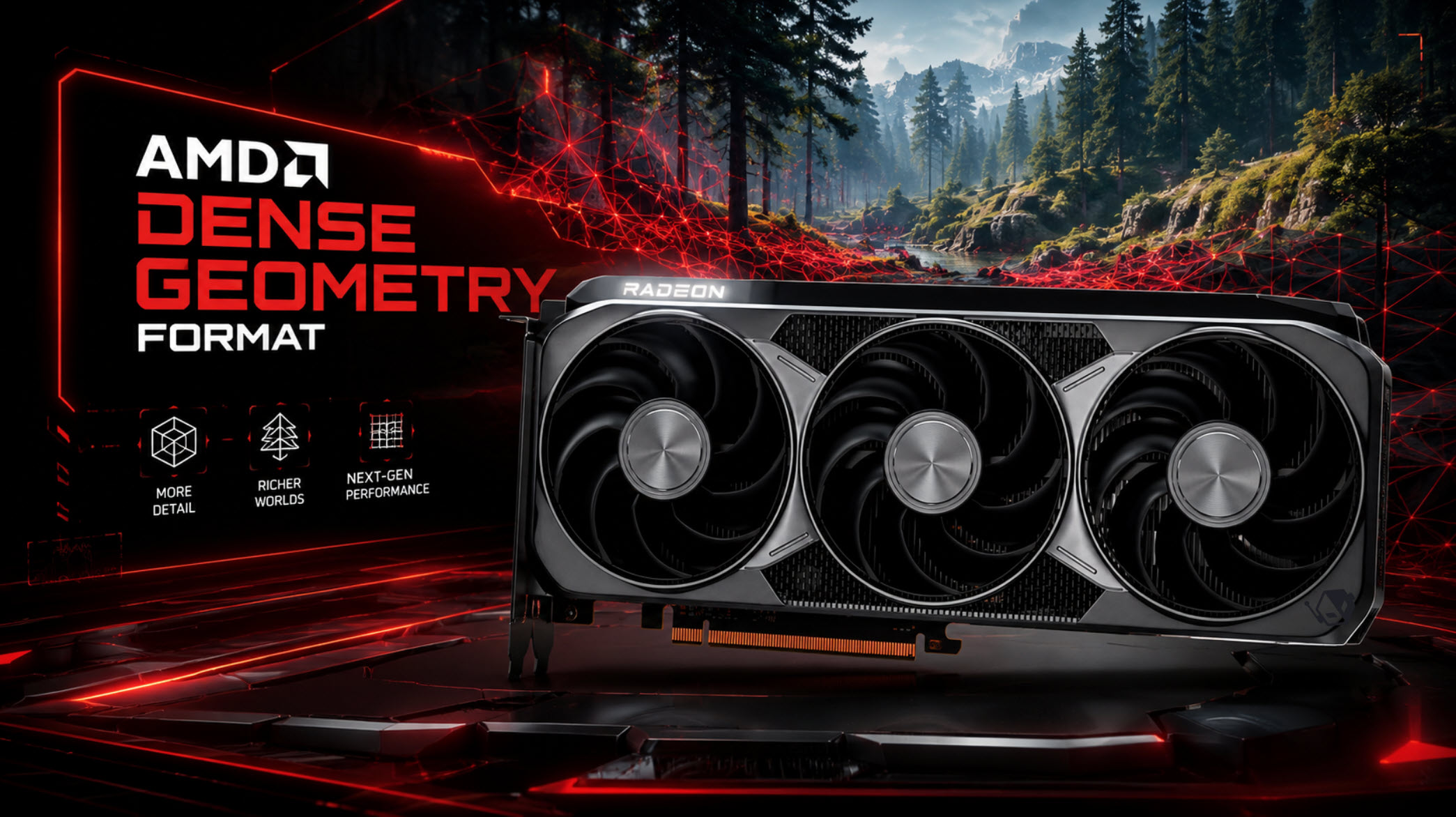
AMD says DGF can help by giving developers a more efficient way to represent dense scenes for both rasterization and ray tracing. The company has also introduced DGF SuperCompression, a software based compression system that can reduce DGF storage size even further.
According to AMD’s data, DGF SuperCompression can cut storage needs by up to around 30 percent on current hardware. Tests on models such as Dragon, Statuette, Buddha, Bike, and Crab showed savings generally ranging from about 17 percent to just over 31 percent, depending on the model and compression path.
Here is the basic idea:
| Feature | What it does |
|---|---|
| DGF | Stores dense geometry in compact meshlet based blocks |
| Meshlet size | Up to 64 vertices and 64 triangles |
| DGF block size | 128 bytes |
| DGF SuperCompression | Further reduces geometry storage size |
| Current GPU benefit | Up to around 30 percent smaller storage in AMD examples |
| Future target | Deeper support on future RDNA GPUs |
| Main use | Ray traced games, content creation, virtual production, and real time 3D |
The useful part is that DGF SuperCompression can still work on non DGF hardware. Older and current Radeon GPUs, including RDNA 4 and earlier, can benefit from smaller storage sizes through software decoding. Future GPUs are expected to support DGF more directly, which should lead to larger gains.
AMD is positioning this as a rival to NVIDIA’s RTX Mega Geometry, though the two approaches are not identical. NVIDIA’s system focuses heavily on accelerating ray tracing for ultra dense dynamic meshes on newer RTX hardware. AMD’s DGF is broader, with a focus on efficient geometry storage and rendering across rasterization and ray tracing.
| Technology | Main focus |
|---|---|
| NVIDIA RTX Mega Geometry | Faster ray tracing with ultra dense dynamic geometry |
| AMD DGF | Compact geometry storage for dense scenes across rasterization and ray tracing |
This is important for the next wave of games. As developers push more detailed worlds, richer assets, path tracing, and heavier ray tracing, geometry handling will become a bigger performance problem. Better compression can reduce VRAM pressure and bandwidth demands, which could help games run more smoothly without sacrificing scene detail.
DGF alone will not close every ray tracing gap between AMD and NVIDIA. Hardware design, drivers, upscaling, developer support, and game engine integration all still matter. But it shows AMD is working on the right kind of problem. Future graphics performance will depend not only on raw compute power, but also on how efficiently GPUs move, store, and process increasingly complex worlds.


Discussion (0)
Be the first to comment.