



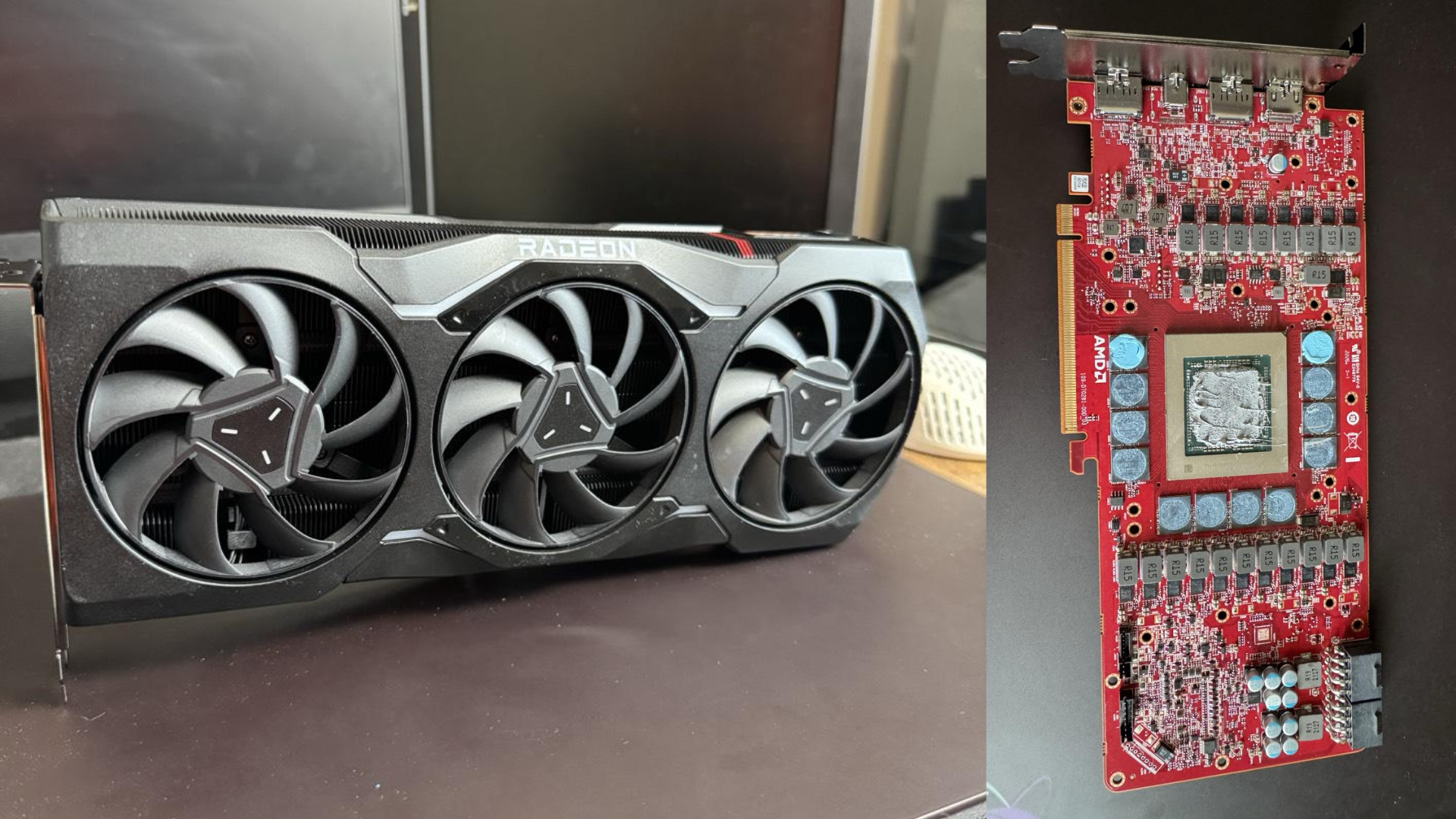
A rare AMD Radeon RX 7900 XTX engineering sample has surfaced online with an unusual red circuit board, extra debug connectors, and a confusing memory configuration that reports only 16GB of VRAM instead of the retail card’s standard 24GB.
The prototype was reportedly found through a marketplace listing and appears to be a pre-production version of AMD’s flagship RDNA 3 graphics card. While its board layout includes hardware associated with the Radeon RX 7900 XTX, software tools identify it as a very different configuration.
GPU-Z reportedly detects 16GB of GDDR6 memory running across a 256-bit memory bus. That is much closer to the Radeon RX 7900 GRE than the retail RX 7900 XTX, which normally uses 24GB of memory and a wider 384-bit bus.
The card is an unusual reminder that early GPU hardware often looks very different from the version that eventually reaches stores.
The Prototype Uses a Red PCB and Extra Engineering Connectors
Retail Radeon RX 7900 XTX cards use production-ready circuit boards with standard power, display, and cooling layouts. This sample stands out because its PCB is entirely red and includes several connectors that are not found on normal consumer cards.
Those connectors were likely used during validation, testing, diagnostics, and firmware development.
| Visible prototype feature | Likely purpose |
|---|---|
| Red PCB | Early engineering or validation board design |
| Extra top-edge connectors | Debugging and board-level testing |
| Blue connector block | Possible I2C, PMBus, and JTAG access |
| Unbranded layout | Pre-production development hardware |
| Exposed engineering components | Easier diagnostics during testing |
JTAG access can be particularly useful for engineers because it allows direct inspection of processor and memory controller behaviour. That kind of hardware is normally removed before a graphics card enters retail production.
GPU-Z Reports 16GB Instead of the Expected 24GB
The most unusual part of the sample is its reported memory capacity.
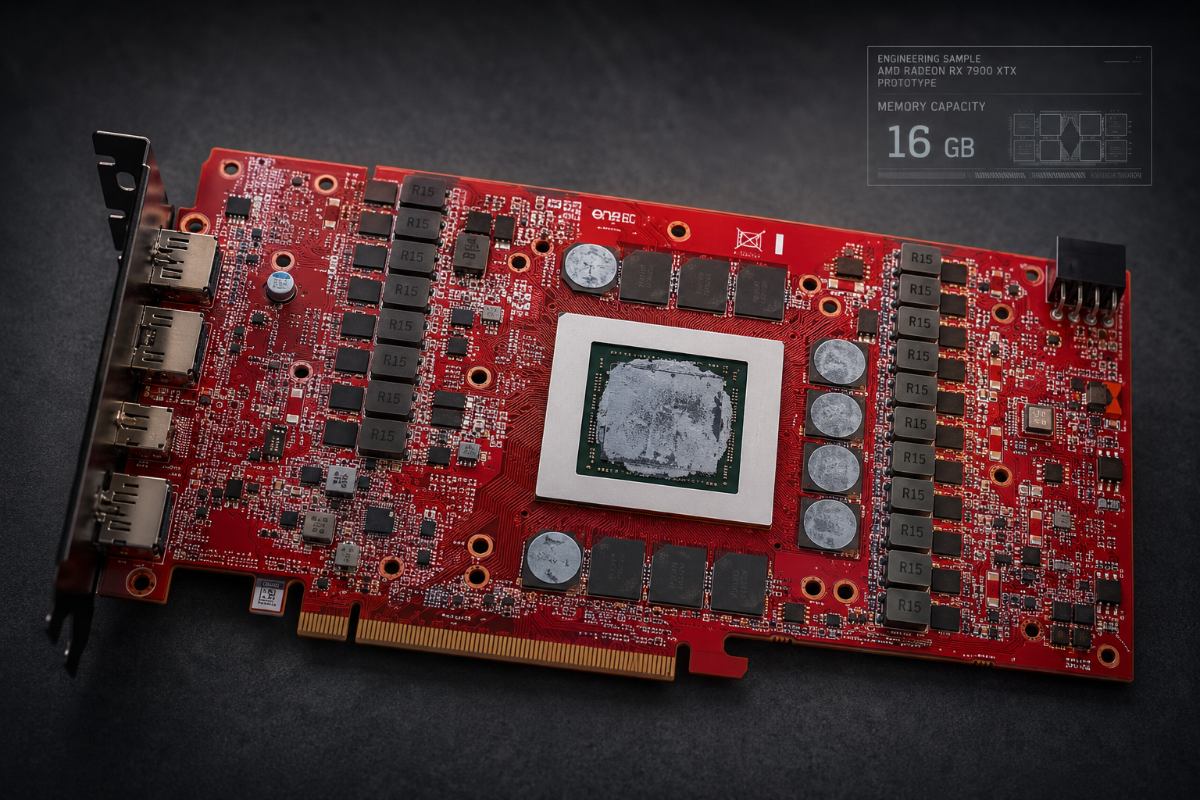
The board reportedly contains 12 physical memory packages around the Navi 31 GPU. If all were active with 2GB GDDR6 chips, that would normally point to a 24GB configuration.
However, GPU-Z only sees 16GB of usable memory.
| Feature | Retail Radeon RX 7900 XTX | Reported prototype |
|---|---|---|
| GPU | Navi 31 | Navi 31 |
| VRAM capacity | 24GB GDDR6 | 16GB detected |
| Memory bus | 384-bit | 256-bit detected |
| Memory packages | 12 | 12 visible |
| PCB design | Retail production board | Red engineering board |
One possible explanation is that some memory channels were disabled during testing. Another possibility is that the board was used to validate a lower-tier configuration before AMD finalized the RX 7900 series lineup.
Because this is an engineering sample, its hardware and firmware may not reflect a fully working consumer product.
Performance Appears Closer to the Radeon RX 7900 XT
The owner reportedly tested the card and found that its performance was closer to the Radeon RX 7900 XT than the full RX 7900 XTX.
That result makes sense if the prototype has a reduced memory interface or disabled hardware blocks. Even if the card uses the same Navi 31 silicon family, memory bandwidth and active compute resources can have a major effect on gaming performance.
The reported configuration also appears closer to the Radeon RX 7900 GRE on paper. However, attempts to flash the card with a Radeon RX 7900 GRE BIOS reportedly failed.
That suggests the prototype may use custom firmware, a different board identifier, disabled channels, or other engineering restrictions that prevent normal retail BIOS files from working.
Engineering Samples Can Be Difficult to Use Safely
Prototype graphics cards are interesting collector items, but they are not ideal for most buyers. They may have unstable firmware, missing driver support, unusual power requirements, limited resale value, or no warranty.
| Risk with engineering GPUs | Why it matters |
|---|---|
| Unfinished firmware | Can cause crashes or limited features |
| Custom board design | May not fit normal coolers or cases |
| BIOS incompatibility | Retail firmware may fail to install |
| Unknown hardware limits | Performance may vary widely |
| No official support | Repairs and updates can be difficult |
The surfaced card is unlikely to reveal a cancelled retail Radeon model on its own. Instead, it offers a rare look at how AMD tested different Navi 31 configurations before deciding which versions of the RX 7900 series would eventually ship.



Discussion (0)
Be the first to comment.