



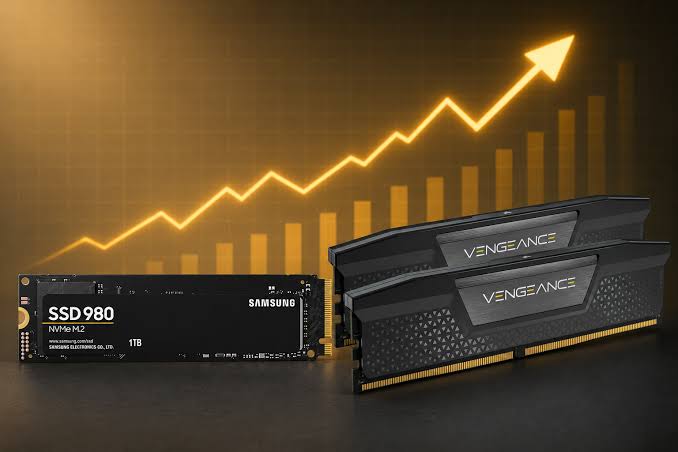
Memory prices may rise faster than previously expected as demand from AI data centers continues to outpace available supply. UBS has raised its forecast for DDR memory contract prices in the third quarter of 2026, predicting a much sharper increase than it expected earlier this year.
The investment bank now expects DDR prices to rise 32% quarter over quarter in the third quarter, compared with its earlier estimate of 17%. It also expects prices to increase another 18% in the fourth quarter.
The forecast adds to growing concern for PC buyers, smartphone makers, and device manufacturers. Higher DRAM and NAND prices are already raising hardware costs, and the latest estimates suggest the pressure may continue for much longer than expected.
DRAM Supply Could Remain Tight Until 2028
UBS believes the memory market may stay constrained until the second quarter of 2028. The main reason is that demand for high-capacity memory is growing much faster than supply.
The bank estimates that DRAM demand could grow by 36.2% in 2027, while supply may increase by only 19.3%. That leaves a large gap between the amount of memory the market wants and the amount manufacturers can produce.
| Memory market factor | UBS estimate |
|---|---|
| DDR price rise in Q3 2026 | 32% quarter over quarter |
| Earlier Q3 estimate | 17% |
| DDR price rise in Q4 2026 | 18% quarter over quarter |
| Earlier Q4 estimate | 12% |
| DRAM demand growth in 2027 | 36.2% |
| DRAM supply growth in 2027 | 19.3% |
| Expected market constraint period | Until Q2 2028 |
The shortage is being driven largely by AI infrastructure. Cloud companies are buying huge amounts of high-bandwidth and server-grade memory for training systems, inference clusters, and large-scale data centers.
That demand gives memory suppliers more reason to focus production on expensive enterprise products rather than lower-margin consumer memory.
NAND Storage Prices Could Rise Too
The pressure is not limited to system memory. UBS also expects NAND flash prices to increase more sharply than previously forecast.
NAND is used for SSDs, smartphones, tablets, game consoles, memory cards, and many other storage products. UBS now expects NAND prices to rise 30% in the third quarter, up from its earlier estimate of 17%.
TrendForce also expects meaningful increases, though its forecast is lower. It predicts DRAM prices could rise around 18% in the third quarter, while NAND prices may increase by about 15%.
| Product category | UBS Q3 forecast | Earlier UBS estimate |
|---|---|---|
| DDR memory | 32% increase | 17% increase |
| NAND flash storage | 30% increase | 17% increase |
The difference between forecasts shows how difficult the market is to predict. However, both outlooks point in the same direction: memory and storage costs are still rising.
Consumers May Feel the Impact Through Higher Device Prices
Higher component costs can affect nearly every type of consumer technology. PC makers may raise laptop and desktop prices, reduce standard RAM and SSD capacities, or limit discounts.
Phone makers, console companies, and handheld manufacturers may face similar pressure, especially for devices that need large amounts of memory or storage.
| Product type | Possible impact |
|---|---|
| Budget laptops | Less RAM or smaller SSDs |
| Gaming PCs | Higher memory upgrade costs |
| Smartphones | Higher prices for large storage models |
| Handheld gaming devices | More expensive high-capacity versions |
| SSD upgrades | Fewer discounts and higher retail pricing |
| Prebuilt desktops | Higher base prices |
The biggest effect may be felt in lower-cost systems. Premium devices have more room to absorb higher component costs, but budget hardware operates on thinner margins.
AI Demand Is Reshaping the Memory Market
The current shortage shows how strongly AI infrastructure is affecting the wider hardware market. Major cloud companies are securing long-term memory supply for data centers, leaving consumer hardware companies to compete for what remains.
UBS expects the imbalance to continue through 2027, while TrendForce also sees supply shortages remaining severe in the near term.
For people planning a PC upgrade, memory and SSD deals may become harder to find. Waiting for prices to fall could become a risky strategy if supply conditions continue to tighten through the rest of 2026.



Discussion (0)
Be the first to comment.