



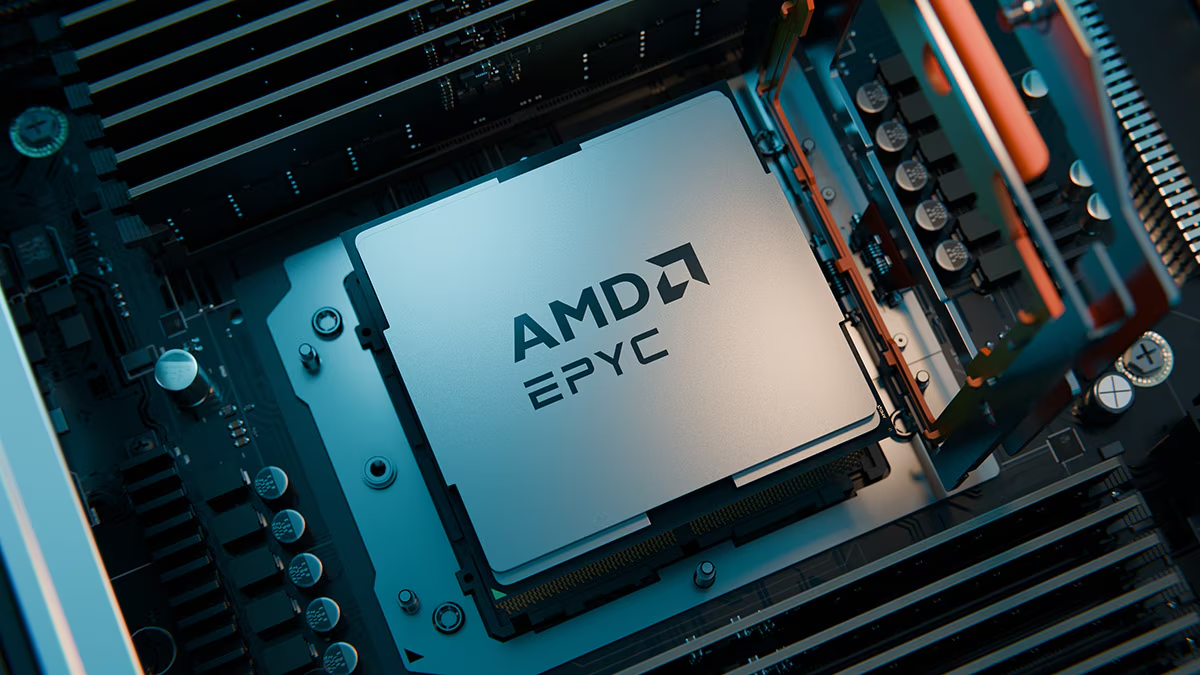
AI hardware demand is no longer only about GPUs.
New data from Japanese substrate supplier Ibiden suggests that CPUs are becoming more important again as agentic AI workloads grow. That shift is already showing up in the supply chain, where demand for server CPU related products is expected to rise.
Ibiden makes integrated circuit package substrates, which help connect chips to printed circuit boards. These substrates are used across AI GPUs, CPUs, and custom ASICs. Because Ibiden sits upstream in the supply chain, its forecasts can give an early signal of where chip demand is moving.
The company now expects stronger demand from general purpose server products and switching IC products. The general purpose server category is especially important because it serves the CPU market.
For its fiscal year 2026, which ends in March 2027, Ibiden raised its Electronics segment sales forecast from 310 billion yen to 330 billion yen. Operating profit expectations also rose from 57 billion yen to 75 billion yen.
| Ibiden Electronics segment | Previous forecast | New forecast |
|---|---|---|
| Net sales | 310 billion yen | 330 billion yen |
| Operating profit | 57 billion yen | 75 billion yen |
The reason is tied to how AI workloads are changing. Early AI infrastructure spending focused heavily on training large models, where GPUs and accelerators dominate. But agentic AI shifts more attention toward systems that can reason, plan, call tools, manage workflows, and coordinate tasks across many services.
That does not remove the need for GPUs. But it does increase the importance of CPUs around them.
Server CPUs handle orchestration, data movement, general purpose compute, networking, memory management, and the many non GPU tasks needed to keep AI systems working. As AI moves from pure training to more interactive and agent based workloads, those CPU roles become harder to ignore.
Ibiden described this as a transition from training to intelligence, with demand for CPUs in general purpose servers expected to increase.
| AI infrastructure area | Why CPUs matter |
|---|---|
| Agentic AI workflows | Manage planning, tool use, and task coordination |
| AI inference systems | Feed accelerators and handle surrounding logic |
| Data center networking | Support switching, routing, and system control |
| General purpose servers | Run workloads that do not belong on GPUs |
| AI rack scale systems | Coordinate CPUs, GPUs, memory, and networking |
Ibiden also expects its production load to rise sharply. For calendar year 2026, the company expects production load to reach 1.8 times its 2024 level. By 2028, it expects that figure to rise to 2.4 times. Growth is expected to come from ASICs, AI servers, and server CPUs, while PC demand is expected to weaken.

That matches what major chip companies have recently said. Intel has argued that agentic AI could renew focus on CPUs. AMD has also pushed back on fears that CPU demand will be cannibalized by GPUs, saying the CPU surge from agentic AI should be largely additive to accelerator demand.
The broader message is clear. AI infrastructure is becoming more balanced. GPUs remain the center of AI acceleration, but CPUs, ASICs, networking chips, optics, substrates, and advanced packaging are all becoming more important.
For suppliers like Ibiden, that means the AI boom is spreading beyond the most obvious chips. The demand is now reaching deeper into the hardware stack.
Agentic AI may not replace the GPU race, but it is changing the shape of it. The next generation of AI data centers will need powerful accelerators, but they will also need far more server CPU capacity to keep those systems useful, responsive, and scalable.


Discussion (0)
Be the first to comment.