



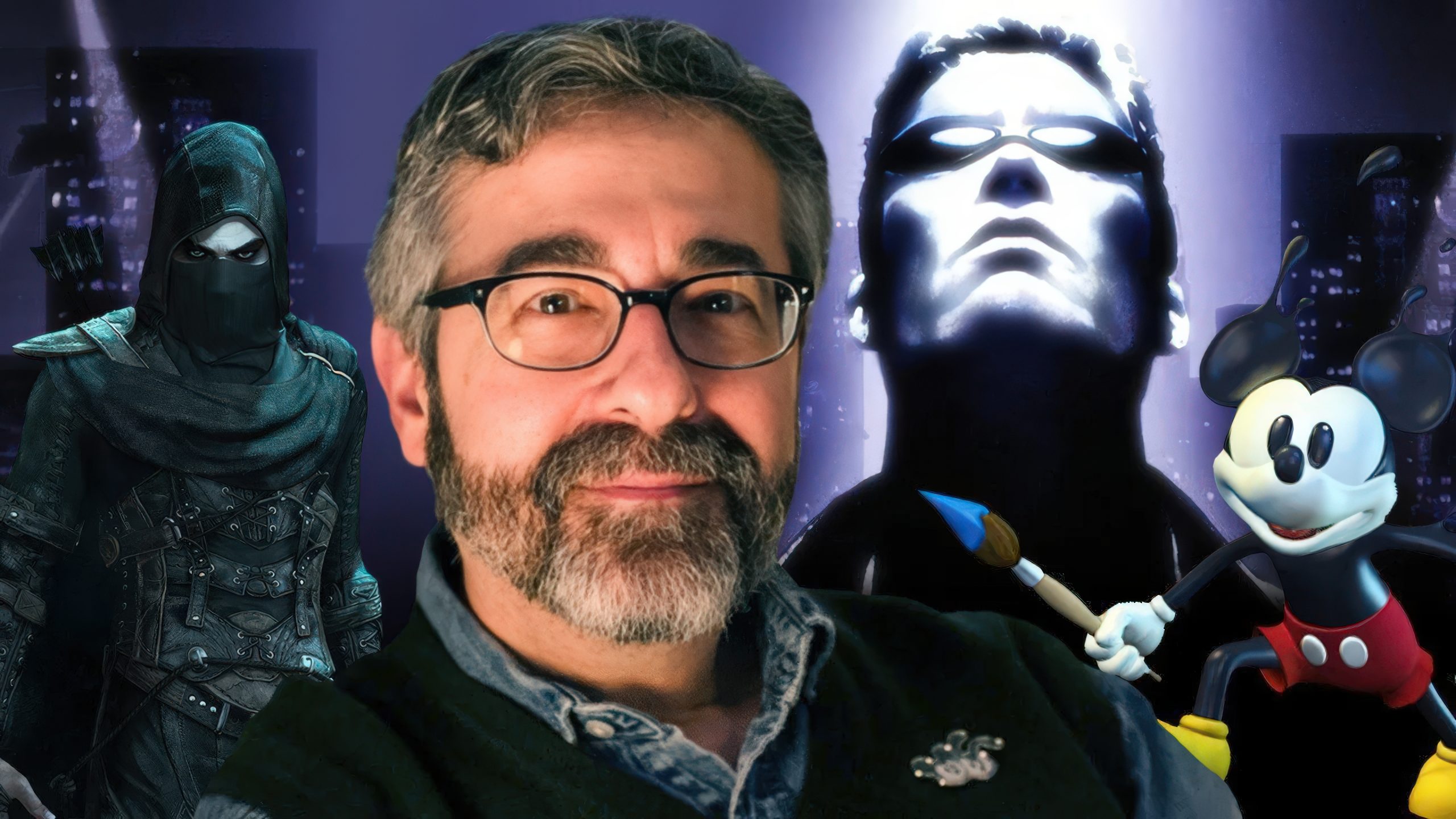
Warren Spector has announced his retirement after nearly 44 years in game development, bringing an end to one of the most influential careers in the history of immersive simulation.
Spector said his decision follows decades of work across tabletop games, board games, and digital games. During that time, he contributed to 17 complete video games and around nine expansion packs, while working with teams ranging from small groups to organizations with hundreds of people.
He is best known for Deus Ex, but his influence reaches far beyond a single series. His work helped shape the design philosophy behind immersive sims, where player choice, systemic interaction, and flexible problem solving are central to the experience.
His career began before video games
Spector started in tabletop games in the early 1980s, working with companies including Steve Jackson Games and TSR.
He moved into video game development in 1989 when he joined Origin Systems.
There, he worked on several major titles, including Ultima VI: The False Prophet and Wing Commander. He later contributed to Ultima Underworld, Ultima Underworld II, System Shock, Wings of Glory, Bad Blood, and Martian Dreams.
| Career stage | Notable work |
|---|---|
| Tabletop games | Steve Jackson Games, TSR |
| Origin Systems | Ultima VI, Wing Commander, Ultima Underworld, System Shock |
| Looking Glass era | System Shock, Thief |
| Ion Storm Austin | Deus Ex, Deus Ex: Invisible War, Thief: Deadly Shadows |
| Junction Point Studios | Epic Mickey, Epic Mickey 2 |
| OtherSide Entertainment | System Shock 3, Underworld Ascendant, Thick as Thieves |
| Career length | Nearly 44 years |
Ultima Underworld is widely regarded as one of the foundational games that helped establish what later became known as the immersive sim genre.
Deus Ex became his defining work
In 1997, Spector founded the Austin branch of Ion Storm.
That studio went on to create Deus Ex, released in 2000.
The game combined first person shooting, RPG systems, exploration, stealth, and player choice in a way that became highly influential.
Its design allowed players to approach objectives in different ways and made consequences feel tied to the decisions they made.

Spector remained at Ion Storm Austin through 2004, where he also oversaw Deus Ex: Invisible War and Thief: Deadly Shadows.
Disney and Epic Mickey marked a different phase
After leaving Ion Storm, Spector founded Junction Point Studios in 2005.
Disney later acquired the studio, and Spector directed Epic Mickey, which launched on Wii in 2010.
The project took a darker approach to Disney characters and settings while still using ideas around choice and consequence.
Epic Mickey 2: The Power of Two followed in 2012.
After Junction Point, Spector also spent time teaching game development before joining OtherSide Entertainment.
Later projects had mixed results
Spector's work at OtherSide included involvement with System Shock 3, Underworld Ascendant, and Thick as Thieves.
Not all of those projects found success.
Underworld Ascendant struggled commercially and critically, while System Shock 3 has remained absent despite being announced years ago.
Thick as Thieves also failed to attract a large enough audience and was followed by major layoffs at the studio.
Those difficulties form part of the later stage of a career that still spans several generations of game development.
Spector says a new generation should take over
In his retirement message, Spector said some of the games he worked on are still being played decades later and noted that several influenced the industry in ways he did not expect.
He also said one of the most meaningful parts of his career was helping talented people advance in their own work.
His contributions have been recognized with multiple lifetime achievement honors, including an award from the Game Developers Conference.
Spector also acknowledged that changes in the industry and a decline in his own enjoyment of the work influenced his decision to retire.
He said a new generation of developers deserves the opportunity to push game design forward and encouraged younger creators to make work strong enough that previous figures like him eventually become less important to the conversation.
For now, Spector plans to spend more time writing, reading, lecturing, and possibly consulting.
He has not ruled out returning completely, but his message makes clear that retirement is the current plan.
After nearly 44 years, his departure closes a major chapter in game development history, particularly for the immersive sim genre that his work helped define.



Discussion (0)
Be the first to comment.