Even though Sync Center and Offline Files are features present in older versions of Windows, few people know about them, let alone use them. That's why I decided to cover these tools in a mini-series of articles. In this first episode you will learn what Sync Center and Offline Files are, how to access them and the basics about working with them.
What's Changed About the Sync Center in Windows 7?
Very few people know that the Sync Center tool has been changed in Windows 7. It no longer allows you to sync data between your computer and other devices such as media players. It can be used only in conjunction with Offline Files and sync files found in network folders you work with when you are offline. Basically, it handles the data transfers required to synchronize the content of a network folder when you work on it offline. When you are connected again to the network, it will sync the files you have modified.
Where to Find the Sync Center
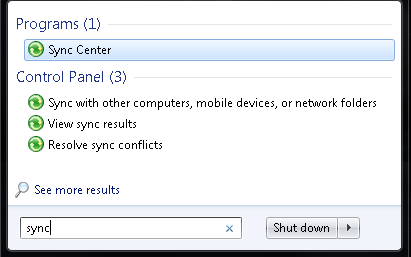
The Sync Center can be launched by searching for the word sync and clicking on the appropriate search result.
Sync Center in Windows 7
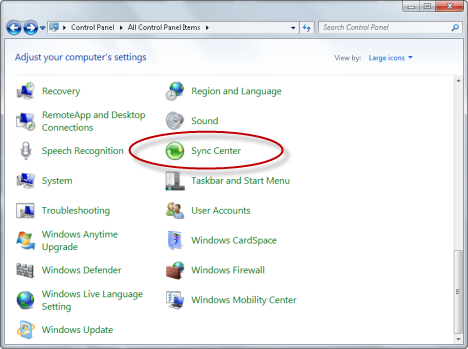
Alternatively, you can go to the Control Panel, use one of the icons views and click on the Sync Center shortcut.
Sync Center in Windows 7
When viewing the Control Panel by category, the Sync Center shortcut is not displayed in any of the available categories.
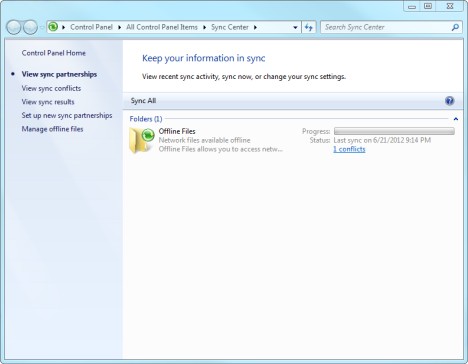
The Sync Center window is easy to understand and use. In the middle you can view the existing sync partnerships that were defined (if any) while on the left you have a column with links to different configurations menus and options.
Sync Center in Windows 7
First, Enable Offline Files
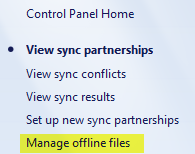
Before using the Sync Center to sync folders across the network, you need to make sure Offline Files are enabled. Therefore, click on Manage offline files.
Offline Files in Windows 7
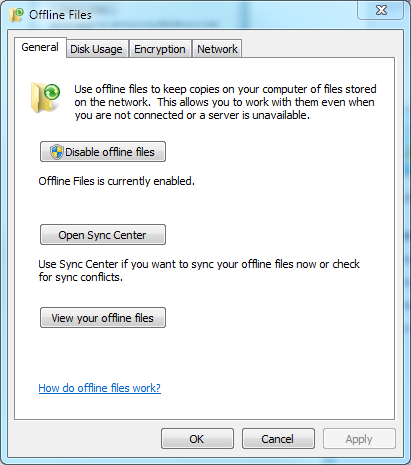
The Offline Files window is now opened. Here you can view its status. By default, it should be enabled on all Windows 7 computers that support this feature. If it is not, then enable it.
Offline Files in Windows 7
Then, Configure Offline Files
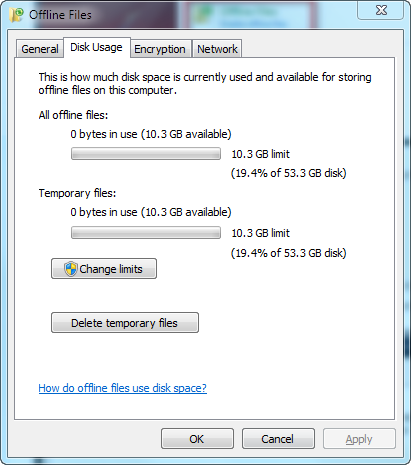
Don't be afraid to configure how Offline Files works on your computer. For example, in the Disk Usage tab you can change how much space is used by this feature.
Offline Files in Windows 7
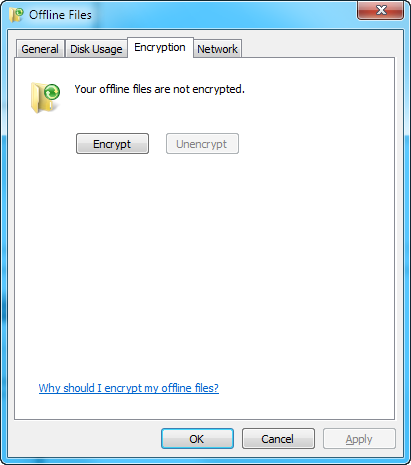
In the Encryption tab you can choose to enable encryption for your offline files, for an added layer of security.
Offline Files in Windows 7
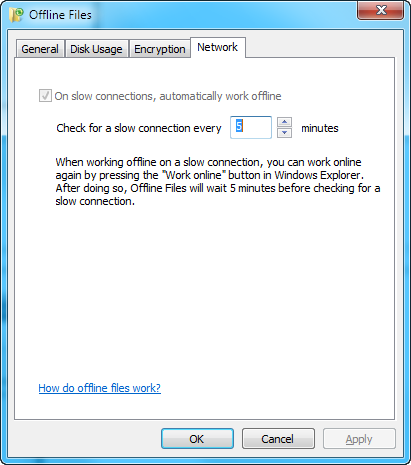
Last but not least, you can set how often you want Windows 7 to check for slow connections.
Offline Files in Windows 7
When a slow connection is detected, Windows 7 can automatically work offline and save local copies of the network files you are using. Once you have a fast connection, Sync Center will automatically sync your files.
How to Work Offline with Network Files and Folders
To save the contents of a network file on your computer and work with it offline, you first need to access it while you are connected to the network.
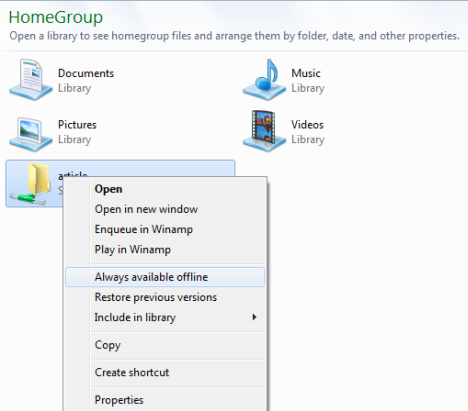
Use Windows Explorer to browse your Homegroup's or your network's shared folders.
When you right click on a folder, you should see an option which says "Always available offline". Click on it and the sync partnership will be automatically created in the Sync Center.
Offline Files in Windows 7
NOTE: This will work as intended only if the folder is shared with write permissions for the account you are using to access it.
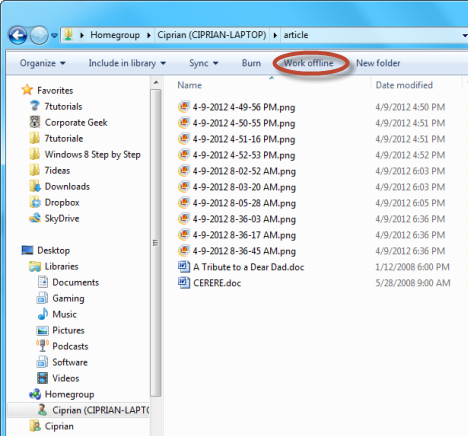
When you work on the same network folder and you are about to disconnect from the network or you just disconnected, click on the Work offline button. You will be able to work with the files in that folder as if the network was available.
Offline Files in Windows 7
When you are connected again to the network, press the Work online button.
Offline Files in Windows 7
To force a manual sync of the files in that folder, press the Sync button and choose Sync offline files in this folder.
Offline Files in Windows 7
On Which Versions of Windows 7 Does this Work?
Depending on your Windows 7 version, it can happen that you can open the Sync Center but you cannot setup any sync partnerships and you cannot use Offline files. Unfortunately, Offline files is enabled only for the following versions of Windows 7: Windows 7 Professional, Windows 7 Enterprise and Windows 7 Ultimate.
In other versions of Windows, you will have Sync Center available but you won't be able to use it.
Conclusion
As you can see from this tutorial, Offline Files and Sync Center can be great tools when you need to work with network folders and files on the go. In this article I covered the basics. We will follow up with an article covering more advanced settings. In the meantime, if you have any questions, don't hesitate to let us know.
I have problems with sync offline files. I’ve set up Sync as explained in the article above. The file I’ve amended last night at home when my laptop was not connected the the company’s network, will not sync automatically when I connect to the network this morning and logged in.
So I did a manual sync. In Syncentre it says : sync started and sync completed. But the file on the fileserver is NOT synced !
My laptop runs Windows7 professional and the file server is Windows Server 2008 R2 Enterprise.
Can you help me out ?
zephyr ·
Have the following problem: Via GPO the homeshare of the user is always offline available. The offline sync works fine and the files are offline available. But in Sync Center there is no Sync Partnership and in the icon bar there is also no Sync Center icon. Can you explain, how to fix it?
Latika ·
I have windows 7 ultimate running on laptop and pc. i have a folder named same way in both computers. i would like the laptop folder (A) to sync with pc folder (B) and viceversa. i have both the folders shared to full control. my problem is as follows:
laptop sync created a folder (C) in offline files which is copy of my pc folder and i can still see it when not connected to network or when pc is off.
but i would like to see the same name folder which is existing in my E drive (A) to sync with the folder on my pc (B).
when i access my laptop folder (A) it does not show me sync on the explorer.
Also when i am creating a sync, the sync center does not give me an option to choose the location for the folder.















Discussion (3)
I have problems with sync offline files. I’ve set up Sync as explained in the article above. The file I’ve amended last night at home when my laptop was not connected the the company’s network, will not sync automatically when I connect to the network this morning and logged in.
So I did a manual sync. In Syncentre it says : sync started and sync completed. But the file on the fileserver is NOT synced !
My laptop runs Windows7 professional and the file server is Windows Server 2008 R2 Enterprise.
Can you help me out ?
Have the following problem: Via GPO the homeshare of the user is always offline available. The offline sync works fine and the files are offline available. But in Sync Center there is no Sync Partnership and in the icon bar there is also no Sync Center icon. Can you explain, how to fix it?
I have windows 7 ultimate running on laptop and pc. i have a folder named same way in both computers. i would like the laptop folder (A) to sync with pc folder (B) and viceversa. i have both the folders shared to full control. my problem is as follows:
laptop sync created a folder (C) in offline files which is copy of my pc folder and i can still see it when not connected to network or when pc is off.
but i would like to see the same name folder which is existing in my E drive (A) to sync with the folder on my pc (B).
when i access my laptop folder (A) it does not show me sync on the explorer.
Also when i am creating a sync, the sync center does not give me an option to choose the location for the folder.