



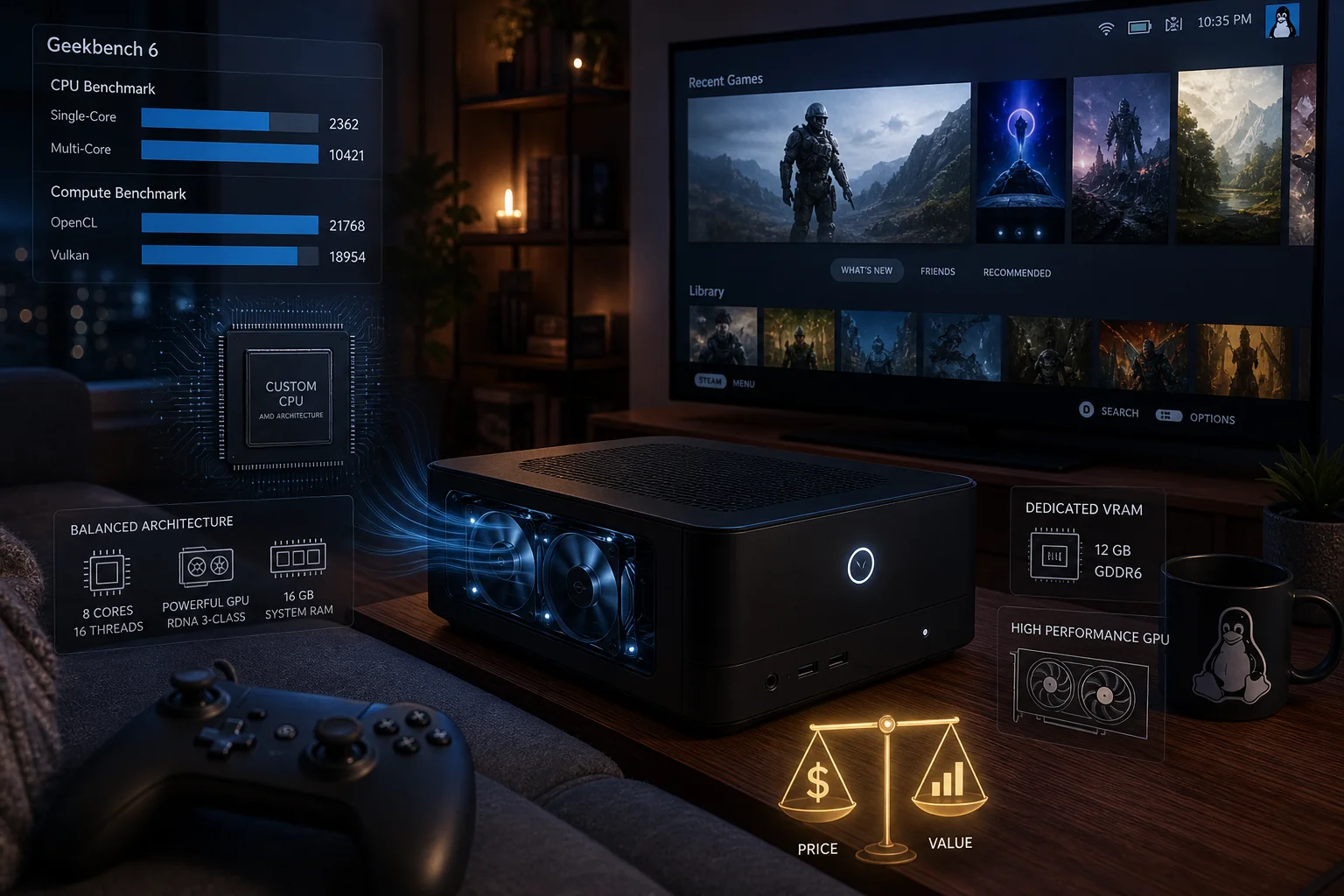
Valve’s upcoming Steam Machine has appeared in new Geekbench 6 benchmark results, and the CPU scores are not especially impressive compared with some gaming handhelds already on the market. However, the numbers do not tell the full story, because the Steam Machine is expected to rely heavily on its dedicated RDNA 3 graphics hardware rather than CPU power alone.
The leaked results reportedly show the Steam Machine running Linux, likely SteamOS, with Valve’s custom AMD 1772 processor. The best scores listed are 2,334 in single core and 7,392 in multi core performance. Those numbers place the chip behind several premium handheld processors, including AMD’s Ryzen AI Z2 Extreme and Intel’s Core Ultra 7 258V.
That may sound worrying at first, but context matters. Geekbench only measures one part of system performance. It does not show how the full Steam Machine will behave in real games, especially since the GPU, memory setup, cooling, SteamOS tuning, and target resolution will all matter.
What the leaked Steam Machine CPU scores show
The Steam Machine’s custom AMD 1772 chip is believed to have 6 cores and 12 threads, with a boost clock up to 4.86GHz. That is a capable setup, but it is not built to top CPU charts.
By comparison, some modern handheld chips use 8 core designs and can run at higher power limits. That naturally gives them an advantage in synthetic CPU tests. In the leaked results, Valve’s chip lands around the middle of the pack rather than near the top.
| Device or chip | CPU performance takeaway |
|---|---|
| Steam Machine custom AMD 1772 | Modest Geekbench 6 scores |
| Ryzen AI Z2 Extreme | Stronger CPU scores in tested handhelds |
| Core Ultra 7 258V | Competitive handheld class CPU performance |
| Steam Deck custom AMD chip | Older and weaker than Steam Machine CPU |
| Steam Machine GPU | Still unknown in real benchmarks |
The important point is that these results are CPU only. They do not measure the dedicated GPU, which is expected to be one of the Steam Machine’s biggest advantages over handheld PCs.
Why the CPU gap may not be a major issue
The Steam Machine is not a handheld. It is expected to be a living room gaming PC designed around SteamOS and TV gaming. That changes the performance priorities.
A handheld gaming PC must balance CPU, GPU, battery life, heat, and screen resolution inside a very small body. The Steam Machine has more room to cool hardware and is expected to use a stronger GPU setup with 8GB of dedicated VRAM.
That matters because many games are more limited by GPU performance than CPU performance, especially at higher resolutions. If the Steam Machine’s RDNA 3 GPU performs well, it could make the weaker CPU benchmark scores much less important in real gameplay.
Where the Steam Machine CPU could struggle
There are still some cases where CPU performance matters. Large open world games, heavy physics systems, simulation titles, strategy games, and high frame rate targets can all put more pressure on the CPU.
If Valve is targeting smooth living room play at common TV resolutions and frame rates, the CPU may be enough. But if players expect very high frame rates or demanding PC settings, the custom AMD chip could become a limitation in some games.
This is why final performance testing will matter. A synthetic score can highlight possible weaknesses, but it cannot replace real game benchmarks across different genres.
SteamOS results may improve before launch
The new benchmark results reportedly come from Linux, while earlier numbers appeared from a Windows setup. Some Windows results were better, which may suggest SteamOS tuning is still in progress.
That would not be surprising. Valve is expected to ship the Steam Machine with SteamOS, and performance can change as drivers, kernel updates, power profiles, and game compatibility improve.
The Steam Deck also benefited from software updates over time. If Valve applies the same approach to the Steam Machine, early benchmark leaks may not reflect final launch performance.
There is no reason to panic yet
The Steam Machine’s CPU scores are not exciting, but they are not enough to judge the device. The system’s gaming value will depend much more on its GPU performance, SteamOS optimization, price, storage, noise, and how well it handles modern PC games on a TV.
Valve has said the Steam Machine is still planned to ship this summer, although pricing remains unknown. That price will be critical. If the system lands too close to more powerful gaming PCs, the modest CPU numbers may become harder to ignore. If Valve prices it well, the Steam Machine could still be a strong living room option.
For now, the leaked Geekbench scores should be treated as an early warning, not a final verdict. The CPU may not set records, but the Steam Machine was never likely to win on CPU alone. Its success will depend on whether Valve can deliver a balanced, affordable, SteamOS powered gaming box with enough GPU strength to make the living room PC idea feel simple.



Discussion (0)
Be the first to comment.