



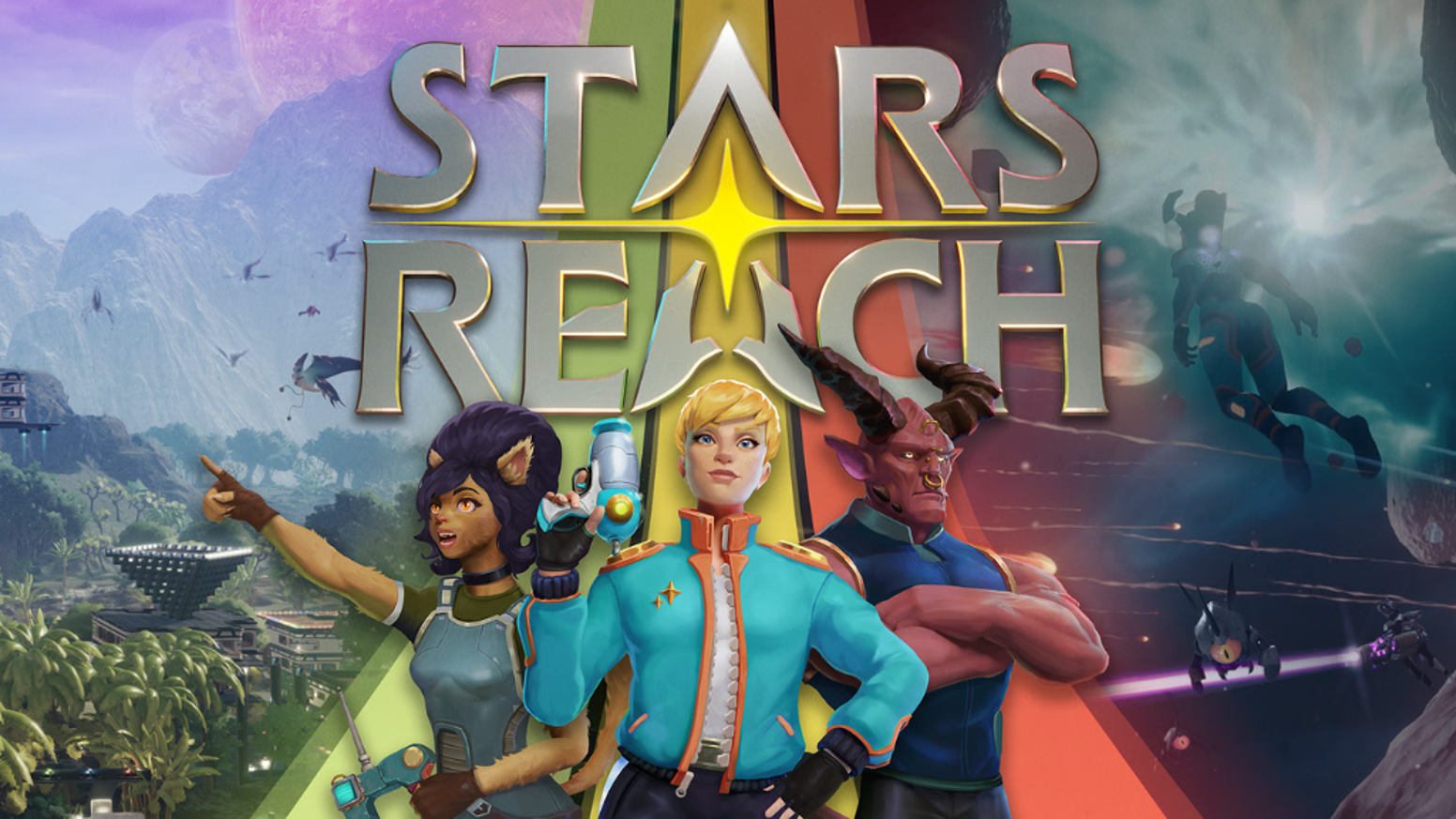
Stars Reach is trying to bring back a kind of MMO that has become rare: a living sandbox where players shape the world, build communities, create economies, and leave lasting marks on the game. Instead of following the usual theme park MMO structure built around fixed zones, scripted quest hubs, and planned raids, Stars Reach is leaning into player freedom, simulation, and social systems.
The game comes from Playable Worlds and is being led by Raph Koster, whose past work includes Ultima Online and Star Wars Galaxies. That history matters because Stars Reach appears to draw heavily from older MMO design, where the world was not only a place to complete quests but also a space where players could form towns, professions, governments, markets, and social roles.
Koster has described the game as a mix of Star Wars Galaxies, RuneScape, Eve, and Ultima Online. That comparison gives a clearer idea of the project’s ambition. Stars Reach is not only trying to be a survival game with multiplayer elements. It is trying to build a galaxy where players can claim planets, shape their rules, and decide what each world becomes.
Some planets could become PvP warzones. Others could become peaceful trade hubs, public cities, conservation zones, or social spaces. These worlds are connected by wormholes, and the map itself is not fixed. If players stop visiting an area, its connection can collapse and the zone can disappear.
Stars Reach uses simulation to make the world feel alive
The most unusual part of Stars Reach is its simulation. The game includes hundreds of materials with different properties, including hardness and behavior. These materials can react in realistic ways, allowing players to reshape the world through tools and environmental interaction.
Rocks can be heated into lava. Marble can be eroded into limestone, then chalk, then sand. Sand can be heated into glass. Water can carve channels through rock and drain into valleys. These details may sound small, but they are important because they give players tools to experiment with the world rather than only move through it.
| Feature | What Stars Reach is trying to offer |
|---|---|
| World structure | Procedurally generated planets |
| Player control | Planet rules, cities, governments, and land use |
| Travel | Wormholes that open and close based on use |
| Professions | More than 40 separate XP tracks |
| Skills | More than 1,000 skills planned |
| Social systems | Leadership, journalism, roleplay, and politics |
| Simulation | Materials, erosion, terrain changes, and environmental reactions |
| Launch plan | Early access planned for this summer |
The idea is to make the environment part of the MMO experience. Instead of only gathering resources and crafting items, players can change landscapes, build settlements, protect ecosystems, and create infrastructure.
The profession system may be the game’s strongest idea
Stars Reach has more than 40 professions, and each one earns XP separately. Players can focus on combat, crafting, cooking, botany, xenobiology, leadership, journalism, and more. Characters can actively use four professions at a time, but they can level many of them independently.
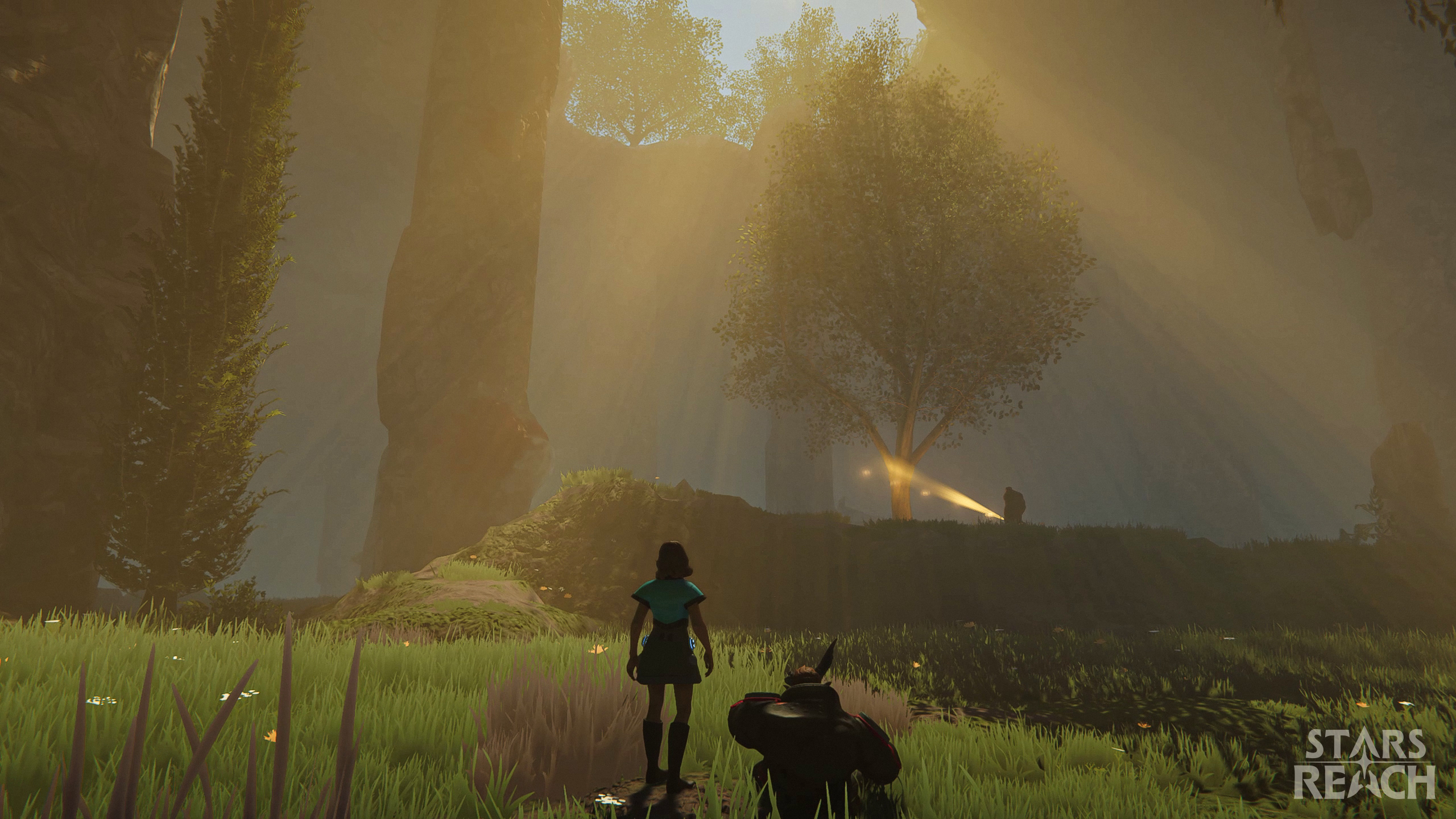
That system is clearly inspired by older sandbox MMOs, especially Star Wars Galaxies. It gives players ways to exist in the world without needing to be combat focused all the time. A player could become a fighter, builder, scientist, politician, journalist, conservationist, or community organizer.
The leadership track is especially interesting because it rewards social behavior. Players can earn progress by leading groups, rescuing others, and helping organize communities. The journalism track is built for roleplayers and creators, with an in game news network where players can post articles or videos, receive likes, charge money, and unlock tools like drone cameras.
That kind of system is rare in modern MMOs. Most online RPGs support social behavior indirectly, but Stars Reach seems to be turning it into progression.
Player creativity could define whether Stars Reach succeeds
The early examples from playtesting are promising. Players have reportedly built cities, formed governments, created public parks, set up zoos, made community gardens, and even experimented with systems that resemble steam power, subways, and elevators.
One of the more interesting examples involves an animal conservation union. Because species can reportedly disappear if players destroy their habitats, some players have started preserving plants and animals. That gives environmental choices real stakes and turns conservation into a player driven activity rather than only background decoration.
This is the kind of story that makes sandbox MMOs exciting. The best moments in these games often come from things developers allow rather than things they directly script. If Stars Reach can support that kind of creativity at scale, it could appeal to players who miss the older MMO style.
The risk is that the game may be too ambitious. Procedural planets, player governments, deep material simulation, professions, ecology, PvP rules, wormholes, and social systems are all difficult to balance. Any one of these systems could become messy if not handled carefully.
Still, the MMO genre could use a project willing to take that risk. Modern MMOs often focus on polished combat, seasonal updates, raids, and controlled progression. Stars Reach is aiming for something looser, stranger, and more player driven.
Stars Reach is planned to launch in early access this summer. It may not deliver on every part of its vision right away, but its direction is worth watching. If Playable Worlds can turn its simulation and profession systems into a stable online world, Stars Reach could become one of the most interesting sandbox MMOs in years.



Discussion (0)
Be the first to comment.