



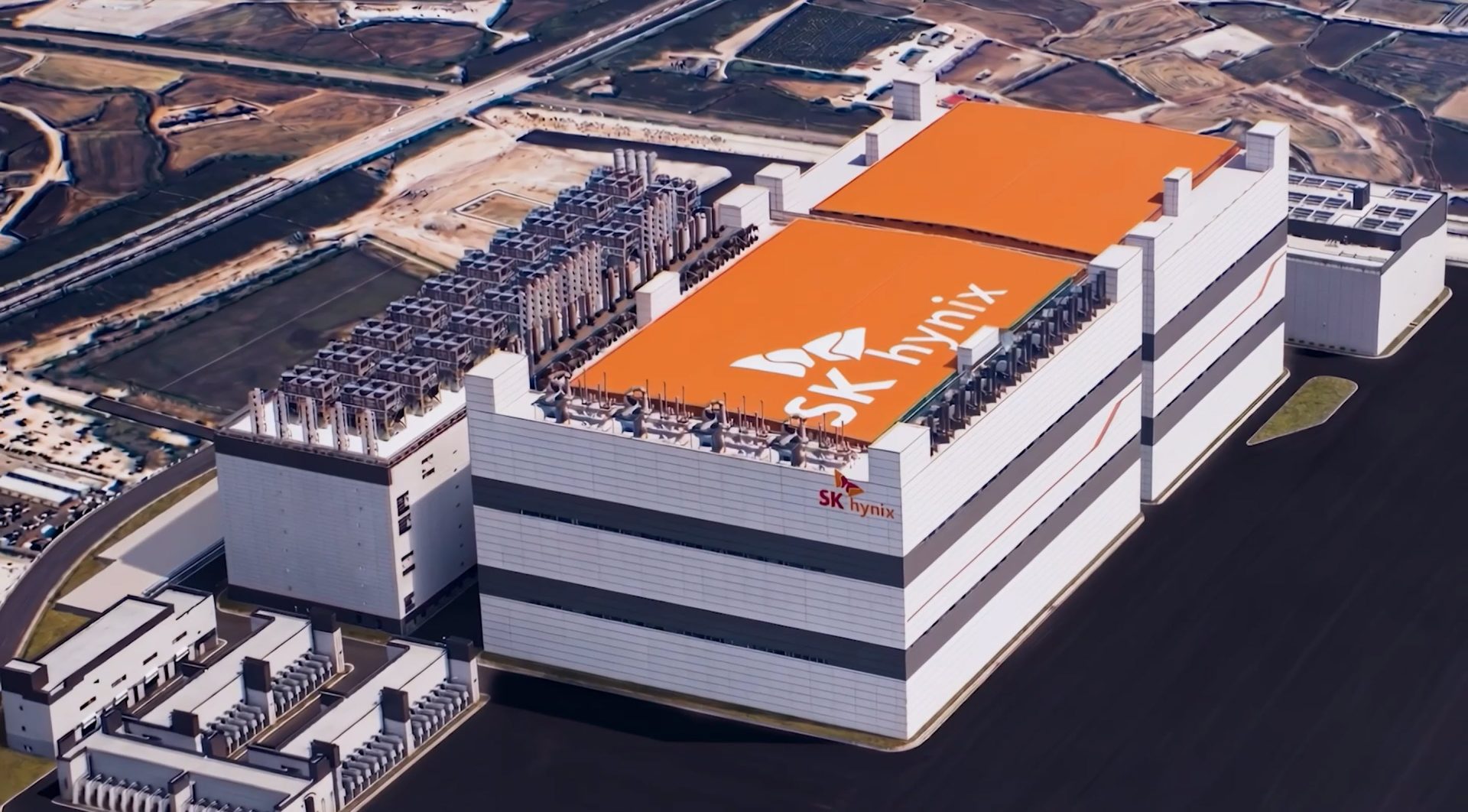
SK Hynix is reportedly moving forward with its next generation iHBM memory technology, which aims to improve heat dissipation in high bandwidth memory chips by reducing thermal resistance by up to 30%.
The South Korean memory manufacturer has begun discussions with domestic and international suppliers about production requirements, manufacturing equipment, and the potential commercialization of iHBM.
The technology introduces integrated cooling elements directly into the memory package to address one of the biggest challenges facing increasingly powerful AI accelerators.
Although SK Hynix is currently focused on manufacturing HBM4 memory, its longer term plans reportedly include introducing iHBM technology with future HBM5 products.
SK Hynix iHBM Uses Integrated Cooling to Improve Heat Dissipation
High bandwidth memory is widely used in advanced AI processors because it provides high data transfer speeds while occupying relatively little physical space.
Unlike conventional memory modules, HBM uses several DRAM dies stacked vertically on top of a base die.
This construction allows memory chips to deliver substantial bandwidth through a compact package.
However, stacking multiple memory layers also creates thermal challenges.
Heat generated within the middle layers can become difficult to remove, particularly as manufacturers increase memory capacity and performance.
Traditional cooling solutions generally rely on heat spreaders, heatsinks, and liquid cooling equipment connected to the processor package.
SK Hynix wants to address these limitations by integrating cooling structures more directly into the memory stack.
The company's proposed iHBM technology uses Integrated Cooling Elements, known as ICE, to improve heat transfer.
According to the reported design, these elements will be incorporated into the physical connections between semiconductor dies, including the die to die physical interface.
The approach is intended to reduce thermal resistance by as much as 30%, helping heat move away from critical parts of the memory package more efficiently.
Importantly, this figure refers to thermal resistance rather than a guaranteed 30% reduction in operating temperature or power consumption.
Actual improvements will depend on the final chip design and cooling configuration.
Why HBM Memory Faces Increasing Thermal Challenges
Modern HBM packages are constructed using several interconnected components.

DRAM dies are stacked above a base die, which connects the memory to a silicon interposer.
The interposer allows HBM stacks to communicate with an adjacent GPU or AI accelerator.
The complete assembly is connected to a package substrate and eventually to the system's printed circuit board.
As more memory layers are added, removing heat from the internal dies becomes increasingly difficult.
This can affect operating efficiency and potentially limit how aggressively manufacturers increase memory speeds and capacity.
SK Hynix's integrated cooling approach aims to improve heat transfer closer to where that heat is generated.
The expected benefits include improved thermal management and greater flexibility when designing future high density memory packages.
However, the company has not disclosed detailed commercial performance results for iHBM.
iHBM Technology Could Be Introduced With HBM5
SK Hynix is reportedly considering iHBM for its future HBM5 generation.
The company is currently concentrating on HBM4 manufacturing, making iHBM a potential longer term development rather than an immediately available commercial product.
The reported technology roadmap can be summarized as follows.
| Technology | Current reported position |
|---|---|
| HBM4 | Current manufacturing priority |
| iHBM | Production and commercialization discussions |
| Integrated Cooling Elements | Designed to reduce thermal resistance by up to 30% |
| HBM5 | Potential future application of iHBM |
| MR-MUF | Existing packaging technology expected to support production |
No official mass production schedule or commercial launch date has been confirmed for iHBM.
The discussions reportedly involve evaluating whether the technology can be manufactured at scale using existing suppliers and production processes.
Existing MR-MUF Technology May Simplify iHBM Manufacturing
SK Hynix reportedly intends to use its Mass Reflow Molded Underfill technology, commonly known as MR-MUF, when developing iHBM.
MR-MUF is an established packaging method used in the company's HBM manufacturing processes.
By building on existing production methods, SK Hynix may be able to reduce the complexity of introducing the new cooling technology.
The approach could also allow the company to work with suppliers that already provide materials and equipment for its memory products.
Industry sources suggest that establishing an iHBM supply chain may therefore be relatively straightforward compared with introducing an entirely new packaging process.
However, production readiness will still depend on manufacturing yields, material compatibility, costs, and successful technical validation.
Discussions with suppliers do not necessarily mean commercial manufacturing has begun.
AI Accelerators Could Benefit From Improved HBM Cooling
Advanced AI accelerators increasingly depend on high bandwidth memory to handle large models and demanding computing workloads.
As manufacturers develop faster processors with greater memory capacity, thermal management becomes an important part of maintaining reliable performance.
Improved cooling could help future HBM products operate more efficiently within increasingly complex semiconductor packages.
It may also provide additional design flexibility as manufacturers introduce higher memory stacks.
For companies developing AI infrastructure, better memory cooling could support future improvements in performance and system density.
However, SK Hynix has not announced specific AI accelerators that will use iHBM.
The company also has not confirmed how much the technology might affect manufacturing costs or overall system power consumption.
Its potential impact will become clearer once commercial specifications and independent performance data are available.
For now, SK Hynix's reported supplier discussions indicate progress toward a new generation of thermally optimized HBM memory.
If the company successfully commercializes integrated cooling with HBM5, iHBM could help address the growing thermal challenges associated with high performance AI memory.


Discussion (0)
Be the first to comment.