


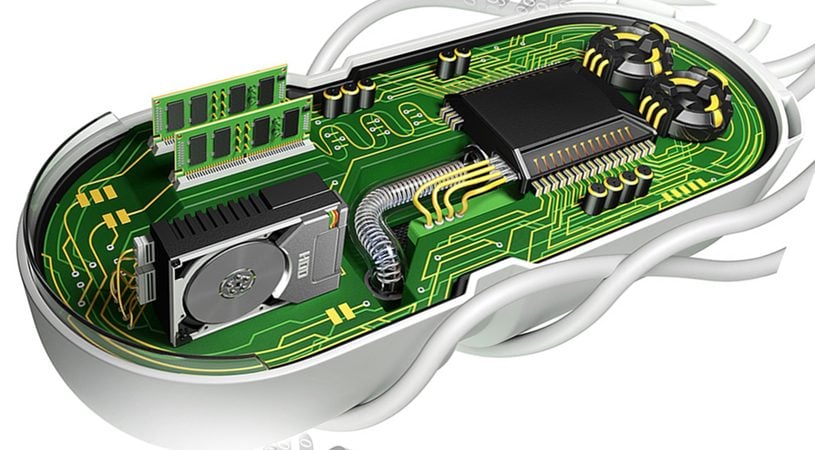
Researchers have developed an experimental biological computer that uses living bacteria to solve mathematical problems, demonstrating an alternative approach to conventional electronic computing.
The project, led by an international research team involving McGill University, uses microorganisms such as E. coli and Vibrio natriegens to explore multiple possible solutions simultaneously.
Unlike traditional processors, which rely on electronic circuits, the experimental system uses microscopic channels to guide bacteria through different computational pathways.
The researchers also demonstrated how bacterial reproduction could increase the number of organisms participating in a calculation, potentially allowing the system to expand its computing resources naturally.
Although the technology remains experimental, it could eventually support specialized computational tasks in scientific research.
Living Bacteria Navigate Microscopic Channels to Perform Calculations
The researchers demonstrated their approach using the Subset Sum Problem, a mathematical challenge involving finding combinations of numbers that satisfy a specific target.
The problem becomes increasingly difficult as the number of possible combinations grows.
To investigate a biological alternative, scientists constructed a network of interconnected microscopic channels.
Bacteria introduced into the network travel through different routes, with each junction representing a computational decision.
The organisms collectively explore possible solutions, allowing multiple pathways to be examined in parallel.
Researchers then use image analysis to identify which routes the bacteria successfully completed and determine whether those pathways correspond to valid solutions.
An important characteristic of this approach is that bacteria can reproduce while moving through the system.
As their population increases, additional organisms become available to explore more pathways without requiring the installation of conventional processing hardware.
Bacterial Reproduction Could Help Biological Computers Scale
Conventional parallel computing systems depend on the processing resources available when a calculation begins.
The experimental biological system offers a different possibility because its participating organisms can multiply.
Researchers can regulate temperature to influence bacterial growth and help manage population density.
However, several technical challenges remain.
Bacteria do not always navigate junctions correctly, and overcrowding can interfere with reliable operation.
The system also requires careful monitoring to identify valid computational results.
For these reasons, the researchers describe the technology as an early demonstration rather than a practical replacement for electronic computers.
Potential future applications include mathematical optimization, molecular biology, protein research and specialized computational problems.
However, these possibilities remain subjects for further investigation, and the research has not established that bacterial computers outperform modern processors in practical workloads.
The experiment demonstrates that living organisms can participate directly in computational processes, providing another direction for researchers exploring alternatives to silicon technology.



Discussion (0)
Be the first to comment.