



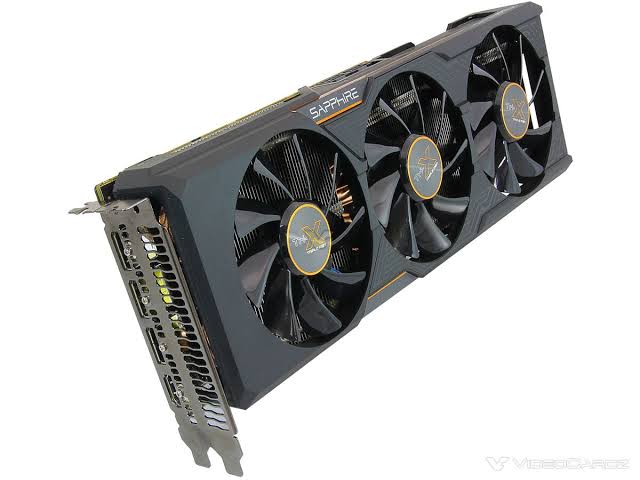
SAPPHIRE is celebrating its 25th anniversary, marking a quarter century since the company was founded in Hong Kong in 2001.
The hardware maker began as a graphics card specialist closely connected to ATI reference designs and has since expanded into Radeon GPUs, motherboards, Mini PCs, professional graphics products and embedded computing systems.
Its history also covers the transition from ATI to AMD, with SAPPHIRE remaining one of the longest standing board partners associated with Radeon hardware.
SAPPHIRE started with ATI graphics cards
SAPPHIRE says it was originally established as a home for ATI reference card production.
That relationship began before AMD acquired ATI for $5.4 billion in October 2006.
SAPPHIRE continued producing Radeon based products after the acquisition and has released graphics cards across many generations since then.
Over the years, the company has used several product families and branding schemes, including ATOMIC, TOXIC, NITRO+, PULSE and PURE.
| Area | SAPPHIRE activity |
|---|---|
| Founded | 2001 |
| Original focus | ATI reference graphics cards |
| Long term GPU partner | AMD Radeon |
| Graphics brands | ATOMIC, TOXIC, NITRO+, PULSE, PURE |
| Current flagship GPU line | Radeon RX 9070 XT and RX 9070 NITRO+ |
| Other hardware | Motherboards and Mini PCs |
| AI focus | Ryzen AI systems with NPUs up to 50 TOPS |
| Industrial expansion | Robotics, automotive and computer vision systems |
The company’s past catalog includes recognizable products such as Radeon R9 Fury Tri X cards, RX 470D models, R9 370X TOXIC hardware, HD 7970 and HD 5870 cards.
RX 9070 XT continues the Radeon focus
SAPPHIRE’s current consumer graphics lineup includes Radeon RX 9070 XT and RX 9070 models under the NITRO+ family.
Depending on the specific version, some RX 9070 XT models can reach clock speeds of up to 3060 MHz.
The company has also continued producing special edition graphics cards tied to games and other themes.
This shows that desktop gaming GPUs remain a major part of SAPPHIRE’s business even as the company moves into additional hardware categories.
Its long relationship with Radeon also makes the 25 year milestone notable because the company has remained attached to the same graphics ecosystem through ATI’s transition into AMD.
Business now extends beyond desktop GPUs
SAPPHIRE is increasingly moving outside traditional graphics cards.
Its portfolio now includes motherboards and EDGE AI Mini PCs based on AMD Ryzen AI processors.
These systems use integrated NPUs capable of delivering up to 50 TOPS of AI performance.
The Mini PC expansion gives SAPPHIRE access to a market that is growing beyond conventional desktop gaming, particularly as more AI workloads move onto local hardware.
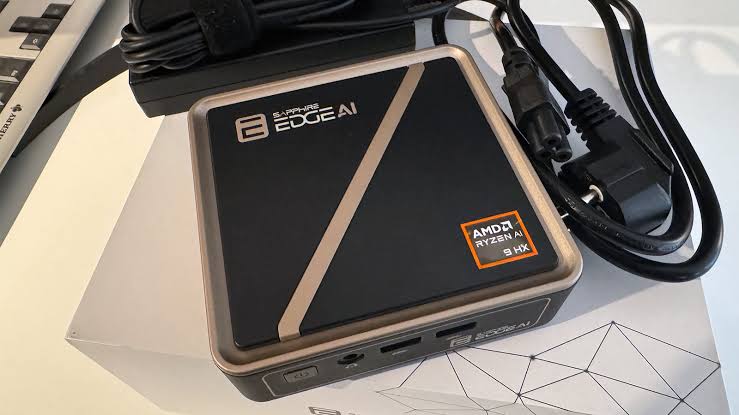
Compact systems with Ryzen AI processors can combine CPU, GPU and NPU processing in a relatively small platform.
That makes them suitable for development, productivity and edge computing applications where dedicated accelerator cards are not always practical.
EDGE+ systems target robotics and automotive workloads
SAPPHIRE is also developing a broader EDGE+ product line for professional and industrial use.
The company says these systems are aimed at areas such as robotics, automotive computing and computer vision.
Those workloads typically require local processing with low latency, making integrated AI hardware useful for tasks such as image recognition, sensor processing and machine control.
This direction moves SAPPHIRE beyond the consumer GPU market and puts part of its future growth around embedded computing and AI acceleration.
Anniversary giveaway includes Radeon and Ryzen hardware
SAPPHIRE is also using the anniversary to promote a hardware giveaway.
The prize package includes parts from its PhantomLink ecosystem, including an X870EA motherboard and a Radeon RX 9070 XT graphics card.
The giveaway also includes a Ryzen 7 9800X3D processor and gaming headset.
The promotion reflects the company’s current position, where graphics cards remain central but are now part of a much wider AMD based hardware portfolio.
After 25 years, SAPPHIRE has moved from ATI reference graphics production into a broader business covering Radeon GPUs, motherboards, Mini PCs, AI systems and embedded computing.
Its future direction appears to combine the gaming hardware that established the brand with newer markets built around local AI processing, robotics and other edge computing workloads.
Discussion (0)
Be the first to comment.