



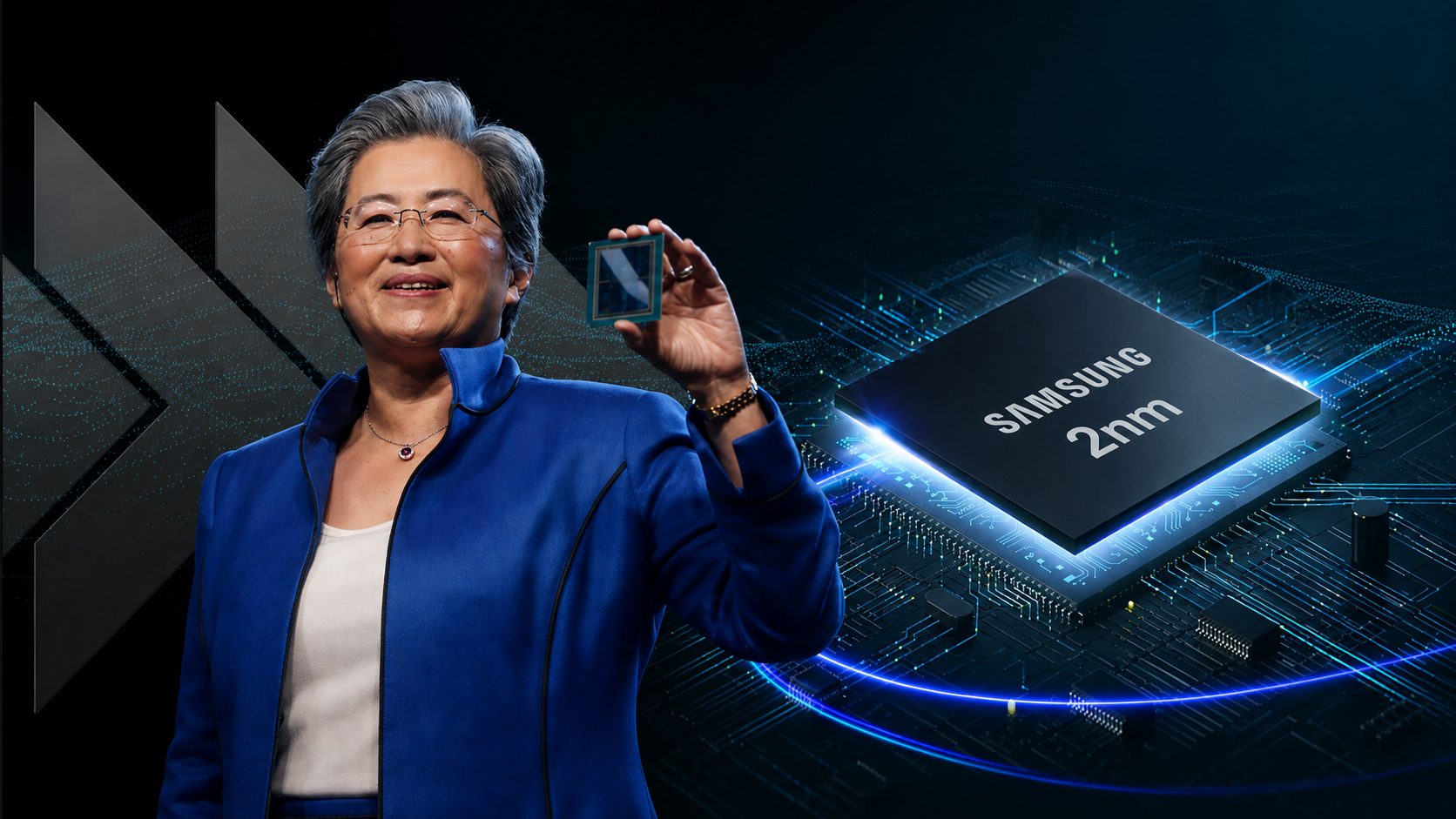
Samsung Foundry may have landed an important 2nm CPU order from a major North American fabless chip company, and AMD is being identified as the likely customer.
The report comes as AMD looks for more advanced manufacturing capacity outside TSMC. TSMC remains AMD’s main chipmaking partner, but its advanced node capacity is heavily booked through 2028. That makes Samsung a more serious option if AMD wants enough supply for upcoming server and AI focused CPUs.
The order is believed to involve AMD’s next generation Venice and Verano processors. Venice is expected to use Zen 6C cores and could scale up to 256 cores across eight CCDs. Verano is described as a more AI focused variant designed for agentic AI workloads such as inference, and it may work alongside AMD’s Instinct MI500 series GPUs.
Samsung’s 2nm process uses gate all around transistor technology, and winning AMD business would be a major boost for Samsung Foundry. The company has been trying to prove it can compete more directly with TSMC at advanced nodes, and a high profile AMD order would help build confidence.
Here is the main picture:
| Area | Details |
|---|---|
| Foundry | Samsung |
| Reported node | 2nm |
| Likely customer | AMD |
| Possible chips | Venice and Verano CPUs |
| Venice focus | High core count Zen 6C server CPU |
| Verano focus | AI inference and agentic AI workloads |
| Main reason | TSMC advanced capacity is tight through 2028 |
| Key uncertainty | Whether Samsung is a backup or a shared production partner |
The biggest unknown is the size of the order. AMD may use Samsung only as a backup source if TSMC cannot supply enough wafers. In that case, Samsung’s volume could be limited. The more important scenario would be a split production plan, with AMD using both TSMC and Samsung for Venice and Verano.
That would be a major shift. AMD has relied heavily on TSMC for its strongest products, especially in CPUs and GPUs. Moving some advanced CPU production to Samsung would show how serious the supply problem has become.

There may also be a memory angle. Samsung is one of the world’s largest DRAM suppliers, and AI servers need huge amounts of memory. If AMD can secure both advanced foundry capacity and better access to memory supply through Samsung, the partnership could be useful beyond just wafer production.
Still, Samsung has to prove yields. A 2nm deal only matters if Samsung can produce chips in useful volumes with good quality and competitive efficiency. That will decide whether AMD treats Samsung as a small backup option or a real second source for major future CPUs.
For AMD, the logic is clear. AI and data center demand are rising quickly, and waiting on limited TSMC capacity could slow its plans. For Samsung, an AMD order would be one of the clearest signs yet that its foundry business still has a serious path back into high end chipmaking.


Discussion (0)
Be the first to comment.