




A claimed solution to the Navier Stokes existence and smoothness problem has entered formal review after the Clay Mathematics Institute acknowledged that the long standing Millennium Prize Problem may have been resolved.
The claim follows work involving an advanced OpenAI agent system, although the proposed proof has not yet been validated. The institute has made clear that any evaluation will be careful and slow, meaning a final decision could take years.
The Navier Stokes problem is one of the seven Millennium Prize Problems announced in 2000. Each problem carries a $1 million prize for an accepted solution.
| Detail | Status |
|---|---|
| Problem | Navier Stokes existence and smoothness |
| Millennium Prize value | $1 million |
| Claim status | Not yet verified |
| Reviewing body | Clay Mathematics Institute |
| Review process | Expected to take multiple years |
| Millennium Problems announced | 2000 |
| Problems originally listed | Seven |
| Previously solved problem | Poincaré conjecture |
The claimed proof still needs extensive verification
The most important point is that the Navier Stokes problem has not officially been declared solved.
The Clay Mathematics Institute has acknowledged the proposed resolution and will now begin a lengthy evaluation process involving expert mathematicians.
That process is intentionally conservative. A proof of this importance needs to survive detailed examination, independent checking and broader scrutiny from specialists before it can be accepted.
The institute has said the review will be deliberately unhurried and that additional information will be provided as the analysis progresses.
Until that work is completed, the claimed solution should be treated as a potentially important result rather than a confirmed mathematical breakthrough.
Navier Stokes deals with the mathematics of fluid motion
The Navier Stokes equations describe how fluids such as liquids and gases move.
The Millennium Prize question focuses on whether sufficiently smooth solutions always exist for the three dimensional equations under suitable starting conditions, or whether singularities can develop.
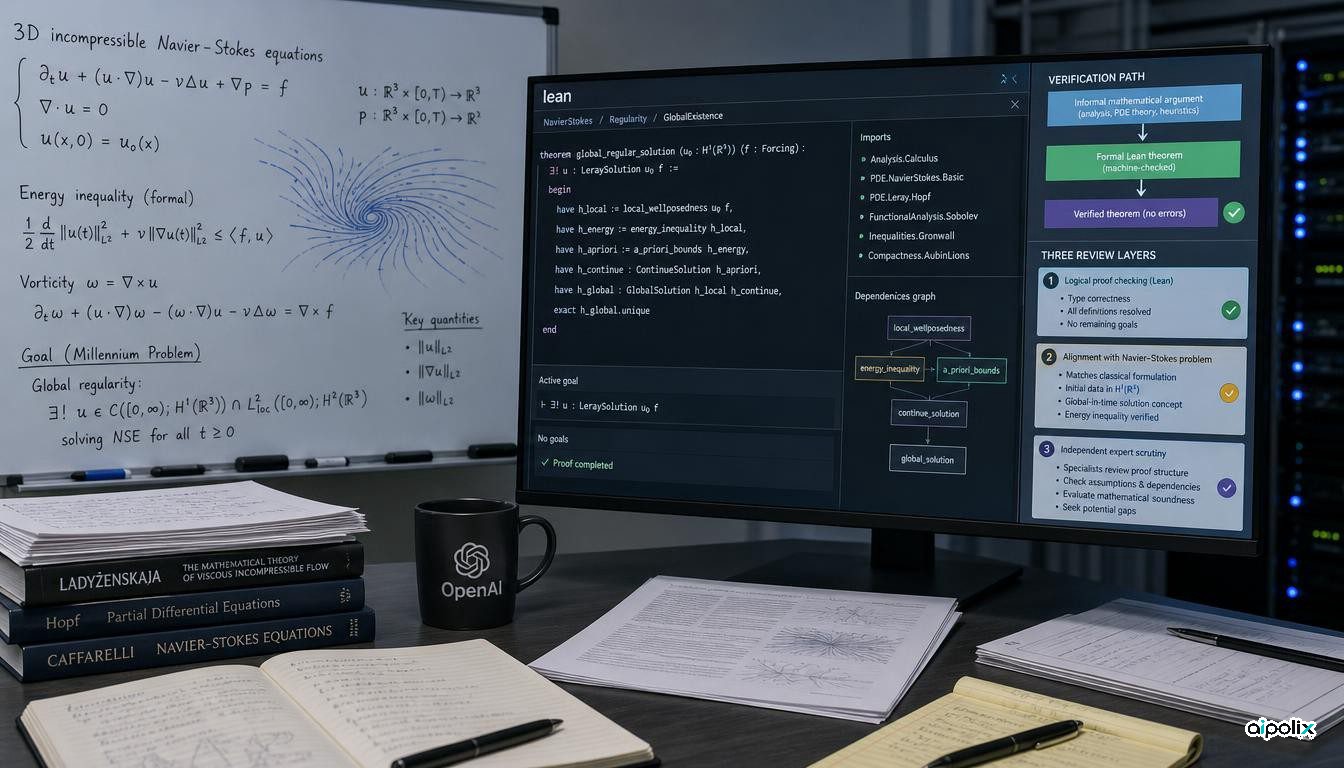
The equations are fundamental across physics and engineering. They are used to study areas including airflow, water movement, turbulence and other fluid systems.
Mathematicians have made substantial progress on related problems, but the full three dimensional existence and smoothness question has resisted a complete proof for decades.
That difficulty is why it was selected as one of the Millennium Prize Problems.
Questions remain over how credit should be assigned
There is also uncertainty surrounding who should receive credit if the result is ultimately accepted.
The reported work involved OpenAI agents, while two mathematicians had also been working on the problem with assistance from Codex.
That creates questions about whether the AI system generated the crucial mathematical ideas independently, built upon private work supplied through other interactions, or worked as part of a broader human and AI research process.
The institute has not yet publicly identified the researchers who would receive formal recognition.
Those questions are likely to become clearer only after the proof itself has been examined and its development history is better understood.
Only one Millennium Prize Problem has been resolved so far
The Clay Mathematics Institute introduced seven Millennium Prize Problems in Paris in 2000.
The Poincaré conjecture is the only one that has been successfully resolved so far. Grigori Perelman published the key work beginning in 2002, and the result was later accepted by the mathematical community.
The remaining problems include the Riemann hypothesis, P versus NP, the Hodge conjecture, the Birch and Swinnerton Dyer conjecture, and the Yang Mills existence and mass gap problem.
If the Navier Stokes proof survives formal review, it would become only the second Millennium Prize Problem to be resolved.
For now, the development represents the start of verification rather than the end of the problem. The proposed proof will need to withstand years of expert scrutiny before the mathematical community can consider the Navier Stokes question settled.



Discussion (0)
Be the first to comment.