



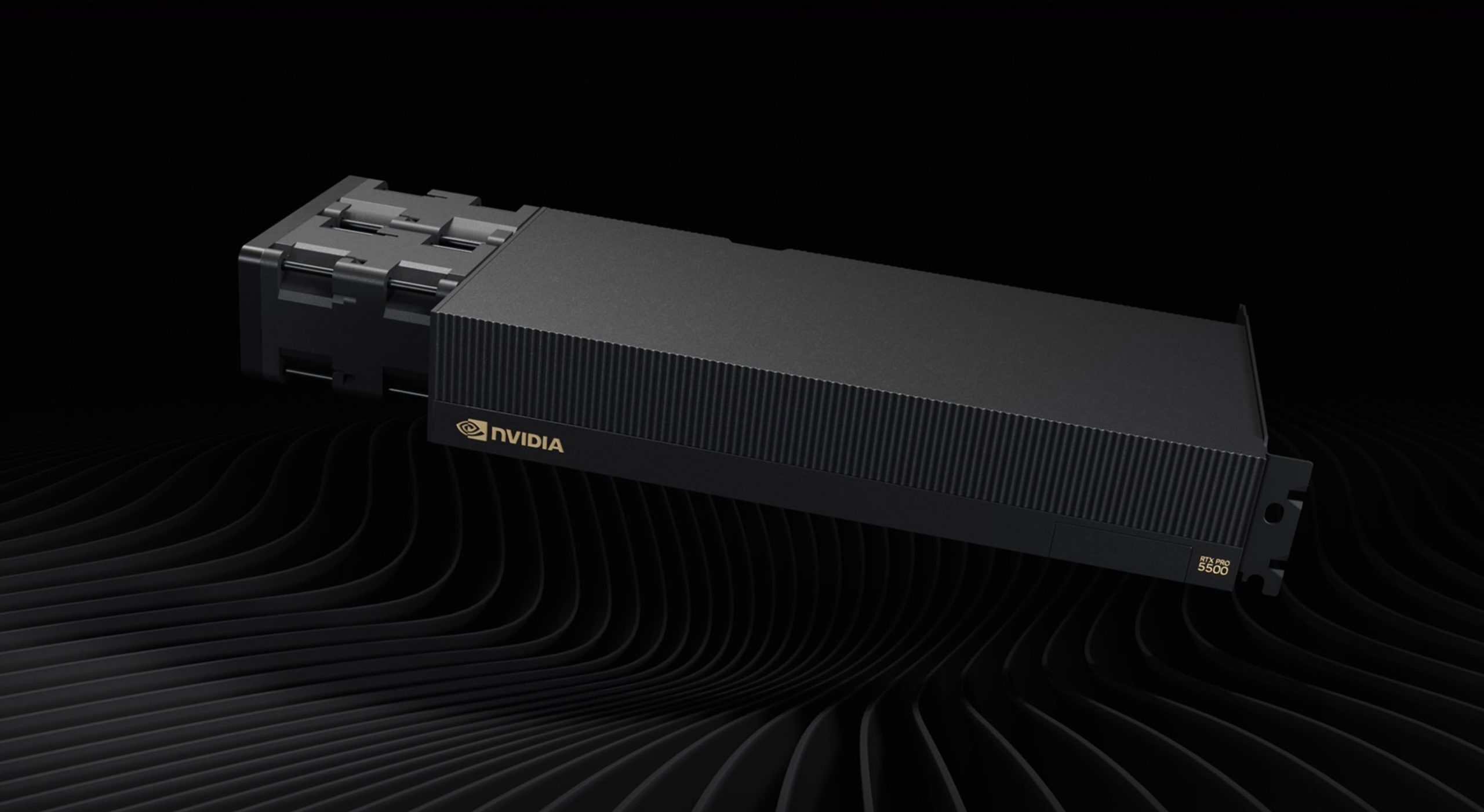
NVIDIA has expanded its Blackwell workstation lineup with the RTX PRO 5500, a professional graphics card built around the GB202 GPU and equipped with 84GB of GDDR7 memory.
The card is aimed at demanding workstation workloads such as AI development, simulation, rendering and large professional projects. It carries the same 21,760 CUDA core count as the GeForce RTX 5090, but offers far more memory and enterprise focused features.
NVIDIA rates the RTX PRO 5500 for up to 600W of power.
| Specification | RTX PRO 5500 |
|---|---|
| Architecture | Blackwell |
| GPU | GB202 |
| CUDA cores | 21,760 |
| VRAM | 84GB GDDR7 |
| Memory bus | Reported 416 bit |
| Memory bandwidth | Up to 1,398 GB/s |
| Maximum power | 600W |
| Interface | PCIe 5.0 x16 |
| Display outputs | Up to four DisplayPort 2.1b |
| Power connector | CEM5 16 pin |
| Cooling | Air or liquid |
| MIG support | Two 42GB instances |
84GB of memory is the main advantage
The RTX PRO 5500 includes 84GB of GDDR7 memory, placing it well above consumer Blackwell cards in memory capacity.
For comparison, the GeForce RTX 5090 has far less VRAM, while the RTX PRO 6000 sits above the new model with 96GB.
The extra memory is important for professional workloads where large data sets, AI models, simulations or high resolution assets may not fit comfortably into a consumer graphics card.
NVIDIA is also positioning the card for centralized workstation deployment, where GPU resources can be shared across larger teams.
Core count matches the RTX 5090
The RTX PRO 5500 uses 21,760 CUDA cores, matching the core count of the RTX 5090.
However, that does not mean the two cards will perform identically.
Professional cards are tuned for different workloads, drivers and reliability requirements. Their memory layouts, clocks and firmware behavior can also differ significantly from consumer models.
The RTX PRO 5500 is based on the same GB202 family used by the RTX 5090 and RTX PRO 6000, but it sits between those products in NVIDIA’s professional lineup.
The company also lists three ninth generation NVENC engines and three sixth generation NVDEC engines.
Memory bandwidth reaches nearly 1.4TB per second
The RTX PRO 5500 is rated for up to 1,398 GB/s of memory bandwidth.
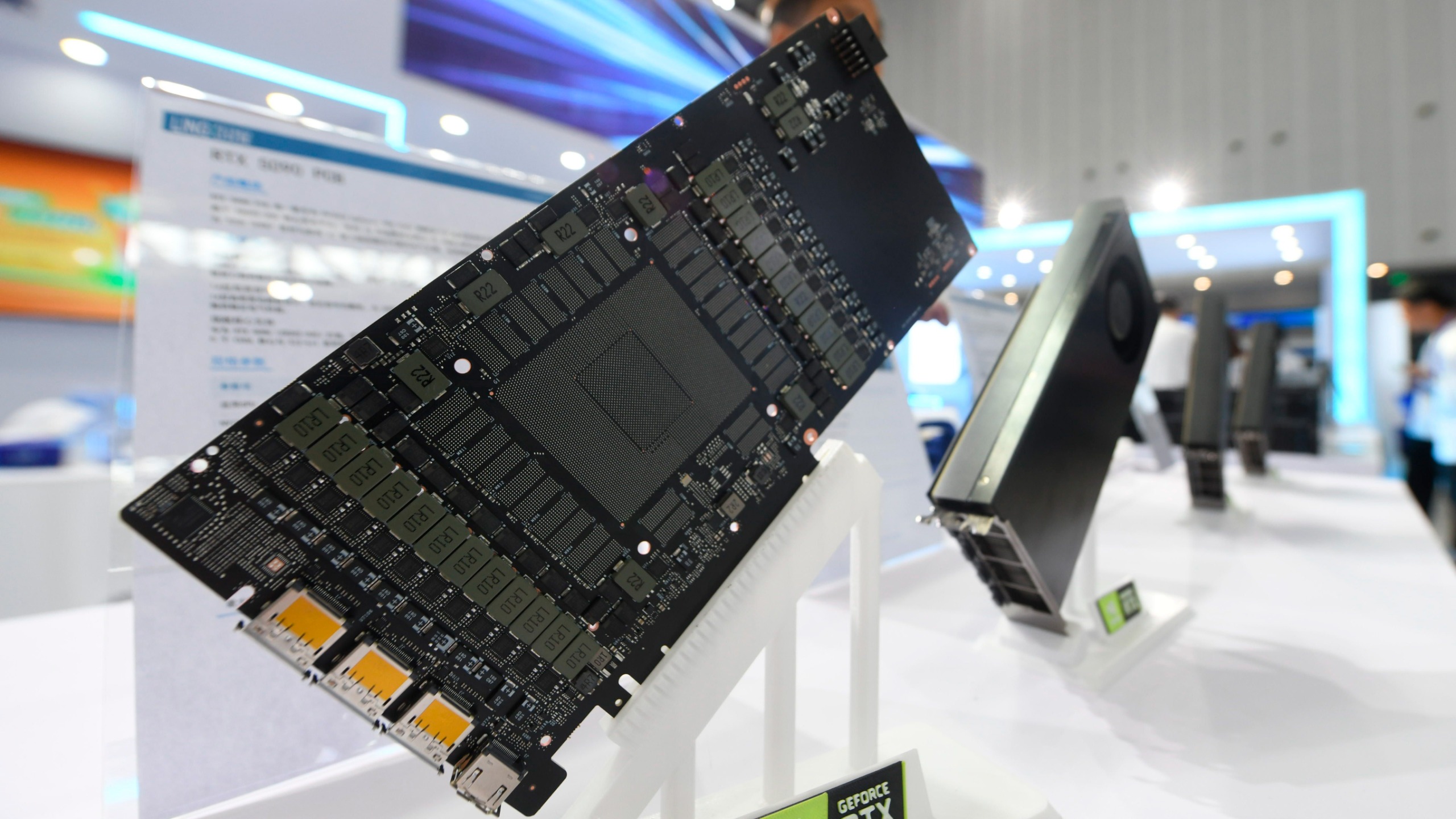
That is slightly higher than the RTX PRO 5000 but lower than the 1,792 GB/s figure associated with the RTX 5090 and RTX PRO 6000.
The reported 416 bit memory interface is unusual and suggests NVIDIA is using a more complex memory configuration to reach the card’s 84GB capacity.
The exact DRAM layout has not been detailed publicly.
MIG support allows the GPU to be split
One important professional feature is Multi Instance GPU support.
MIG can divide the RTX PRO 5500 into two separate GPU instances with 42GB of memory allocated to each.
This can be useful in enterprise environments where one physical card needs to support two separate workloads or users.
That type of functionality is one of the clearest differences between a workstation product and a gaming card.
Built for rack workstations and high power systems
The card supports PCIe 5.0 x16 and uses a single 16 pin CEM5 power connector.
Its 600W power rating means it will require substantial cooling and power delivery.
NVIDIA is supporting both air cooled and liquid cooled configurations, which makes sense for rack mounted workstations and dense professional systems.
The RTX PRO 5500 also supports up to four DisplayPort 2.1b outputs.
NVIDIA has not announced official pricing yet.
Given the positioning of the rest of the RTX PRO Blackwell lineup, the RTX PRO 5500 is expected to be considerably more expensive than consumer GPUs and aimed mainly at professional buyers who need high memory capacity, workstation drivers and enterprise features.


Discussion (0)
Be the first to comment.