



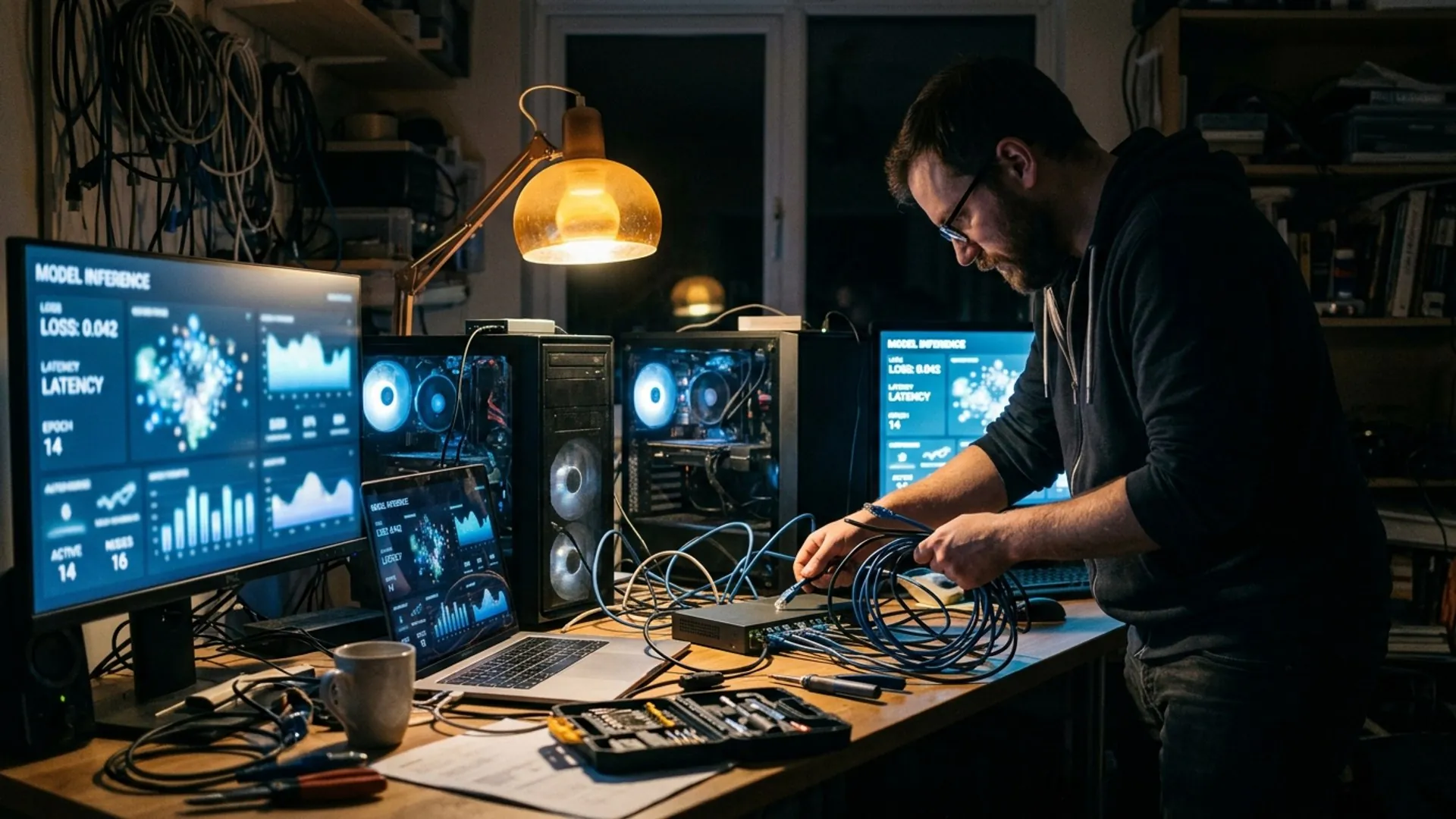
NVIDIA has introduced PAIR, a software based personal AI router that can distribute local inference jobs across multiple computers on the same network.
The idea is to use idle computing power already available in a home or small office instead of sending every AI request to one machine or relying on cloud APIs.
PAIR does not combine GPUs into one larger accelerator and does not pool VRAM. Instead, it sends separate inference jobs to whichever compatible machine is available.
| Feature | NVIDIA PAIR |
|---|---|
| Main purpose | Distribute local AI inference jobs |
| Hardware requirement | No dedicated new hardware |
| Supported platforms | Windows, Linux, macOS |
| Compatible engines | Ollama, LM Studio |
| Network discovery | mDNS |
| Pairing | Secure 6 digit code |
| Communication | mTLS |
| License | Apache 2.0 |
| Release stage | Beta |
| GPU support | NVIDIA and compatible non NVIDIA hardware |
| Maximum tested devices | 18 |
| VRAM pooling | No |
| Single model sharding | No |
PAIR Routes Jobs to Available PCs
PAIR installs on each participating computer and automatically discovers compatible systems on the local network.
Once devices are paired, the software checks whether each node is online, whether the required inference engine is available, whether the requested model is installed, and how busy the system currently is.
If one computer is already heavily loaded, PAIR can send the next inference request to another machine.
For example, if your main gaming PC is busy running a game, another laptop or desktop on the network could handle an AI job instead.
That makes the system useful for households with several machines that are idle for much of the day.
It Does Not Merge Multiple GPUs
PAIR is not a distributed model training or tensor parallelism system.
It cannot combine two 24GB GPUs into one virtual 48GB GPU.
It also cannot split a single model across several PCs.
Each inference request is handled by one compatible node at a time.
The advantage appears when several independent jobs are running together.
A multi agent workflow with several sub agents, for example, can send different requests to different machines instead of making every task wait behind one inference engine.
NVIDIA Shows Faster Multi Agent Workflows
NVIDIA demonstrated PAIR with a Hermes workflow using five sub agents.
On one RTX 5090, the reported workload took an average of 6 minutes and 18 seconds.
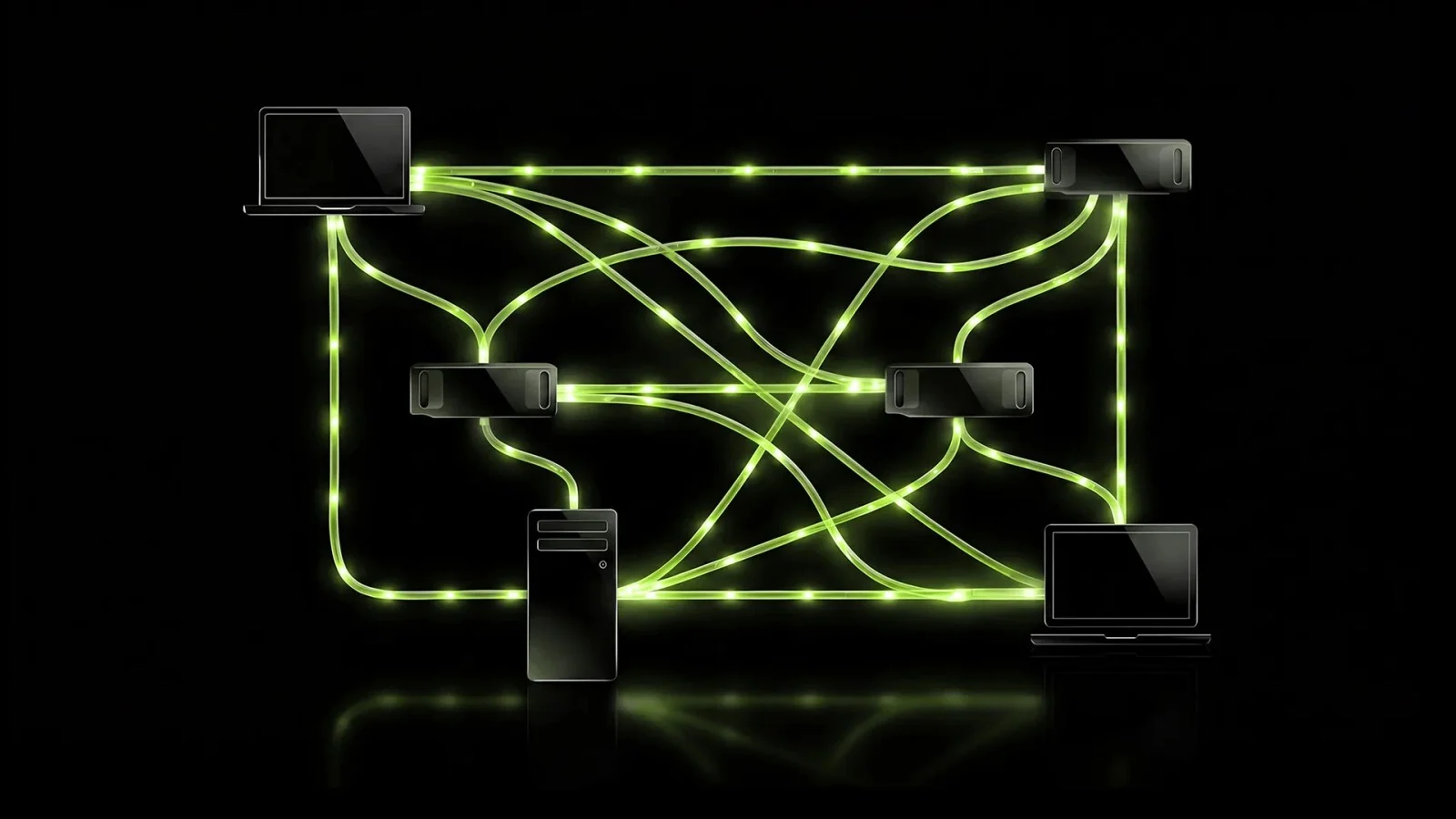
Using two RTX 5090 systems connected through PAIR reduced the reported completion time to 3 minutes and 48 seconds.
That result is specific to the demonstrated configuration and does not mean performance will scale linearly with every additional PC.
The benefit depends on how independent the requests are and how evenly they can be distributed.
Ollama and LM Studio Reduce Setup Changes
PAIR works by proxying existing Ollama and LM Studio interfaces.
That means compatible applications do not need a completely new clustering API.
The same inference request can be redirected to another available machine while the application continues using a familiar interface.
This approach also allows devices to join and leave the network dynamically.
A laptop can contribute compute while it is available, then disappear from the cluster when it goes to sleep or is shut down.
Local Traffic Stays on the Network
NVIDIA says PAIR is designed to keep prompts, model requests, and inference traffic inside the existing local network.
Machines are paired through a secure six digit code and communicate through mTLS.
Because PAIR mainly sends text based REST API requests between systems, network bandwidth requirements should be relatively low compared with moving model weights or large video files between machines.
That is another consequence of PAIR routing whole jobs rather than splitting one inference calculation across several nodes.
Older Systems Can Also Participate
PAIR is not limited to high end RTX desktops.
Any device that meets the minimum requirements for Ollama or LM Studio can potentially participate.
That can include systems with smaller GPUs or even some older laptops using integrated graphics, provided they can run an appropriate model.
NVIDIA says it has tested setups with as many as 18 devices, although more can potentially be added.
The software is also intended to work with compatible non NVIDIA hardware.
Main Uses Include Offload and Parallel Tasks
NVIDIA highlights three main use cases.
Multi agent workflows can spread independent sub agent requests across several machines.
Multitasking can allow several AI sessions to run simultaneously without competing for one GPU.
System offload can move inference away from a primary PC while that machine is being used for gaming, video work, or another demanding application.
PAIR therefore focuses less on making one model larger and more on making multiple local AI tasks easier to manage across the hardware you already own.
The beta is being released as open source software under the Apache 2.0 license, with Windows, Linux, and macOS support planned from launch.


Discussion (0)
Be the first to comment.