



NVIDIA has expanded its Nemotron 3.5 family with three new open weight AI models aimed at enterprise agents, local workloads and lightweight edge applications.
The lineup is led by Nemotron 3.5 Super VL, a 120 billion parameter model designed for always on multimodal agents. NVIDIA is also introducing two smaller Nemotron 3.5 Bolt models, including a 74 billion parameter version that fits within 24GB of memory and a compact 4GB model designed for conversational and physical agents.
The additions continue NVIDIA's push into open weight AI models and arrive as the company builds out a broader ecosystem around local and enterprise agentic computing.
Nemotron 3.5 Super VL Targets Large Enterprise Agents
Nemotron 3.5 Super VL is designed for workloads that combine text, images, tools and multistep reasoning.
NVIDIA says the model can handle instruction following, tool use, visual understanding and complex business workflows while delivering performance comparable to its largest reasoning model despite using roughly one fifth as many parameters.
The company also claims Super VL is around five times faster than its closest open weight competitor in the same class. Those performance figures come from NVIDIA and will need independent testing before broader comparisons can be made.
| Model | Main target | Memory or size |
|---|---|---|
| Nemotron 3.5 Super VL | Large multimodal and enterprise agents | 120B parameters |
| Nemotron 3.5 Bolt 74B-A9B | Local agentic workloads | 24GB |
| Nemotron 3.5 Bolt E4B | Fast conversational and physical agents | 4GB |
Super VL also focuses heavily on document understanding.
The model can process OCR data, tables, charts and other structured visual information from sources such as PDFs and web pages. By combining text and visual understanding inside one system, an agent can extract information, interpret charts and produce analysis without moving the task between separate models.
NVIDIA says the model was trained on more than 25 trillion tokens and approximately 4 million post training samples.
Organizations can also post train the model using their own private data, tools and workflows before deploying it on infrastructure of their choice.
NVIDIA is releasing model weights, datasets and training recipes, while also offering Super VL as a production ready NIM microservice.
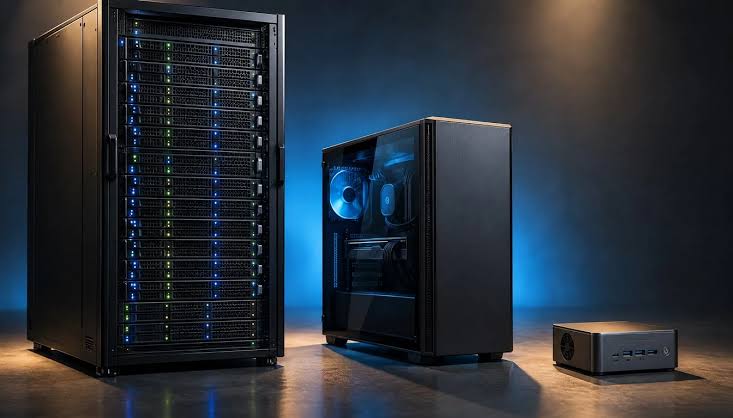
The model is designed to run across Nvidia hardware including DGX Spark, DGX Station, Jetson systems and cloud infrastructure.
Bolt 74B Fits Into 24GB of Memory
Nemotron 3.5 Bolt 74B-A9B takes a different approach.
It contains 74 billion total parameters but uses a mixture of experts architecture that activates only 9 billion parameters at a time.
NVIDIA combines this with 2 bit quantization, allowing the model to fit within 24GB of memory.
That makes it suitable for local workloads such as web research, coding, debugging, tool calling and multistep reasoning without requiring cloud inference.
The model is optimized for systems including RTX Spark and DGX Spark 64GB hardware.
NVIDIA is also making it available through Hugging Face with support for popular local inference platforms including vLLM, Ollama, LM Studio and llama.cpp.
Nemotron 3.5 Bolt E4B Targets Lightweight Agents
The smallest addition is Nemotron 3.5 Bolt E4B, which is designed to operate within 4GB of memory.
Its focus is on fast conversational and physical agents rather than larger reasoning workloads.
The model supports multi turn conversation, tool use, instruction following and application state grounding.
That combination could make it suitable for embedded interfaces, local voice assistants, interactive characters and device based agents where memory and power are limited.
It is designed to run across GeForce RTX, Jetson and RTX or DGX Spark systems.
New Models Build on Nemotron 3.5 Lightning
The three new models borrow several architectural ideas from Nemotron 3.5 Lightning, which NVIDIA introduced in August.
Those technologies include a hybrid Mamba Transformer architecture, multi token prediction, latent mixture of experts design and speculative decoding.
NVIDIA previously claimed Nemotron 3.5 Lightning could generate tokens around four times faster than comparable models, although actual agentic task performance improved by only about 30%.
That difference highlights an important limitation when evaluating AI models solely by token generation speed. Faster output does not always translate directly into the same improvement in complete agent workflows.
With Nemotron 3.5 Super VL and the two Bolt models, NVIDIA is now covering a much wider range of deployment sizes, from 120 billion parameter enterprise systems to local models designed for 24GB or even 4GB environments.
The strategy gives developers more options to keep AI processing local while still using NVIDIA's software and hardware ecosystem, particularly for agentic workloads that require privacy, tool access and repeated interaction with local data.
Discussion (0)
Be the first to comment.