



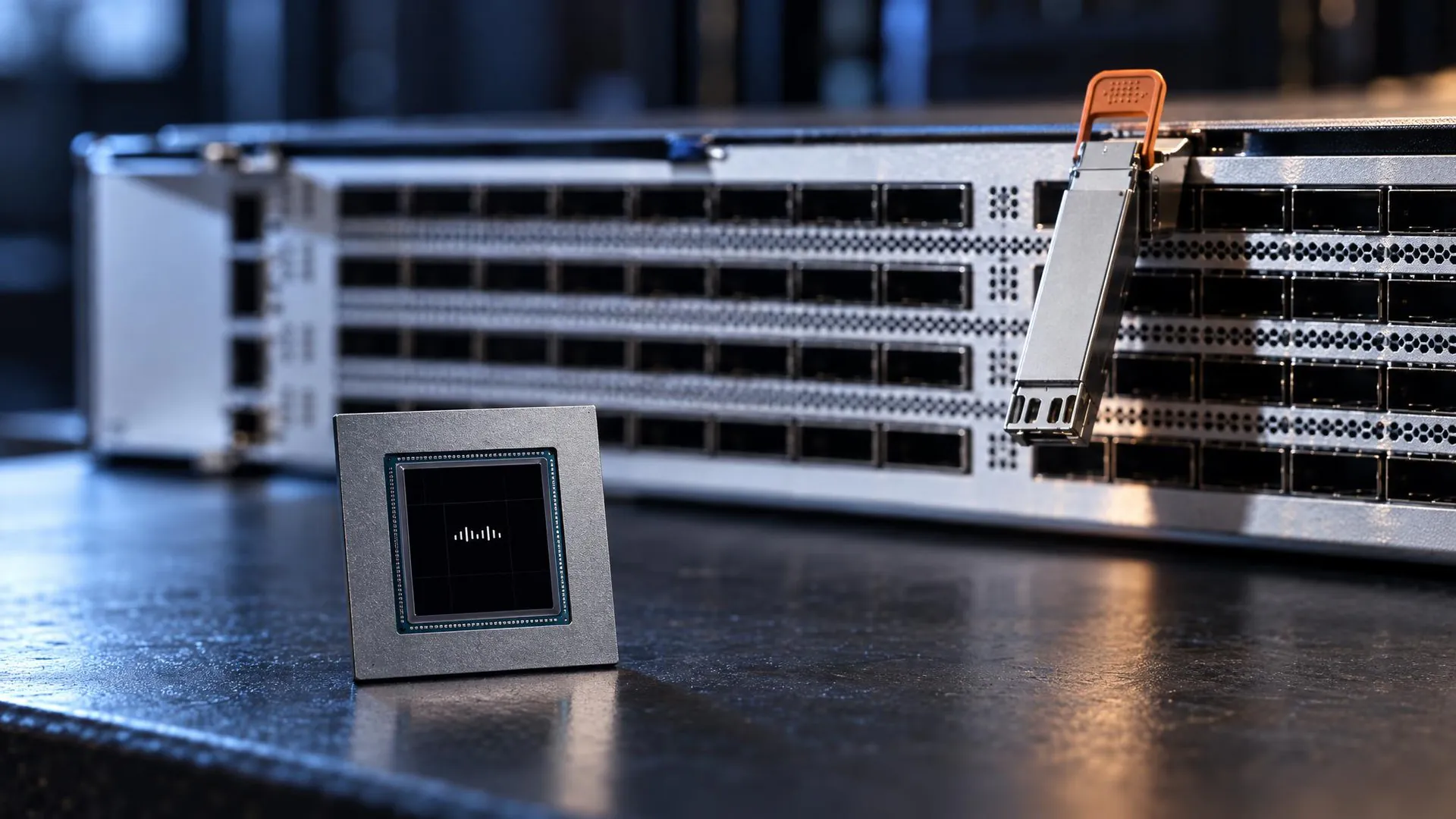
NVIDIA and Cisco have introduced a new optical networking module called USFP, designed to increase bandwidth density for large AI infrastructure while keeping the physical module close to the size of existing OSFP hardware.
USFP stands for Ultra Dense Small Form Factor Pluggable. The design supports 400 Gb/s per lane and can scale to as many as 32 electrical lanes, giving a maximum theoretical capacity of 12.8 Tb/s within a single module.
The companies are positioning the technology for large AI factories, where growing clusters require more bandwidth without continuously expanding the physical networking footprint.
USFP Delivers Four Times the Bandwidth Density of OSFP
The main advantage of USFP is bandwidth density.
The module is designed to provide four times the bandwidth density of current 200 gig OSFP solutions while retaining a similar physical footprint.
That could allow switches to connect significantly more compute hardware without requiring proportionally larger front panels or more networking equipment.
| USFP specification | Detail |
|---|---|
| Maximum lane speed | 400 Gb/s |
| Supported electrical lanes | Up to 32 |
| Maximum capacity | 12.8 Tb/s |
| Initial product configuration | 16 lanes |
| Initial capacity | 6.4 Tb/s |
| Bandwidth density improvement | 4 times versus 200 gig OSFP |
| Claimed power efficiency improvement | 1.3 times |
| Target market | AI networking and large compute fabrics |
Initial USFP products are expected to use 16 lanes, providing up to 6.4 Tb/s of total capacity.
Future implementations could double that figure by using the full 32 lane configuration.
Moving to 400 Gb/s Per Lane Raises Power Requirements
The increase in bandwidth is not free.
Moving to 400 gig signaling per lane reportedly raises power consumption by around 1.5 times compared with 200 gig designs.

However, NVIDIA and Cisco say USFP still achieves around 1.3 times better power efficiency.
That efficiency matters because power has become one of the largest constraints in modern AI data centers.
Adding more bandwidth without improving energy use can increase cooling requirements and operational costs, so the companies are emphasizing performance per watt alongside raw networking throughput.
AI Factories Need More Connections Per Switch
Modern AI clusters connect large numbers of CPUs, GPUs, storage systems and networking components.
As these installations grow, the network has to move increasingly large amounts of data between systems with minimal delay.
Simply increasing the number of switches can add cost, complexity and power consumption.
USFP is intended to address that issue by increasing the amount of bandwidth that can be delivered through a similar physical space.
The companies say the design could make dense 1.6 terabit fabrics more practical while allowing operators to expand compute capacity without making the networking layer proportionally larger.
NVIDIA and Cisco Are Building an Open Ecosystem Around USFP
NVIDIA and Cisco are also working with Amphenol and TE Connectivity to encourage broader adoption of the new format.
The collaboration is intended to help create the connectors, components and supporting hardware required for an ecosystem around USFP.
The design will also connect with NVIDIA Spectrum X Ethernet networking and Cisco Silicon One based Ethernet infrastructure.
That approach suggests USFP is intended to function across complete networking platforms rather than remain a proprietary module tied to a single switch family.
Pluggable Optics Remain Central to the Design
Another important goal is maintaining the operational advantages associated with traditional pluggable optics.
Instead of moving entirely toward more difficult to replace integrated optical designs, USFP is meant to preserve serviceability and deployment flexibility.
Operators should still be able to install or replace optical modules without fundamentally changing how network infrastructure is maintained.
This could be important for hyperscale and enterprise data centers, where simple replacement and upgrade procedures can reduce downtime.
USFP is ultimately aimed at solving a space and bandwidth problem created by rapidly growing AI systems.
By supporting up to 12.8 Tb/s inside a module similar in size to OSFP hardware, NVIDIA and Cisco are attempting to increase networking density without forcing data center operators to dramatically expand their switch footprint.
The first implementations are expected to start with 6.4 Tb/s capacity, while the broader architecture leaves room for 32 lane designs reaching the full 12.8 Tb/s target.


Discussion (0)
Be the first to comment.