



Researchers have developed a new type of sonic black hole that can be inserted into existing pipes to reduce echoes and unwanted vibrations without rebuilding the pipe itself.
The 3D printed device is designed to progressively slow sound waves as they travel through a duct. Instead of reflecting back toward the source, the acoustic energy becomes increasingly concentrated and is eventually dissipated through friction and heat exchange.
The concept takes inspiration from astrophysical black holes, although it works with sound rather than light or gravity.
The Device Uses 29 Rings Mounted on a Central Rod
Traditional sonic black holes usually require specially shaped structures built directly into the walls of a pipe.
That can make them difficult to use in existing ventilation systems, ducts or plumbing because the pipe itself may need to be redesigned or replaced.
The new approach changes that geometry.
Instead of placing rings around the inner wall, the researchers mounted 29 rings of different diameters along a central rod. The result resembles a tapered tree shaped structure that can be manufactured separately and then inserted into a pipe.
| Feature | New sonic black hole design |
|---|---|
| Manufacturing method | 3D printing |
| Main structure | 29 rings on a central support rod |
| Installation | Plug in design for existing pipes |
| Purpose | Reduce reflected sound and vibration |
| Energy removal | Friction and heat exchange |
| Potential uses | Ducts, ventilation, plumbing and room acoustics |
This makes the design easier to retrofit into infrastructure that was not originally built with acoustic absorption systems.
Sound Waves Become Shorter and More Concentrated
As sound enters the structure, the changing geometry alters how the wave travels.
Its wavelength becomes progressively shorter as it moves deeper into the device. At the same time, the wave slows and its energy becomes concentrated into a smaller region.
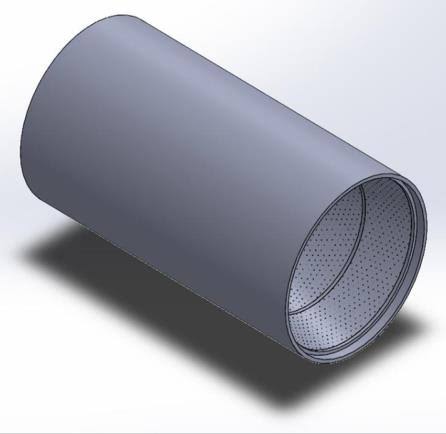
Instead of reaching the end of the pipe and bouncing back as an echo, much of that energy is absorbed by interactions between the moving air and the surfaces of the device.
The energy is then dissipated mainly as heat.
The effect can make a closed duct behave acoustically more like a pipe that continues indefinitely, because much less sound returns from the end.
The Black Hole Comparison Comes From Wave Behavior
The name sonic black hole refers to similarities in how waves behave near the structure.
From the perspective of an outside observer, waves approaching an astrophysical black hole can appear to slow dramatically as they near a limiting point.
The acoustic device creates a comparable effect for sound waves by gradually changing the conditions they experience as they move through the pipe.
The researchers are not creating an actual gravitational black hole. The comparison relates only to how wave energy is slowed, concentrated and prevented from returning in the usual way.
Prototype Tests Reduced Reflections Across More Frequencies
The team tested the concept using a 3D printed prototype.
According to the reported results, the plug in design substantially reduced sound reflections and operated across a broader frequency range than conventional sonic black hole structures built directly into pipe walls.
That wider operating range could be particularly useful because real ventilation and mechanical systems often produce sound at many different frequencies rather than a single predictable tone.
A system capable of absorbing a broader range of noise could therefore be easier to use in practical environments.
Possible Uses Extend Beyond Pipes
The researchers currently see ducts, ventilation systems and plumbing as obvious applications.
Industrial systems often contain long enclosed channels where fans, pumps and airflow can produce persistent echoes and vibrations.
A removable acoustic structure could potentially reduce that noise without requiring major changes to the surrounding equipment.
The researchers also want to explore whether the same idea can be adapted for room acoustics.
If the principle scales effectively, future versions could potentially be used to control reflected sound in buildings, industrial environments or other enclosed spaces.
The key advantage of the new design is its modular nature. Instead of rebuilding a pipe around a sonic black hole, the acoustic absorber can be manufactured independently and inserted where it is needed, making the concept more practical for real installations.



Discussion (0)
Be the first to comment.