



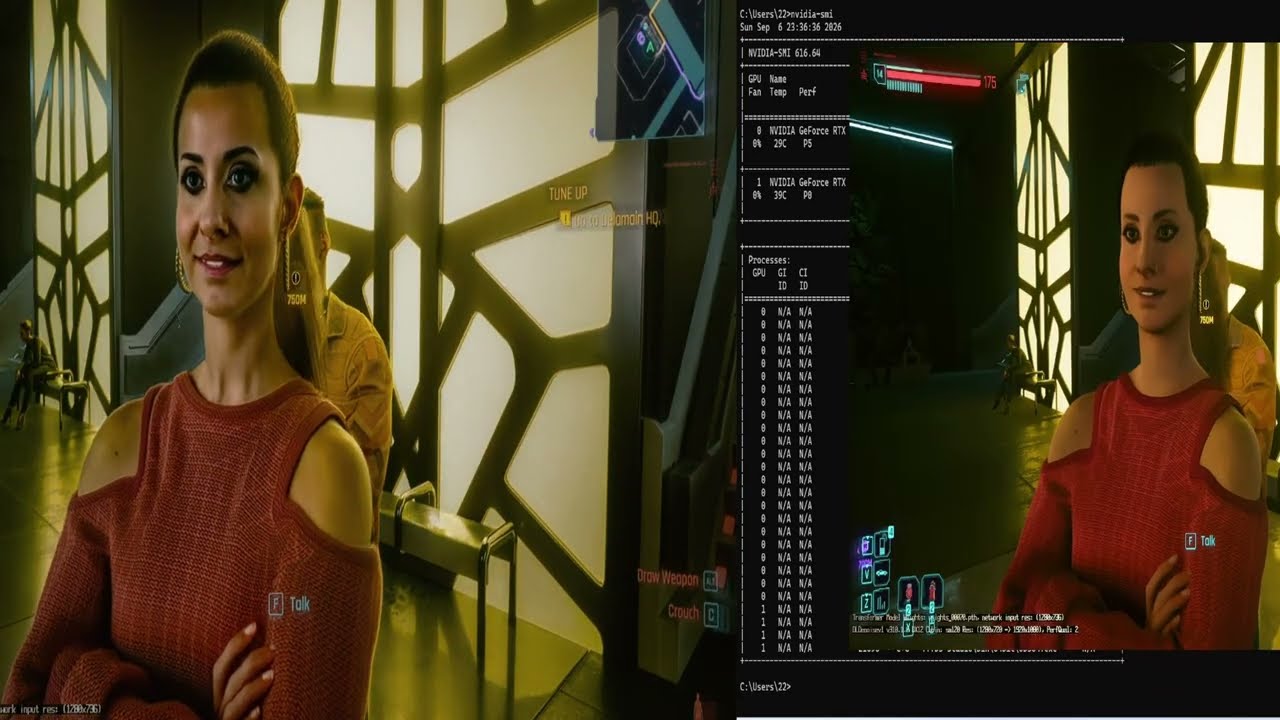
Community developers are expanding Nvidia DLSS 5 beyond its official game support with tools that automate installation and experiment with a different neural rendering process.
Two projects, DLSS 5 Swapper and DLSS 5 Autopilot, are designed to make unofficial DLSS 5 support easier to use. Autopilot also offers an experimental method that can substantially reduce the performance cost of Nvidia's new neural rendering technology, although early testing suggests image quality can suffer.
These remain unofficial modifications, so their compatibility, stability and visual results can vary considerably between games.
DLSS 5 Swapper automates unofficial game support
DLSS 5 Swapper is designed to remove much of the manual work previously required to add DLSS 5 to unsupported PC games.
Instead of copying and configuring the necessary files individually, players can provide the tool with a game's folder and let it prepare the required components automatically.
The application can also identify installed games that may be compatible with the modification.
Importantly, a game does not necessarily need existing DLSS support. Swapper incorporates another community project called DLSS 5 Feeder, which can provide the underlying integration required to introduce DLSS 5 into additional titles.
| Tool or feature | Main purpose |
|---|---|
| DLSS 5 Swapper | Automates installation of DLSS 5 modifications |
| DLSS 5 Feeder | Helps add DLSS 5 to games without native support |
| DLSS 5 Autopilot | Provides simplified setup and additional rendering options |
| Neural upstream | Moves DLSS 5 neural processing earlier in the rendering pipeline |
Support is not universal, and compatibility will depend on the individual game.
Autopilot can reduce DLSS 5's performance cost
DLSS 5 Autopilot takes a similar approach to simplified installation but also supports an experimental feature known as neural upstream.
Nvidia normally applies DLSS 5's neural rendering process near the end of the rendering pipeline, after the image has been upscaled. Neural upstream changes that order by applying the AI processing earlier.
Early community testing indicates that this can significantly improve frame rates.
One reported test used an RTX 4080 running Assassin's Creed Shadows at 4K. Performance was around 63 fps without DLSS 5 and fell to about 31 fps with the standard DLSS 5 process. Using the neural upstream method increased performance to roughly 50 fps.
That represents a much smaller performance penalty, although the result comes from community testing rather than standardized independent benchmarking.
Better performance may reduce image quality
The additional speed does not appear to come without compromises.
Moving neural rendering earlier in the pipeline can alter the information available to later rendering stages. Early observations suggest this may introduce visual artifacts or reduce image quality compared with Nvidia's intended DLSS 5 implementation.

The tradeoff therefore appears to be higher performance in exchange for potentially less accurate or consistent visuals.
There are also normal considerations associated with unofficial software. These projects are open source, which allows their code to be examined, but they are still third party modifications that Nvidia and game developers do not officially support.
DLSS 5 remains officially available in a limited number of supported games. The growing collection of community tools shows how quickly PC modders are experimenting with the technology, particularly around broader game compatibility and reducing its substantial rendering cost.



Discussion (0)
Be the first to comment.