



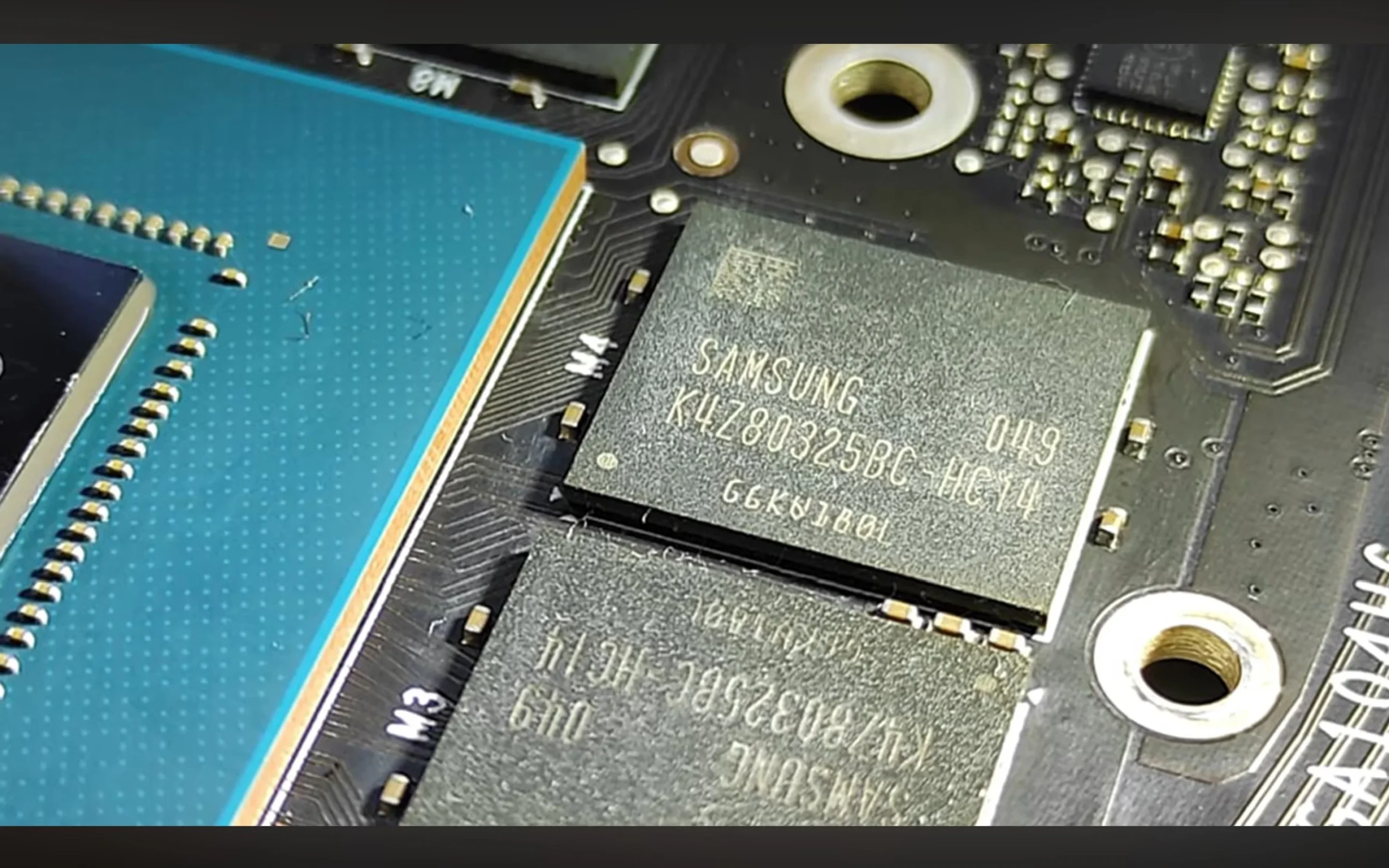
A Brazilian hardware modder has created a working 16GB version of Nvidia's GeForce RTX 3070 Ti by combining an RTX 3070 PCB, an RTX 3070 Ti GPU and higher capacity GDDR6 memory chips.
The project effectively recreates a graphics card Nvidia was once expected to launch commercially. References to an RTX 3070 Ti with 16GB of VRAM appeared years ago through database listings and prototype hardware, but the retail RTX 3070 Ti ultimately shipped with 8GB of GDDR6X memory.
The custom card built by Fabian, who runs the fmklab channel, takes a different route. Instead of using expensive GDDR6X memory, the mod uses standard GDDR6 while doubling capacity to 16GB.
RTX 3070 PCB provides the base for the modification
The project started with an RTX 3070 graphics card. Its original GPU was removed and replaced with an RTX 3070 Ti chip.
Using an RTX 3070 PCB was important because the RTX 3070 normally uses GDDR6 memory, while the retail RTX 3070 Ti uses faster GDDR6X.
The existing Samsung HC14 memory chips were also replaced. These 8Gb devices were swapped for higher capacity HC16 chips with 16Gb density.
That change doubled the available video memory from 8GB to 16GB.
| Component | Modified configuration |
|---|---|
| PCB | GeForce RTX 3070 |
| GPU | GeForce RTX 3070 Ti chip |
| Memory type | GDDR6 |
| Original memory capacity | 8GB |
| Modified memory capacity | 16GB |
| Original memory chips | Samsung HC14, 8Gb |
| Replacement chips | Samsung HC16, 16Gb |
| Validation | GPU Z, MATS, gaming and local AI workloads |
The physical memory replacement alone was not enough to make the entire 16GB usable.
Memory straps had to be reconfigured
When the modified graphics card was first started, GPU Z reportedly detected only 8GB of VRAM.
The issue was traced to the memory configuration straps on the PCB. These hardware settings tell the graphics card how the installed memory is arranged and how much capacity should be exposed.
Fabian used an Nvidia BIOS analysis utility to determine which straps needed adjustment. After the required soldering changes were completed, Nvidia's MATS memory testing utility recognized the full 16GB capacity without reporting errors.
GPU Z also identified the finished card as an RTX 3070 Ti with 16GB of GDDR6 memory.
This was an important stage because simply displaying a larger VRAM figure would not prove that applications could actually access the additional memory.
Games and local AI workloads used more than 8GB
The modified card was tested with workloads designed to push memory usage beyond the original 8GB limit.
A local large language model reportedly allocated close to the full 16GB memory pool, confirming that the additional VRAM could be used by real applications.
Call of Duty: Warzone also consumed more than 13GB of VRAM when the card was paired with a Ryzen 7 9800X3D system. No instability was reported during that test.
These results suggest the modification successfully increased usable memory rather than simply changing the amount shown by monitoring software.
More memory comes with lower bandwidth
The main compromise is memory performance.
A standard RTX 3070 Ti uses GDDR6X, while the modified card relies on slower GDDR6. That reduces available memory bandwidth even though capacity has doubled.
The custom GPU scored 5,367 points in Unigine Superposition. That result was reportedly below many normal RTX 3070 Ti cards, with the slower memory subsystem considered a likely factor.
This means the additional 8GB is particularly useful for workloads where memory capacity is the main limitation, including some local AI models and applications with large VRAM requirements. It does not automatically make the modified card faster in conventional gaming workloads.
The project demonstrates that a functional 16GB RTX 3070 Ti can be assembled from existing Ampere hardware with extensive GPU, memory and PCB modifications. It also shows the tradeoff involved in replacing the retail model's faster GDDR6X memory with higher capacity GDDR6.
Discussion (0)
Be the first to comment.