



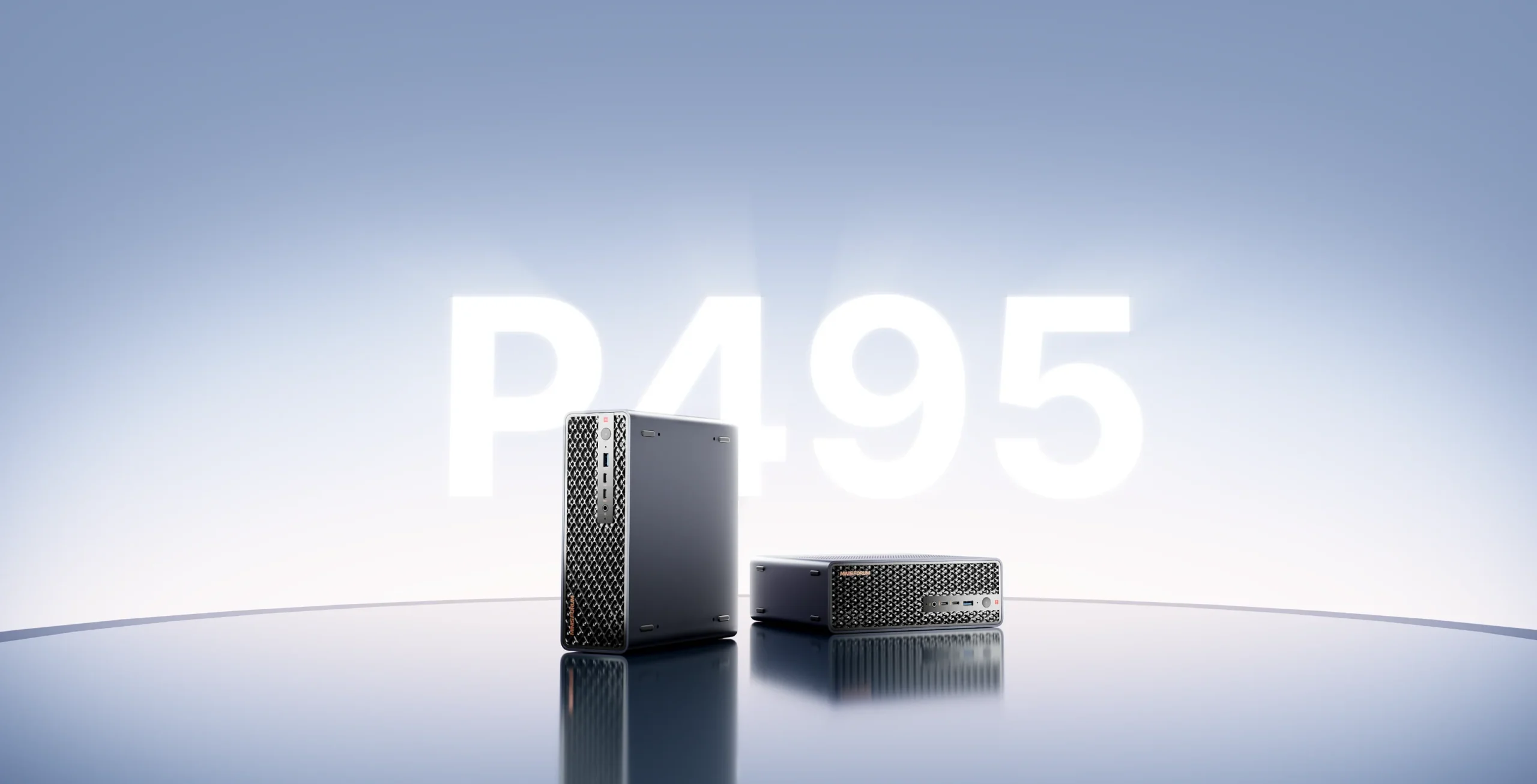
Minisforum has introduced the MS-S1 Max-P495, a compact workstation built around AMD's Ryzen AI Max+ Pro 495 processor and up to 192GB of LPDDR5X 8533 unified memory.
The system is aimed at local AI development, large language model inference, and other memory intensive workloads that would normally require much larger workstations or several discrete GPUs.
Up to 160GB of the system memory can be allocated as graphics memory, giving the machine enough capacity to run very large quantized models entirely on the device.
| Specification | Minisforum MS-S1 Max-P495 |
|---|---|
| Processor | AMD Ryzen AI Max+ Pro 495 |
| CPU | 16 Zen 5 cores, 32 threads |
| Maximum boost | 5.2GHz |
| Integrated graphics | Radeon 8065S |
| GPU compute units | 40 RDNA 3.5 CUs |
| NPU performance | Up to 55 TOPS |
| Total claimed AI performance | Up to 131 TOPS |
| Unified memory | 192GB LPDDR5X 8533 |
| Allocatable graphics memory | Up to 160GB |
| Chassis volume | 3.5 litres |
| Sustained power | 120W |
| Peak power | 160W |
| Storage | Two M.2 PCIe 4.0 slots, up to 16TB |
| Networking | Dual 10GbE |
192GB Memory Is the Main Attraction
The biggest advantage of the MS-S1 Max-P495 is its memory capacity.
Traditional desktop AI systems often depend on discrete GPUs with fixed VRAM limits. That can become a problem when loading large language models that require tens or hundreds of gigabytes of memory.
Minisforum's system uses unified memory shared between the CPU and integrated Radeon graphics.
Up to 160GB can be assigned for graphics workloads.
That gives developers more flexibility when running 70 billion parameter models or heavily quantized models with several hundred billion parameters.
The available capacity does not guarantee fast performance for every model, but it removes one of the biggest constraints found on smaller consumer GPUs.
Ryzen AI Max+ Pro 495 Uses 16 Zen 5 Cores
The system is powered by AMD's Ryzen AI Max+ Pro 495.
The processor includes 16 Zen 5 CPU cores and 32 threads.
Base frequency is listed at 3.1GHz, while maximum boost reaches 5.2GHz.
The chip also includes 16MB of L2 cache and 64MB of L3 cache, giving it 80MB of total cache.
For general CPU workloads, that gives the MS-S1 Max-P495 significantly more processing capability than a typical small form factor PC.
Radeon 8065S Provides 40 RDNA 3.5 Compute Units
Graphics are handled by the integrated Radeon 8065S.
It includes 40 RDNA 3.5 compute units and operates at up to 3GHz.
The processor also contains a dedicated NPU capable of up to 55 TOPS.
Minisforum cites combined CPU and GPU AI performance of up to 131 TOPS.
For local AI workloads, the more important advantage may be the large unified memory pool rather than the raw TOPS figure alone.
Cooling Is Designed for Sustained 120W Operation
Packing this hardware into a 3.5 litre chassis creates a significant cooling challenge.
Minisforum says the system is designed to sustain 120W of package power and briefly reach 160W.
Cooling hardware includes a copper cold plate, six heat pipes, dual turbine blowers, and phase change thermal interface material.
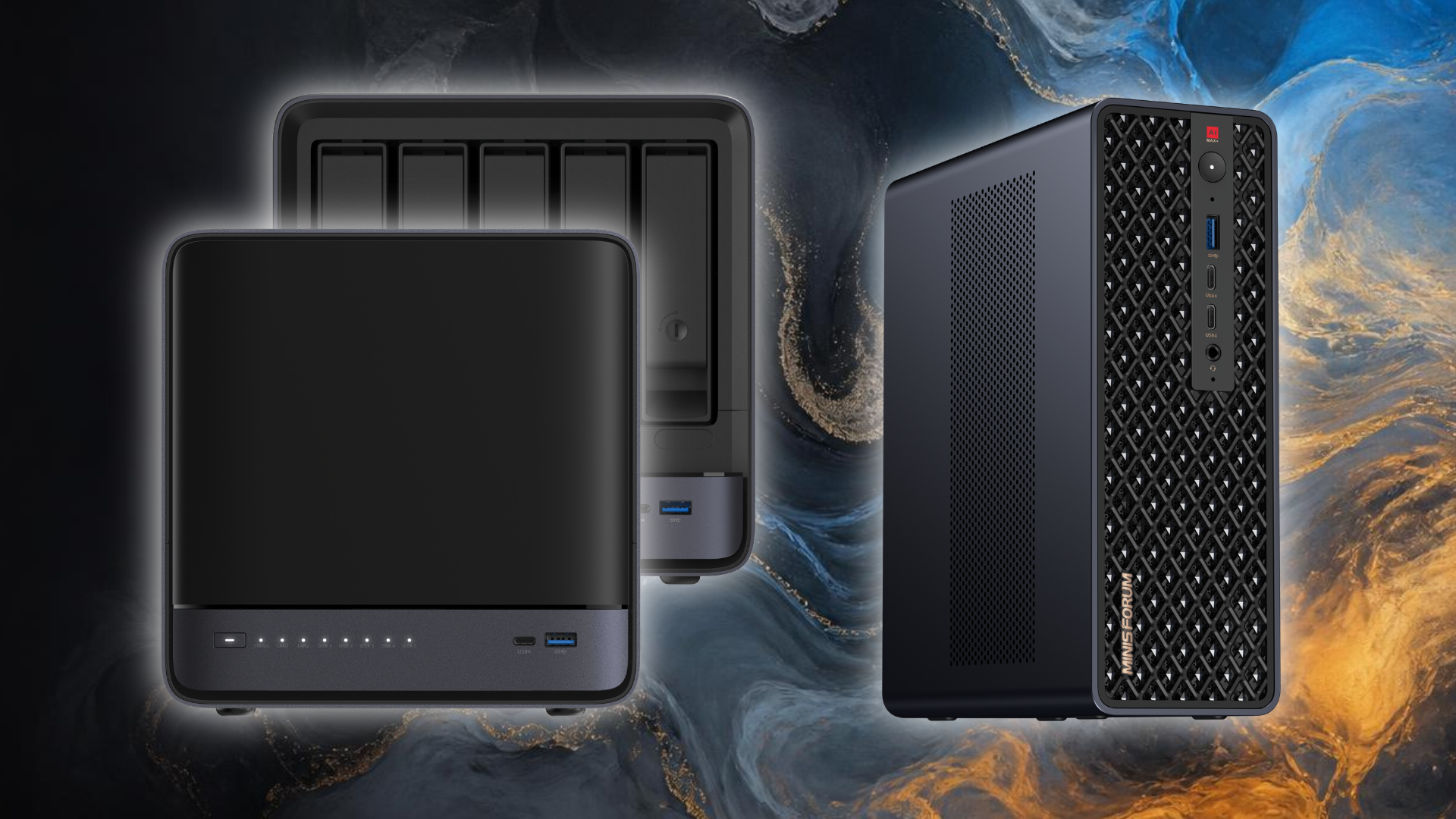
The chassis itself is made from aluminium.
The company says the cooling system is intended to maintain performance during long workloads rather than reducing clock speeds because of thermal limits.
Those claims will depend on real world testing, especially under extended AI and rendering workloads.
Expansion Is Unusually Strong for a Mini PC
The MS-S1 Max-P495 offers more expansion than many compact systems.
It includes a full length PCIe 4.0 x16 slot.
There are also two M.2 PCIe 4.0 storage slots supporting up to 16TB in total, with RAID 0 and RAID 1 support.
The storage tray uses a slide out design for easier access.
Connectivity includes two 10GbE network ports, two standard USB4 ports rated at 40Gbps, and two USB4 V2 ports rated at 80Gbps.
The system also includes two USB 3.2 Gen 2 ports, HDMI 2.1 FRL, DisplayPort support through USB4, and a 3.5mm audio jack.
Multiple Systems Can Be Linked Together
Minisforum is also positioning the machine for clustered deployments.
Multiple units can be connected through a master power header.
According to the company, a two unit cluster using 192GB systems can run a 235 billion parameter model at around 16 tokens per second.
That performance figure comes from Minisforum and will depend on model format, quantization, software, and workload.
The ability to link multiple units may appeal to developers who want to scale local inference without moving to conventional rack servers.
Chassis Can Fit Into a 2U Rack
The machine can be placed vertically on a desk or installed horizontally inside a standard 2U rack enclosure.
This gives the system a broader role than a typical home mini PC.
A single unit can function as a compact workstation, while multiple systems could be deployed together for AI labs, edge computing, or small scale development clusters.
Minisforum Also Introduced an AI Focused NAS
The MS-S1 Max-P495 was shown alongside the N5 Max-P495.
The companion NAS supports five drive bays and up to 200TB of local storage.
Minisforum positions it as a storage backend for local AI applications, including vector databases and retrieval augmented generation workloads.
Pairing a high memory AI workstation with a large local storage system could allow organizations to keep both models and private datasets on site.
Pricing Has Not Been Announced
Minisforum has not yet disclosed the retail price or final availability date for the MS-S1 Max-P495.
Given the Ryzen AI Max+ Pro 495 processor, 192GB of high speed memory, dual 10GbE networking, and extensive expansion support, the machine is likely to sit well above mainstream mini PCs.
Its main appeal is not conventional desktop value.
It is designed for developers and professionals who need very large local memory capacity for AI workloads while still wanting a compact system instead of a traditional workstation or multi GPU server.


Discussion (0)
Be the first to comment.