



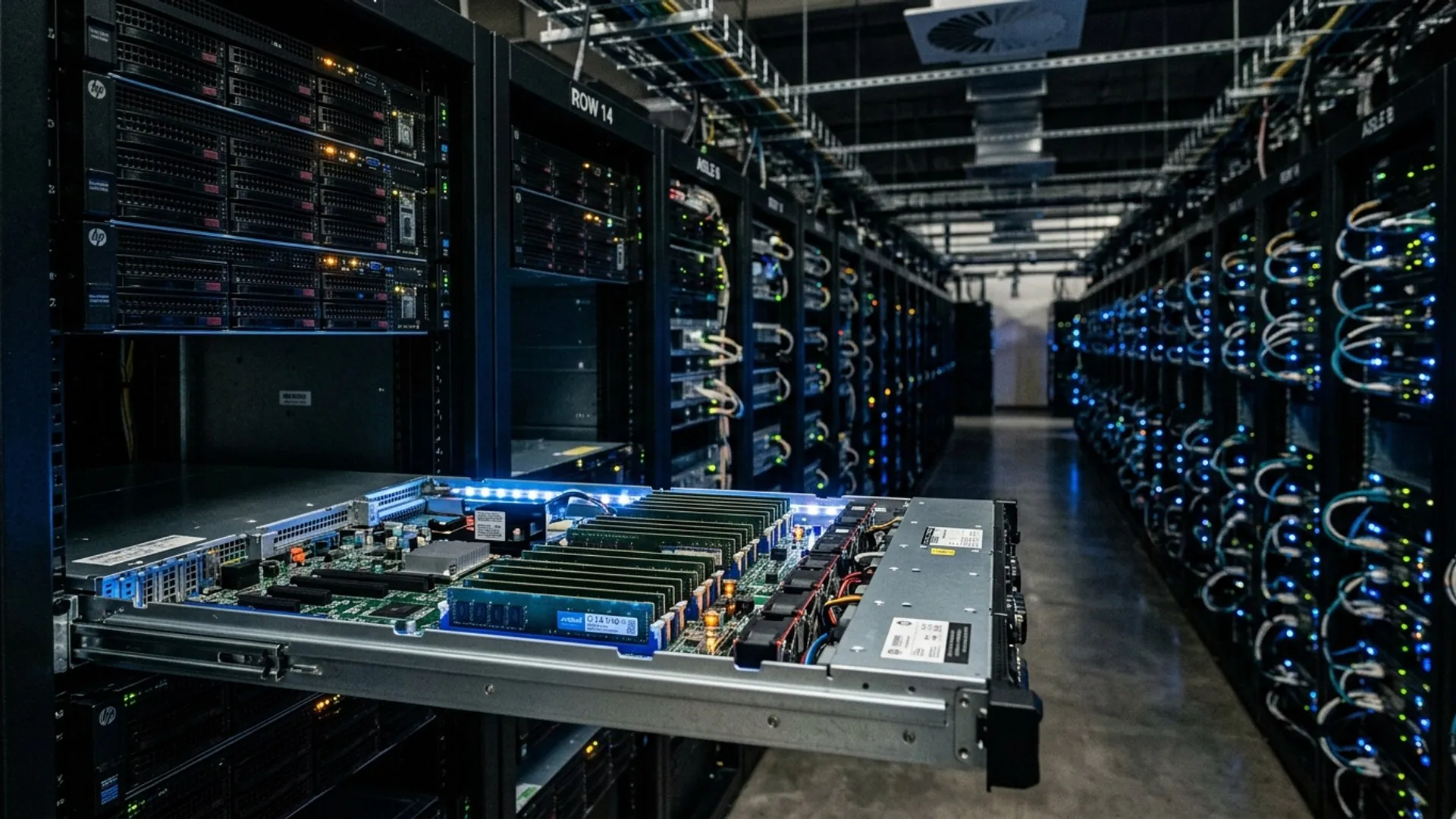
Micron has demonstrated a 512GB DDR5 server memory module that can operate at speeds of up to 9200 MT/s, giving future servers a way to reach much higher memory capacities without increasing the number of DIMM slots.
The company describes the new RDIMM as the world's first 512GB DDR5 module and says production readiness is planned for 2027. AMD and Intel are already validating the technology for future server platforms.
The module is aimed at data center workloads rather than consumer PCs. Its main targets include AI, analytics, virtualization, large databases, and simulation workloads that benefit from keeping more information directly in system memory.
A server equipped with 24 of these modules could reach 12TB of DDR5 memory.
512GB capacity comes from vertically stacked DRAM
Micron reaches the unusually high capacity by stacking DRAM dies vertically and connecting them using through silicon vias.
This approach allows more memory to fit into a standard server DIMM without requiring additional motherboard slots.
| Specification | Micron 512GB DDR5 RDIMM |
|---|---|
| Capacity per module | 512GB |
| Memory type | DDR5 RDIMM |
| Maximum reported speed | 9200 MT/s |
| Target market | Servers and data centers |
| Maximum example capacity | 12TB with 24 modules |
| Power consumption | 16W per 512GB module |
| Platform validation | AMD and Intel |
| Production target | 2027 |
| Pricing | Not announced |
The new module follows Micron's 256GB DDR5 RDIMM, which entered sampling earlier in 2026 and also supports speeds of up to 9200 MT/s.
Both designs use advanced stacked DRAM technology to increase density while maintaining high memory bandwidth.
Higher density can reduce power use
One of the biggest advantages of the 512GB module is power efficiency.
Micron says a single 512GB RDIMM consumes about 16W under its test conditions.
By comparison, four 128GB modules providing the same total 512GB capacity consumed a combined 44.2W.
That represents a reduction of more than 60 percent in Micron's comparison.
The difference could become significant in large server installations where hundreds or thousands of memory modules operate continuously.
Reducing memory power consumption can lower both direct electricity use and the cooling requirements needed to remove the heat generated inside a data center.
24 modules could provide 12TB of DDR5
The capacity increase also allows server builders to reach very large memory configurations without increasing DIMM counts.
Using 24 of the new modules would provide 12TB of DDR5 memory.
That amount of memory can be useful for workloads that would otherwise need to access slower storage frequently.
Large AI datasets, in memory databases, virtualization hosts, scientific models, and analytics applications are among the workloads Micron expects to benefit.
Higher capacity per slot can also leave room for future expansion or allow system designers to reach their memory targets using fewer modules.
Micron reports performance gains in memory bound workloads
Capacity is not the only claimed advantage.
Micron says the 512GB configuration delivered up to 1.4 times higher performance in Spark SVM memory bound analytics workloads compared with systems using 256GB DDR5 configurations.
The performance improvement will not apply equally to every application.
Workloads that are limited primarily by CPU or accelerator performance may see little benefit from additional system memory. The biggest gains are more likely in software that regularly runs into memory capacity or bandwidth limits.
AMD and Intel are already validating the modules
AMD and Intel are both testing the new RDIMMs for future server platforms.
That validation process is important because extremely high capacity server memory needs to work reliably with processor memory controllers, motherboard firmware, and platform power management.
Micron has not announced exactly which upcoming AMD or Intel processor families will support the modules.
The company has also not disclosed pricing.
Server memory with this level of capacity will almost certainly target enterprise customers rather than conventional desktop buyers, particularly during its initial rollout.
Production readiness is expected in 2027, giving server manufacturers time to validate platforms and prepare systems around the new modules.
If the technology reaches broad deployment, 512GB DDR5 RDIMMs could allow future servers to reach multi terabyte memory capacities with fewer modules while reducing power consumption compared with equivalent configurations built from smaller DIMMs.


Discussion (0)
Be the first to comment.