



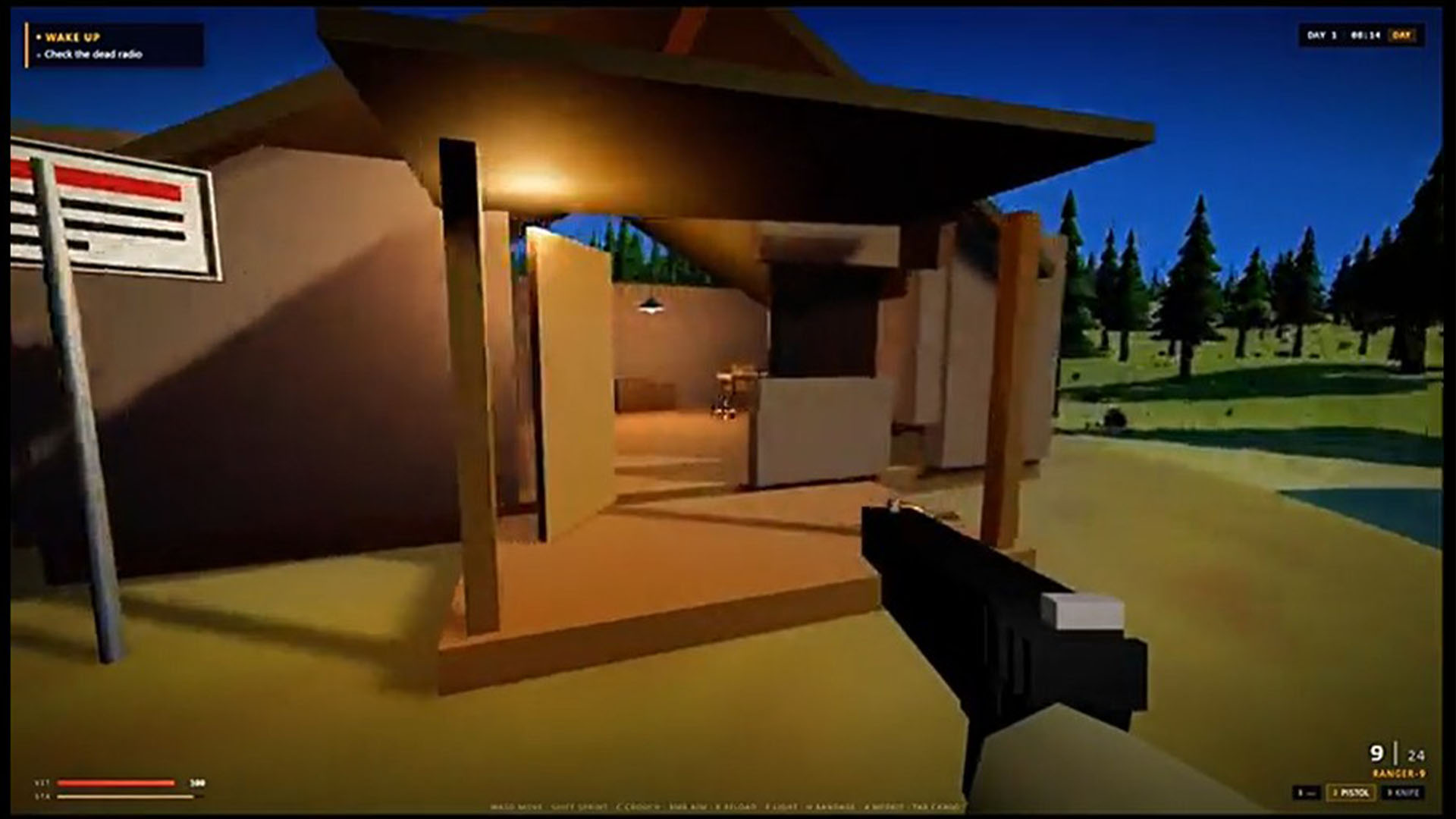
A developer claims to have used a locally running Qwen3.8 27B AI model to create a playable first person zombie shooter in about five hours.
The project is visually basic and far below modern commercial games, but it shows how local AI tools can already handle a surprising amount of coding and iteration without relying on cloud services or paid token usage.
The creator reportedly used a quantized version of Qwen3.8 27B on a PC equipped with an RTX 3090. The model was not used in a single prompt. Instead, the developer ran several iterative coding sessions with two configured agentic coding setups.
| Detail | Reported information |
|---|---|
| AI model | Qwen3.8 27B |
| Model format | Q4KM 4 bit quantized |
| Approximate model file size | 16.8GB |
| Total memory requirement | Around 32GB |
| GPU used | GeForce RTX 3090 |
| Development time | About 5 hours |
| Game type | First person zombie shooter |
| Final game size | Around 190MB |
| Internet required | No |
| Cloud token usage | None |
The project relied on local AI hardware
The creator used a 4 bit quantized version of Qwen3.8 27B because the full model requires substantially more memory.
An unquantized version is said to need roughly 55GB to 60GB of combined system memory and VRAM for practical use.
The 4 bit version reduced those requirements enough to run on a system with an RTX 3090, although around 32GB of total memory was still needed.
That means local AI game development is becoming possible on older high end hardware, but it is still far from lightweight.
The AI needed several rounds of correction
The game was not generated perfectly on the first attempt.
According to the creator, the initial code had multiple problems and required several follow up passes.
Later iterations reportedly fixed issues involving player movement, collision detection, lighting and other gameplay elements.

This is important because it shows that AI coding still depends on repeated testing and correction.
The model can produce a large amount of working code quickly, but the process is closer to guided iteration than fully automatic game development.
Visual quality remains very basic
The finished game is reportedly around 190MB and has simple graphics that resemble much older PC games.
The project includes an interactive 3D environment and first person gameplay, but it is not close to the visual quality of modern commercial shooters.
The engine is believed to be based on browser friendly technology such as HTML or JavaScript, although that detail has not been confirmed.
The project is therefore more useful as a demonstration of AI assisted development speed than as an example of advanced game design.
Local AI could lower the entry barrier for small projects
One of the more interesting parts of the experiment is that the model ran entirely on local hardware.
That removes the need for an internet connection, API access or continuous token payments.
For hobby developers, students or small teams, this could make AI coding tools easier to experiment with over long sessions.
The result also shows how agentic coding systems can help people who are not expert programmers move from an idea to a working prototype much faster.
That does not eliminate the need for technical knowledge. Hardware requirements remain high, and debugging, testing and design decisions still matter.
Five hours is impressive, but context matters
Creating a basic playable shooter in roughly five hours is a strong demonstration of how quickly AI coding tools are improving.
However, the result should not be compared directly with professional game development.
Commercial games require art production, animation, audio, level design, testing, networking, optimization and many other systems that go far beyond generating a simple prototype.
The project is better viewed as evidence that local AI models can already help produce functional interactive software with relatively little manual coding.
As local models become more capable and hardware support improves, similar tools could make rapid prototyping much more accessible to individual developers and small teams.



Discussion (0)
Be the first to comment.