



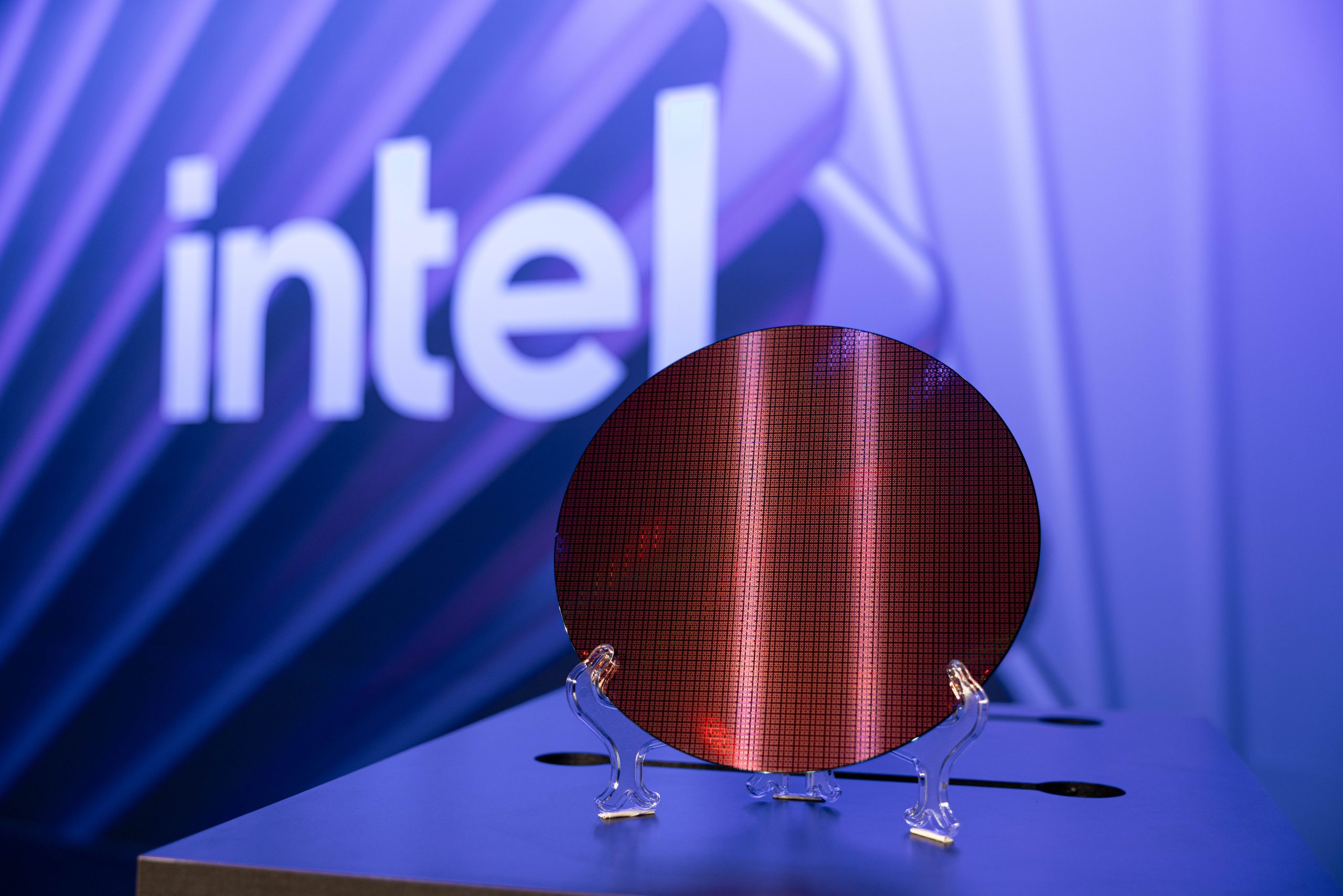
Intel has shared new details on its 18A P process technology, showing a measured 30 percent frequency improvement at 0.5V on production silicon compared with equivalent FinFET based cores.
The process combines Gate All Around RibbonFET transistors with backside power delivery, additional metal layers, improved thermal characteristics and a new Power Boost design. Intel says the first products expected to benefit include Diamond Rapids Xeon processors and Nova Lake client CPUs.
Compared with standard Intel 18A, the company says 18A P can provide more than 9 percent higher performance at the same power or over 18 percent lower power at the same performance.
| Intel 18A P improvement | Reported gain |
|---|---|
| Frequency at 0.5V | Up to 30% higher |
| Performance at same power vs 18A | More than 9% higher |
| Power at same performance vs 18A | More than 18% lower |
| W3P Power Boost device | Up to 10% faster |
| NMOS external resistance | 20% lower |
| PMOS external resistance | 12% lower |
| Bond stack thermal conductance | 50% higher |
| Overall stack thermal resistance | 20% to 40% improvement |
Backside power and RibbonFET work together
One of the key changes in 18A P is Intel's use of backside power delivery.
Instead of routing both power and data through the front side of the chip, PowerVia moves power delivery to the back of the wafer. This reduces congestion in the signal wiring and can limit voltage loss during heavy workloads.
Intel says the 30 percent frequency result at 0.5V came from direct measurements comparing Gate All Around cores with backside power against equivalent FinFET designs at the same voltage. The comparison was intended to isolate the process technology benefit rather than an architectural change.
RibbonFET also gives Intel tighter control over the transistor channel because the gate surrounds it on all four sides. That helps support lower threshold voltages and improves efficiency.
The company says standard 18A had already demonstrated gains from backside power, including around 5 percent higher frequency at 1.1V and 7.5 percent at 0.95V.
Power Boost adds a new dual contact design
Intel 18A P expands the RibbonFET device portfolio with several options designed for different performance targets.
W1 and W1.5 devices are intended for lower power and lower capacitance designs. W3P targets higher performance workloads and includes Power Boost, a dual contact architecture designed to increase drive current without increasing electrical load.
Intel says W3P can enable around 10 percent faster operation at matched capacitance.
The process also reduces external resistance by 20 percent for NMOS devices and 12 percent for PMOS devices, which should help improve current delivery and frequency scaling.
Two additional coarse metal layers are also being added to reduce interconnect resistance and routing congestion. Intel reports about a 3 percent frequency improvement at 1.1V and 2 percent at 0.65V, along with roughly 2 percent lower power consumption.
Thermal improvements are another part of the node
Intel is also focusing on heat removal.
The company says 18A P improves bond stack thermal conductance by 50 percent, resulting in an overall stack thermal resistance improvement of around 20 percent to 40 percent.
That matters because frequency gains at higher voltages can be limited by both electrical and thermal constraints.
Intel is also researching future interconnect technologies including ruthenium with air gaps and vertically stacked logic, though those technologies are further out and are not part of current 18A P production.
Diamond Rapids and Nova Lake will be early 18A P products
Diamond Rapids is expected to be one of the leading server products built on 18A P.
Intel says the processor can scale to as many as 256 cores, with the I/O moved toward the center of the package to provide more uniform memory access across the chip. The company expects the extra frequency headroom from 18A P to improve per core performance alongside the higher core count.
Nova Lake is also expected to use 18A P for upcoming Core processors.
Intel's latest disclosures suggest that 18A P is intended to be more than a minor revision of 18A. The company is combining transistor, power delivery, wiring and thermal changes to improve both low voltage efficiency and higher voltage performance, with Diamond Rapids and Nova Lake expected to provide the first practical examples of those gains.



Discussion (0)
Be the first to comment.