




GMKtec is preparing a stronger version of its EVO X3 mini PC with AMD’s Ryzen AI Max Plus PRO 495 processor and 192GB of LPDDR5X memory. The company’s current plan is to launch the EVO X3 first with the Ryzen AI Max Plus 395, then follow later this year with the upgraded PRO 495 configuration.
That makes the EVO X3 one of the first mini PCs confirmed with AMD’s new Ryzen AI Max PRO 400 series processor option. The system is positioned as a compact workstation rather than a basic mini PC, with a focus on AI development, high memory workloads, external graphics support, and professional software use.
The EVO X3 is a larger follow up to the EVO X2. At launch, it will use the same Ryzen AI Max Plus 395 Strix Halo APU found in the EVO X2, but GMKtec is improving the surrounding platform. The company lists native OCuLink for external graphics, WiFi 7, USB4, dual PCIe 4.0 drive bays, and ROCm software support.
The system was previously shown at AMD AI Developer Day 2026 in Shanghai, which fits the product’s focus. This is not only a compact desktop for general work. GMKtec is clearly trying to build a small system for local AI tasks, GPU accelerated development, creator workloads, and users who need more memory than a normal mini PC can provide.
Ryzen AI Max Plus PRO 495 brings more memory and faster graphics
AMD confirmed the Ryzen AI Max PRO 400 series on May 20, 2026. The company said systems using the new processors will arrive from OEM partners in the third quarter of 2026, including commercial PCs, mobile workstations, and small form factor desktops.
The Ryzen AI Max Plus PRO 495 fits that category well. It is still based on Zen 5 CPU cores and RDNA 3.5 graphics, so this is a refresh of the existing Strix Halo platform rather than a new architecture. The changes are focused on higher clocks, more memory capacity, stronger integrated graphics, and improved AI capability.
| Feature | Ryzen AI Max Plus 395 | Ryzen AI Max Plus PRO 495 |
|---|---|---|
| Architecture | Zen 5 and RDNA 3.5 | Zen 5 and RDNA 3.5 |
| Memory support | Up to 128GB LPDDR5X 8000 | Up to 192GB LPDDR5X |
| Configurable VRAM | Lower than PRO 495 | Up to 160GB |
| Integrated graphics | Radeon 8060S | Radeon 8065S |
| GPU clock | Up to 2.9 GHz | Up to 3.0 GHz |
| NPU | XDNA 2 | XDNA 2 |
| NPU performance | Lower listed figure | Up to 55 TOPS |
The 192GB memory configuration is the most important upgrade. Strix Halo uses unified memory, which means the CPU and integrated GPU share the same memory pool. For AI workloads, this can be a major advantage because the system can allocate a much larger portion of memory to graphics or AI tasks than typical integrated graphics platforms.
AMD lists up to 160GB of configurable VRAM for the Ryzen AI Max Plus PRO 495. That does not make it a direct replacement for every discrete GPU workstation, but it gives the platform a unique position. A compact PC with that much shared memory can be useful for local AI models, development work, large creative projects, and GPU accelerated tasks that benefit from memory capacity.
EVO X3 looks designed for compact AI workstations
The rest of the EVO X3 platform also supports that direction. Native OCuLink gives the mini PC a high speed external PCIe path for external graphics or other expansion hardware. That is useful because even though Strix Halo has powerful integrated graphics, some users may still want a discrete GPU for specific workloads.
USB4 and dual PCIe 4.0 drive bays also make the system more flexible. Fast external storage, multiple internal drives, and modern connectivity are important for workstation style mini PCs. WiFi 7 gives it current wireless support, while ROCm support matters for developers using AMD GPU compute tools.
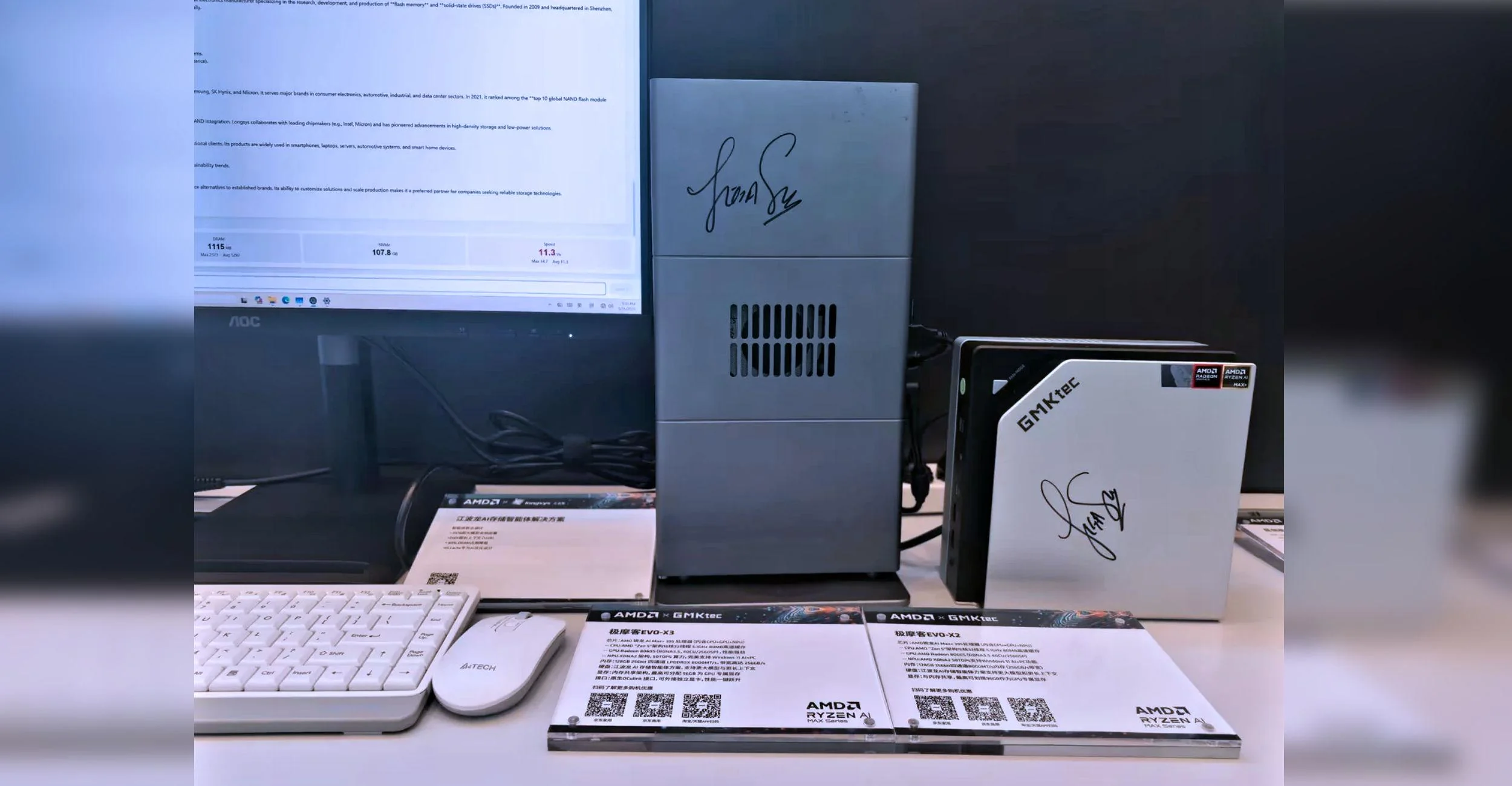
The Ryzen AI Max Plus 395 version should already be strong. It brings 16 Zen 5 CPU cores, Radeon 8060S graphics, and support for up to 128GB memory. But the Ryzen AI Max Plus PRO 495 version pushes the concept further by raising the memory ceiling to 192GB and adding Radeon 8065S graphics.
This makes the later EVO X3 configuration more attractive for people working with larger AI models or heavier GPU memory demands. In small systems, memory capacity is often the limiting factor. GMKtec appears to be addressing that directly.
The PRO 495 model could make Strix Halo more serious for developers
The EVO X3 is part of a wider shift in mini PCs. These systems are no longer only about office work, media playback, or casual gaming. With chips like Strix Halo, mini PCs are becoming compact workstations with serious CPU, GPU, and AI capability.
The Ryzen AI Max Plus PRO 495 version will likely be expensive, especially with 192GB of memory. But the target buyer is not the same person shopping for a low cost mini PC. This is for developers, AI hobbyists, creators, engineers, and workstation users who want a powerful system in a much smaller footprint than a desktop tower.
There are still questions. GMKtec has not shared final pricing, exact launch timing, sustained power behavior, or cooling performance for the PRO 495 configuration. Those details will matter because Strix Halo performance depends heavily on power limits and thermal design.
Still, the announcement is important because it confirms that AMD’s Ryzen AI Max PRO 400 series is moving into compact desktop systems, not only large workstations or laptops. The EVO X3 could become one of the more interesting small form factor AI PCs if GMKtec delivers strong cooling, stable ROCm support, and a reasonable price for the 192GB model.
For now, the EVO X3 looks like a clear step above the EVO X2. The first model will bring upgraded I/O around Ryzen AI Max Plus 395, while the later Ryzen AI Max Plus PRO 495 version will raise the ceiling with 192GB memory, Radeon 8065S graphics, and a stronger local AI workstation focus.



Discussion (0)
Be the first to comment.