



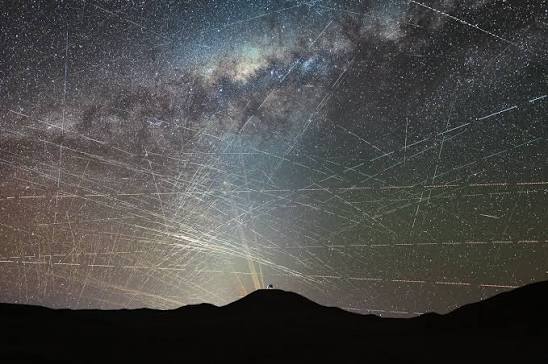
A new study from the European Southern Observatory warns that plans to place more than 1.7 million additional satellites into orbit could seriously damage ground-based astronomy. The report highlights SpaceX’s proposed million-satellite network for space-based data centers as one of the biggest concerns, arguing that uncontrolled growth in low Earth orbit could make some telescope observations far less effective.
The study focuses on a simple problem: satellites reflect sunlight. When they pass through a telescope’s field of view, they can leave bright streaks across images and block faint objects behind them. For astronomers studying distant galaxies, exoplanets, asteroids, and other weak targets, even a short trail can ruin valuable data.
Researchers say the impact will depend on how many satellites are launched, how bright they are, and how regulators respond.
Satellite Trails Could Remove Large Parts of Telescope Images
The study simulated the movement and brightness of existing and proposed satellite fleets. It found that some major observatories could lose a significant share of their usable observations during parts of the night.
For SpaceX’s proposed constellation, observations from the Very Large Telescope in Chile could reportedly contain dozens of satellite trails just a few hours after sunset. In some cases, up to 28% of the observed field could be affected.
| Observatory type | Potential impact from large satellite fleets |
|---|---|
| Narrow-field telescopes | Multiple bright trails in each image |
| Very Large Telescope observations | Up to 28% of the field could be affected |
| Wide-field survey cameras | Large portions of night-time images may be lost |
| Asteroid tracking programs | Harder to detect faint moving objects |
| Exoplanet and galaxy studies | Higher risk of lost data from reflected light |
The concern becomes even greater for wide-field facilities such as the Vera C. Rubin Observatory. These telescopes capture huge areas of sky at once, which makes them more likely to record satellite trails during large-scale surveys.
Mirror Satellites Could Make the Problem Worse
The study also examined proposed reflective satellite systems, including large mirror-based fleets designed to direct sunlight toward Earth.
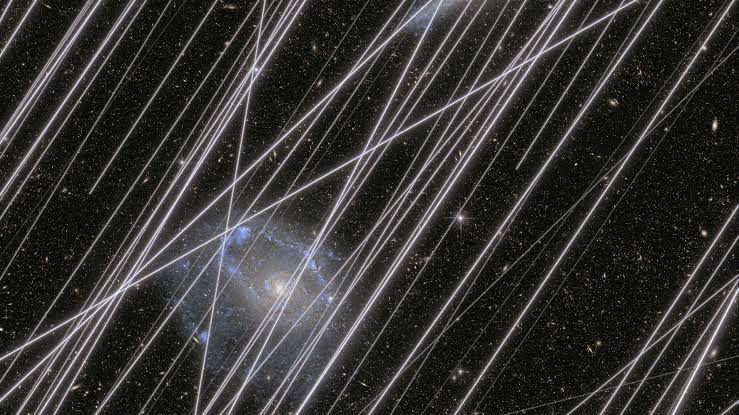
According to the analysis, even a single reflective satellite could interfere with an observation without directly aiming light at an observatory. A large fleet could make the situation much worse by increasing the brightness of the night sky itself.
Researchers warned that this could make faint targets harder to observe, including distant galaxies, small asteroids, and possible Earth-like planets around other stars.
A brighter sky does not only affect professional observatories. It can also reduce what amateur astronomers, students, and ordinary people are able to see from dark locations.
Scientists Want a Global Satellite Limit
The study recommends limiting the total number of satellites in orbit to around 100,000, provided they remain too dim to be seen with the naked eye from dark locations. The preferred number would be closer to 50,000.
That is far below the number included in current satellite proposals.
| Proposed approach | Suggested target |
|---|---|
| Preferred global satellite cap | Around 50,000 satellites |
| Maximum suggested cap | Around 100,000 satellites |
| Current proposed additional satellites | More than 1.7 million |
| SpaceX proposal | Up to 1 million satellites |
The researchers describe low Earth orbit as a shared resource that should support communication services without permanently damaging the night sky.
The Effects Could Go Beyond Astronomy
The warning is not limited to telescope images. Large satellite fleets may also affect wildlife, human sleep cycles, atmospheric pollution, and the long-term sustainability of low Earth orbit.
Maintaining huge constellations requires frequent launches and replacement satellites. Those launches, along with re-entering spacecraft that burn up in the atmosphere, can add pollution and debris concerns.
Regulators now face a difficult choice. Satellite networks can improve internet access and communication services around the world, especially in underserved regions. But astronomers argue that the growth of these systems needs firm limits before the damage becomes permanent.
The study’s message is clear: global connectivity has value, but the night sky is also a shared resource that may be impossible to restore once it is overwhelmed.



Discussion (0)
Be the first to comment.