



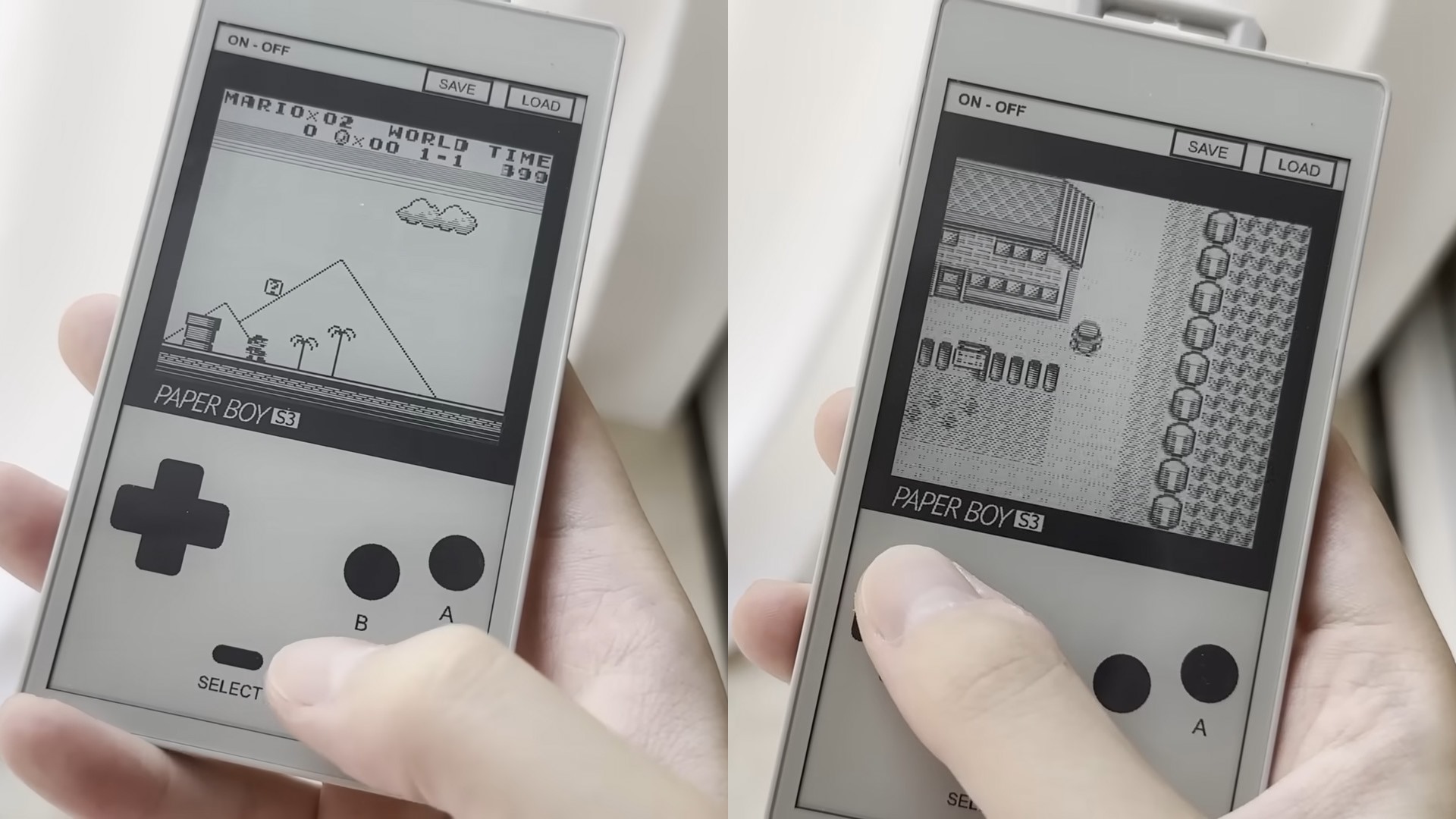
A hardware modder has turned an e-ink development board into a working Game Boy-style handheld that can run classic games at up to 60Hz. The project, called PaperBoy S3, uses an M5Stack PaperS3 board with an e-ink display and an ESP32-S3 dual-core processor, along with a modified version of the CrankBoy emulator.
The result is unusual because e-ink screens are normally associated with e-readers, smart labels, and low-power devices rather than fast-moving games. Despite that limitation, the handheld can run titles such as Pokémon Blue, Super Mario Land, and The Legend of Zelda: Link’s Awakening with surprisingly smooth motion.
It is not a perfect Game Boy replacement, but it shows how far e-ink technology and lightweight emulation can be pushed.
PaperBoy S3 Uses E-Ink for Classic Game Boy Emulation
The project is based on the M5Stack PaperS3, a compact development board that includes an e-ink screen and an ESP32-S3 processor. The ESP32-S3 is not a high-performance gaming chip, but it is powerful enough to emulate older Game Boy hardware with careful optimization.
The creator modified the CrankBoy emulator to work with the board and its display limitations. The device uses monochrome visuals that fit naturally with original Game Boy games, making the e-ink screen a better match than it might be for more colourful systems.
| Component | PaperBoy S3 setup |
|---|---|
| Main board | M5Stack PaperS3 |
| Processor | ESP32-S3 dual-core chip |
| Display type | E-ink |
| Emulator | Modified CrankBoy |
| Target system | Original Game Boy |
| Maximum refresh rate | Up to 60Hz |
| Control method | Touchscreen controls |
| Extra input support | Limited Bluetooth LE controller support |
The sharp black-and-white presentation helps the device look closer to an unusual modern version of the original Game Boy rather than a standard handheld emulator.
E-Ink Gaming Still Comes With Important Limits
E-ink displays are usually slow compared with LCD and OLED panels. They can show noticeable ghosting when images change quickly, which makes them difficult to use for action games.
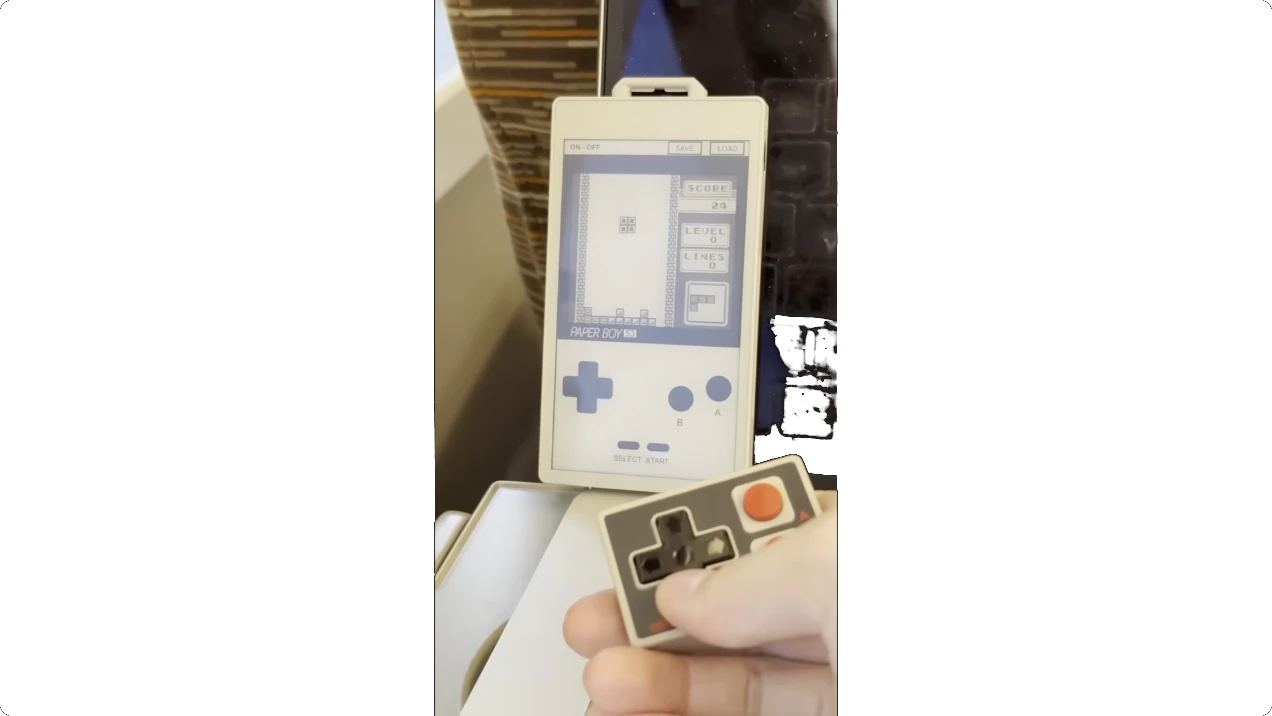
PaperBoy S3 reportedly handles motion much better than expected, but it still needs frame skipping during performance drops. The emulator can dip below 60 frames per second in some situations, so skipping frames helps keep gameplay moving.
Audio is another limitation. The system cannot reproduce original Game Boy sound at full quality, so music and effects are represented through rougher high-pitched tones.
| Limitation | Effect on gameplay |
|---|---|
| E-ink response time | Can create ghosting in fast scenes |
| Limited processor power | Causes occasional performance drops |
| Frame skipping | Helps maintain smoother movement |
| Audio processing limits | Produces simplified beeps instead of full sound |
| Bluetooth support | May not work consistently with every controller |
The ESP32-S3 also needs to dedicate one of its two CPU cores largely to audio processing, showing how tightly the hardware is being pushed.
Save States Add More Convenience Than an Original Game Boy
The modified emulator includes save and load state support. This gives players the ability to pause a game almost anywhere and return to the same moment later.
That is a useful feature for portable gaming, especially on a small experimental device. However, save states can create problems if they are loaded after an in-game save was made later. Doing that can overwrite or corrupt progress depending on the game and emulator behaviour.
Players using save states should keep them updated whenever they make meaningful progress through normal in-game save systems.
The Project Shows Another Use for E-Ink Displays
PaperBoy S3 is mostly a technical experiment, but it highlights why e-ink still has value beyond e-readers. The display uses very little power, remains easy to read in bright light, and can reduce eye strain compared with traditional backlit screens.
Gaming will probably remain a niche use for e-ink because fast action games need quicker display response times. Still, slower retro games, turn-based titles, text adventures, puzzle games, and classic handheld systems could work surprisingly well on this type of display.
The PaperBoy S3 is not likely to become a mass-market handheld, but it is an impressive example of what happens when a developer designs around the strengths and weaknesses of unusual hardware.



Discussion (0)
Be the first to comment.