



A damaged Intel Celeron 1200 processor that appeared beyond repair has been brought back to life after an enthusiast performed a delicate reconstruction of one of its missing data pins. The restored CPU not only booted successfully after the repair, but also remained stable after being overclocked from 1.2 GHz to 1.6 GHz, representing a 33% increase in clock speed.
The processor is based on Intel’s Tualatin generation, which dates back roughly 25 years and is closely related to the Pentium III family. Its failure was more serious than a typical bent or broken CPU pin because the contact pad beneath the missing pin had also been torn away.
That meant simply soldering another pin onto the surface would not work.
Repair required exposing the connection inside the substrate
The missing contact was identified as D47, a data pin required for normal processor operation. Unlike some power or ground pins, which may have duplicate connections elsewhere on a CPU package, losing a data pin can prevent the system from booting completely.
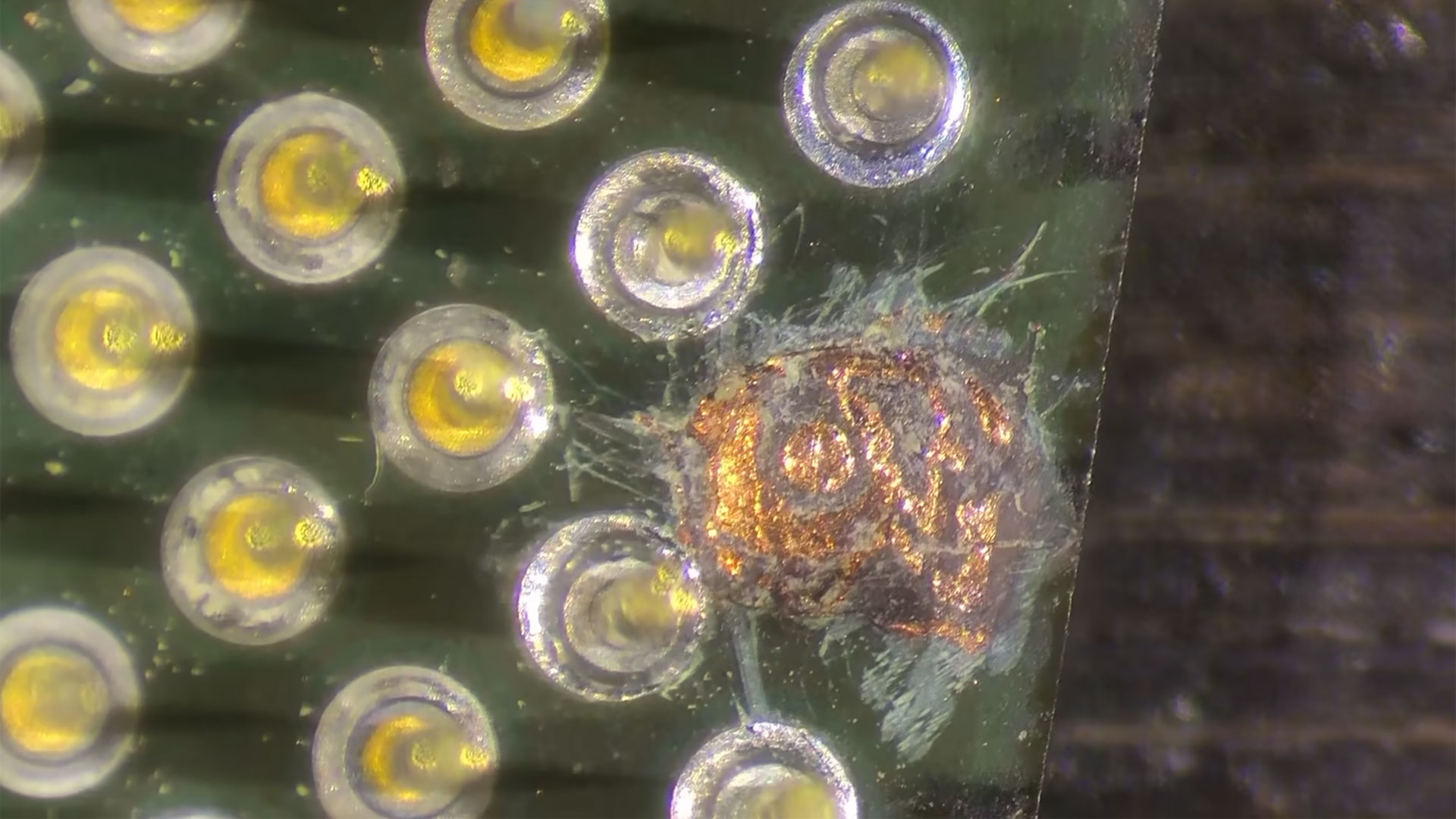
To restore the connection, the damaged section of the processor substrate had to be carefully opened until the internal copper structure became accessible.
Several copper layers were visible beneath the green outer surface of the CPU. The challenge was connecting the replacement pin to one specific central contact while avoiding the surrounding copper planes. Any accidental electrical bridge could have created a short circuit or permanently damaged the processor.
Solder mask was applied around the exposed contact to isolate the correct connection. After the mask cured, the repairer prepared the small copper area with flux and solder.
A replacement pin was taken from another damaged Tualatin processor and positioned over the reconstructed contact. Despite the extremely small working area, the donor pin was successfully soldered into place and remained upright enough to fit into the motherboard socket normally.
| Repair stage | What was required |
|---|---|
| Damage assessment | Identify missing D47 data pin and destroyed surface pad |
| Substrate work | Expose the internal copper connection |
| Electrical isolation | Protect nearby copper layers with solder mask |
| Replacement part | Harvest a compatible pin from another CPU |
| Soldering | Attach the donor pin directly to the exposed contact |
| Verification | Check the repaired area with a multimeter before power on |
| Final testing | Boot the CPU, run benchmarks and test overclocking |
Repaired CPU boots and reaches 1.6 GHz
Before turning the system on, the repaired processor was checked with a multimeter to look for obvious shorts or incorrect connections. The measurements did not reveal any immediate problems, so the CPU was installed for a full boot test.
The system started successfully.
Further testing included several processor benchmarks, showing that the repaired connection was reliable enough for normal operation. The Celeron 1200 was then pushed beyond its original clock speed.
Instead of its standard 1.2 GHz frequency, the processor successfully operated at 1.6 GHz, a 33% overclock.
That result is particularly notable because the repair affected a critical data connection rather than a redundant power or ground pin. Stable operation under an overclock also suggests that the reconstructed electrical path was strong enough to remain functional under higher operating demands.
The project shows how older processors can sometimes be repaired even after damage reaches below the visible surface of the package. However, this type of work is far beyond a typical broken pin repair. It requires precision soldering equipment, magnification, knowledge of PCB structures and careful electrical testing.
For most damaged CPUs, particularly modern processors with much denser packaging, attempting to cut into the substrate would carry a significant risk of destroying additional internal connections. In this case, careful work turned what appeared to be a dead Celeron into a fully working processor that ultimately ran faster than its original specification.

Discussion (0)
Be the first to comment.