



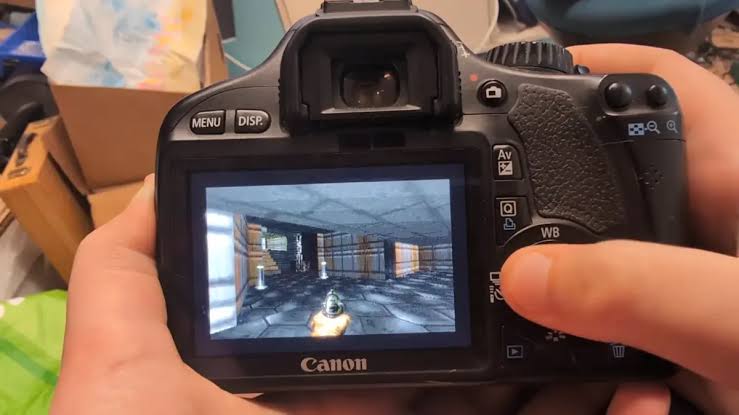
The original Doom has found another unusual home, this time on a Canon EOS 550D DSLR camera released in 2010.
Developer Bas Lichtjaar, known online as lauris nl, created a playable version of the 1993 shooter for the camera using Magic Lantern. The result is more functional than many novelty Doom ports, with working controls, sound, save files, and support for several compatible WAD files.
The Canon EOS 550D was also sold as the Rebel T2i and EOS Kiss X4. Despite its age and original purpose as an entry level DSLR, its DIGIC 4 processor is capable of running the game at playable speeds.
Camera buttons become Doom controls
The port makes use of the physical buttons already present on the back of the camera, turning photography controls into a basic gamepad.
| Camera control | Doom function |
|---|---|
| Direction buttons | Movement and menu navigation |
| Set button | Fire or select |
| Menu button | Open the game menu |
| DISP button | Back or additional game control |
| Rear controls | Weapon switching on supported configurations |
| Built in speaker | Game audio |
Doom runs directly on the camera display, with the project supporting a 320 x 240 rendering mode along with a larger display option that uses the EOS 550D's 720 x 480 screen area.
Audio is also supported through the camera's built in mono speaker. The sound quality is naturally limited by hardware designed for camera playback rather than gaming, but the addition makes the port considerably more complete.
The project also includes save and load functionality, allowing you to continue progress rather than treating the camera version as a short technical demonstration.
Magic Lantern makes the port possible
The project relies on Magic Lantern, an open source software platform created to expand the capabilities of compatible Canon cameras.
Magic Lantern runs alongside Canon's software and has traditionally been used to add photography and video functions that were not available in the original camera interface. Its features can include RAW video recording, focus peaking, expanded ISO options, interval shooting, exposure tools, and additional on screen information.
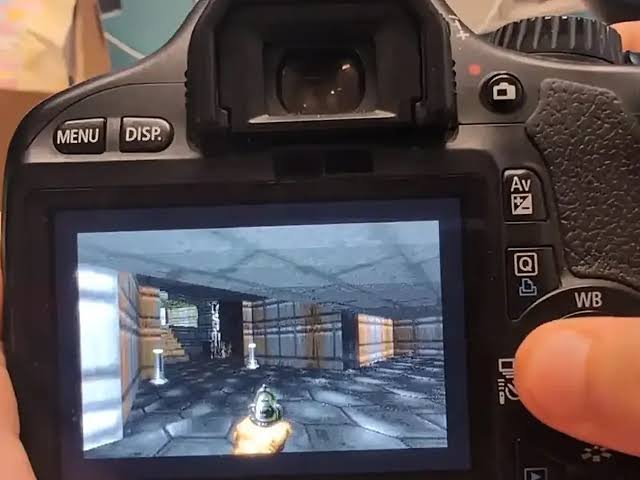
That flexible software environment has now provided a way to run Doom as well.
The port supports multiple Doom compatible game files. Doom, Doom II, TNT: Evilution, The Plutonia Experiment, and compatible alternatives such as Freedoom can be used. Some games based on related technology, including Heretic and Hexen, are not supported by the current version.
Multiple WAD files can also be stored, giving the camera access to more than the original Doom campaign.
The project comes with an important compatibility warning
Anyone interested in experimenting with the port needs to pay close attention to its hardware requirements.
The current build is specifically intended for the Canon EOS 550D running Canon firmware version 1.0.9. The developer warns against installing the binary on another camera model or a different firmware version.
That restriction matters because unofficial camera software can create serious problems when used on unsupported hardware. The project should therefore be viewed as an experimental modification rather than a normal application that can simply be copied to any Canon DSLR.
The EOS 550D itself originally shipped with an 18 megapixel APS C sensor, a 3 inch display, and Canon's DIGIC 4 image processor. Those specifications were aimed at still photography and video recording, but they are apparently enough to handle a game first released more than three decades ago.
The experiment adds another device to the long list of unexpected hardware capable of running Doom, while also showing how much flexibility remains hidden inside older consumer electronics when developers gain deeper access to the hardware.



Discussion (0)
Be the first to comment.