




Cooler Master is experimenting with a massive liquid cooling concept designed to handle up to 2000W of heat from both the CPU and GPU. The prototype, called Project AIO Liquid Cooling Solution, was shown at Cooler Master’s Taiwan headquarters during Computex 2026 and looks aimed more at extreme workstations than ordinary gaming PCs.
The cooler uses a huge 360 x 360 radiator, which is very different from the standard 360 mm radiators used in many AIO liquid coolers. Instead of three 120 mm fans, this prototype uses four large 180 mm fans to create a full wall of airflow across the radiator. Cooler Master says the larger fans can reduce noise by around 20 percent, which would be important for a system designed to cool hardware drawing this much power.
The setup is built to cool both the processor and graphics card in one loop. Flexible tubing connects the radiator to large blocks for the CPU and GPU, making it closer to a custom liquid cooling setup than a typical sealed AIO cooler. Cooler Master still calls it an AIO concept, which suggests the company may be exploring a more prebuilt or easier to install version for future systems.
Cooler Master is targeting extreme thermal loads
The headline figure is the 2000W cooling capacity. That is far beyond what normal gaming systems need, but it makes sense in the context of modern high end hardware. Flagship CPUs, large workstation processors, and top end GPUs can produce heavy thermal loads, especially when used for rendering, AI workloads, simulation, and professional compute tasks.
| Feature | Cooler Master Project AIO |
|---|---|
| Cooling target | Up to 2000W |
| Radiator size | 360 x 360 |
| Fan setup | Four 180 mm fans |
| Cooling coverage | CPU and GPU |
| Design type | AIO style concept with custom loop traits |
| Main target | High end workstations and extreme builds |
| Status | Prototype mockup |
| Case shown | Cooler Master Cosmos |
The radiator is large enough to take up the entire rear section of some of Cooler Master’s larger gaming and workstation cases. That means this cooler is not meant for compact builds or standard mid tower layouts. It needs a case designed around it.
Cooler Master displayed the prototype inside a Cosmos case, which suggests the company is at least considering compatibility with some of its consumer facing chassis. Still, this kind of cooler would likely require careful case planning, motherboard clearance, GPU block support, and tubing management.
This looks more like a custom loop than a normal AIO
Most AIO liquid coolers are simple products. They cool the CPU, come prefilled, and usually include a radiator with two or three fans. Project AIO is much more ambitious. Since it is designed to cool both the CPU and GPU, it moves closer to the territory normally occupied by custom liquid cooling loops.
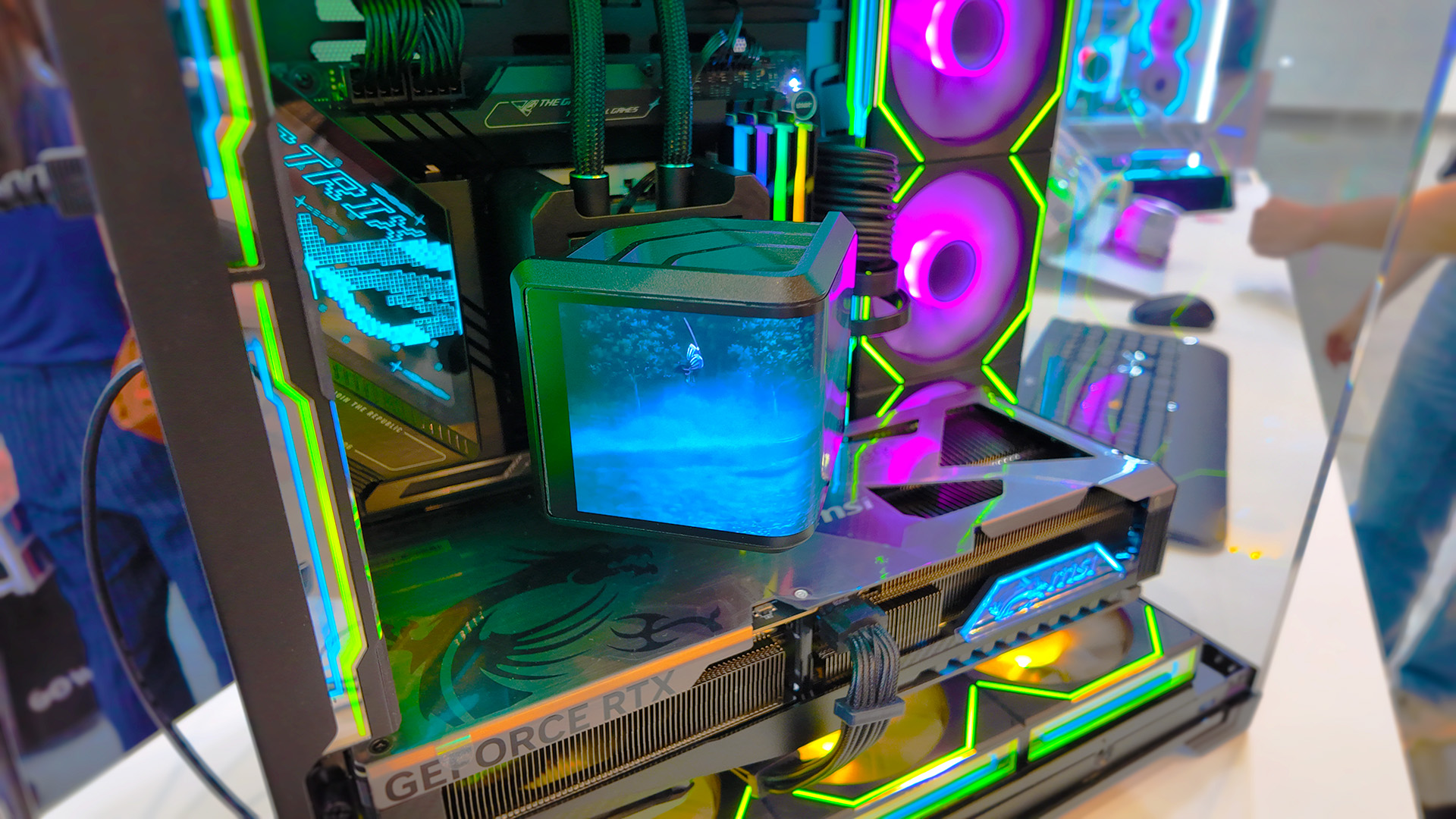
That could be useful if Cooler Master can make it easier to install than a traditional custom loop. Many PC builders like the performance and clean look of water cooled CPUs and GPUs, but custom loops require more planning, maintenance, fittings, fluid handling, and risk management. A prebuilt or semi prebuilt version of this concept could make extreme cooling more accessible for workstation buyers.
The 180 mm fans are also a key part of the design. Larger fans can move more air at lower speeds, which can reduce noise if the radiator and fan tuning are handled well. A 2000W system could easily become loud if cooled by smaller fans spinning aggressively, so Cooler Master’s focus on huge airflow makes sense.
However, the size also creates obvious limitations. This cooler will not fit most cases. It will also likely cost far more than standard AIO coolers if it becomes a real product. The CPU and GPU blocks would need to support specific hardware, especially on the GPU side, where board layouts differ across models and manufacturers.
Cooler Master may be preparing for hotter future hardware
Project AIO reflects a larger trend in PC hardware. Cooling companies are preparing for systems that draw more power, especially as AI, workstation, and enthusiast hardware continue to expand. A high core count CPU paired with one or two flagship GPUs can already push cooling requirements beyond what a normal gaming PC needs.
For gaming alone, this cooler would be excessive for most people. Even a high end gaming system with an RTX 5090 would not normally need a 2000W cooling solution unless it was heavily modified or paired with additional extreme hardware. But for professional systems, the idea is easier to understand.
Workstations used for rendering, AI development, engineering, and other compute heavy tasks often run at high load for long periods. That creates a different cooling problem than gaming, where load can vary more widely. A large shared cooling loop could help keep both CPU and GPU temperatures under control while also reducing noise compared with smaller, faster fans.
Cooler Master has not confirmed when or if Project AIO will reach the market. The current version is still a mockup, and many practical details remain unknown. Compatibility, maintenance, pricing, reliability, and final performance will decide whether it becomes a real product or stays a Computex concept.
Still, the prototype shows that Cooler Master is thinking beyond ordinary AIO coolers. A 2000W CPU and GPU cooling system is not for most builds, but it could make sense for the next wave of extreme workstations. If the company can turn this into a prebuilt liquid cooling solution that is easier to use than a custom loop, Project AIO could become one of the most interesting cooling products in the high end PC space.



Discussion (0)
Be the first to comment.