



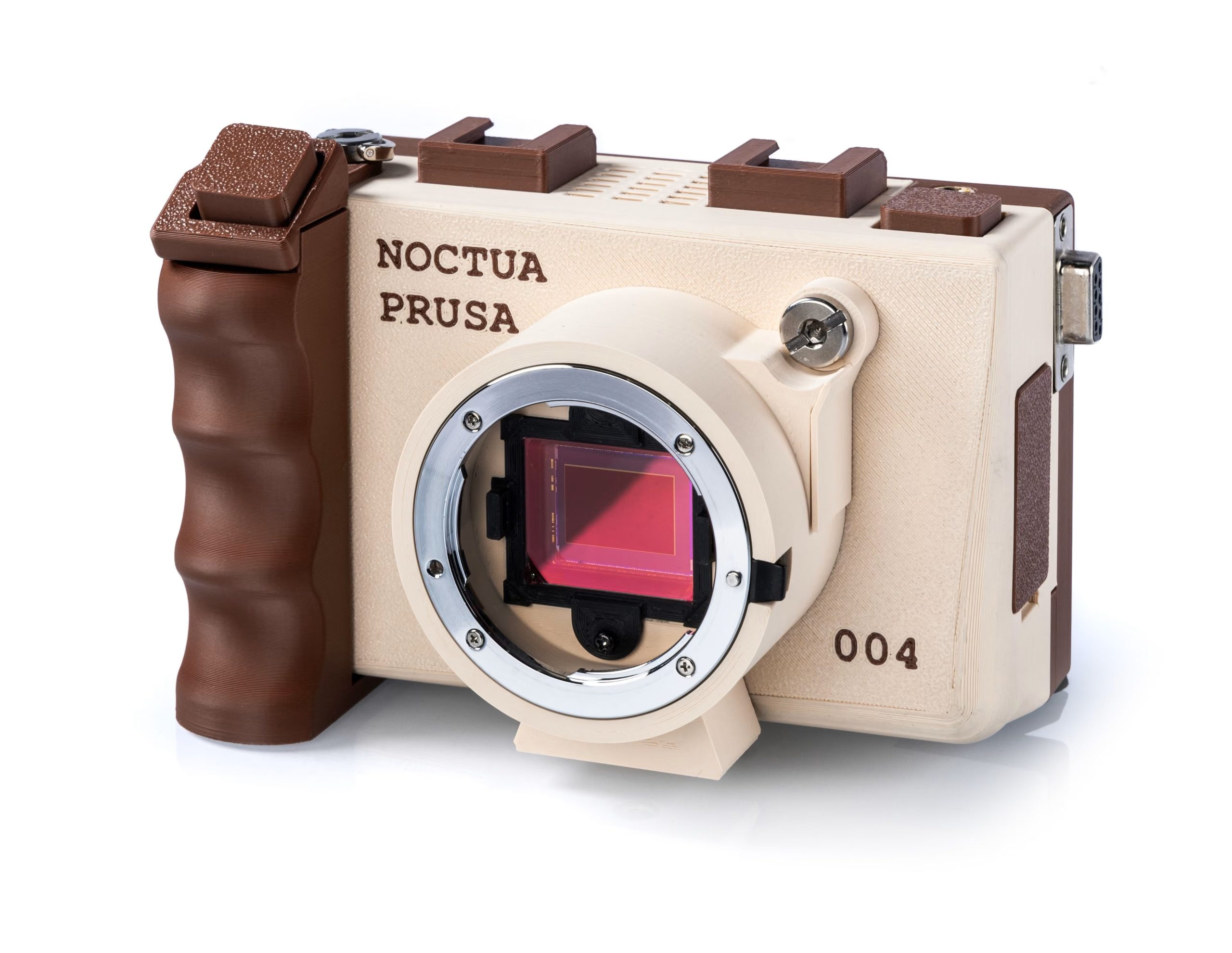
A new camera called CAIM1 is being developed around a simple goal: prove that an image or video was captured by a real camera at the moment of recording rather than generated later by AI.
The camera uses a hardware based verification system that creates cryptographic proof as footage is captured. According to the company behind it, the process is designed to provide an auditable record showing that the content originated from the device.
The project also includes an unexpected piece of hardware inside. Noctua supplies the small cooling fan used to manage heat generated by the camera’s processors during 4K60 recording and simultaneous cryptographic verification.
CAIM1 combines image capture with hardware verification
The camera integrates the TROPIC01 security chip from Tropic Square into its capture pipeline.
When you press record, the system is designed to generate proof alongside the image or video data. That proof is then stored separately in a form that can be checked later.
The company says the verification information is placed on immutable decentralized infrastructure and can be accessed openly for validation.
| Feature | Details |
|---|---|
| Camera | CAIM1 |
| Main purpose | Verify human captured images and video |
| Video capability | Up to 4K60 |
| Security hardware | TROPIC01 |
| Verification | Cryptographic proof created during capture |
| Lens | Bring your own lens design |
| Cooling fan | Noctua NF A4x10 5V PWM |
| Fan voltage | 5V |
| Proof storage | Decentralized verification infrastructure |
The important distinction is that the system attempts to establish authenticity at capture time rather than trying to detect AI generated material afterward.
That approach could be useful because AI detection methods can become less reliable as image generation models improve.
Noctua fan handles heat without adding much noise
Recording 4K60 video while generating cryptographic proof places a significant load on the camera’s processors.
The mostly enclosed body therefore needs active cooling.
Noctua is supplying its NF A4x10 5V PWM fan for the camera. The model was chosen because it combines a compact 40 mm size with controlled airflow, low noise and PWM speed adjustment.
Using a native 5V fan also avoids the need for a voltage step up converter that would be required with a conventional 12V model.
That matters in a battery powered camera because an additional converter would consume more space and power while also introducing more electrical switching noise.
Noise and vibration are particularly important in a camera. Mechanical vibration can interfere with sensitive imaging hardware, while audible fan noise could be captured by microphones during video recording.
Noctua says the fan’s bearing system and motor design help limit both vibration and tonal noise.
The camera uses a bring your own lens approach
CAIM1 does not appear to ship with a fixed lens.
Instead, it follows a bring your own lens design, allowing owners to attach compatible optics depending on their needs.
That makes the camera closer to a modular professional or enthusiast system than a typical consumer compact camera.
The design also helps explain why thermal management has received so much attention. The camera needs to handle image processing, video recording, cryptographic signing and security functions at the same time inside a relatively compact enclosure.
CAIM1 is still an upcoming product, so important details such as final pricing, release timing and broader lens compatibility have not yet been fully established.
Its main idea, however, is already clear. Rather than analyzing an image later and guessing whether it is real, the camera aims to create verifiable evidence of origin at the moment the content is captured.



Discussion (0)
Be the first to comment.