



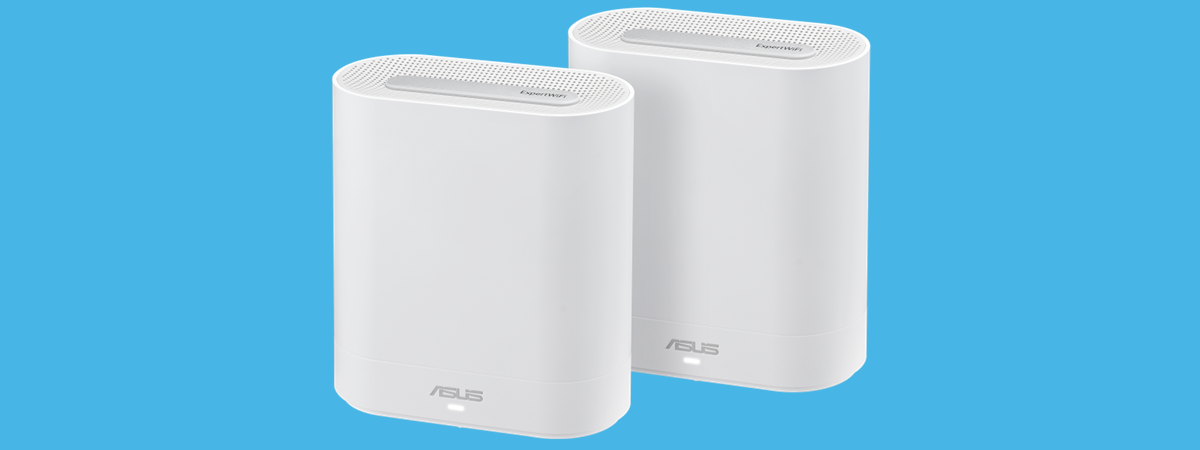
Although ASUS has a lot of expertise in building high-quality routers and mesh Wi-Fi systems for home users, the company has not focused on building networking solutions for business users so far. Luckily, things are changing with the introduction of the new ExpertWiFi lineup, which includes networking equipment designed for small and medium-sized businesses. Their first mesh system for the business sector is the ASUS ExpertWiFi EBM68, and I’m one of the first to test it in the real world. If you own or work for a company that needs good Wi-Fi, read this review and see whether ExpertWiFi EBM68 is the right choice for you:
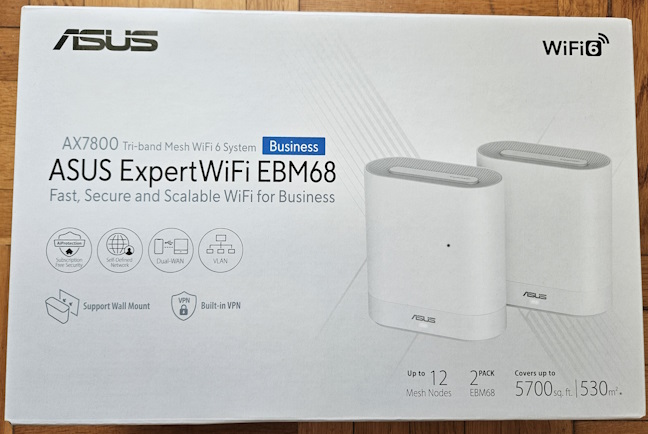
 The box used for ASUS ExpertWiFi EBM68
You find further information about this product, its hardware, and software specifications on the sides and back. When you open the box, you first see the two ExpertWiFi EBM68 stations that make up the kit, nicely packaged.
The box used for ASUS ExpertWiFi EBM68
You find further information about this product, its hardware, and software specifications on the sides and back. When you open the box, you first see the two ExpertWiFi EBM68 stations that make up the kit, nicely packaged.
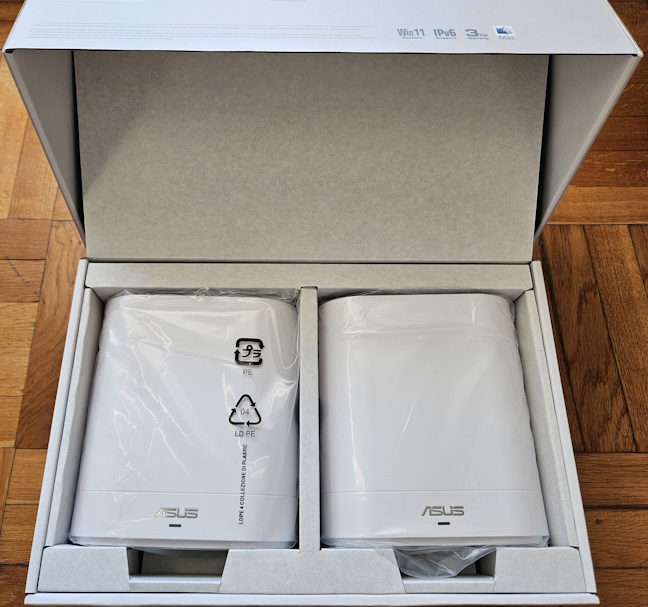
 Unboxing the ASUS ExpertWiFi EBM68
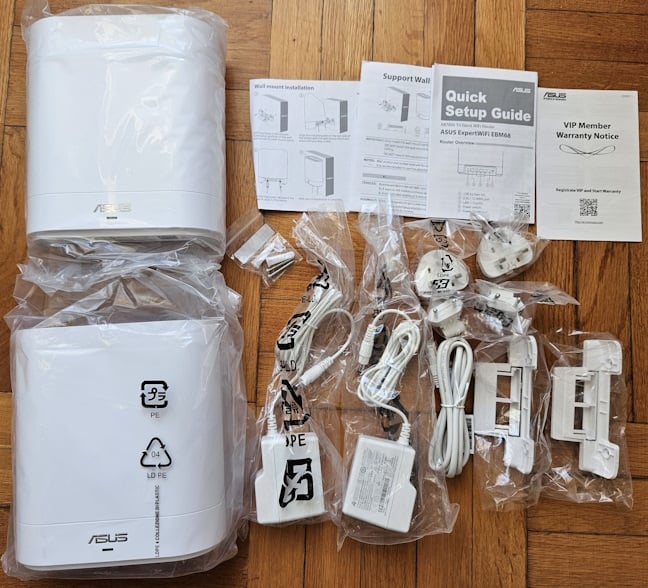
Take them out, and you will find plenty of items under them. At the end of the unboxing process, you should have the following: two ExpertWiFi EBM68 stations, their power adapters, a CAT5e network cable, two wall mounting kits, the quick setup guide, the warranty card, and other leaflets. As you can see in the picture below, the European version I received in testing bundles two power plugs: the standard EU and the UK versions.
Unboxing the ASUS ExpertWiFi EBM68
Take them out, and you will find plenty of items under them. At the end of the unboxing process, you should have the following: two ExpertWiFi EBM68 stations, their power adapters, a CAT5e network cable, two wall mounting kits, the quick setup guide, the warranty card, and other leaflets. As you can see in the picture below, the European version I received in testing bundles two power plugs: the standard EU and the UK versions.
 Everything you find inside the box
Unboxing the ASUS ExpertWiFi EBM68 is a pleasant experience. Inside the packaging, you get all kinds of accessories, including what you need to mount the stations on walls and the instructions for doing so.
Everything you find inside the box
Unboxing the ASUS ExpertWiFi EBM68 is a pleasant experience. Inside the packaging, you get all kinds of accessories, including what you need to mount the stations on walls and the instructions for doing so.
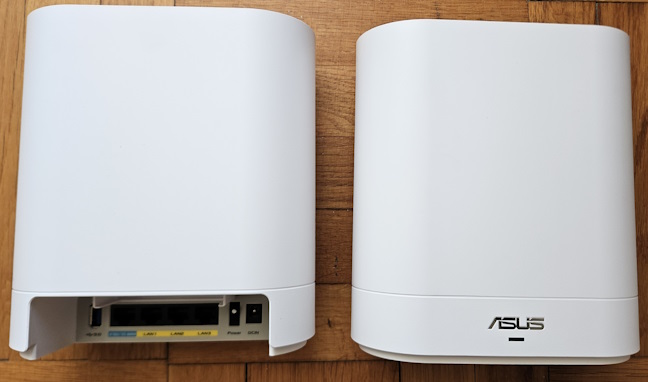
 ASUS ExpertWiFi EBM68 - front and back
For each ExpertWiFi EBM68, you also get a wall mounting stand and the screws required to fix it into place.
ASUS ExpertWiFi EBM68 - front and back
For each ExpertWiFi EBM68, you also get a wall mounting stand and the screws required to fix it into place.
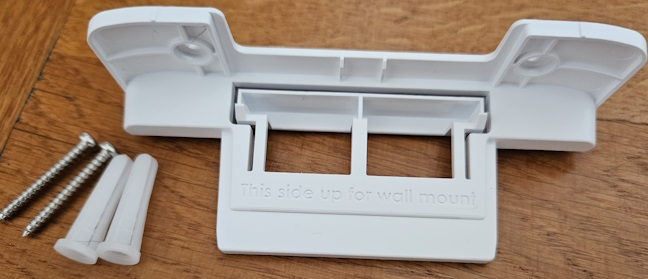
 Wall mounting is easy
On the top cover, you find a silver line in the middle with the ExpertWiFi family name printed on it, surrounded by a grid with many ventilation holes.
Wall mounting is easy
On the top cover, you find a silver line in the middle with the ExpertWiFi family name printed on it, surrounded by a grid with many ventilation holes.
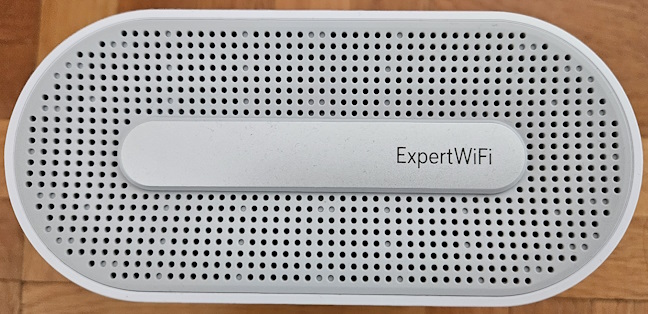
 The ExpertWiFi logo is on the top cover
On the bottom, there’s a large sticker with information about the product you just bought, including details about the default Wi-Fi name and password used by each ExpertWiFi EBM68. To make things easier, there’s also a QR code that helps you connect to the WiFi automatically. Two rubber feet hold the device into place, and next to them, you get a Reset and a WPS button.
The ExpertWiFi logo is on the top cover
On the bottom, there’s a large sticker with information about the product you just bought, including details about the default Wi-Fi name and password used by each ExpertWiFi EBM68. To make things easier, there’s also a QR code that helps you connect to the WiFi automatically. Two rubber feet hold the device into place, and next to them, you get a Reset and a WPS button.
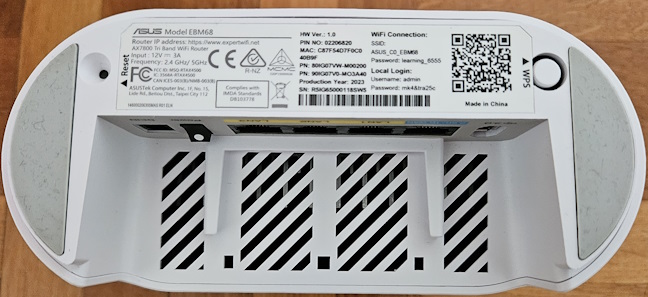
 The WPS button is on the bottom
On the back of each ExpertWiFi EBM68, you find the following ports: a USB 3.2 Gen 1 port, a WAN port that can work at speeds up to 2.5 Gbps, three 1 Gbps LAN ports, a Power switch, and a Power jack.
The WPS button is on the bottom
On the back of each ExpertWiFi EBM68, you find the following ports: a USB 3.2 Gen 1 port, a WAN port that can work at speeds up to 2.5 Gbps, three 1 Gbps LAN ports, a Power switch, and a Power jack.
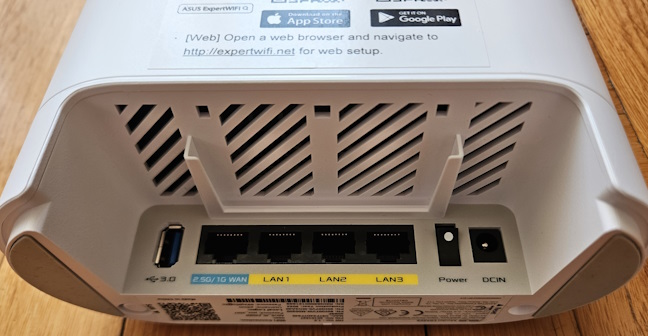
 All the ports are on the back
ASUS ExpertWiFi EBM68 is a powerful tri-band mesh WiFi system with a total theoretical bandwidth split as follows: 574 Mbps for the 2.4 GHz band, 2402 Mbps for the first 5 GHz band, and 4804 Mbps for the second 5 GHz band. This leads to a total of 7780 Mbps. To provide this high bandwidth, ASUS ExpertWiFi EBM68 is equipped with a quad-core Broadcom BRCM 6756 processor running at 1.7 GHz, 1 GB of RAM, and 256 MB storage space for the firmware.
All the ports are on the back
ASUS ExpertWiFi EBM68 is a powerful tri-band mesh WiFi system with a total theoretical bandwidth split as follows: 574 Mbps for the 2.4 GHz band, 2402 Mbps for the first 5 GHz band, and 4804 Mbps for the second 5 GHz band. This leads to a total of 7780 Mbps. To provide this high bandwidth, ASUS ExpertWiFi EBM68 is equipped with a quad-core Broadcom BRCM 6756 processor running at 1.7 GHz, 1 GB of RAM, and 256 MB storage space for the firmware.
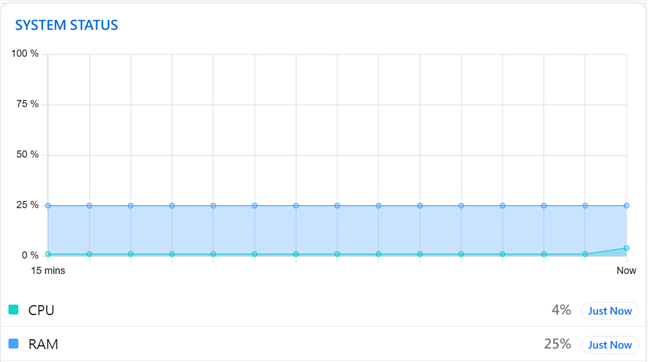
 ASUS ExpertWiFi EBM68 packs some powerful hardware
Inside each station, six antennas emit the Wi-Fi signal. The system offers 2x2 MU-MIMO transfers on the 2.4 GHz band and first 5 GHz band. The second 5 GHz band comes with 4x4 MU-MIMO. While this is good, it would have been ideal for it to provide 4x4 MU-MIMO transfers on both 5 GHz bands. I recommend reading this guide if you want to know what MU-MIMO is and why it is important.
ASUS ExpertWiFi EBM68 packs some powerful hardware
Inside each station, six antennas emit the Wi-Fi signal. The system offers 2x2 MU-MIMO transfers on the 2.4 GHz band and first 5 GHz band. The second 5 GHz band comes with 4x4 MU-MIMO. While this is good, it would have been ideal for it to provide 4x4 MU-MIMO transfers on both 5 GHz bands. I recommend reading this guide if you want to know what MU-MIMO is and why it is important.
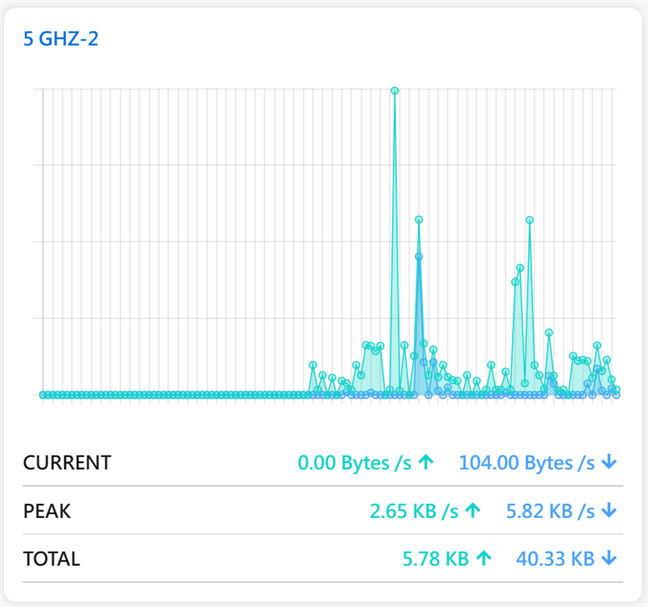 The second 5 GHz band benefits from 4x4 MU-MIMO transfers
The ASUS ExpertWiFi EBM68 works using all the wireless standards up to Wi-Fi 6, offering WPA 3 encryption and 160 MHz channel bandwidth on the 5 GHz bands.
These are all the important technical aspects of ASUS ExpertWiFi EBM68. For more technical information about this product, check its official page: ASUS ExpertWiFi EBM68.
The second 5 GHz band benefits from 4x4 MU-MIMO transfers
The ASUS ExpertWiFi EBM68 works using all the wireless standards up to Wi-Fi 6, offering WPA 3 encryption and 160 MHz channel bandwidth on the 5 GHz bands.
These are all the important technical aspects of ASUS ExpertWiFi EBM68. For more technical information about this product, check its official page: ASUS ExpertWiFi EBM68.
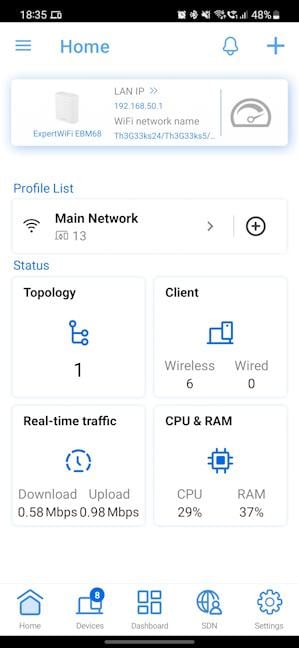
 The ExpertWiFi app for Android
There’s also an SDN tab, meaning Self-Defined Network. It’s one of the most important features on the ExpertWiFi EBM68, allowing users to create different types of networks, depending on the type of business they’re running and their specific needs. I’ll share more details about it on the second page of this review, in the Features for businesses section.
The ExpertWiFi app for Android
There’s also an SDN tab, meaning Self-Defined Network. It’s one of the most important features on the ExpertWiFi EBM68, allowing users to create different types of networks, depending on the type of business they’re running and their specific needs. I’ll share more details about it on the second page of this review, in the Features for businesses section.
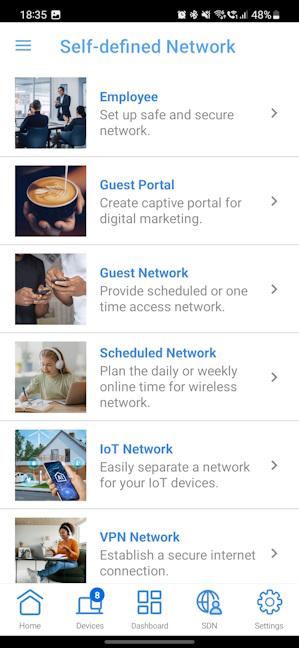 Creating a Self-defined Network is easy
The Settings tab reveals a long list of settings. While the ExpertWiFi app doesn’t give you access to all the controls available in the firmware of this mesh system, you do get plenty of control, which is great. One neat aspect available only in the ExpertWiFi app is that you can integrate ASUS ExpertWiFi EBM68 with Google Assistant and control your mesh system using voice commands and other tools from Google’s smart ecosystem.
Creating a Self-defined Network is easy
The Settings tab reveals a long list of settings. While the ExpertWiFi app doesn’t give you access to all the controls available in the firmware of this mesh system, you do get plenty of control, which is great. One neat aspect available only in the ExpertWiFi app is that you can integrate ASUS ExpertWiFi EBM68 with Google Assistant and control your mesh system using voice commands and other tools from Google’s smart ecosystem.
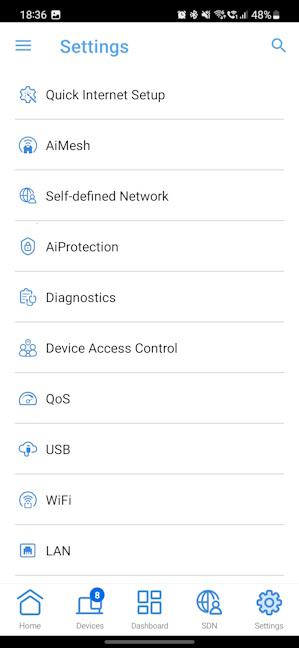 The settings found in the ExpertWiFi app
If you want access to everything that ASUS ExpertWiFi EBM68 has to offer, you should open a web browser on a computer connected to the network and type expertwifi.net in the address bar.
When you log in, you see the dashboard. As you can see, it provides all kinds of technical information, like the status of your primary internet connection, the network’s IP address, how many clients are connected, the system status, the status of each port, as well as a real-time DNS Benchmark, so that you can optimize the DNS servers your network is using.
The settings found in the ExpertWiFi app
If you want access to everything that ASUS ExpertWiFi EBM68 has to offer, you should open a web browser on a computer connected to the network and type expertwifi.net in the address bar.
When you log in, you see the dashboard. As you can see, it provides all kinds of technical information, like the status of your primary internet connection, the network’s IP address, how many clients are connected, the system status, the status of each port, as well as a real-time DNS Benchmark, so that you can optimize the DNS servers your network is using.
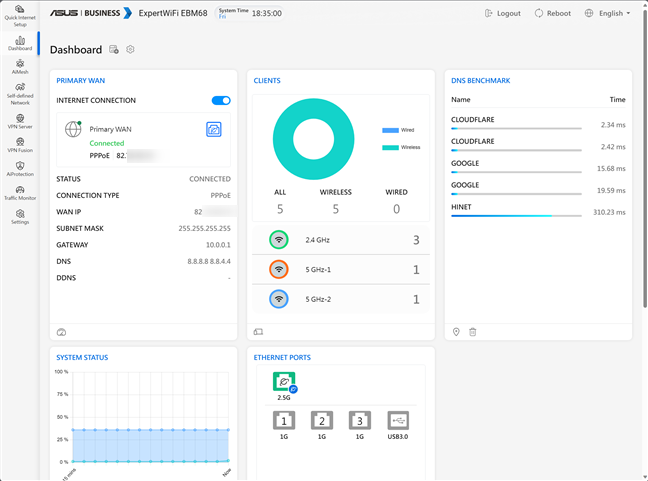
 The web dashboard for ASUS ExpertWiFi EBM68
The left sidebar of the user interface gives you quick access to the device’s most important features. For example, viewing and setting the network topology is done from the AiMesh section, and the options available are the same as for any other mesh system made by ASUS. An important aspect that you need to be aware of is that, by default, this tri-band mesh system uses the second 5 GHz band for its backhaul. This band is also the only one that provides wireless transfers using 4x4 MU-MIMO. This is great for the backhaul itself, as it guarantees excellent performance for the communications between the mesh stations. Unfortunately, you get 2x2 MU-MIMO instead of 4x4 on the other two bands, reserved for the clients connecting to the network.
The web dashboard for ASUS ExpertWiFi EBM68
The left sidebar of the user interface gives you quick access to the device’s most important features. For example, viewing and setting the network topology is done from the AiMesh section, and the options available are the same as for any other mesh system made by ASUS. An important aspect that you need to be aware of is that, by default, this tri-band mesh system uses the second 5 GHz band for its backhaul. This band is also the only one that provides wireless transfers using 4x4 MU-MIMO. This is great for the backhaul itself, as it guarantees excellent performance for the communications between the mesh stations. Unfortunately, you get 2x2 MU-MIMO instead of 4x4 on the other two bands, reserved for the clients connecting to the network.
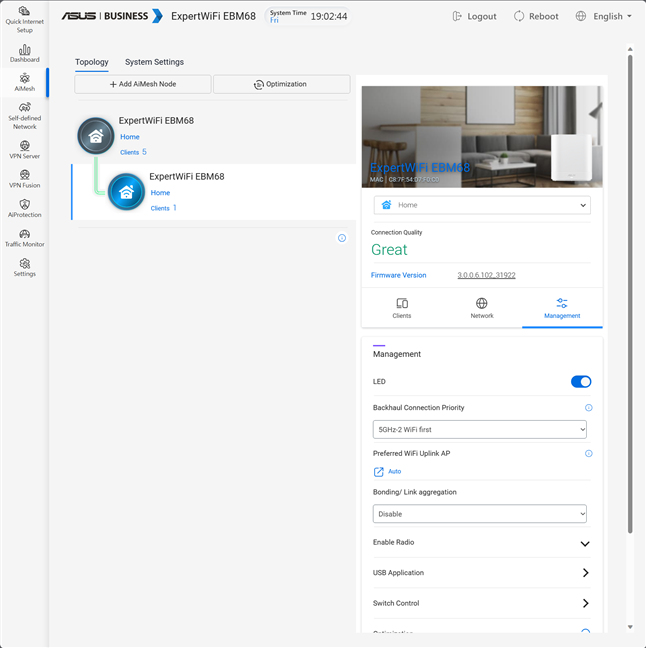
 Setting up the network topology
The Settings section is where you find most of the things that you can configure about your network. Luckily, finding your way is easy, even if you are new to the user interface created by ASUS for the ExpertWiFi family. To help you out, the multilingual support is excellent, as the user interface has been translated into 25 languages. Also, many settings are obvious if you have minimal networking knowledge. One downside is that there’s no help documentation available, as is the case for the ASUS routers made for consumers. Hopefully, it will be created in the coming months as more ExpertWiFi products are released.
Setting up the network topology
The Settings section is where you find most of the things that you can configure about your network. Luckily, finding your way is easy, even if you are new to the user interface created by ASUS for the ExpertWiFi family. To help you out, the multilingual support is excellent, as the user interface has been translated into 25 languages. Also, many settings are obvious if you have minimal networking knowledge. One downside is that there’s no help documentation available, as is the case for the ASUS routers made for consumers. Hopefully, it will be created in the coming months as more ExpertWiFi products are released.
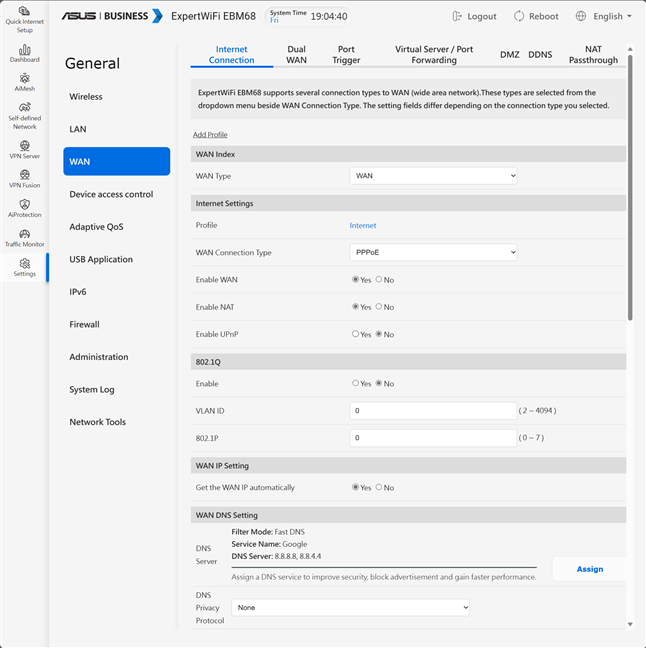 Here are your WAN settings
ASUS’ ExpertWiFi EBM68 has a 2.5 Gbps WAN port, which is great, as it allows it to use ultra-fast internet connections. However, this mesh system doesn’t offer a second 2.5 Gbps port for LAN connections, which is a missed opportunity. Especially in a business setting, a 2.5 Gbps LAN port would have been useful for connecting a local server, a NAS solution, or some other business equipment that would benefit from higher bandwidth.
Here are your WAN settings
ASUS’ ExpertWiFi EBM68 has a 2.5 Gbps WAN port, which is great, as it allows it to use ultra-fast internet connections. However, this mesh system doesn’t offer a second 2.5 Gbps port for LAN connections, which is a missed opportunity. Especially in a business setting, a 2.5 Gbps LAN port would have been useful for connecting a local server, a NAS solution, or some other business equipment that would benefit from higher bandwidth.
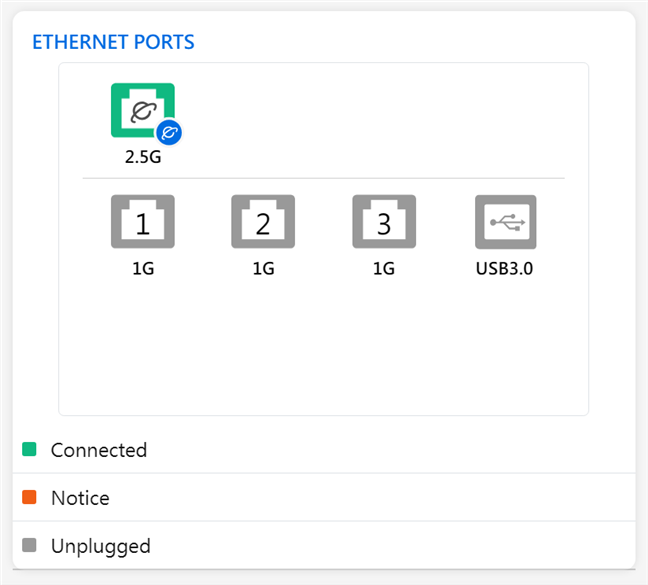
 We get only one 2.5 Gbps port
Sadly, I could only test the ASUS ExpertWiFi EBM68 in my two-bedroom apartment, not in a real business location. Also, my apartment is quite small for such a powerful mesh system. This system was designed for much larger places, so I couldn’t assess the coverage area you get from ExpertWiFi EBM68 very well. Even so, I was pleased with my testing experience. As you will see later in this review, this mesh system delivers fast downloads on the 2.4 GHz band. This is especially good for a network with many IoT devices. Though it wasn’t very fast, I enjoyed stable network transfers on the 5 GHz band, when using the Wi-Fi 6 standard. Also, I didn’t encounter any connectivity issues or stability issues. But, if you want to know more about the real-world performance offered by ASUS ExpertWiFi EBM68, go to the next page of this review, where I present detailed measurements and comparisons.
We get only one 2.5 Gbps port
Sadly, I could only test the ASUS ExpertWiFi EBM68 in my two-bedroom apartment, not in a real business location. Also, my apartment is quite small for such a powerful mesh system. This system was designed for much larger places, so I couldn’t assess the coverage area you get from ExpertWiFi EBM68 very well. Even so, I was pleased with my testing experience. As you will see later in this review, this mesh system delivers fast downloads on the 2.4 GHz band. This is especially good for a network with many IoT devices. Though it wasn’t very fast, I enjoyed stable network transfers on the 5 GHz band, when using the Wi-Fi 6 standard. Also, I didn’t encounter any connectivity issues or stability issues. But, if you want to know more about the real-world performance offered by ASUS ExpertWiFi EBM68, go to the next page of this review, where I present detailed measurements and comparisons.
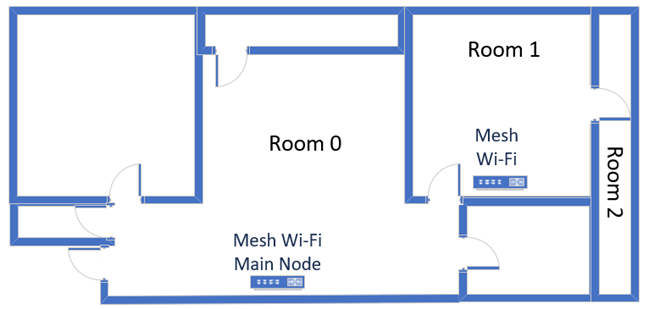
 The apartment in which I tested ASUS ExpertWiFi EBM68
I evaluated the quality of the wireless network managed by the mesh system through measurements made in three different places:
The apartment in which I tested ASUS ExpertWiFi EBM68
I evaluated the quality of the wireless network managed by the mesh system through measurements made in three different places:
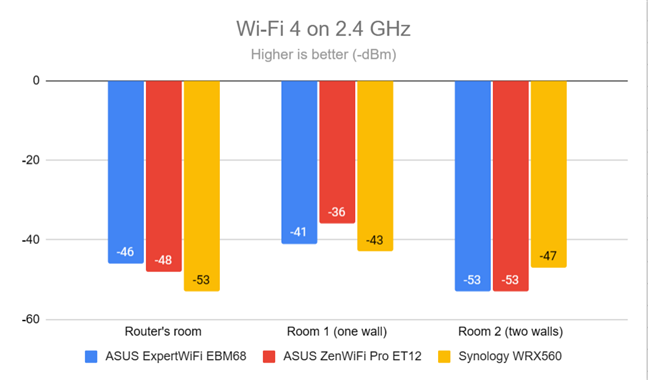
 Signal strength on Wi-Fi 4 (2.4 GHz band)
Switching to the Wi-Fi 6 standard on the 2.4 GHz band lowered the signal strength slightly, which is generally what happens with most Wi-Fi 6 routers and mesh systems. However, the wireless signal was strong enough to offer a good experience everywhere in my flat.
Signal strength on Wi-Fi 4 (2.4 GHz band)
Switching to the Wi-Fi 6 standard on the 2.4 GHz band lowered the signal strength slightly, which is generally what happens with most Wi-Fi 6 routers and mesh systems. However, the wireless signal was strong enough to offer a good experience everywhere in my flat.
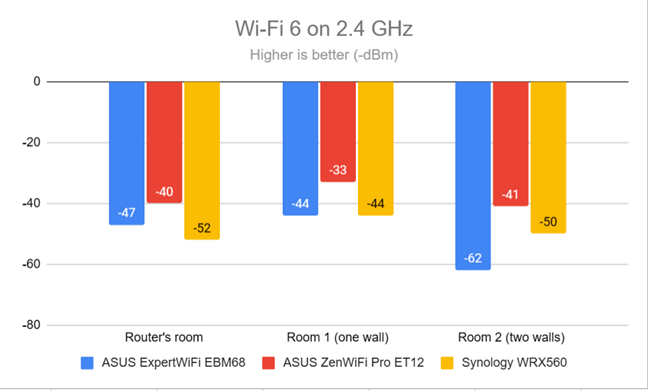
 Signal strength on Wi-Fi 6 (2.4 GHz band)
Next, I used the SpeedTest app to measure the maximum speed you get when transferring data to and from the internet on the 2.4 GHz band, using Wi-Fi 4. The download speeds offered by ASUS ExpertWiFi EBM68 were the best in my comparison.
Signal strength on Wi-Fi 6 (2.4 GHz band)
Next, I used the SpeedTest app to measure the maximum speed you get when transferring data to and from the internet on the 2.4 GHz band, using Wi-Fi 4. The download speeds offered by ASUS ExpertWiFi EBM68 were the best in my comparison.
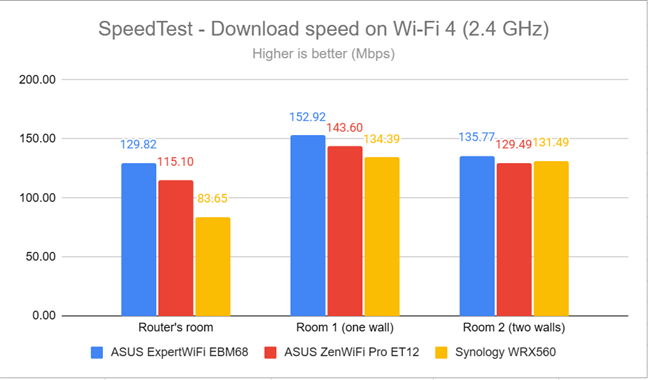 SpeedTest - The download speed on Wi-Fi 4 (2.4 GHz)
Uploads were slower than downloads, and ExpertWiFi EBM68 was defeated by the ZenWiFi Pro ET12.
SpeedTest - The download speed on Wi-Fi 4 (2.4 GHz)
Uploads were slower than downloads, and ExpertWiFi EBM68 was defeated by the ZenWiFi Pro ET12.
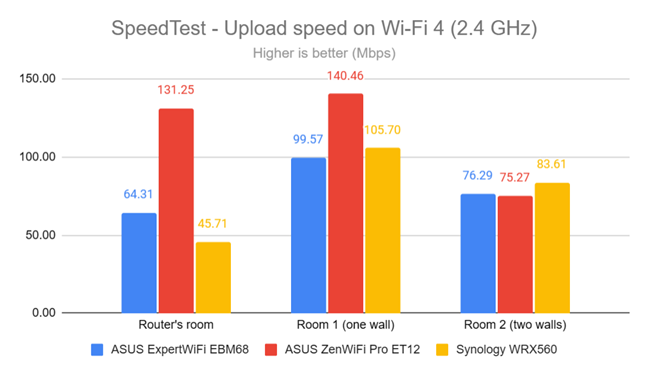
 SpeedTest - The upload speed on Wi-Fi 4 (2.4 GHz)
I then switched to Wi-Fi 6 on the same 2.4 GHz band and repeated the same test. The download speed increased everywhere in my apartment, but the ExpertWiFi EBM68 was the speed champion only in the room where the main station was.
SpeedTest - The upload speed on Wi-Fi 4 (2.4 GHz)
I then switched to Wi-Fi 6 on the same 2.4 GHz band and repeated the same test. The download speed increased everywhere in my apartment, but the ExpertWiFi EBM68 was the speed champion only in the room where the main station was.
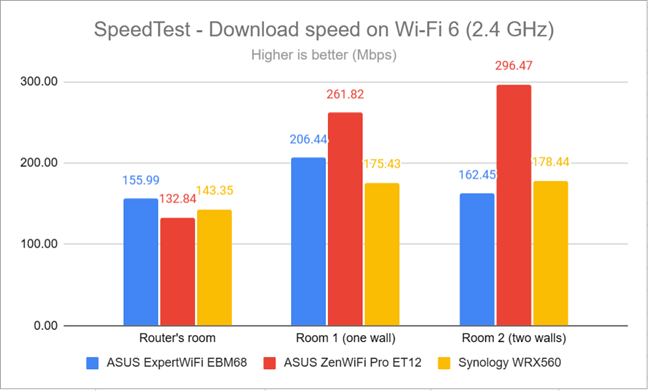 SpeedTest - The download speed on Wi-Fi 6 (2.4 GHz)
Uploads were faster than when using the Wi-Fi 4 standard, but other mesh systems outperformed ASUS’ ExpertWiFi EBM68.
SpeedTest - The download speed on Wi-Fi 6 (2.4 GHz)
Uploads were faster than when using the Wi-Fi 4 standard, but other mesh systems outperformed ASUS’ ExpertWiFi EBM68.
 SpeedTest - The upload speed on Wi-Fi 6 (2.4 GHz)
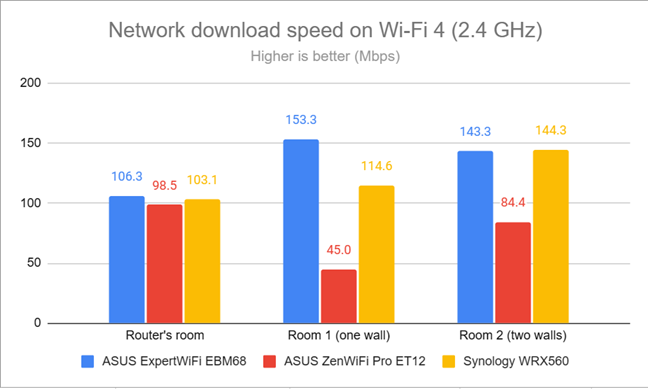
For the next set of measurements, I used the PassMark Performance test to transfer data between two computers connected to the network. Again, I started on the 2.4 GHz band using the Wi-Fi 4 standard. Again, the download speeds offered by ASUS ExpertWiFi EBM68 were excellent everywhere in my apartment, and this mesh system outmatched the ones I’ve compared it to.
SpeedTest - The upload speed on Wi-Fi 6 (2.4 GHz)
For the next set of measurements, I used the PassMark Performance test to transfer data between two computers connected to the network. Again, I started on the 2.4 GHz band using the Wi-Fi 4 standard. Again, the download speeds offered by ASUS ExpertWiFi EBM68 were excellent everywhere in my apartment, and this mesh system outmatched the ones I’ve compared it to.
 Network downloads on Wi-Fi 4 (2.4 GHz)
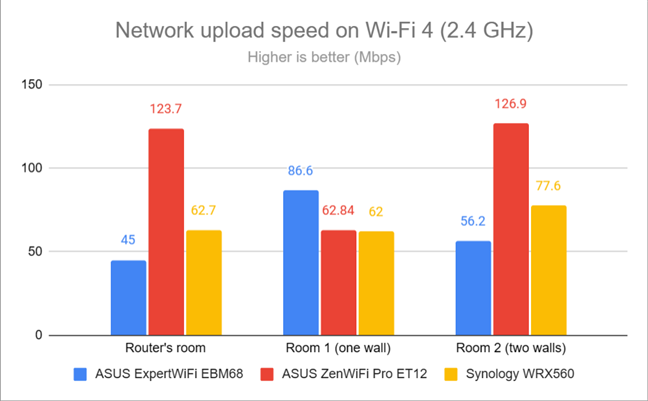
Uploads were a lot slower, though, and I was disappointed by the results.
Network downloads on Wi-Fi 4 (2.4 GHz)
Uploads were a lot slower, though, and I was disappointed by the results.
 Network uploads on Wi-Fi 4 (2.4 GHz)
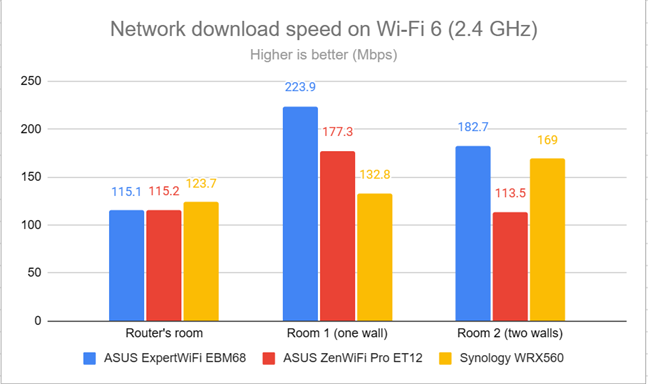
I repeated the same measurements on the 2.4 GHz band using the Wi-Fi 6 standard. The download speeds increased considerably, and the ASUS ExpertWiFi EBM68 was the gold medalist in my comparison.
Network uploads on Wi-Fi 4 (2.4 GHz)
I repeated the same measurements on the 2.4 GHz band using the Wi-Fi 6 standard. The download speeds increased considerably, and the ASUS ExpertWiFi EBM68 was the gold medalist in my comparison.
 Network downloads on Wi-Fi 6 (2.4 GHz)
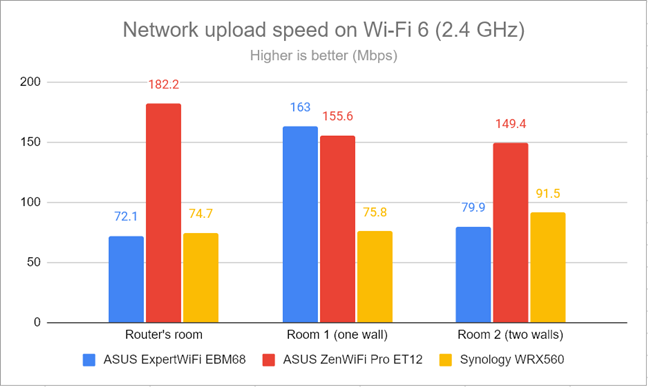
Again, the upload speeds were a lot slower, and in this metric, the ASUS ExpertWiFi EBM68 was easily outmatched by the systems I’ve compared it to.
Network downloads on Wi-Fi 6 (2.4 GHz)
Again, the upload speeds were a lot slower, and in this metric, the ASUS ExpertWiFi EBM68 was easily outmatched by the systems I’ve compared it to.
 Network uploads on Wi-Fi 6 (2.4 GHz)
ASUS ExpertWiFi EBM68 offers a positive experience on the 2.4 GHz band when using the older Wi-Fi 4 standard and the newer Wi-Fi 6. Download speeds are excellent, but the uploads are on the slower side.
Network uploads on Wi-Fi 6 (2.4 GHz)
ASUS ExpertWiFi EBM68 offers a positive experience on the 2.4 GHz band when using the older Wi-Fi 4 standard and the newer Wi-Fi 6. Download speeds are excellent, but the uploads are on the slower side.
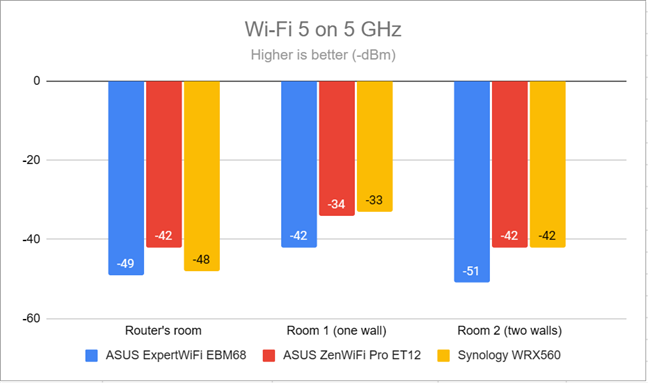
 Signal strength on Wi-Fi 5 (5 GHz band)
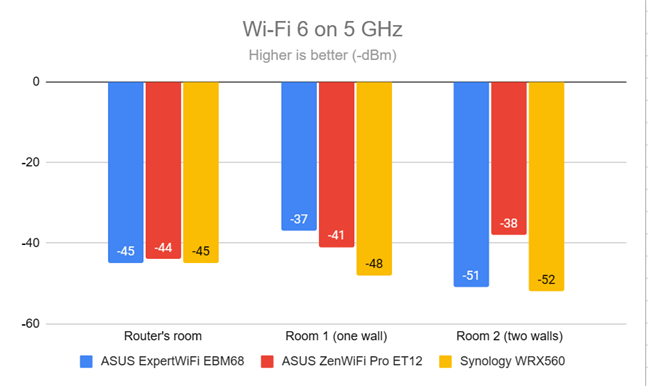
The situation improved greatly when I switched to the Wi-Fi 6 standard on the 5 GHz band.
Signal strength on Wi-Fi 5 (5 GHz band)
The situation improved greatly when I switched to the Wi-Fi 6 standard on the 5 GHz band.
 Signal strength on Wi-Fi 6 (5 GHz band)
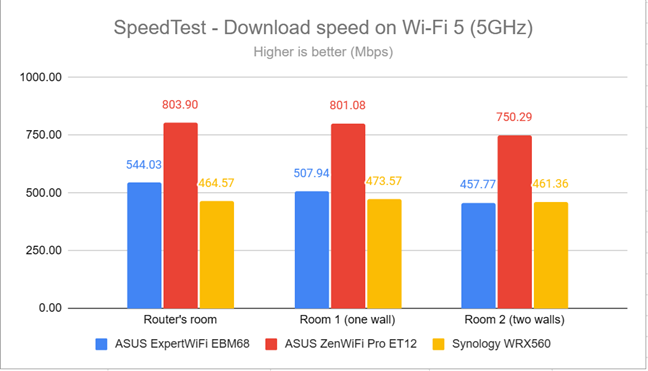
For the next round of measurements, I used the SpeedTest app to see how fast the internet connection is when using the Wi-Fi 5 standard. ASUS ExpertWiFi EBM68 delivered fast downloads but without breaking any records.
Signal strength on Wi-Fi 6 (5 GHz band)
For the next round of measurements, I used the SpeedTest app to see how fast the internet connection is when using the Wi-Fi 5 standard. ASUS ExpertWiFi EBM68 delivered fast downloads but without breaking any records.
 SpeedTest - The download speed on Wi-Fi 5 (5 GHz)
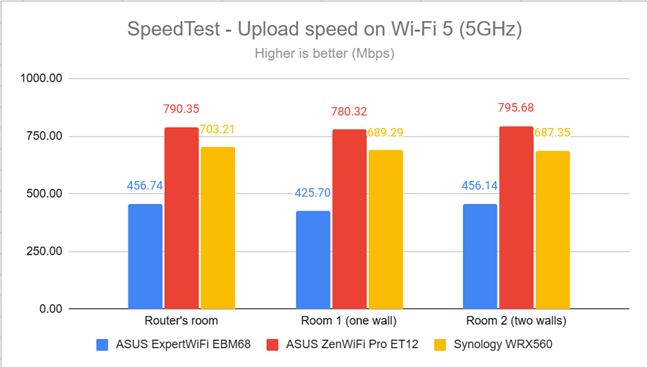
Uploads were slower than expected, and the other mesh systems performed much better than the ASUS ExpertWiFi EBM68.
SpeedTest - The download speed on Wi-Fi 5 (5 GHz)
Uploads were slower than expected, and the other mesh systems performed much better than the ASUS ExpertWiFi EBM68.
 SpeedTest - The upload speed on Wi-Fi 5 (5 GHz)
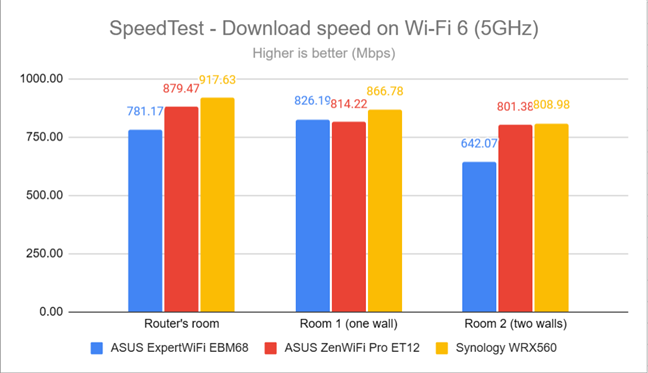
When switching to the Wi-Fi 6 standard on the 5 GHz band, the download speed improved significantly, and the ExpertWiFi EBM68 got close to the systems I’ve compared it to.
SpeedTest - The upload speed on Wi-Fi 5 (5 GHz)
When switching to the Wi-Fi 6 standard on the 5 GHz band, the download speed improved significantly, and the ExpertWiFi EBM68 got close to the systems I’ve compared it to.
 SpeedTest - The download speed on Wi-Fi 6 (5 GHz)
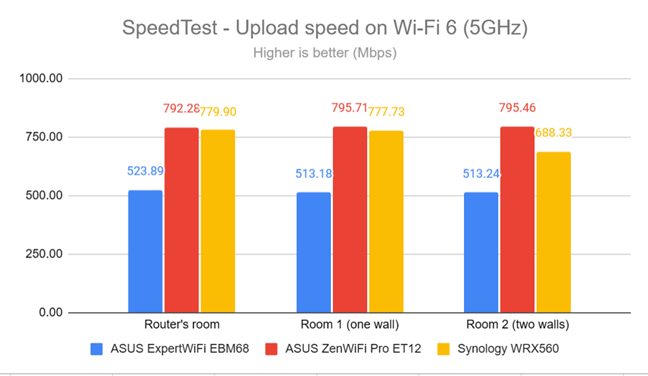
While uploads were faster when using Wi-Fi 6, they were still much slower than those offered by competing mesh WiFi systems.
SpeedTest - The download speed on Wi-Fi 6 (5 GHz)
While uploads were faster when using Wi-Fi 6, they were still much slower than those offered by competing mesh WiFi systems.
 SpeedTest - The upload speed on Wi-Fi 6 (5 GHz)
Lastly, I used the PassMark Performance test and transferred data between two computers connected to the network. This benchmark tells me the average speed you get when transferring data only inside the network and not on the internet. For example, when using Wi-Fi 5, the ASUS ExpertWiFi EBM68 delivered download speeds similar to a Synology WRX560.
SpeedTest - The upload speed on Wi-Fi 6 (5 GHz)
Lastly, I used the PassMark Performance test and transferred data between two computers connected to the network. This benchmark tells me the average speed you get when transferring data only inside the network and not on the internet. For example, when using Wi-Fi 5, the ASUS ExpertWiFi EBM68 delivered download speeds similar to a Synology WRX560.

 Network downloads on Wi-Fi 5 (5 GHz)
Again, upload speeds were slower than I expected.
Network downloads on Wi-Fi 5 (5 GHz)
Again, upload speeds were slower than I expected.

 Network uploads on Wi-Fi 5 (5 GHz)
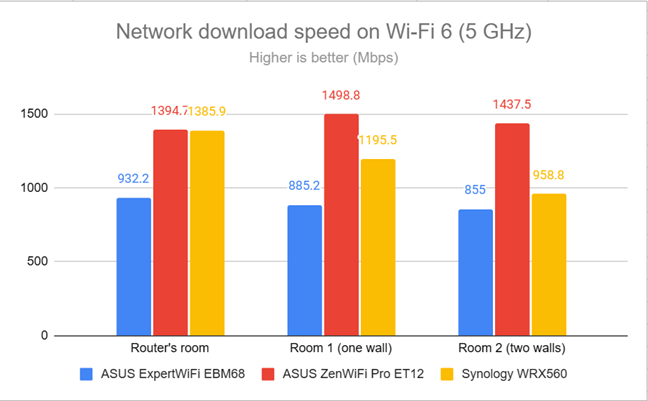
Switching to the Wi-Fi 6 standard meant that downloads got a lot faster. However, the other mesh systems in this comparison proved even faster.
Network uploads on Wi-Fi 5 (5 GHz)
Switching to the Wi-Fi 6 standard meant that downloads got a lot faster. However, the other mesh systems in this comparison proved even faster.
 Network downloads on Wi-Fi 6 (5 GHz)
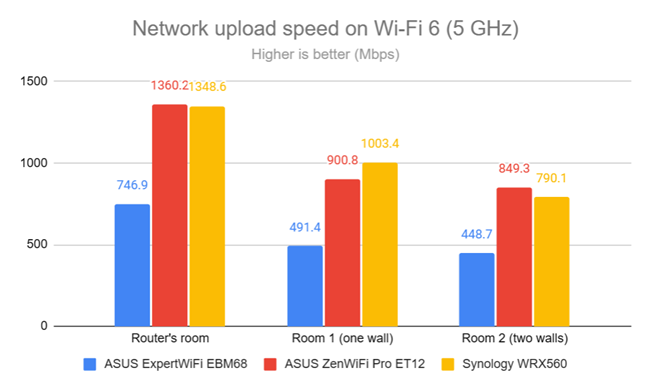
Lastly, the upload speeds measured on Wi-Fi 6 were good but slower than what the competition could deliver.
Network downloads on Wi-Fi 6 (5 GHz)
Lastly, the upload speeds measured on Wi-Fi 6 were good but slower than what the competition could deliver.
 Network uploads on Wi-Fi 6 (5 GHz)
ASUS ExpertWiFi EBM68 performs reasonably well on the 5 GHz band but doesn’t break any speed records. Just like on the 2.4 GHz band, upload speeds tend to be slower than expected.
Network uploads on Wi-Fi 6 (5 GHz)
ASUS ExpertWiFi EBM68 performs reasonably well on the 5 GHz band but doesn’t break any speed records. Just like on the 2.4 GHz band, upload speeds tend to be slower than expected.
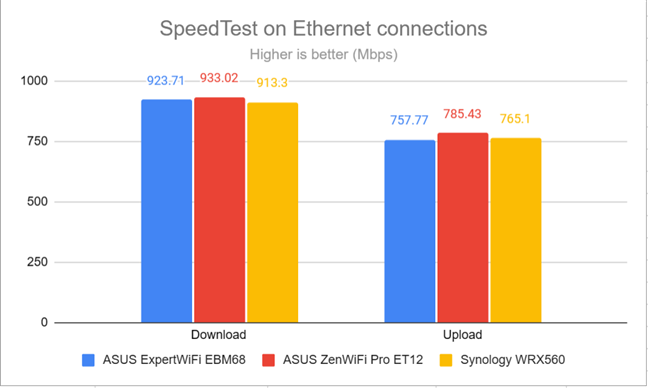
 SpeedTest on Ethernet connections
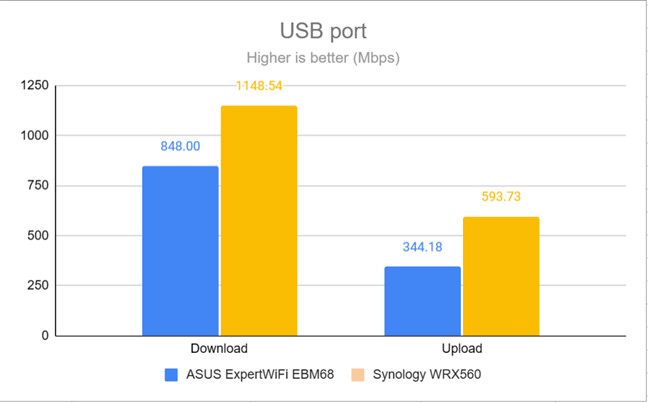
I also connected a portable SSD to the USB port of the ExpertWiFi EBM68. I transferred data between a desktop PC and the SSD when connected through an Ethernet cable. The USB 3.2 Gen 1 port on this mesh system delivered very fast download speeds. However, uploads were a lot slower.
SpeedTest on Ethernet connections
I also connected a portable SSD to the USB port of the ExpertWiFi EBM68. I transferred data between a desktop PC and the SSD when connected through an Ethernet cable. The USB 3.2 Gen 1 port on this mesh system delivered very fast download speeds. However, uploads were a lot slower.
 The speed of the USB port
Ethernet connections don’t represent a problem for ASUS ExpertWiFi EBM68. You can achieve speeds up to 1 Gbps with maximum ease. Also, the USB port on this mesh system delivers fast data transfers. That’s always useful when connecting a storage solution to your mesh system.
The speed of the USB port
Ethernet connections don’t represent a problem for ASUS ExpertWiFi EBM68. You can achieve speeds up to 1 Gbps with maximum ease. Also, the USB port on this mesh system delivers fast data transfers. That’s always useful when connecting a storage solution to your mesh system.
 Creating a Self-defined network
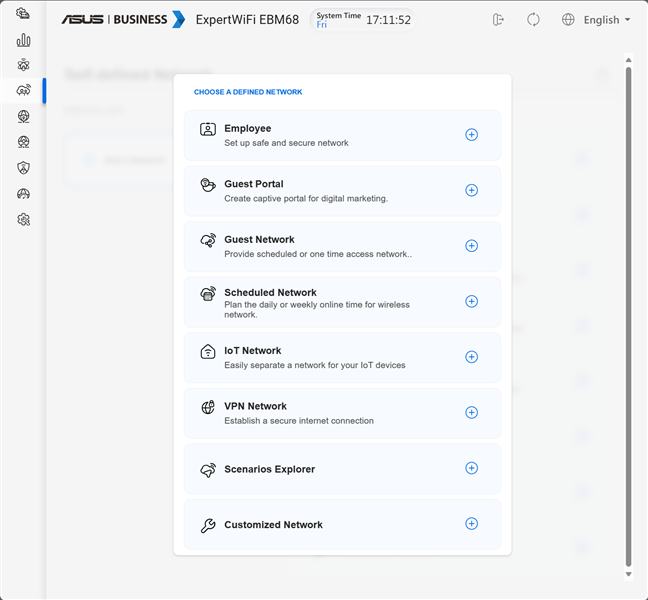
If all these options are too technical for you, the firmware also offers a Scenarios Explorer. This guides you into creating the kind of network you need, with the necessary rules, in a more visual manner. For example, you may have to offer Wi-Fi in a hotel. If you choose this scenario, the wizard recommends you create a guest portal and walks you through the steps involved.
Creating a Self-defined network
If all these options are too technical for you, the firmware also offers a Scenarios Explorer. This guides you into creating the kind of network you need, with the necessary rules, in a more visual manner. For example, you may have to offer Wi-Fi in a hotel. If you choose this scenario, the wizard recommends you create a guest portal and walks you through the steps involved.

 Scenarios Explorer
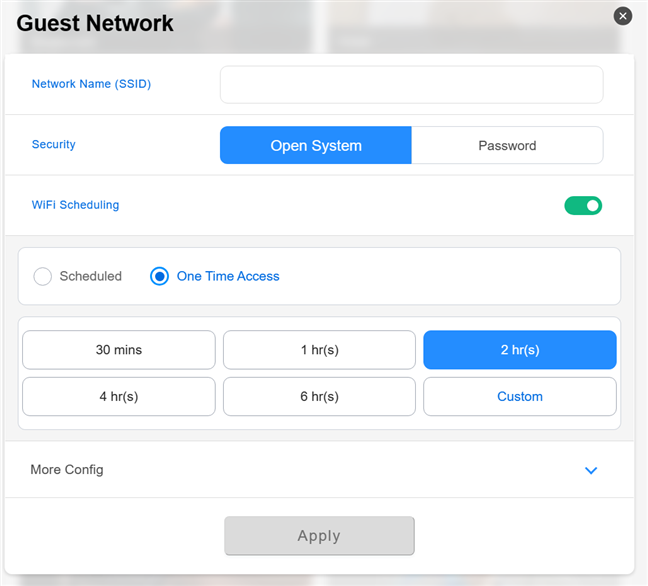
Similarly, if you own a gym, the wizard recommends creating a guest network with limited-time access for your clients. Using the wizard and the options presented, you can create a network that gives your clients Wi-Fi and internet access for up to two hours (for example) and keeps them outside your company’s intranet.
Scenarios Explorer
Similarly, if you own a gym, the wizard recommends creating a guest network with limited-time access for your clients. Using the wizard and the options presented, you can create a network that gives your clients Wi-Fi and internet access for up to two hours (for example) and keeps them outside your company’s intranet.
 Creating a network with limited internet access
Maybe you manage an EV charging station. Then, the wizard recommends you create an IoT network and walks you through all the required settings.
ASUS ExpertWiFi EBM68 is a mesh system for business users. Therefore, it is unsurprising that VPN is this product’s major focus area. As a result, this mesh system can act like a VPN Server and be set to work using the PPTP, OpenVPN, IPSec, and WireGuard VPN protocols. You also get VPN Fusion, which allows you to connect to multiple VPN servers simultaneously and assign your client devices to connect to different VPN tunnels.
Creating a network with limited internet access
Maybe you manage an EV charging station. Then, the wizard recommends you create an IoT network and walks you through all the required settings.
ASUS ExpertWiFi EBM68 is a mesh system for business users. Therefore, it is unsurprising that VPN is this product’s major focus area. As a result, this mesh system can act like a VPN Server and be set to work using the PPTP, OpenVPN, IPSec, and WireGuard VPN protocols. You also get VPN Fusion, which allows you to connect to multiple VPN servers simultaneously and assign your client devices to connect to different VPN tunnels.
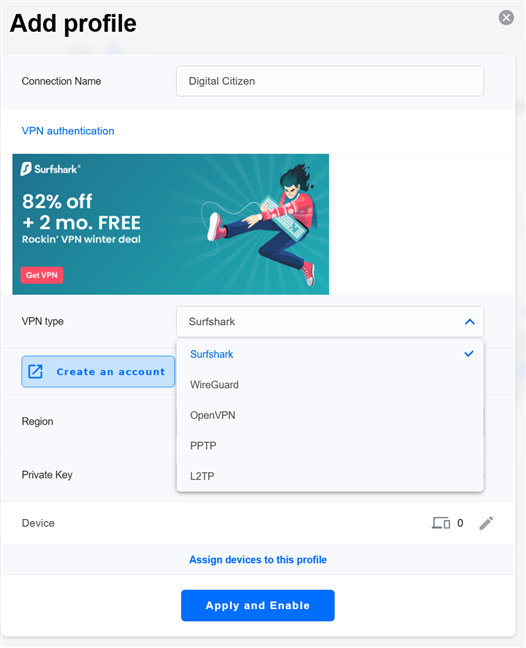
 Setting up VPN Fusion
Next, the AiProtection module found on most ASUS products is also included in the firmware created for the ExpertWiFi EBM68. Its user interface looks different, but its protection features remain the same. You get comprehensive security tools that protect your network from attacks, malicious sites, infected devices, and poor router settings.
Setting up VPN Fusion
Next, the AiProtection module found on most ASUS products is also included in the firmware created for the ExpertWiFi EBM68. Its user interface looks different, but its protection features remain the same. You get comprehensive security tools that protect your network from attacks, malicious sites, infected devices, and poor router settings.
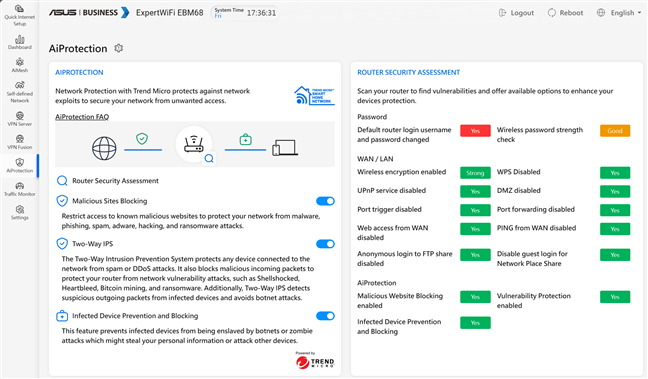
 AiProtection is available on ASUS ExpertWiFi EBM68
Another feature tailored for businesses is the Traffic Monitor, which displays real-time statistics about the traffic in your network for each wireless band and all your LAN connections. You can also analyze the network traffic by devices and apps.
AiProtection is available on ASUS ExpertWiFi EBM68
Another feature tailored for businesses is the Traffic Monitor, which displays real-time statistics about the traffic in your network for each wireless band and all your LAN connections. You can also analyze the network traffic by devices and apps.
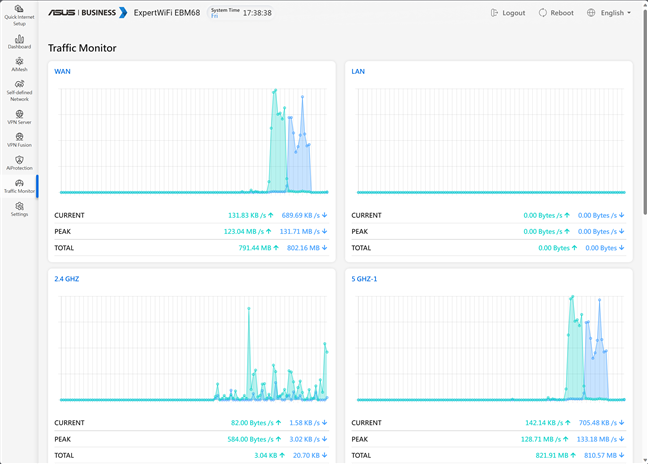
 The Traffic Monitor
 can be complemented by Device access control, a panel where you can enforce rules for blocking inappropriate traffic in your company’s network. For example, you can block access to adult content online, P2P file transfers, and other types of content.
The Traffic Monitor
The Traffic Monitor can be complemented by Device access control, a panel where you can enforce rules for blocking inappropriate traffic in your company’s network. For example, you can block access to adult content online, P2P file transfers, and other types of content.
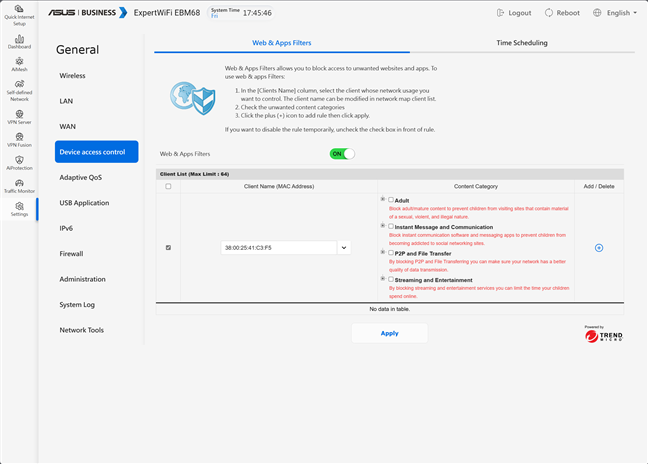 Setting up Device access controls
You can also use the Adaptive QoS feature if your company’s bandwidth is limited. First, you can test the speed of your internet connection, then enable the Quality of Service feature, and set which kinds of online activities get prioritized across the network. You also get a Bandwidth Monitor and can enable a complete Web History to see what websites your employees access when connected to the company’s network.
Setting up Device access controls
You can also use the Adaptive QoS feature if your company’s bandwidth is limited. First, you can test the speed of your internet connection, then enable the Quality of Service feature, and set which kinds of online activities get prioritized across the network. You also get a Bandwidth Monitor and can enable a complete Web History to see what websites your employees access when connected to the company’s network.
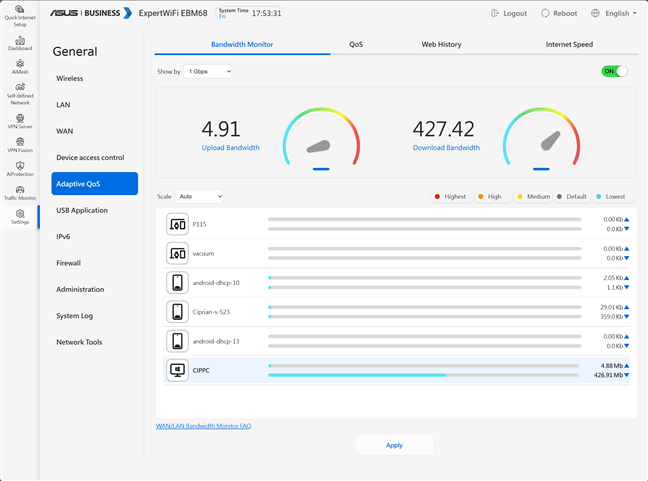 Setting up Adaptive QoS
The DUAL WAN feature can be a game changer for companies when internet connectivity is critical for running the business. The ASUS ExpertWiFi EBM68 can work with two internet connections in parallel, both in Load Balancing and Fail Over modes. Since this mesh Wi-Fi system has a USB port, you can also connect a smartphone and use its mobile connection as a backup internet service.
Setting up Adaptive QoS
The DUAL WAN feature can be a game changer for companies when internet connectivity is critical for running the business. The ASUS ExpertWiFi EBM68 can work with two internet connections in parallel, both in Load Balancing and Fail Over modes. Since this mesh Wi-Fi system has a USB port, you can also connect a smartphone and use its mobile connection as a backup internet service.
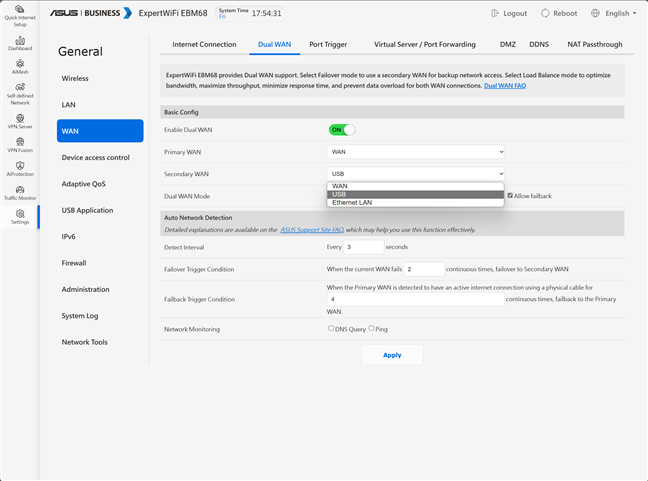 Dual WAN is available
The list of advanced features doesn’t stop here. You also get:
Dual WAN is available
The list of advanced features doesn’t stop here. You also get:
ASUS ExpertWiFi EBM68: Who is it good for?
This mesh Wi-Fi system is a suitable choice for:- Small to medium-sized businesses that need easy-to-use networking solutions
- Locations with fast 1 Gbps or 2.5 Gbps internet connections
- Companies that want VPN, antivirus, and firewall protection
Pros and cons
Here are the things I like about the ASUS ExpertWiFi EBM68:- It can work with fast internet connections, up to 2.5 Gbps
- Versatile networking features for business users
- Fast downloads on the 2.4 GHz band
- Steady transfers on the 5 GHz band, with Wi-Fi 6
- Fast USB 3.2 Gen 1 port
- Its upload speeds deserve some improvement
- It has only one 2.5 Gbps port
Verdict
ASUS ExpertWiFi EBM68 does a good job of providing a fast, secure, and versatile network for small and medium-sized businesses. Its firmware and apps have been adapted for a business audience, and features like the new Self-Defined Network are helpful in setting up the network according to your specific needs. Performance is good, especially on the 2.4 GHz band, and this will be helpful for businesses with many IoT devices that can’t use the faster 5 GHz band. The hardware inside the ASUS ExpertWiFi EBM68 is quite powerful, and its support for 2.5 Gbps internet connections does provide some futureproofing for your network.Unboxing the ASUS ExpertWiFi EBM68
ASUS ExpertWiFi EBM68 is the first tri-band mesh WiFi 6 system in the company’s line-up of business devices. It comes in a kit of two stations, packed in a large white cardboard box with subtle shades of gray. On the box, you see a picture of the devices that make up the kit, the product name, and details about its most important features.Hardware specifications and design
Design-wise, ASUS ExpertWiFi EBM68 follows the lines set by the company’s ZenWiFi family for the consumer segment. On the front of each ExpertWiFi EBM68, you see the ASUS logo and one LED, which lights up in different colors, signaling the status of each station. On the back, you have the ports and the slot where you plug the wall-mounting stand. Each station is 18.5 x 7.8 x 17 cm or 7.2 x 3 x 6.7 inches in width x depth x height, weighing 808 grams or 28.5 ounces.Setting up and using the ASUS ExpertWiFi EBM68
Setting up the ExpertWiFi EBM68 is different from traditional consumer routers and mesh systems made by ASUS. That’s because you need to install a different mobile app named ExpertWiFi. The app is free, and you can find it in the App Store and Google Play. This app differs greatly from the ASUS Router app available for home users. That’s because it’s designed for business users and focused on their needs. As a result, on the Home tab, you see the status of the network, its topology, real-time traffic, and the resource consumption of the ASUS ExpertWiFi EBM68.Wireless network performance
I have tested ASUS ExpertWiFi EBM68 in my two-bedroom apartment, which is quite small for a mesh Wi-Fi system. You can see how I placed the two stations in the diagram below.- Room 0 - I recorded the maximum speeds when no walls absorb the wireless signal in the room where the main node is placed.
- Room 1 - is separated by one wall from the main station.
- Room 2 - is separated from the main station by two walls absorbing the wireless signal. Also, the wall between Room 1 and Room 2 is twice as thick as the one between Room 0 and Room 1. As a result, Room 2 can be a difficult challenge for some routers, but it should be fine for a mesh Wi-Fi system.
How the ASUS ExpertWiFi EBM68 performs on the 2.4 GHz band
I started by measuring the signal strength using NetSpot on the Wi-Fi 4 (802.11n) standard. As expected, the signal strength offered by ASUS ExpertWiFi EBM68 was good everywhere in my apartment.How the ASUS ExpertWiFi EBM68 performs on the 5 GHz band
I moved on to the 5 GHz band and repeated the same measurements. I started using the Wi-Fi 5 standard and fired up NetSpot to analyze the signal strength. ASUS ExpertWiFi EBM68 performed reasonably well, but other mesh systems delivered better results.Wired network performance & USB port
My internet connection offers a maximum of 1 Gbps for the download speed and 800 Mbps for uploads. When I connected a PC to the main station using an Ethernet cable and ran SpeedTest, ASUS ExpertWiFi EBM68 delivered speeds close to my internet connection’s maximum potential.Features for businesses
The firmware on the ASUS ExpertWiFi EBM68 includes all the traditional features from the company’s ZenWiFi consumer line-up of mesh systems and adds a couple of unique features aimed at small to mid-sized companies. One of the most prominent features for enterprises is the Self-defined network. It allows you to set up a safe and secure network for different situations:- A separate WiFi for your employees, with separate access rules, settings, bandwidth limits, and scheduling.
- A guest portal for people visiting your business, which can promote the company’s website or social media channels.
- One-time access networks for guests can provide them with internet access for short intervals (from 30 minutes up to 6 hours) and keep them outside the company’s intranet.
- A scheduled network that functions on weekdays or weekends, during specific intervals that you set, with specific rules and security.
- An IoT network for smart devices that need wireless connectivity on a large area, using the 2.4 GHz band.
- A VPN network that automatically connects all its clients to a VPN server used by your company through protocols like WireGuard VPN, IPSec, OpenVPN, or PPTP.
- DDNS - allows you to connect to your mesh Wi-Fi from the internet, even if your internet provider assigns you a dynamic public IP address.
- USB Application - allows you to connect a USB hard drive to your mesh system and set it up as a NAS, connect a USB modem, or even a printer.
- Firewall - you can enable firewall protection on the ExpertWiFi EBM68 and configure how it works to block DDOS attacks and filter the network traffic you don’t want.
- Network Tools - for analyzing the network and identifying what’s wrong with it. They are helpful when you need to troubleshoot problems.

Discussion (0)
Comments are closed.