



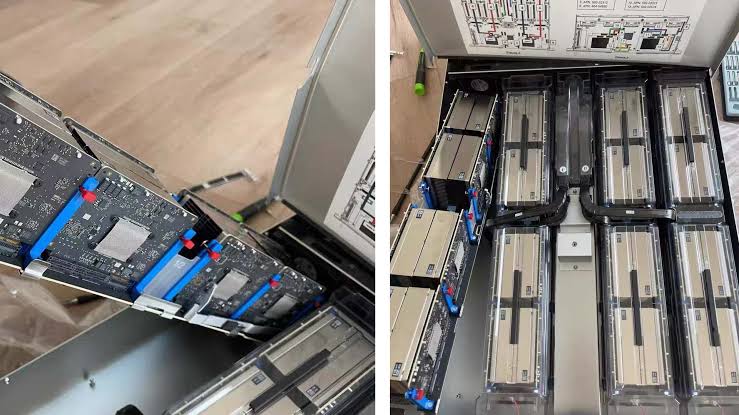
Apple may be testing M5 powered hardware for its Private Cloud Compute infrastructure, according to newly shared images that allegedly show several M5 based server modules packed closely together inside a single enclosure.
The report is not officially confirmed by Apple, so the hardware shown should be treated as a leak rather than a finalized production design.
The images appear to show multiple custom boards, each carrying an M5 chip, unified memory and NAND storage. Large heatsinks are positioned between the modules, suggesting Apple is prioritizing dense packaging while keeping thermal output under control.
M5 could offer a different balance for Apple servers
| Area | Reported detail |
|---|---|
| Processor | Apple M5 |
| Intended use | Private Cloud Compute |
| Module design | Custom PCB |
| Memory | Unified memory visible on board |
| Storage | NAND flash on board |
| AI hardware | 16 core Neural Engine |
| Memory bandwidth | 153.6GB/s |
| Server layout | Multiple M5 modules in one enclosure |
| Status | Alleged leak, not officially confirmed |
Apple has previously been linked with higher end chips such as the M2 Ultra and M4 Ultra for AI server workloads.
The M5 is a smaller and less powerful chip than those workstation class processors, but it also operates at much lower power.
That could make it attractive in a server environment where Apple wants to place several chips inside a limited amount of rack space without creating excessive cooling demands.
Multiple M5 modules appear to share one enclosure
The leaked hardware reportedly uses separate custom PCBs for each M5 SoC.
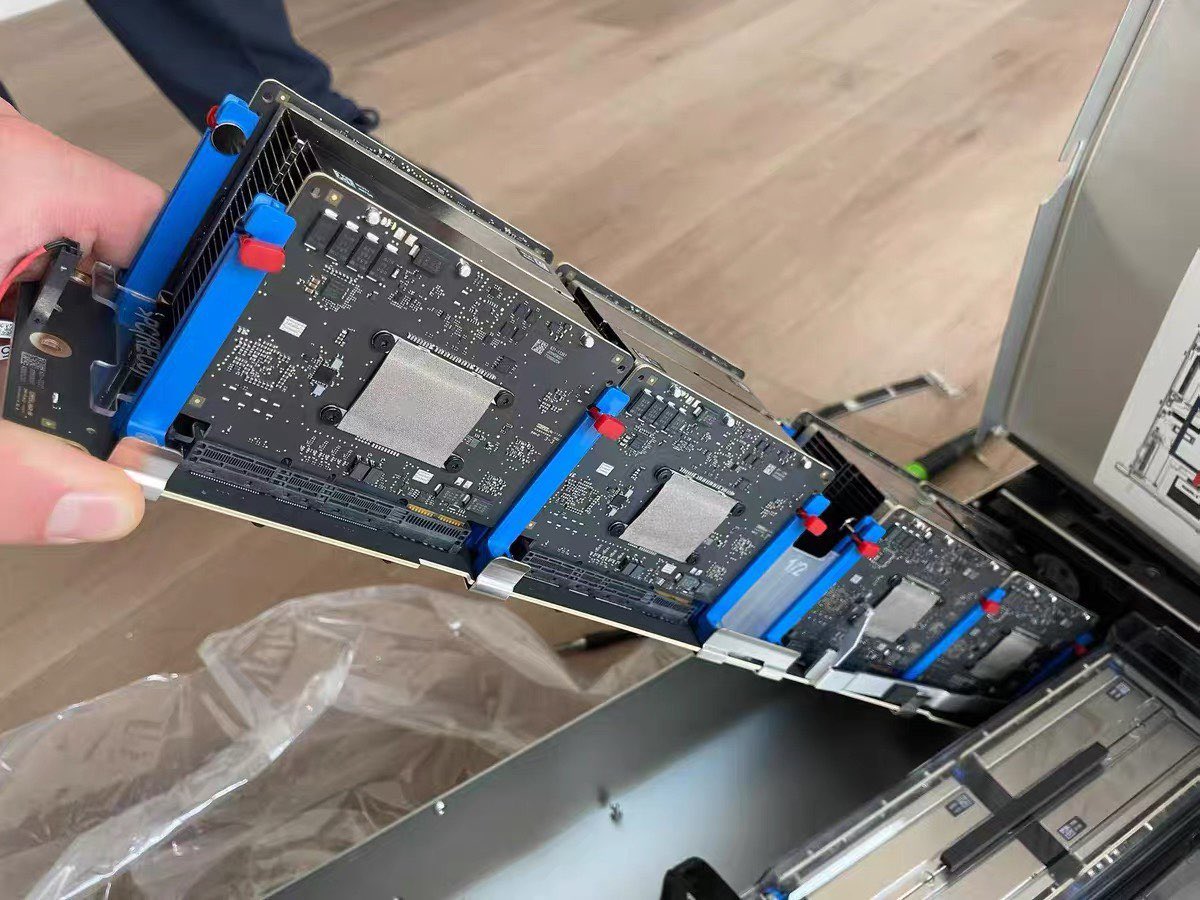
Each board appears to carry the chip alongside its unified memory and NAND storage, while substantial heatsinks sit between the modules.
Using several lower power processors in parallel could give Apple a way to scale compute capacity by adding more self contained modules rather than relying only on a smaller number of much larger chips.
The report suggests that the efficiency of the M5 may be one reason Apple is considering this layout.
M5 already powers devices such as the iPad Pro, where thermal and power limits are far stricter than in a server rack.
Neural Engine could support AI focused workloads
The standard M5 includes a 16 core Neural Engine.
It also provides 153.6GB/s of memory bandwidth, giving the chip useful local bandwidth for AI, graphics and compute workloads.
One M5 would not match the raw multi core performance of Apple’s largest Ultra class chips, but several units operating together could provide substantial aggregate compute while keeping power and heat manageable.
The supplied report does not provide benchmark results for the alleged server configuration, so its real world performance remains unknown.
Earlier reports pointed to M5 Pro and M5 Max
Previous analysis had suggested Apple could use more powerful M5 Pro or M5 Max processors in future server systems.
The newly leaked design raises the possibility that Apple is also considering the base M5 for at least some Private Cloud Compute deployments.
That does not necessarily mean M5 Pro or M5 Max plans have been abandoned.
Apple could use different chip configurations for different workloads, or the photographed hardware could represent an engineering or validation platform rather than the final server design.
Private Cloud Compute remains focused on Apple Intelligence
Private Cloud Compute is Apple’s cloud infrastructure for handling AI tasks that cannot be completed entirely on device.
The company has emphasized using its own silicon and software stack to maintain tighter control over performance, efficiency and privacy.
A modular M5 based design would fit that broader strategy by extending Apple Silicon deeper into its server infrastructure.
For now, the key point is that the leaked images appear to show multiple M5 based modules built into a dense custom server enclosure.
Until Apple confirms the hardware, however, it remains unclear whether this exact configuration will be deployed widely or whether it is simply one of several designs being evaluated.
Discussion (0)
Be the first to comment.