



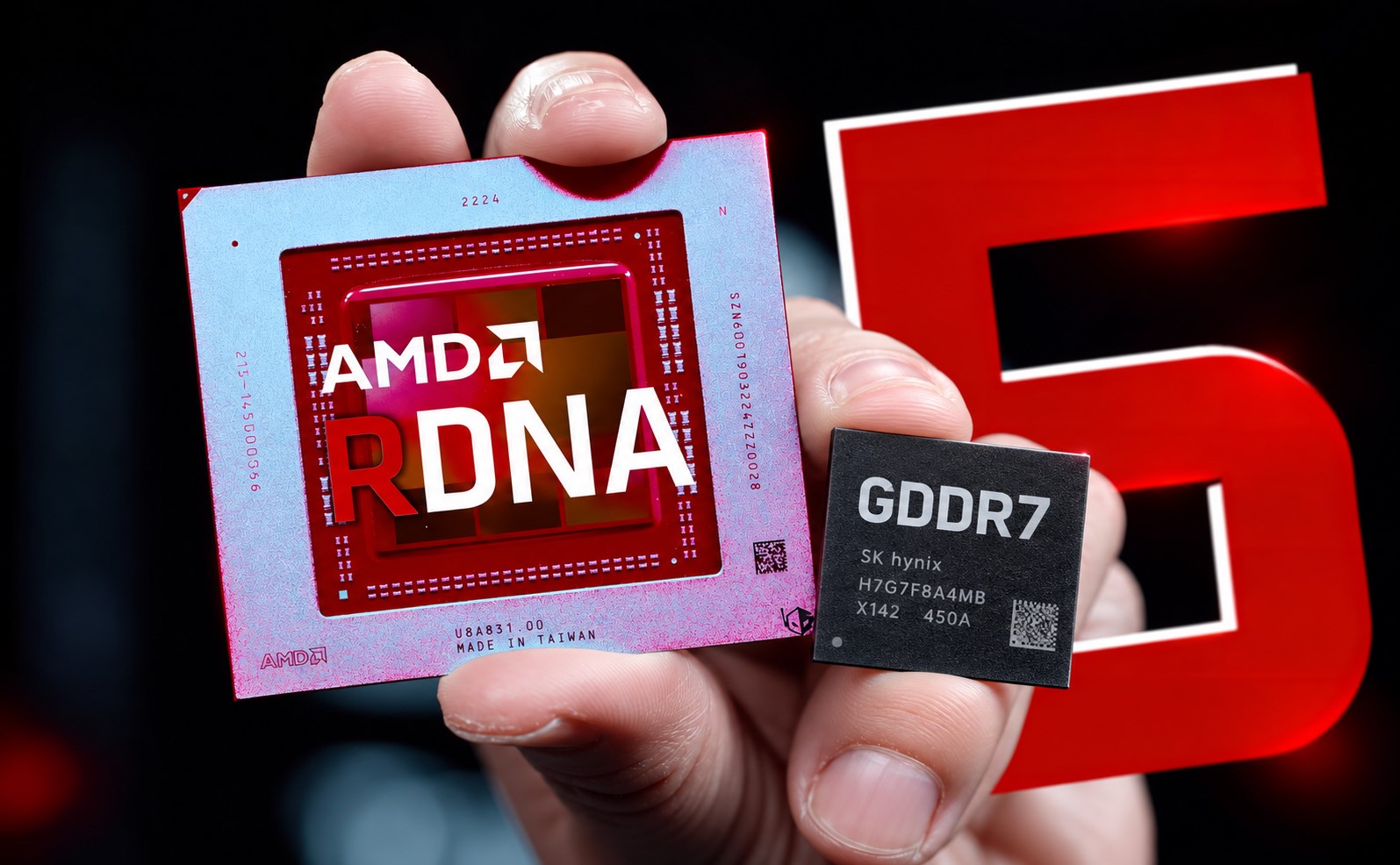
AMD has started preparing its Linux graphics driver for GDDR7 memory, offering another early sign that future Radeon GPUs could finally move beyond GDDR6.
The latest AMDGPU kernel patches add GDDR7 as a recognized video memory type. AMD has not confirmed that its next generation RDNA 5 graphics cards will use the newer standard, but the timing is notable because other recent patches are already introducing support for hardware associated with the upcoming architecture.
RDNA 5 has previously appeared under the GFX13 codename, and AMD is gradually adding related graphics and system IP blocks to its open source driver stack.
GDDR7 support appears alongside new graphics IP blocks
The new patch adds a GDDR7 VRAM identifier to the AMDGPU driver, allowing Linux to recognize the memory type correctly when future hardware uses it.
This is a small code change, but it matters because low level driver support is usually prepared well before consumer graphics cards reach the market.
The same development cycle is also bringing support for newer AMD hardware blocks.
| Development | Current status |
|---|---|
| GDDR7 memory identifier | Added to AMDGPU patches |
| RDNA 5 codename | GFX13 |
| Interrupt handling block | IH 8.0 |
| Bus interface block | NBIF 7.10 |
| RDNA 5 launch | Not officially confirmed |
| Rumored wider launch window | 2028 |
| Memory type for RDNA 5 | Not officially confirmed |
IH 8.0 relates to interrupt processing, while NBIF 7.10 is a newer version of AMD's New Bus Interface.
These additions do not reveal final consumer specifications, but together they show that AMD is actively building software support for its next generation GPU platform.
Radeon has stayed with GDDR6 for several generations
The possible move to GDDR7 would mark an important change for Radeon graphics cards.
AMD has used GDDR6 across several generations, while NVIDIA moved to GDDR7 with its GeForce RTX 50 series.
GDDR7 provides significantly higher data rates than GDDR6 and can increase available memory bandwidth without requiring the same degree of bus width expansion.
That can be useful for higher resolution gaming, ray tracing, larger textures and other workloads that depend heavily on memory throughput.
However, memory type alone does not determine GPU performance.
Architecture, cache design, memory bus width, compression, clock speeds and power limits all influence the final result.
Linux patches are not confirmation of RDNA 5 specifications
The appearance of GDDR7 in the driver should not be treated as proof that every RDNA 5 GPU will use it.
AMD may be preparing generic support ahead of multiple future products, and the company has not announced the memory configuration of its next Radeon generation.
Linux driver development often exposes broad hardware capabilities months or years before final products appear.
That makes these patches useful for understanding direction, but not for confirming exact launch specifications.
The most reasonable interpretation is that AMD now wants its driver stack ready for graphics hardware that may use GDDR7.
RDNA 5 software preparation is gathering pace
Recent patches suggest that development around RDNA 5 is becoming more visible.
AMD has already started preparing support for new display and graphics blocks associated with the architecture, and the latest GDDR7 addition fits that broader pattern.
Current rumors suggest most RDNA 5 based graphics products may not arrive until 2028, although one GPU could reportedly appear earlier in 2027.
Those timelines remain unofficial.
AMD has not announced a release date, product names or final architecture details.
For now, the main confirmed development is in software.
The Linux AMDGPU driver can now recognize GDDR7 memory, giving AMD one of the pieces it would need if future Radeon cards move away from GDDR6.
If RDNA 5 ultimately adopts the newer memory standard, it would bring Radeon into line with the direction already taken by NVIDIA and could provide significantly more memory bandwidth for AMD's next generation graphics hardware.

Discussion (0)
Be the first to comment.