



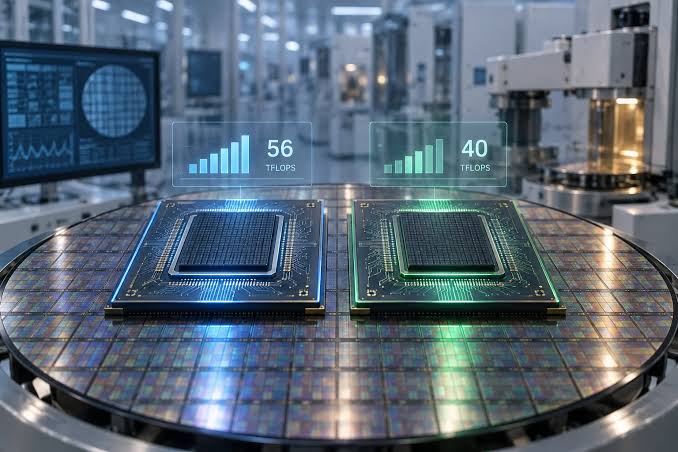
Microsoft's next Xbox console, reportedly known as Project Helix, could offer substantially more raw GPU compute than Sony's PlayStation 6, according to new hardware claims from a well known AMD leaker.
The latest figures put Xbox Helix at 56 TFLOPS and the PlayStation 6 at 40 TFLOPS.
That would give the Xbox a 40 percent advantage in theoretical floating point performance on paper, although TFLOPS alone do not determine actual gaming performance.
None of these specifications have been confirmed by Microsoft, Sony or AMD, so they should still be treated as rumor.
Both console chips are reportedly taped out
The report claims AMD's chip designs for both next generation consoles have completed tape out.
Tape out is one of the final design stages before a chip moves toward manufacturing.
If accurate, that would support earlier reports pointing to a late 2027 launch window rather than 2028.
Production has previously been rumored to begin around the second quarter of 2027.
| Specification | PlayStation 6 | Xbox Helix |
|---|---|---|
| Reported GPU compute | 40 TFLOPS | 56 TFLOPS |
| GPU architecture | RDNA 5 | RDNA 5 |
| Reported active CUs | 52 | 68 |
| GPU clock | Around 2.6 to 3.0GHz | 2.5GHz or higher |
| CPU | 8 Zen 6c plus 2 Zen 6 LP cores | 3 Zen 6 plus 8 Zen 6c cores |
| Memory | 30GB to 40GB GDDR7 | 36GB to 48GB GDDR7 |
| Memory bus | 160 bit | 192 bit |
| AI hardware | GPU integrated neural arrays | Dedicated NPU, reportedly up to 110 TOPS |
| Process | TSMC N2 or possibly N3 | TSMC N3P |
| Reported launch target | Late 2027 | Late 2027 |
The reported PS6 figure also lines up with earlier claims that the system would use 54 Compute Units, with 52 active, running at up to around 3.0GHz.
Using RDNA's dual issue FP32 structure, that configuration lands close to the newly reported 40 TFLOPS figure.
Xbox Helix could use a much larger chip
Previous leaks have suggested that Microsoft's next Xbox may use considerably more silicon than Sony's design.
Helix has been described as a chiplet based system combining a roughly 144mm² SoC die with a 264mm² GPU die, producing a total area of around 408mm².
The PS6 has instead been rumored to use a monolithic die around 280mm².
If those figures are accurate, Xbox Helix would have roughly 42 percent more silicon available.
That would help explain its reported advantage in Compute Units, memory bandwidth and overall GPU throughput.
The extra hardware would also carry a significant manufacturing cost.
TFLOPS do not translate directly into frame rates
A 40 percent TFLOPS advantage does not mean Xbox Helix would automatically run games 40 percent faster.
TFLOPS measure theoretical floating point throughput.
Real game performance also depends on memory bandwidth, cache, ray tracing hardware, CPU performance, architecture efficiency, software optimization, upscaling and how developers use each console.
Two GPUs with similar TFLOPS figures can perform very differently in actual games.
Likewise, a large theoretical advantage can shrink significantly depending on workload.
The rumored numbers therefore provide a useful indication of hardware scale, but they are not a direct prediction of frame rates.
Memory could become one of the biggest differences
Helix is also rumored to use more memory.
Current claims place the Xbox between 36GB and 48GB of GDDR7 connected through a 192 bit bus.
The PS6 has been associated with 30GB to 40GB of GDDR7 on a 160 bit interface.
That would give Microsoft more memory capacity and potentially higher bandwidth.
Memory has become increasingly important as games use larger textures, more complex worlds and advanced ray tracing systems.
It is also one of the biggest sources of uncertainty around next generation console pricing.
Rising memory costs could make both consoles expensive
The same reports suggesting powerful specifications also point to steep production costs.
An earlier estimate placed the PS6 bill of materials at around $760.
A later estimate reportedly increased that figure to roughly $960 as memory prices rose.
Those numbers are unofficial, but they illustrate how rapidly component pricing could affect console economics.
Xbox Helix may be even more expensive to manufacture because of its larger GPU, broader memory interface and higher memory capacity.
Some estimates have placed its bill of materials around $900 at volume, while other claims suggest the final component cost could exceed $1,000.
Retail pricing remains unknown.
Any specific estimate such as $999 or $1,200 is still speculative.
Microsoft's open store strategy could affect pricing
Helix is also expected to support third party storefronts, according to previous reports.
That could make the system more PC like than earlier Xbox consoles.
Traditional console makers can sometimes sell hardware with thin margins because they later collect revenue from software purchases and platform fees.
If Microsoft allows competing stores to operate more freely on Helix, it may capture less software revenue from each console.
That could make hardware subsidies harder to justify.
If that happens, Microsoft may need to price Helix closer to its actual manufacturing cost.
Sony appears to be targeting a smaller design
The rumored PS6 specifications suggest Sony may be taking a different approach.
Rather than maximizing raw silicon area, the company appears to be aiming for a smaller chip with fewer Compute Units and a narrower memory interface.
That could reduce manufacturing cost and power consumption.
It could also give Sony more flexibility around retail pricing if memory costs remain high.
The tradeoff would be lower theoretical compute performance compared with the larger Xbox design.
Late 2027 remains the rumored target
The reported tape out status is one of the more important details in the latest leak.
Once a console chip has completed that stage, the design is much closer to manufacturing.
That supports earlier reports that both Sony and Microsoft are still working toward late 2027 launches.
However, production schedules can still change.
Memory availability, manufacturing yields, component costs and broader market conditions could all affect final launch timing.
For now, the reported 56 TFLOPS Xbox Helix and 40 TFLOPS PlayStation 6 figures offer an early picture of how the two companies may be approaching the next console generation.
Microsoft appears to be targeting a larger and more powerful system on paper, while Sony may be choosing a smaller design that could provide more flexibility around power use and manufacturing cost.
Until the companies officially reveal their hardware, all of these specifications remain unconfirmed.



Discussion (0)
Be the first to comment.